


Court Upholds Deletion of Income Tax Additions, Citing Lack of Substantial Lega…


Full News

Court Upholds Deletion of Income Tax Additions, Citing Lack of Substantial Legal Questions
Court Upholds Deletion of Income Tax Additions, Citing Lack of Substantial Legal Questions
This case involves an appeal by the Revenue (Income Tax Department) against an order passed by the Income Tax Appellate Tribunal (ITAT) in favor of the assessee, Bimla Goel. The High Court dismissed the appeal, agreeing with the ITAT's decision to delete certain additions made by the Assessing Officer, finding no substantial question of law arising from the case.
Get the full picture - access the original judgement of the court order here
Case Name:
Commissioner of Income Tax Vs Bimla Goel (High Court of Delhi)
ITA No. 972/2005
Date: 29th November 2007
Key Takeaways
1. Concurrent findings by appellate authorities carry significant weight in tax disputes.
2. The court emphasizes the importance of substantial evidence to support tax additions.
3. Explanations provided by assessees, if reasonable, should be considered by tax authorities.
4. High Courts are reluctant to interfere with factual findings unless there's a clear perversity.
Issue
Did the Income Tax Appellate Tribunal err in deleting the additions made by the Assessing Officer, and does this decision raise any substantial question of law?
Facts
1. A search was conducted at the assessee's residence on December 2, 1997, under Section 132 (of Income Tax Act, 1961).
2. During the search, a document was seized containing entries of Rs.80,000 and Rs.1,71,000 in the names of Babita and Babu respectively.
3. Another entry of Rs.6 lakhs with the description "Pehle Ke" was also found.
4. The Assessing Officer made additions based on these entries, which were subsequently deleted by the CIT(A) and the Tribunal.
5. The Revenue appealed to the High Court under Section 260A (of Income Tax Act, 1961).
Arguments
Assessee's Arguments:
1. The amounts of Rs.80,000 and Rs.1,71,000 were kept with two persons for emergency medical treatment due to health issues.
2. The Rs.6 lakhs entry represented approximate receivables from an earlier period ending March 31, 1997.
Revenue's Arguments:
1. The assessee failed to explain the sources of the amounts found in the seized document.
2. The Rs.6 lakhs entry represented undisclosed investment.
Key Legal Precedents
The judgment doesn't explicitly mention any specific legal precedents. However, it relies on the principle that concurrent findings of fact by lower appellate authorities should not be disturbed unless there's a substantial question of law.
Judgement
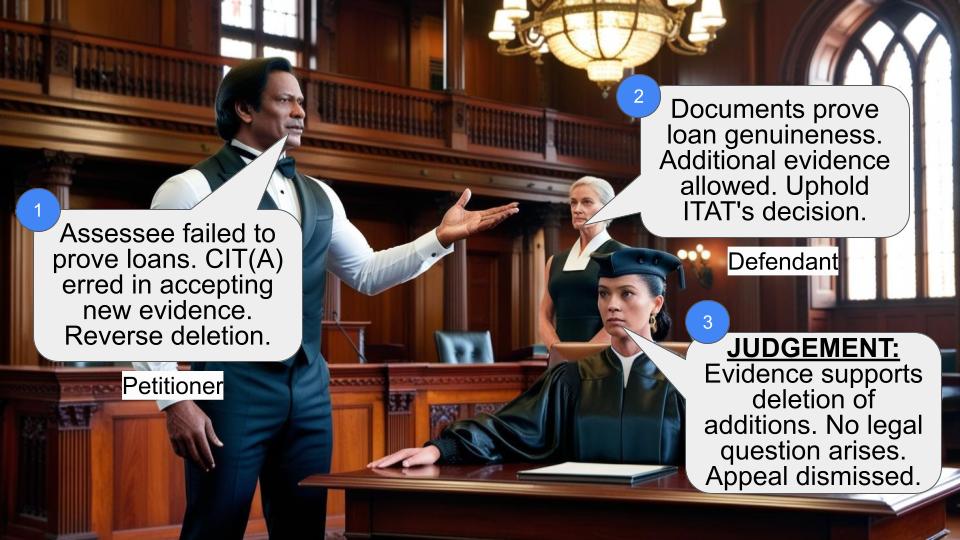
1. The High Court dismissed the Revenue's appeal, finding no substantial question of law arising from the case.
2. The court agreed with the CIT(A) and Tribunal's acceptance of the assessee's explanations regarding the disputed amounts.
3. The court found no perversity in the conclusions reached by the CIT(A) and Tribunal.
4. The High Court emphasized that concurrent findings based on appreciation of evidence should not be disturbed unless perverse or contrary to the record.
FAQs
Q1: What is a "substantial question of law" in this context?
A: A substantial question of law is a significant legal issue that needs to be addressed by a higher court. In this case, the High Court found that the dispute was primarily factual and didn't involve any complex legal questions that required their intervention.
Q2: Why did the court give importance to "concurrent findings"?
A: Concurrent findings refer to similar conclusions reached by multiple lower authorities (in this case, the CIT(A) and Tribunal). Courts generally respect these findings unless there's a clear error or misinterpretation of law, as lower authorities are considered better positioned to appreciate evidence.
Q3: What does "perversity" mean in legal terms?
A: In legal context, perversity refers to a decision that is irrational, unreasonable, or goes against the weight of evidence. The High Court found no such perversity in the lower authorities' decisions.
Q4: How does this judgment impact future tax cases?
A: This judgment reinforces the principle that tax authorities should consider reasonable explanations provided by assessees and that higher courts will generally not interfere with factual findings unless there's a clear legal question involved.
Q5: What is the significance of Section 260A (of Income Tax Act, 1961) mentioned in the judgment?
A: Section 260A (of Income Tax Act, 1961), allows for appeals to be filed in the High Court against orders passed by the Income Tax Appellate Tribunal, but only on substantial questions of law.

1. The Revenue has preferred this appeal under Section 260A (of Income Tax Act, 1961)( Act ) against an order dated 4th February, 2005 passed by the Income Tax Appellate Tribunal, Bench E , Delhi ( Tribunal ) in IT(SS)A No.180/DEL/2001 for the block period 1st April, 1987 to 2nd December, 1997. 2. The Revenue has urged three issues. The fist concerns an addition of Rs.19,81,000/- made by the Assessing Officer ( AO ) on account of peak undisclosed investment. This Court, by its order dated 30th March 2007, held that the said addition was rightly deleted by the Tribunal and therefore no substantial question of law arises in that regard.
3. The second issue relates to the addition of the sums of Rs.80,000/- and Rs.1,71,000/- made by the AO on account of the alleged failure by the Assessee to explain the sources of these amounts.The facts relevant to this issue are that during the course of a search conducted under Section 132 (of Income Tax Act, 1961) at the residence of the Assessee on 2nd December 1997, a document was seized which inter alia contained entries of amounts of Rs.80,000/- and Rs.1,71,000/- in the name of Babita and Babu respectively. The explanation offered by the Assessee was that he was not keeping good health and, therefore, had kept some of his cash with Babita and Smt. Bimla Goel (whose nick name was Babu) for his emergency medical treatment.Although this explanation was not accepted by the AO, the CIT(A) accepted it and deleted the addition. The Tribunal concurred with the view taken by the CIT(A) and held that nothing had been brought on record by the Revenue to show that the explanation offered by the Assessee was false.
4.After considering the submissions of learned counsel for the Revenue as well as the orders under appeal, we too are of the view that the explanation offered by the Assessee cannot be said to be improbable. There is no perversity in the conclusion arrived at by both the CIT(A) as well as the Tribunal. No substantial question of law arises.
5.The third issue pertains to the addition made by the AO in the sum of Rs.6 lakhs on account of undisclosed investment. An entry was found in the seized document showing the amount of Rs.6 lakhs with the description Pehle Ke . The explanation offered by the Assessee was that this entry represented the approximate receivables of an earlier period ending 31st March, 1997. It was also pointed out by the Assessee that the loans and advances given by him and his wife as on 31st March, 1997 were to an extent of Rs.5,85,060. However the AO rejected this explanation and held that the Assessee had failed to reconcile the figure of Rs.6 lakhs with the receivables appearing in the balance sheet.
6.The CIT(A) reversed the finding of the AO and held that in the absence of any corroborative evidence it could not be said that the document recovered represented the suppressed income of the Assessee. There was also nothing to show that the transaction related to the year under reference. Concurring with the view expressed by the CIT(A), the Tribunal held that the inference drawn by the AO that the said entry represented unexplained investment was untenable since nothing was brought on record during the course of the search or even thereafter to substantiate the said conclusion.
7.Here again we find that concurrent views have been expressed by both the CIT(A) as well as the Tribunal on an appreciation of the evidence. We do not find anything in those orders which can be termed as perverse or contrary to the record.
No substantial question of law arises.
Dismissed.
MADAN B. LOKUR, J
S. MURALIDHAR, J NOVEMBER 29, 2007
×
Similar Ripples
Questions
Court Upholds Deletion of Income Tax Additions, Citing Lack of Substantial Legal Questions
Write your CommentSimilar Posts
Generic
- Reportdata/5122_.pdf
