


Court Upholds Developer’s Claim for Tax Deduction on Housing Project


Full News
Court Upholds Developer’s Claim for Tax Deduction on Housing Project
Court Upholds Developer’s Claim for Tax Deduction on Housing Project
This case involves the Commissioner of Income Tax challenging the Income Tax Appellate Tribunal’s decision to allow a tax deduction under Section 80IB(10) (of Income Tax Act, 1961) to a developer (the assessee) for a housing project. The main contention was whether the developer could claim the deduction without owning the land. The High Court upheld the Tribunal’s decision, allowing the deduction.
Get the full picture - access the original judgement of the court order here
Case Name:
Commissioner of Income Tax vs Swastik Associates (High Court of Gujarat)
Tax Appeal No. 335 of 2014
Date: 7th May 2014
Key Takeaways:
- Ownership of land is not a strict requirement for claiming deduction under Section 80IB(10) (of Income Tax Act, 1961).
- Developers with substantial control over the project through development agreements can qualify for the deduction.
- The court criticized the Revenue Department’s continued litigation on settled issues.
Issue:
Whether a developer who is not the registered owner of the land but has substantial control through a development agreement is eligible for tax deduction under Section 80IB(10) (of Income Tax Act, 1961)?
Facts:
- The assessee (developer) entered into a development agreement with landowners to construct a housing project.
- The assessee claimed a tax deduction under Section 80IB(10) (of Income Tax Act, 1961) for income derived from the project.
- The Assessing Officer rejected the claim, stating the assessee wasn’t the land owner and didn’t have the development permission in its name.
- The case went through appeals, reaching the High Court.
Arguments:
Revenue’s Arguments:
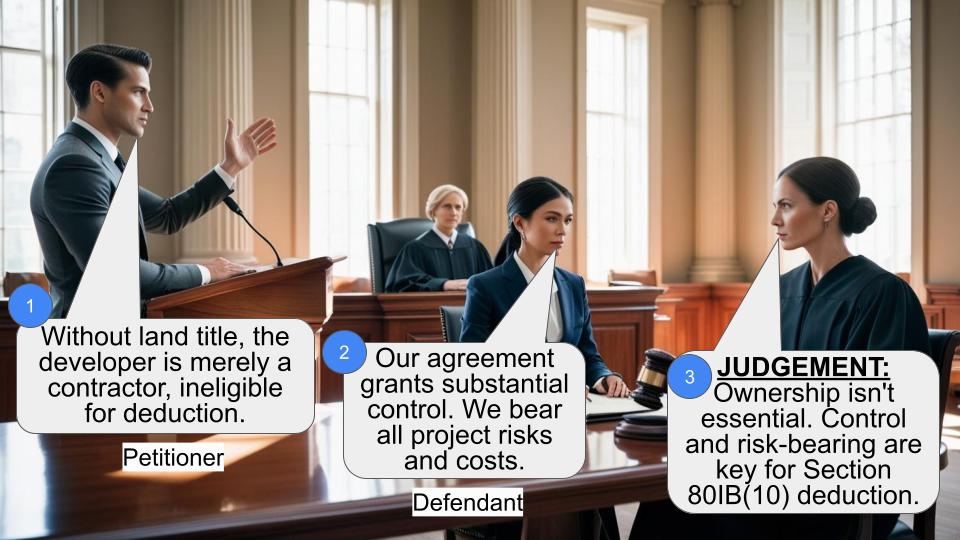
- The assessee is not the owner of the land.
- Approval and permissions were not issued to the assessee.
- The assessee is merely a contractor for the landowners.
Assessee’s Arguments:
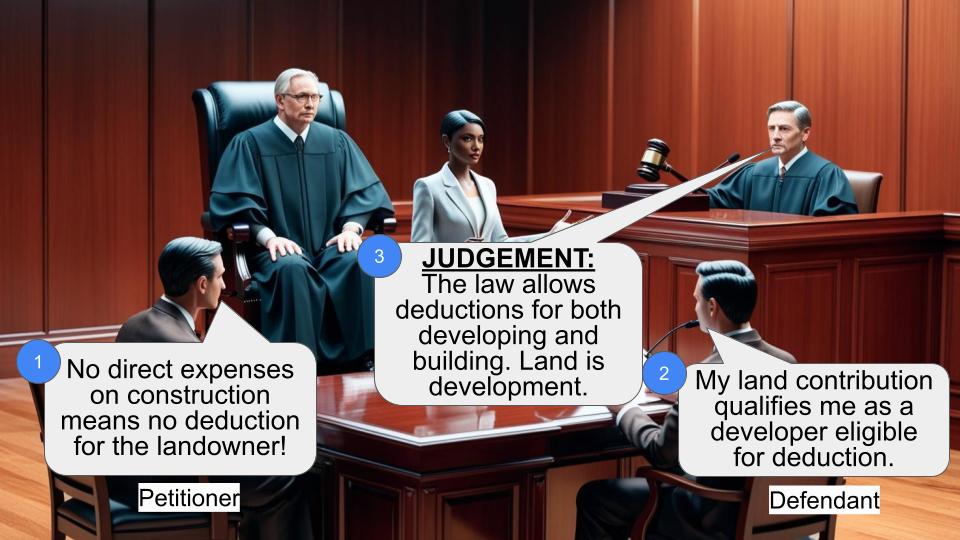
- Ownership of land is not a requirement for Section 80IB(10) (of Income Tax Act, 1961) deduction.
- The development agreement gives substantial control over the project.
- The assessee bears the risk and cost of the project.
Key Legal Precedents:
- Commissioner of Income Tax v. Radhe Developers (2012) 341 ITR 403(Guj): Established that land ownership is not necessary for Section 80IB(10) (of Income Tax Act, 1961) deduction.
- Mysore Minerals Ltd. vs. Commissioner of Income Tax and Commissioner of Income Tax vs. Podar Cement Pvt. Ltd.: Discussed different interpretations of ownership in various contexts.
- Faqir Chand Gulati vs. Uppal Agencies Private Limited (2008) 10 SCC 345: Discussed in the context of Consumer Protection Act, not directly applicable here.
Judgement:
The High Court dismissed the Revenue’s appeal and upheld the Tribunal’s decision, allowing the deduction under Section 80IB(10) (of Income Tax Act, 1961) to the assessee. The court reasoned that:
- The assessee had substantial control over the land and project through the development agreement.
- The assessee bore the risk and cost of the project, indicating real involvement beyond mere contracting.
- For the purpose of Section 80IB(10) (of Income Tax Act, 1961), the assessee could be considered the “owner” even without holding the title to the land.
FAQs:
Q: Does a developer need to own the land to claim Section 80IB(10) (of Income Tax Act, 1961) deduction?
A: No, substantial control through a development agreement can be sufficient.
Q: What factors determine if a developer qualifies for the deduction?
A: Factors include control over the project, bearing risks and costs, and the nature of the development agreement.
Q: How does this judgment impact similar cases?
A: It sets a precedent for allowing deductions to developers with substantial project control, even without land ownership.
Q: Why did the court criticize the Revenue Department?
A: The court felt the department was unnecessarily litigating an issue that had been settled in previous judgments.
Q: Can this judgment be applied to all developer-landowner agreements?
A: Not necessarily. Each case would be judged on its specific facts and the nature of the agreement between parties.

1.Revenue has challenged the judgement of the Income Tax Appellate Tribunal (“the tribunal” for short) dated 13.9.2013 raising following questions of law :
“(A) Whether the tribunal is right in law and on facts to delete the disallowance of deduction u/s.80IB(10) (of Income Tax Act, 1961) made by the Assessing Officer?
(B) Whether the Tribunal is right in law to ignore the following material aspects in the present matter :
(i) The assessee is not the owner of the land and approval was not issued to it by the Local authority?
(ii) The assessee entered into the project by a Development agreement with the land owner and construction was done as per the agreement and hence the assessee is merely a work contractor for the purposes of construction of the project?
(iii) The Assessee has not sold any unit to the purchaser but the landowners have executed the sale deeds as a seller and the assessee joined only as a confirming party to the transaction?
(iv) The assessee has not any dominion control over the project and merely a contractor/agent of the landowners?”
2.Issue pertains to deduction claimed by the respondent assessee under section 80IB(10) (of Income Tax Act, 1961) for having constructed and developed a housing project. The Assessing Officer objected such claim on the ground that the assessee was not the owner of land and development permission was also not granted to assessee but to a cooperative housing society who was the owner., Undoubtedly, this issue is covered by the decision of this Court in case of Commissioner of Incometax v. Radhe Developers reported in (2012) 341 ITR 403(Guj), that is how the tribunal considered the issue in the impugned judgement dated 13.9.2013 confirming the view of CIT (Appeals). In Radhe Developers (supra), this Court observed as under :
“3. In Tax Appeal No.546 of 2008 (M/s. Radhe Developers), the assessee had claimed deduction under Section 80IB(10) (of Income Tax Act, 1961) ( “ the Act” for short) of Rs.24,75,940/ on the premise that such income was derived from the business of the undertaking developing and building housing project approved by the local authority. To execute such housing project, the assessee had entered into a development agreement with Vinodbhai Nathabhai Patel (HUF) and others as party of the First Part and heirs of deceased Ambalal Motibhai Patel as party of the Second Part. In the said development agreement dated 18.5.2000, the assessee was referred as a party of the Third Part. The party of the Second Part represented the land owners and party of the First Part represented those, who had previously entered into an agreement to purchase such land. Under this development agreement, the assessee agreed to develop the land belonging to party of the Second Part on certain terms and conditions. We would refer to relevant terms and conditions at a later stage.
4. On the same day i.e. 18.5.2000, the land owners entered into an agreement to sell the land in question to the assessee. The assessee was described as purchaser and the original land owners i.e. the heirs of deceased Ambalal Motibhai Patel were described as party of the Second Part or the sellers.
5. The Assessing Officer, however, rejected the assessee's claim for deduction under Section 80IB(10) (of Income Tax Act, 1961). The Assessing Officer was of the opinion that the assessee firm was not the owner of the land. Approval by the local authority as well as permission to develop the project and permission to commence construction were not in the name of the assessee firm. The Assessing Officer was also of the opinion that the assessee had merely acted as an agent or a contractor for construction of residential houses.
6. The assessee carried the matter in appeal. CIT(Appeals) vide order dated 19.9.2006 rejected the assessee's appeal. CIT(Appeals) put considerable stress on the requirement of ownership of the land to qualify for deduction under Section 80IB(10) (of Income Tax Act, 1961). He was of the opinion that the land is intrinsic and inalienable part of the housing project. No assessee, therefore, could carry on the business of undertaking developing and building housing projects without owning the land.
7. The assessee carried the matter further in appeal before the Income Tax Appellate Tribunal (“ the Tribunal” for short). The Tribunal vide its impugned judgment dated 29.6.2007 allowed the assessee's appeal and reversed the orders passed by the Revenue authorities. The Tribunal based its order on two aspects. Firstly, the Tribunal was of the opinion that for deduction under Section 80IB(10) (of Income Tax Act, 1961) it is not necessary that the assessee must be the owner of the land. Second aspect of the Tribunal's judgment was that even otherwise looking to the provisions contained in Section 2(47) (of Income Tax Act, 1961), read with Section 53A of the Transfer of Property Act, by virtue of the development agreement and the agreement to sell, the assessee had, for the purpose of Income Tax, become the owner of the land. The Tribunal, accordingly, allowed the assessee's appeal directing the Assessing Officer to grant deduction under Section 80IB(10) (of Income Tax Act, 1961). The Revenue is, therefore, in appeal before this Court.
8. Second stream of appeals led by Tax Appeal No.733 of 2009 ( M/s. Shakti Corporation) arises in the following background.
8.1 Here also the assessee had claimed deduction under Section 80IB(10) (of Income Tax Act, 1961) on the ground that the income was derived from the business of the undertaking developing and building housing projects approved by the local authority. The Assessing Officer disallowed the claim primarily on the ground that not being the owner of the land, the assessee was not eligible for deduction under Section 80IB(10) (of Income Tax Act, 1961).
8.2 In appeal, CIT(Appeals) followed the decision of the Tribunal in case of M/s. Radhe Developers, which was by then available. This decision of CIT(Appeals) was challenged by the Revenue before the Tribunal. Revenue contended that the assessee's facts were different from those involved in the case of M/s. Radhe Developers. The Revenue pressed in service the decision of the Apex Court in the case of Faqir Chand Gulati vs. Uppal Agencies Private Limited and another reported in (2008) 10 SCC 345 to contend that for an assessee to seek benefit under Section 80IB(10) (of Income Tax Act, 1961), he must show his ownership over the land in question.
8.3 The Tribunal, though did not accept the Revenue's stand; in view of the decision of the Apex Court in the case of Faqir Chand Gulati vs. Uppal Agencies Private Limited and another (supra), made a minor departure from its own decision in the case of M/s. Radhe Developers. The Tribunal confined its view in its judgment dated 7.11.2008 on the aspect of the ownership of the land. Considering the terms and conditions of development agreement and other documents on record, the Tribunal was of the opinion that the benefit of section 80IB(10) (of Income Tax Act, 1961) to the assessee could not be denied.
8.4 The Tribunal held that the assessee had acquired dominion over the land, which he had developed by constructing housing project incurring expenses and also taking risks. The Tribunal, however, observed that decision in the case of M/s. Radhe Developers would not apply in cases, where the assessee had entered into an agreement for a fixed remuneration and worked merely as contractor to construct the housing project on behalf of the land owners. In such a case, agreement between the assessee and the land owner would not permit the assessee to claim the benefit.
9. In the case of M/s.Shakti Corporation, since the assessee had produced documents on record, the Tribunal accepted its case for benefit under Section 80IB(10) (of Income Tax Act, 1961). However, in group of other cases, which the Tribunal was disposing off by the said common judgment, such documents were not readily available. The Tribunal remanded the proceedings to the Assessing Officer with a direction that the Assessing Officer should look into the agreement entered into in each case by the land owner and decide whether the assessee had in fact purchased the land for a fixed consideration and had developed a housing project at its own cost and risk. If it was so found, the Assessing Officer should allow the deduction under Section 80IB(10) (of Income Tax Act, 1961). On the other hand, if the Assessing Officer found that the developer had acted on behalf of the land owner and received only a fixed consideration for developing the housing project, the assessee would not be eligible for deduction under Section 80IB(10) (of Income Tax Act, 1961). This common judgment in the case of M/s. Shakti Corporation is also in appeal before us at the hands of the Revenue. We may record that the assessees have accepted the judgment and not carried the issue further before us.
10. While admitting Tax Appeal No.546 of 2008, the Division Bench of this Court had framed following substantial question of law:
“Whether, on the facts and in the circumstances of the case, the Appellate Tribunal was right in law in allowing deduction u/s.80IB(10) (of Income Tax Act, 1961) r.w.s. 80IB(1) (of Income Tax Rules, 1962) to the assessee when the approval by the local authority as well as completion certificate was not granted to the assessee but to the landowner and the rights and the obligations under the said approval were not transferable, and when the transfer of dwelling units in favour of the endusers was made by the landowner and not by the assessee?”
35. With respect to the question whether the assessee had acquired the ownership of the land for the purposes of the Income Tax Act and, in particular, Section 80IB(10) (of Income Tax Act, 1961) and to examine the effect of Explanation to Section 80IB(10) (of Income Tax Act, 1961) introduced with retrospective effect from 1.4.2001, since several aspects overlap, it would be convenient to discuss the same together.
36. We have noted at some length, the relevant terms and conditions of the development agreements between the assessees and the land owners in case of Radhe Developers. We also noted the terms of the agreement of sale entered into between the parties. Such conditions would immediately reveal that the owner of the land had received part of sale consideration. In lieu thereof he had granted development permission to the assessee. He had also parted with the possession of the land. The development of the land was to be done entirely by the assessee by constructing residential units thereon as per the plans approved by the local authority. It was specified that the assessee would bring in technical knowledge and skill required for execution of such project. The assessee had to pay the fees to the Architects and Engineers. Additionally, assessee was also authorized to appoint any other Architect or Engineer, legal adviser and other professionals. He would appoint Subcontractor or labour contractor for execution of the work. The assessee was authorized to admit the persons willing to join the scheme. The assessee was authorised to receive the contributions and other deposits and also raise demands from the members for dues and execute such demands through legal procedure. In case, for some reason, the member already admitted is deleted, the assessee would have the full right to include new member in place of outgoing member. He had to make necessary financial arrangements for which purpose he could raise funds from the financial institutions, banks etc. The land owners agreed to give necessary signatures, agreements, and even power of attorney to facilitate the work of the developer. In short, the assessee had undertaken the entire task of development, construction and sale of the housing units to be located on the land belonging to the original land owners. It was also agreed between the parties that the assessee would be entitled to use the the full FSI as per the existing rules and regulations. However, in future, rules be amended and additional FSI be available, the assessee would have the full right to use the same also. The sale proceeds of the units allotted by the assessee in favour of the members enrolled would be appropriated towards the land price. Eventually after paying off the land owner and the erstwhile proposed purchasers, the surplus amount would remain with the assessee. Such terms and conditions under which the assessee undertook the development project and took over the possession of the land from the original owner, leaves little doubt in our mind that the assessee had total and complete control over the land in question. The assessee could put the land to use as agreed between the parties. The assessee had full authority and also responsibility to develop the housing project by not only putting up the construction but by carrying out various other activities including enrolling members, accepting members, carrying out modifications engaging professional agencies and so on. Most significantly, the risk element was entirely that of the assessee. The land owner agreed to accept only a fixed price for the land in question. The assessee agreed to pay off the land owner first before appropriating any part of the sale consideration of the housing units for his benefit. In short, assessee took the full risk of executing the housing project and thereby making profit or loss as the case may be. The assessee invested its own funds in the cost of construction and engagement of several agencies. Land owner would receive a fix predetermined amount towards the price of land and was thus insulated against any risk.
41. In the present case, we find that the assessee had, in part performance of the agreement to sell the land in question, was given possession thereof and had also carried out the construction work for development of the housing project. Combined reading of Section 2(47)(v) (of Income Tax Act, 1961) and Section 53A of the Transfer of Property Act would lead to a situation where the land would be for the purpose of Income Tax Act deemed to have been transferred to the assessee. In that view of the matter, for the purpose of income derived from such property, the assessee would be the owner of the land for the purpose of the said Act. It is true that the title in the land had not yet passed on to the assessee. It is equally true that such title would pass only upon execution of a duly registered sale deed. However, we are, for the limited purpose of these proceedings, not concerned with the question of passing of the title of the property, but are only examining whether for the purpose of benefit under Section 80IB(10) (of Income Tax Act, 1961), the assessee could be considered as the owner of the land in question. As held by the Apex Court in the case of Mysore Minerals Ltd. vs. Commissioner of Income Tax (supra), and in the case of Commissioner of IncomeTax vs. Podar Cement Pvt. Ltd. and others (supra), the ownership has been understood differently in different context. For the limited purpose of deduction under Section 80IB(10) (of Income Tax Act, 1961), the assessee had satisfied the condition of ownership also; even if it was necessary.
42. In the case of Shakti Corporation similarly the assessee had entered into a development agreement with the land owners on similar terms and conditions. It is true that there were certain minor differences, however, in so far as all material aspects are concerned, we see no significant or material difference. Here also assessee was given full rights to develop the land by putting up the housing project at its own risk and cost. Entire profit flowing therefrom was to be received by the assessee. It is true that the agreement provided that the assessee would receive remuneration. However, such one word used in the agreement cannot be interpreted in isolation out of context. When we read the entire document, and also consider that in form of “remuneration” the assessee had to bear the loss or as the case may be take home the profits, it becomes abundantly clear that the project was being developed by him at his own risk and cost and not that of the land owners. Assessee thus was not working as a works contract. Introduction of the Explanation to Section 80IB(10) (of Income Tax Act, 1961) therefore in this group of cases also will have no effect.
43. We may at this stage examine the ratio of different judgments cited by the Revenue. The decision in case of Faqir Chand Gulati vs. Uppal Agencies Private Limited and another (supra) was rendered in the background of the provisions of the Consumer Protection Act. In the case before the Apex Court, the land owner had entered into an agreement with the builder requiring him to construct apartment building on the land in question. Part of the constructed area was to be retained by the owner of the land. In consideration of the land price remaining area was free for the builder to sell. When the land owner found series of defects in the construction, he approached the Consumer Protection Forum. It was in this background the Apex Court was considering whether the land owner can be stated to be a consumer and the builder a service provider. It was in this background that the Apex Court made certain observations. Such observations cannot be seen out of context nor can the same be applied in the present case where we are concerned with the deduction under Section 80IB(10) (of Income Tax Act, 1961).
44. In the case K. Raheja Development Corporation vs. State of Karnataka (supra), the Apex Court considered whether the builder, who was engaged in the development of property and for such purpose had entered into an agreement with the land owner, can be stated to have executed works contract. Such interpretation was rendered in the background of the term “works contract” defined in Section 2(1) (of Income Tax Act, 1961)(vi) of the Karnataka Sales Tax Act, which reads as under: “12. Section 2(1) (of Income Tax Act, 1961)(vi) is relevant. It defines a “works contract” as follows:
“2.(1)(vi) 'works contract' includes any agreement for carrying out for cash, deferred payment or other valuable consideration, the building, construction, manufacture, processing, fabrication, erection, installation, fitting out, improvement, modification, repair or commissioning of any movable or immovable property;” It is thus to be seen that under the Karnataka Sales Tax Act the definition of the words “works contract” is very wide. It is not restricted to a “works contract” as commonly understood i.e. a contract to do some work on behalf of somebody else. It also includes “any agreement for carrying out either for cash or for deferred payment or for any other valuable consideration, the building and construction of any movable and immovable property”. (emphasis supplied) The definition would therefore take within its ambit any type of agreement wherein construction of a building takes place either for cash or deferred payment, or valuable consideration. To be also noted that the definition does not lay down that the construction must be on behalf of an owner of the property or that the construction cannot be by the owner of the property. Thus even if an owner of property enters into an agreement to construct for cash, deferred payment or valuable consideration a building or flats on behalf of anybody else, it would be a works contract within the meaning of the term as used under the said Act.”
It was in background of this definition provided by the statute that the Apex Court concluded that the agreement was one of works contract. The Apex Court observed that the term works contract contained in the Act is inclusive definition and includes not merely the works contract as normally understood but it is a wide definition which includes any agreement for carrying out building or construction activity for cash, deferred payment or other valuable consideration. Thus the interpretation rendered by the Apex Court in the said decision was based on not the normal meaning of term “works contract” but on the special meaning assigned to it under the Act itself, which provided for a definition of the inclusive nature.
45. Under the circumstances, we are of the opinion that the Tribunal committed no error in holding that the assessees were entitled to the benefit under Section 80IB(10) (of Income Tax Act, 1961) even where the title of the lands had not passed on to the assessees and in some cases, the development permissions may also have been obtained in the name of the original land owners.”
3.Counsel for the Revenue however, came up with a novel contention namely, that development agreement in the present case was vitally different from those considered by this Court in case of Radhe Developers (supra) and Commissioner of Incometax v. M/s. Shakti Corporation (Tax Appeal No.733/2009). He submitted that the landowners in those cases were individuals. In the present case, land was owned by the cooperative society. When Radhe group of appeals were taken for hearing, we had a fond hope that decision of this Court would give a quietus to large number of issues travelling to High Court and hopefully even before the tribunal. Such hope has been completely belied by litigious approach of the department. Even after the decision of this Court in case of Radhe developers(supra) and series of SLP being dismissed against the group of appeals, decided in the said judgement, fresh appeals keep coming before us on this very issue. Till the appeals were pending before the High Court or even after the judgement was rendered, the department was further contemplating appeals before the Supreme Court, we could still appreciate the stand of the Assessing Officer to deny the benefits on the premise that the Revenue has not accepted the finality of the view. However, when no further proceedings are available to the Revenue, Supreme Court having finally repelled all such challenges, it is rather unfortunate that even today the appeals still keep travelling before us. In fact, the tribunal's judgement was rendered after this Court’s judgement in Radhe Developers (supra). This appeal was filed long after the SLPs against such judgement came to be dismissed. In a recent judgement in case of Commissioner of Incometax v. Excel Industries Ltd. reported in (2013) 358 ITR 295(SC), severely criticising such litigious approach of the department, for wasting public time and money. The distinction presented by counsel for the Revenue was not even drawn by the Assessing Officer. In the order of assessment all that is recorded is that the department wishes to keep the issue open. Quite apart from not being convinced by any such distinction in law, the factual aspects which the Assessing Officer has not relied upon would not be enough to draw a distinction in a decided issue. All parameters appearing on record are identical to those appearing in Radhe Developers (supra).
4.In the result, tax appeal is dismissed.
(AKIL KURESHI, J.)
(MS SONIA GOKANI, J.)
×
Questions
Court Upholds Developer’s Claim for Tax Deduction on Housing Project
Write your CommentSimilar Posts
Generic
- Reportdata/3759.pdf
