Court Upholds Disallowance Under Section 14A (of Income Tax Act, 1961), Dismiss…


Full News

Court Upholds Disallowance Under Section 14A (of Income Tax Act, 1961), Dismisses Appeal
Court Upholds Disallowance Under Section 14A (of Income Tax Act, 1961), Dismisses Appeal
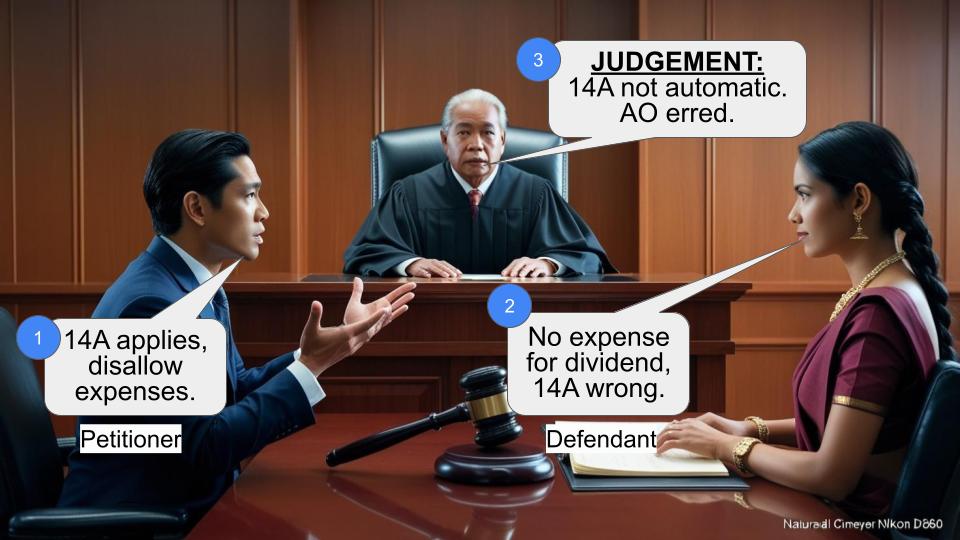
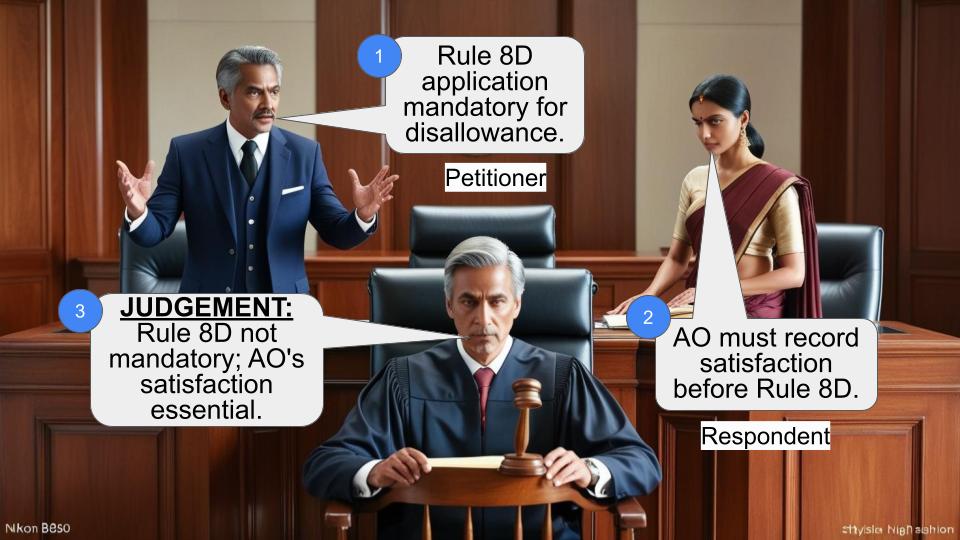
In the case of “Indiabulls Financial Services Ltd. vs Deputy Commissioner of Income Tax,” the court addressed the issue of disallowance under Section 14A (of Income Tax Act, 1961). The court upheld the disallowance made by the Assessing Officer (AO) and dismissed the appeal, emphasizing the mandatory application of Rule 8D (of Income Tax Rules, 1962) when the AO is dissatisfied with the disallowance amount offered by the assessee.
Get the full picture - access the original judgement of the court order here
Case Name
Indiabulls Financial Services Ltd. vs Deputy Commissioner of Income Tax (High Court of Delhi)
ITA 470/2016
Date: 21st November 2016
Key Takeaways
- The court reinforced the mandatory nature of Rule 8D (of Income Tax Rules, 1962) under Section 14A (of Income Tax Act, 1961) when the AO is not satisfied with the disallowance amount.
- The AO must provide reasons for dissatisfaction, but substantial compliance with the provisions is sufficient.
- The decision highlights the importance of following statutory methodologies in tax assessments.
Issue
Was the Assessing Officer justified in disallowing the amount under Section 14A (of Income Tax Act, 1961) without explicitly recording dissatisfaction with the assessee’s offered disallowance?
Facts
Indiabulls Financial Services Ltd. reported tax-exempt income and offered a disallowance of expenses related to this income. The AO, after analyzing the provisions and relevant case law, disallowed a larger amount than what the assessee offered. The assessee argued that the AO did not record dissatisfaction before making the disallowance.
Arguments
- Assessee’s Argument: The AO should have recorded explicit dissatisfaction with the offered disallowance before proceeding with Rule 8D (of Income Tax Rules, 1962).
- Revenue’s Argument: The AO followed the statutory mandate of Rule 8D (of Income Tax Rules, 1962), and substantial compliance with the provisions was achieved.
Key Legal Precedents
- Section 14A (of Income Tax Act, 1961): No deduction is allowed for expenses related to exempt income.
- Rule 8D (of Income Tax Rules, 1962): Provides the methodology for calculating disallowance under Section 14A (of Income Tax Act, 1961).
- Commissioner of Income Tax-I vs Consolidated Photo & Finvest Ltd. (2012): Emphasized the need for the AO to take an overall view rather than a piecemeal decision.
Judgement
The court dismissed the appeal, stating that the AO’s analysis and application of Rule 8D (of Income Tax Rules, 1962) were justified. The court found that the AO’s substantial compliance with the provisions was sufficient, even if explicit dissatisfaction was not recorded.
FAQs
Q: What is Section 14A (of Income Tax Act, 1961)?
A: Section 14A (of Income Tax Act, 1961) disallows deductions for expenses incurred in relation to income that does not form part of the total income under the Act.
Q: Why is Rule 8D (of Income Tax Rules, 1962) important in this case?
A: Rule 8D (of Income Tax Rules, 1962) provides the methodology for calculating disallowance under Section 14A (of Income Tax Act, 1961), which the AO must follow if dissatisfied with the assessee’s offered disallowance.
Q: What was the court’s main reason for dismissing the appeal?
A: The court dismissed the appeal because the AO’s substantial compliance with the statutory provisions was deemed sufficient, even without explicit dissatisfaction being recorded.

ITA 470/2016 & CM No. 26633/2016
1. The issue in this appeal under Section 260A (of Income Tax Act, 1961) (in short the ‘Act’) is the Revenue’s action in disallowing Rs. 3,87,10,146/- under Section 14A (of Income Tax Act, 1961). The assessee urges that without recording his dissatisfaction as a prelude to the exercise conducted by him under the said provisions, further disallowance was not possible.
2. The facts are that the assessee had reported Tax Exempt Income to the tune of Rs. 105.24 crores, during Assessment Year (‘AY’) 2009-10. The assessee had offered disallowance of Rs. 25,19,380/- as expenses attributable to that exempt income. The Assessing Officer (‘AO’) after carrying out an elaborate analysis of the provisions as well as Rule 8D (of Income Tax Rules, 1962) and also after discussing the relevant case law concluded that Rs. 3,87,10,146/- had to be disallowed and he proceeded to do so.
3. The Commissioner of Income Tax (Appeals) [CIT(A)] by independent reasoning and analysis of Section 14A (of Income Tax Act, 1961) and Rule 8D (of Income Tax Rules, 1962) was of the opinion that the preliminary stage of recording satisfaction with respect to the amount offered by the assessee as disallowance i.e. expenses attributable to the earning of exempt income, had not been carried out in which the AO would have been clothed with jurisdiction to enter into the next stage and calculate the disallowance in terms of Rule 8D (of Income Tax Rules, 1962).
4. The Income Tax Appellate Tribunal (in short the ‘Tribunal’) reversed the CIT(A)’s opinion and held that in the circumstances of the case the opinion expressed by the AO was sufficient and justified the disallowance ultimately made.
5. It is urged by the assessee that the ITAT has fallen into error in as much as it premised its conclusion and the working out of the disallowance based upon Rule 8D(iii) (of Income Tax Rules, 1962) carried out by the AO in the first instance in this case. It is urged that ITAT ignored the fact that there had to be good and cogent reason, in the AO’s opinion to persuade him to reject the amount offered as expenses i.e. Rs. 25,19,380/-. In this case the learned counsel relied upon the decision of this Court in Commissioner of Income Tax-I vs Consolidated Photo & Finvest Ltd. (2012) 25 Taxman.com 371 (Delhi). In the present instance the AO carried out an elaborate analysis of Section 14A (of Income Tax Act, 1961) as well as the applicable case law and thereafter proceeded to state as follows:
“.... Further the case laws relied upon by the assessee have also been thoroughly examined and it is found that all the decisions have somehow unanimously have laid down certain ratios to be followed by the Assessing Officer before invoking the provision of section l4A of I T Act. These common ratios are as under:-
1. The assessing officer has to draw dissatisfaction in regard to the correctness of the claim of the assessee in respect of the expenditure which the assessee claims to have incurred in relation to income which does not form part of the total income.
2. The satisfaction of the assessing officer must he arrived at on an objective basis.
3. If the assessing officer wants to disallow an expenditure under a particular provision then the onus would be on the assessing officer to prove that conditions for disallowance are satisfied......
.......The investment made, being a conscious decision and having deployment of funds clearly brings into picture expenditure by way of cost of funds, “Invested." Composite fund having cost needs to be spread so as to apportion appropriate cost of funds invested in the activity lending to carrying of exempt income.
In view of above, the provisions of sub sections (2) of section 14 (of Income Tax Act, 1961) A and Rule 8D (of Income Tax Rules, 1962) are in operation and therefore will strictly he adhered to by the assessee. The language of subsection (1) of section 14A (of Income Tax Act, 1961) clearly provides that no deduction shall he allowed "in respect of expenditure incurred by the assessee in relation to income which does not form part of the total incon1e under this Act''. On going through the simple and plain language, it is abundantly clear that the relation has to be seen between the exempt income and the expenditure incurred in relation to it and not vice versa. What is relevant is to work out the expenditure in relation to the exempt income and the expenditure incurred in relation to it and not vice versa. What is relevant whether the expenditure incurred by the assessee has resulted into exempt income or taxable income. From the three clauses of rule 8D (of Income Tax Rules, 1962) it clearly emerges that stipulation of section is to compute the amount of expenditure which is not allowable u/s 14A (of Income Tax Act, 1961) as is relatable to the exempt income and not in considering all the expenses one by one for ascertaining if either of them have resulted into exempt income and thereafter considering such amount as disallowable u/s 14A (of Income Tax Act, 1961). As discussed above, the assessee had substantial interest free surplus fund as compared to quantum of investment resulted in earning dividend income, hence, the assessee's contention in regard to non deployment of interest bearing borrowed fund in investment, is acceptable, however, keeping in view the substantial growth in investment during the year as compared to previous year, and quantum of tax free dividend income received. The third clause of Rule 8D (of Income Tax Rules, 1962) is dearly attracted. The assessee has also invoked the p1·ovision of section 14A (of Income Tax Act, 1961) while disallowing an amount of Rs.2519380/- which is the amount paid to two employees as salary who have been exclusively involved in looking after the investment affairs of the company. Total disallowance is worked out as per Rule 8D (of Income Tax Rules, 1962) here as under...”
6. This Court in the Consolidated Photo & Finvest Ltd. (supra) – following the judgment of the Bombay High Court in Godrej & Boyce Mfg. Co. Ltd. vs Dy. CIT (2010) 194 Taxman 203, held that the AO has to take an overall view and not a “piecemeal decision” regarding merits of the disallowance. A close analysis of that judgment would show the AO’s view was reversed by the CIT(A) in that case which was ultimately affirmed by the ITAT. This factor significantly dissuaded the Court from exercising its jurisdiction under Section 260A (of Income Tax Act, 1961).
7. Undoubtedly, the language of Section 14A (of Income Tax Act, 1961) presupposes that the AO has to adduce some reasons if he is not satisfied with the amount offered by way of disallowance by the assessee. At the same time Section 14A(2) (of Income Tax Act, 1961) as indeed Rule 8D(i) (of Income Tax Rules, 1962) leave the AO equally with no choice in the matter inasmuch as the statute in both these provisions mandates that the particular methodology enacted should be followed. In other words, the AO is under a mandate to apply the formulae as it were under Rule 8D (of Income Tax Rules, 1962) because of Section 14A(2) (of Income Tax Act, 1961). If in a given case, therefore, the AO is confronted with a figure which, prima facie, is not in accord with what should approximately be the figure on a fair working out of the provisions, he is but bound to reject it. In such circumstances the AO ordinarily would express his opinion by rejecting the disallowance offered and then proceed to work out the methodology enacted.
8. In this instance the elaborate analysis carried out by the AO – as indeed the three important steps indicated by him in the order, shows that all these elements were present in his mind, that he did not expressly record his dissatisfaction in these circumstances, would not per se justify this Court in concluding that he was not satisfied or did not record cogent reasons for his dissatisfaction to reject the AO’s conclusion. To insist that the AO should pay such lip service regardless of the substantial compliance with the provisions would, in fact, destroy the mandate of Section 14A (of Income Tax Act, 1961).
9. Having regard to these facts, this Court is satisfied that the disallowance which is otherwise in accord with Rule 8D(c) (of Income Tax Rules, 1962) was justified. No substantial question of law arises. The appeal is dismissed.
S. RAVINDRA BHAT, J
NAJMI WAZIRI, J
NOVEMBER 21, 2016
×