


Court Upholds Dismissal of Tax Appeals, Rejects Writ Petition Against Reassessm…


Full News

Court Upholds Dismissal of Tax Appeals, Rejects Writ Petition Against Reassessment Notice
Court Upholds Dismissal of Tax Appeals, Rejects Writ Petition Against Reassessment Notice
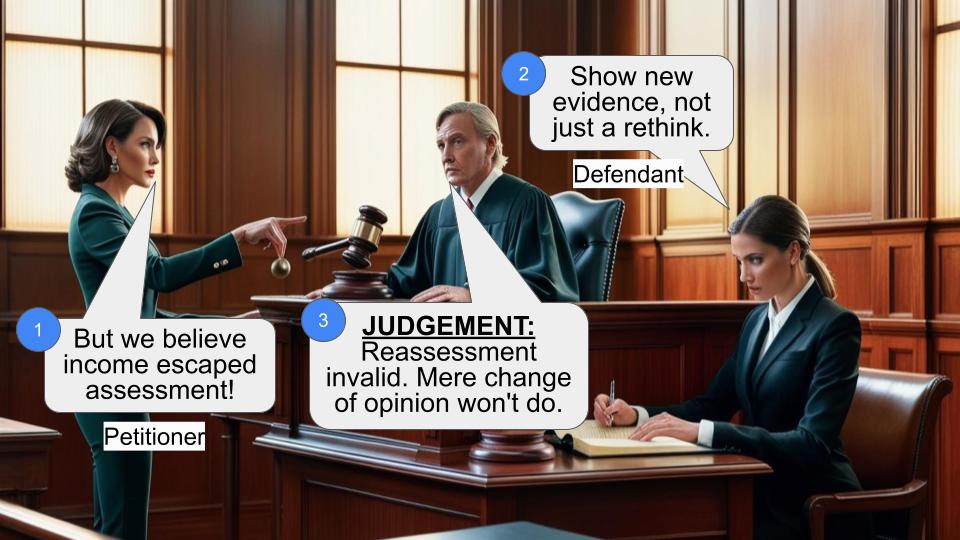
This case involves appeals by the Revenue department against orders of the Income Tax Appellate Tribunal (ITAT) and a writ petition by an assessee challenging a reassessment notice. The court dismissed all appeals by the Revenue and also rejected the writ petition, emphasizing that the writ was not maintainable to challenge a notice under Section 148 (of Income Tax Act, 1961).
Get the full picture - access the original judgement of the court order here
Case Name:
Commissioner of Income Tax vs. The Bank of Rajasthan Ltd. (High Court of Rajasthan)
Income Tax Appeal No.47 of 2002
Date: 23rd January 2008
Key Takeaways:
1. The court affirmed that debatable issues cannot be addressed under Section 143(1)(a) (of Income Tax Act, 1961).
2. Assessees are entitled to file applications under Section 154 (of Income Tax Act, 1961) if actions are taken under Section 143(1)(a) (of Income Tax Act, 1961).
3. Writ petitions are not maintainable to challenge notices under Section 148 (of Income Tax Act, 1961); assessees should respond to such notices through appropriate channels.
4. The court emphasized the distinction between accrual and receipt of income for taxation purposes.
Issue:
Can the Revenue department proceed against an assessee under Section 143(1)(a) (of Income Tax Act, 1961) for interest income shown on a receipt basis when the assessee follows a mercantile system of accounting?
Facts:
- The Revenue department sent information to the assessee under Section 143(1)(a) (of Income Tax Act, 1961), claiming tax liability on interest income.
- The assessee filed an application under Section 154 (of Income Tax Act, 1961), which was initially rejected but later allowed by the Commissioner.
- The ITAT upheld the Commissioner's order allowing the Section 154 (of Income Tax Act, 1961) application.
- The case involved three appeals by the Revenue for assessment years 1991-92, 1992-93, and 1993-94.
- The assessee also filed a writ petition challenging a notice under Section 148 (of Income Tax Act, 1961) for reassessment.
Arguments:
Revenue's Argument:
- The assessee adopted a mercantile system of accounting and should be taxed on interest income on an accrual basis.
- Relied on a recent Madras High Court judgment in CIT v. Tamil Nadu Mercantile Bank (291 ITR 137).
Assessee's Argument:
- Tax should be levied on actually earned income, not hypothetical income.
- The action under Section 143(1)(a) (of Income Tax Act, 1961) was based on hypothetical income and thus an error apparent on record.
Key Legal Precedents:
1. SBBJ v. DCIT (22 Tax World 6)
2. CIT v. Canara Bank (195 ITR 66)
3. CIT v. M/s Shoorji Vallabhdas & Co. (46 ITR 144)
4. E.D. Sasson & Co. Ltd. v. CIT (26 ITR 27)
5. Kedarnath Jute Mfg. Co. Ltd. (82 ITR 363)
These cases established distinctions between "accrue," "arise," and "receive" in terms of income and taxation.
Judgement:
1. The court dismissed all three appeals by the Revenue, upholding the ITAT's order.
2. It was held that the issue of taxability of interest income was debatable and thus not suitable for proceedings under Section 143(1)(a) (of Income Tax Act, 1961).
3. The court affirmed that the assessee was entitled to file an application under Section 154 (of Income Tax Act, 1961), which was rightly allowed.
4. The writ petition challenging the Section 148 (of Income Tax Act, 1961) notice was also dismissed, with the court stating that the assessee should respond to the notice through appropriate channels.
FAQs:
Q1: What was the main issue in this case?
A1: The main issue was whether the Revenue could proceed against the assessee under Section 143(1)(a) (of Income Tax Act, 1961) for interest income shown on a receipt basis when the assessee followed a mercantile system of accounting.
Q2: Why did the court dismiss the Revenue's appeals?
A2: The court found that the taxability of interest income was a debatable issue, which cannot be addressed under Section 143(1)(a) (of Income Tax Act, 1961).
Q3: What did the court say about the writ petition challenging the Section 148 (of Income Tax Act, 1961) notice?
A3: The court dismissed the writ petition, stating that it was not maintainable to challenge a notice under Section 148 (of Income Tax Act, 1961). The assessee should respond to the notice through appropriate channels.
Q4: What is the significance of this judgment for taxpayers?
A4: This judgment reinforces that debatable tax issues cannot be addressed under Section 143(1)(a) (of Income Tax Act, 1961) and that assessees have the right to file Section 154 (of Income Tax Act, 1961) applications in such cases. It also clarifies that writ petitions are not the appropriate method to challenge Section 148 (of Income Tax Act, 1961) notices.
Q5: Did the court decide on the taxability of the interest income?
A5: No, the court explicitly stated that it was not deciding whether the assessee is liable to tax on the amount of interest. The judgment focused on the procedural aspects of the case.

These are four matters, closely interconnected with each other. Appeals No.47/2002, 48/2002 and 63/2004 are by the Revenue, seeking to challenge the order of the ITAT, upholding the acceptance of the application of the assessee, filed under Sec.154 (of Income Tax Act, 1961), while Civil Writ, being No.2568/1993, is by the assessee.
First of all, we take up the appeals of the Revenue.
The three appeals relate to the different assessment years, inasmuch as the Appeal No.47/2002 relates to assessment year 1991-92, the Appeal No.48/2002 relates to assessment year 1992-93 and Appeal No.63/2004 relates to assessment year 1993-94.
The ITAT decided two appeals, relating to assessment years 1991-92 and 1992-93 by common order, which order is the subject matter of Appeals No.47 and 48 of 2002 respectively.
The facts necessary for the present controversy are, that the Department sent an information to the assessee under Sec.143(1)(a) (of Income Tax Act, 1961), conveying, that the assessee is liable to the amount of tax, mentioned therein. The assessee thereupon filed application under sec.154 (of Income Tax Act, 1961), which was rejected by the Dy. Commissioner (Assessment), Special Range. However, the learned Commissioner set aside that order, and allowed application u/s.154 (of Income Tax Act, 1961), and that order of the Commissioner has been upheld by the learned ITAT.
The controversy related to taxability of the interest income of the assessee, inasmuch as, according to the Revenue, the assessee had adopted Mercantile System of accounting, wherein the assessee had shown interest income on “accrual basis”. However, in the computation of the income, made for the purpose of taxable income, the interest income was shown on the “receipt basis”, therefore, the Revenue felt, that the assessee was liable to tax, and the amount of tax was required to be added, within the meaning of Section 143(1)(a) (of Income Tax Act, 1961), in view of the fact, that the assessee was adopting “mercantile system” of accounting.
The assessee, accordingly, filed application u/s.154 (of Income Tax Act, 1961), contending that the tax may be levied on income, actually earned, and not on any hypothetical income, and since the action under Sec.143(1)(a) (of Income Tax Act, 1961) attracted liability on hypothetical income, it is an error apparent on the face of the record. The learned CIT (A) considered the matter threadbare, and found, that the controversy arose on account of change in law, and that, there is no doubt, that on this issue, there can be more than one view, and therefore, anything that involves a doubt, could not be proceeded under Sec.143(1)(a) (of Income Tax Act, 1961), and having so proceeded, it would amount to error apparent on the face of the record. Accordingly, the application u/s.154 (of Income Tax Act, 1961) was allowed. Then the learned ITAT, in appeal by the Revenue, again considered the matter. It also noticed, that similar view has already been taken by the Tribunal, in SBBJ v. DCIT reported in 22 Tax World 6, on merits, in favour of the assessee. Then, the learned Tribunal has proceeded to reproduce the relevant portion of the said judgment in SBBJ's case, which in turn, proceeded on a judgment of the Karnataka High Court in CIT v. Canara Bank, reported in 195 ITR 66, and three judgments of the Supreme Court, being CIT v. M/s Shoorji Vallabhdas & Co.,reported in 46 ITR 144, E.D. Sasson & Co. Ltd. v. CIT, reported in 26 ITR 27, and Kedarnath Jute Mfg.Co. Ltd, reported in 82 ITR 363, and had followed those judgments. A look at the cases, cited in the said judgment in SBBJ's case (supra), does show, that the Hon'ble Supreme Court has consistently drawn a distinction between the expressions “accrue”, “arise” and “receive”, as the word “receive” indicates a right to receive. Likewise, it has also been propounded by Hon’ble the Supreme Court, that if income does not result at all, there can be no tax, even though, in book keeping, an entry is made about hypothetical income, which does not materialize.
Learned counsel for the Revenue relied upon a recent judgment of Madras High Court in CIT v. Tamil Nadu Mercantile Bank, 291 ITR 137, to contend, that the assessee was liable to tax on accrual basis.
On the other hand, learned counsel for the assessee supported the impugned judgment.
At the outset, it may be observed, that learned counsel for the revenue was asked, as to what has been the ultimate status of the judgment in SBBJ's case (supra), substantially on which basis, the impugned orders have been passed, but the learned counsel could not satisfy, that the said judgment does not hold good, any more.
That being the position, since that judgment proceeds substantially on four judgments of the Supreme Court, which, in our view also, are on all the fours, on the controversy involved in the present case, it can not be said that the learned tribunal committed any error in dismissing the appeals of the revenue. So far as Tamil Nadu Mercantile Bank's case is concerned, that case also does not help the cause of the Revenue, inasmuch as, it was considered even in that case, that the interest can be taxed, only after it becomes due i.e. receivable, which, in that particular case, was receivable after specified date, which was the date after the closure of the accounting year, and therefore, the Revenue was not held entitled to tax. In the present case, it is not shown, that the amount of interest sought to be included, was the amount which had become payable on a particular date i.e. realizable by the assessee, apart from the fact, that in any case, admittedly, it has not been realized by the assessee.
We may immediately make it clear that, we should not be understood to mean, to hold, as to whether the assessee would be, or not, liable to tax on the amount of interest, simply because the particular specified date on which the interest can be realizable, had passed, inasmuch as, in the present case, that question is not involved. Here, the question involved is, as to whether the Revenue can proceed against the assessee under Section 143(1)(a) (of Income Tax Act, 1961), obviously, in view of the judgment in SBBJ's case (supra), it was very much a debatable question, as to whether the assessee can be held liable to tax, on this count, or not. If that were so, in view of the settled legal position, the provisions of Sec.143(1)(a) (of Income Tax Act, 1961) were not attracted, and since the action had been taken under Sec.143(1)(a) (of Income Tax Act, 1961), obviously, it rightly attracted the right of the assessee, to move application under Sec.154 (of Income Tax Act, 1961), and the same was rightly allowed by the CIT, as well as the ITAT.
Since, out of three appeals, substantial question of law has been framed only in Appeal No.63/2004 and not in other two appeals, however, instead of standing to ceremony, we have considered the questions in all the three appeals, and in our view, for the conclusions arrived-at as above, the question, framed, vide order dated 10.11.2004, in Appeal No.63, is answered against the Revenue, and in favour of the assessee, and the order of the Tribunal, in all the three appeals, is upheld.
In view of the above, all the three appeals filed by the Revenue are dismissed.
Now we take up the writ petition filed by the assessee. By this writ petition the petitioner assessee only seeks to challenge Annexure-12, which is a notice under Section 148 (of Income Tax Act, 1961), on the basis of satisfaction recorded by the assessing authority about particular income of the assessee having escaped assessment. In our view, it is open to the petitioner to submit appropriate facts, return, or representation before the assessing authority, in response to the notice. Since in this judgment we have already made it clear, that we are not deciding the question as to whether the assessee is liable to tax, or not, on this amount of interest, we do not think it appropriate to go into the merits of the notice Annexure-12.
Consequently, the Writ Petition No. 2568 is also dismissed.
( DEO NARAYAN THANVI ),J. ( N P GUPTA ),J.
×
Similar Ripples
Questions
Court Upholds Dismissal of Tax Appeals, Rejects Writ Petition Against Reassessment Notice
Write your CommentSimilar Posts


Generic
- Reportdata/4967.pdf
