


Full News
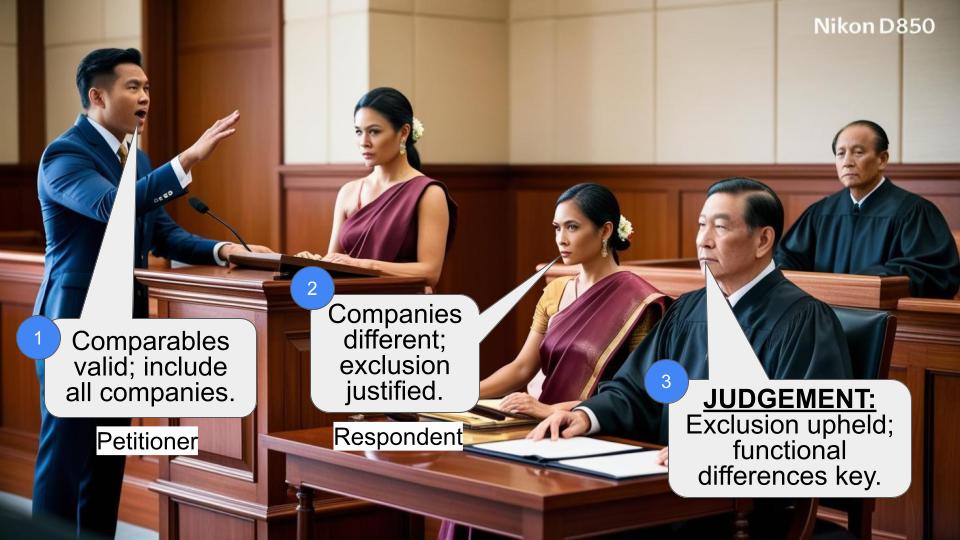
Court Upholds Exclusion of Functionally Different Companies in Transfer Pricing Case
Court Upholds Exclusion of Functionally Different Companies in Transfer Pricing Case
The tax authorities and a company called B.C. Management Services Pvt. Ltd. are duking it out over transfer pricing issues. The main beef? Whether certain companies can be used as comparables for figuring out the arm's length price in international transactions. The Income Tax Appellate Tribunal (ITAT) said "nope" to four comparables, and the tax folks weren't happy about it. But guess what? The High Court backed up the ITAT's decision. It's a win for the company.
Get the full picture - access the original judgement of the court order here
Case Name:
Principal Commissioner of Income Tax & Anr. Vs B.C. Management Services Pvt. Ltd. & Anr. (High Court of Delhi)
ITA 1064/2017 & CM No. 43177/2017
Date: 28th November 2017
Key Takeaways:
1. Functional differences matter big time when selecting comparables for transfer pricing.
2. No segmental data? That's a valid reason to exclude a company as a comparable.
3. Brand value can impact profitability, making a company unsuitable as a comparable.
4. Foreign exchange gains from trading items in international transactions should be treated as operating income.
5. Notional interest on delayed payments can't be added to income for transfer pricing adjustments.
Issue:
The main question here is: Was the ITAT right in excluding four companies (e-Clerx Pvt. Ltd., ICRA Techno Analytics Ltd., TCS E-Serve Ltd., and Accentia Technologies Pvt. Ltd.) as comparables for transfer pricing analysis?
Facts:
1. B.C. Management Services Pvt. Ltd. is our star player here. They're in the IT-enabled services game, doing stuff like application development, testing, and system management.
2. For the 2011-12 assessment year, they filed their tax returns declaring an income of Rs.2,98,06,000/-.
3. The Transfer Pricing Officer (TPO) wasn't totally happy and made some adjustments, adding Rs.2,89,52,326/- to the income. Ouch!
4. The company wasn't thrilled, so they took their case to the Dispute Resolution Panel (DRP). They got a little relief when the DRP said to remove Accentia from the comparables list.
5. Still not satisfied, the company appealed to the ITAT, who then excluded all four comparables. The tax department wasn't pleased with this decision, so they took it to the High Court.
Arguments:
The tax department's side:
- They argued that the four companies (e-Clerx, ICRA Techno Analytics, TCS E-Serve, and Accentia) should be included as comparables.
- They also wanted to include foreign exchange gains as non-operating income and add notional interest on delayed payments from associated enterprises.
The company's side:
- They said these companies were functionally different or had other factors (like brand value) that made them unsuitable comparables.
- They argued that segmental data wasn't available for some companies, making comparison difficult.
- They contended that foreign exchange gains should be treated as operating income and that adding notional interest wasn't justified.
Key Legal Precedents:
1. Principal Commissioner of Income Tax Vs. Cashedge India Pvt. Ltd., ITA 279/2016 (decided on 04.05.2016): This case dealt with foreign exchange gains and notional interest issues.
2. Principal Commissioner of Income Tax Vs. Ameriprise India Private Limited (ITA 206/2016) (decided on 23.03.2016): This case established that foreign exchange gains from trading items in international transactions should be treated as operating income.
3. Principal Commissioner of Income Tax Vs. Bechtel India Pvt. Ltd. ITA 379/2016 (decided on 21.07.2016): This case ruled that notional income on delayed payments can't be added to income for adjustments.
Judgement:
The High Court sided with the company and the ITAT's decision. Here's the breakdown:
1. They agreed that e-Clerx, ICRA Techno Analytics, and Accentia were functionally different from B.C. Management Services.
2. For TCS E-Serve, while functionally similar, its connection to Tata Consultancy Services Ltd. and the associated brand value made it an unsuitable comparable.
3. The court upheld the treatment of foreign exchange gains as operating income, based on previous case law.
4. They also agreed that adding notional interest on delayed payments wasn't justified.
The court concluded that no substantial question of law arose from these issues and dismissed the tax department's appeals.
FAQs:
1. Q: What does this judgment mean for companies involved in transfer pricing?
A: It emphasizes the importance of functional similarity and availability of segmental data when selecting comparables for transfer pricing analysis.
2. Q: Can brand value affect a company's suitability as a comparable?
A: Yes, the court recognized that high brand value can significantly impact profitability, making a company unsuitable as a comparable.
3. Q: How should foreign exchange gains be treated in transfer pricing cases?
A: According to this judgment, foreign exchange gains from trading items in international transactions should be treated as operating income.
4. Q: Can tax authorities add notional interest on delayed payments from associated enterprises?
A: No, the court ruled that such notional interest cannot be added to income for transfer pricing adjustments.
5. Q: Does this judgment set a precedent for future transfer pricing cases?
A: While each case is unique, this judgment provides guidance on selecting comparables and treating certain types of income in transfer pricing cases.

1. The Revenue is aggrieved by the order of the ITAT which in AY 2011-12, accepted the assessee’s appeals. The questions of law urged are as follows:-
“1. Whether the exclusion of four comparables i.e. e-Clerx Pvt. Ltd., M/s ICRA Techno Analytics Ltd., M/s TCS E- Serve Ltd. and M/s Accentia Technologies Pvt. Ltd., are sustainable and not erroneous?”
2. Whether the findings of the ITAT with respect to foreign exchange gain and the manner of its treatment as part of Operating Income for ALP determination, is correct and is justified?
3. Whether the exclusion of the Transfer Pricing adjustment made by the TPO, added notional interest on delay in receipt of payment of Associated Enterprises (AE) was justified?”
2. The Assessee company was incorporated on 12.05.2010, which provides IT enabled services i.e. Application and infrastructure development and testing, system and performance operations management and support etc. to its associated enterprises.
3. The assessee was required to file Transfer Pricing Report along with its income tax returns on 28.11.2011 declaring the total income of Rs. 2,98,06,000/-.
4. The matter was referred to Transfer Pricing Officer (TPO) who made certain adjustments – to the tune of Rs. 2,89,52,326/- after taking into account the margins earned by the comparable industry/assessee, the detail and data of which was available. The assessee preferred its objections to the Dispute Resolutions Panel (DRP); which granted partial relief in the sense of direction to delete the comparable i.e. Accentia was made. The AO then completed the assessment under Section 143(3) (of Income Tax Act, 1961). The Assessee preferred appeal to the ITAT.
5. The ITAT granted relief with respect to the assessee’s appeals by directing the exclusion of all four comparables and rejected the Revenue’s appeals. Likewise, the additions made by the AO on the ground of foreign exchange gains, as well as additions of notional interest; were deleted.
6. This Court notes that so far as the second and third questions i.e. foreign exchange and notional interest are concerned, they are no longer res integra in terms of the order made by the DB of this Court in Principal Commissioner of Income Tax Vs. Cashedge India Pvt. Ltd., ITA 279/2016 decided on 04.05.2016.
7. In Principal Commissioner of Income Tax Vs. Ameriprise India Private Limited (ITA 206/2016) decided on 23.03.2016, this Court had held that foreign exchange gains earned by the assessee which is in relation to trading items and emanating from international transactions, direct value derived from it cannot be treated as Non- Operating losses and gains.
8. This Court notices that Revenue seeks to rely on the Safe Harbour Rules which were notified by the Revenue authority and came into force in 2013. In these circumstances, given that the present assessment period covers AY 2011-12, the treatment cannot be in accordance with those rules as held in ‘Principal Commissioner of Income Tax Vs. M/s Cashedge India Pvt. Ltd., ITA 279/2016’, decided on 04.05.2016. Consequently, no question of law arises.
9. With respect to the treatment of notional interest by the TPO/AO, the Court is of the opinion that no question of law arises. In an identical situation, in Principal Commissioner of Income Tax Vs. Bechtel India Pvt. Ltd. ITA 379/2016, decided on 21.07.2016, the Court had held that such notional income on account of delayed payment made by the AO cannot be treated as part of the income and made the subject matter of the adjustments. The question no. 2 and 3 therefore does not arise for consideration.
10. So far as question no. 1 with respect to exclusion of four comparables is concerned, we notice that E-clerx was excluded on two grounds i.e. no segmental data was available, and it was functionally different as it was providing high end/BPO services.
11. This Court further notes that E-clerx is to provide financial services such as consultancy business solution and testing.
12. The Assessee provides IT abled services in infrastructure development and testing, system and performance operations management and support etc. The ITAT excluded E-clerx as comparable after noticing that it provided high value financial services relating to consultancy business and solution testing besides the web content management merchandising execution, web analytics, etc. This functional dissimilarity, and absence of segmental data led to its exclusion as a comparable. Those are findings of facts based upon record. Consequently, exclusion of E-Clerx was in order and cannot be interfered with.
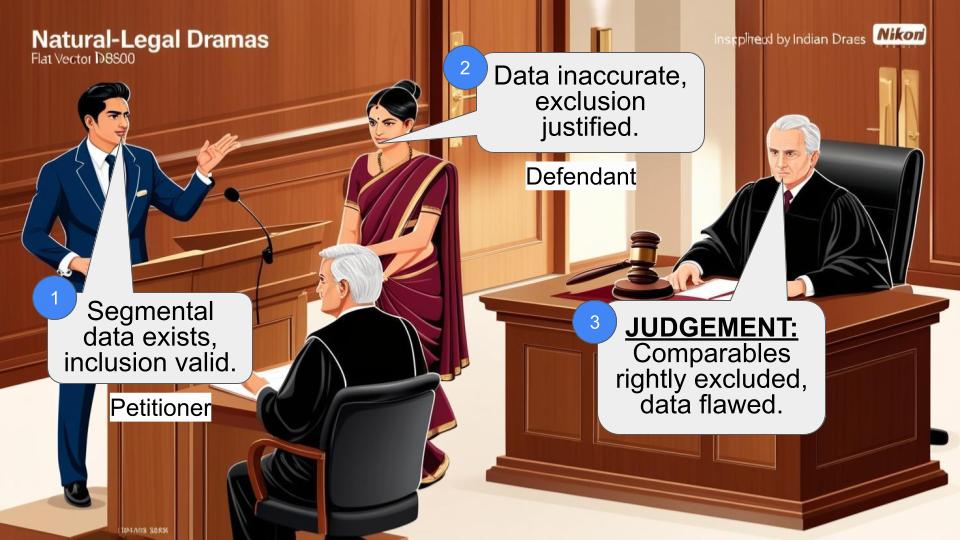
13. The exclusion of second comparable ICRA Techno Analytics Ltd. was on the basis that it had engaged itself in processing and providing software development and consultancy and engineering services/web development services. The reasons for execution were functional dis-similarities and that segmental data were unavailable. Again the findings of the ITAT are reasonable and based on record. The third comparable that the AO/TPO excluded is TCS E-serve. The ITAT observed that though there is a close functional similarity between that entity and the assessee, however, there is a close connection between TCS E-serve and TATA Consultancy Service Ltd. which was high brand value; that distinguished it and marked it out for exclusion. The ITAT recorded that the brand value associated with TCS Consultancy reflected impacted TCS E-serve profitability in a very positive manner. This inference too in the opinion of Court, cannot be termed as unreasonable. The rationale for exclusion is therefore upheld. The assessee was aggrieved by the inclusion of Accentia a Software Development Company. The Revenue is aggrieved by the exclusion of Accentia from the TP analysis. The DRP had directed its deletion. We observe that the ITAT has noticed the unavailability of the segmental data so far as these comparables are concerned. Furthermore, the functionality of this entity was concerned, it is different from that of the assessee; Accentia was engaged in KPO services in the healthcare sector.
14. In view of the above findings, this Court is of the opinion that no substantial question of law arises. The appeals are dismissed.
S. RAVINDRA BHAT
(JUDGE)
SANJEEV SACHDEVA
(JUDGE)
NOVEMBER 28, 2017
×
Similar Ripples
Questions
Court Upholds Exclusion of Functionally Different Companies in Transfer Pricing Case
Write your CommentSimilar Posts

Generic
- Reportdata/1799_VEVtSF4.pdf
