


Court Upholds ITAT's Decision: AO's "Bogus Transaction" Claim Dismissed


Full News

Court Upholds ITAT's Decision: AO's "Bogus Transaction" Claim Dismissed
Court Upholds ITAT's Decision: AO's "Bogus Transaction" Claim Dismissed
This case involves an appeal by the Principal Commissioner of Income Tax against Consolidated Finvest and Holdings Pvt. Ltd. The dispute centered around whether a series of share transactions were genuine or bogus. The Income Tax Appellate Tribunal (ITAT) had ruled in favor of the assessee, and the High Court upheld this decision, dismissing the appeal.
Get the full picture - access the original judgement of the court order here
Case Name:
Principal Commissioner of Income Tax Vs Consolidated Finvest and Holding Pvt Ltd. (High Court of Delhi)
ITA 220/2015
Date: 19th August 2015
Key Takeaways:
1. Consistency in tax treatment across assessment years is crucial.
2. The burden of proof lies with the Assessing Officer (AO) to prove a transaction is bogus.
3. Courts are reluctant to interfere with ITAT decisions unless there's clear perversity.
Issue:
Was the Assessing Officer justified in concluding that the entire share transaction was bogus, despite similar transactions not being questioned in previous assessment years?
Facts:
1. The case pertains to Assessment Year (AY) 2006-07.
2. The assessee, a non-banking finance company, claimed a long-term capital loss of Rs.41,81,03,448 from the sale of 2% Redeemable Convertible Preference Shares (RCPS) of Jindal Polyfilms Ltd. (JPL).
3. The transaction history:
- FY 2000-01: Assessee purchased 6,60,00,000 Optionally Convertible Preference Shares (OCPS) of JPL at Rs.15 per share (Rs.10 face value + Rs. 5 premium).
- March 3, 2004: 0% OCPS converted to 2% RCPS.
- FY 2005-06: 2% RCPS redeemed at face value of Rs.10 each, with share premium forfeited.
Arguments:
Assessee's Argument:
- The transactions were genuine and had been accepted in previous assessment years.
- There was no new event to justify treating the transaction as bogus in the current year.
Revenue's Argument:
- The entire transaction series was bogus and aimed at creating artificial losses.
Key Legal Precedents:
The judgment doesn't explicitly mention any specific legal precedents. However, it relies on the principle of consistency in tax treatment across assessment years.
Judgement:
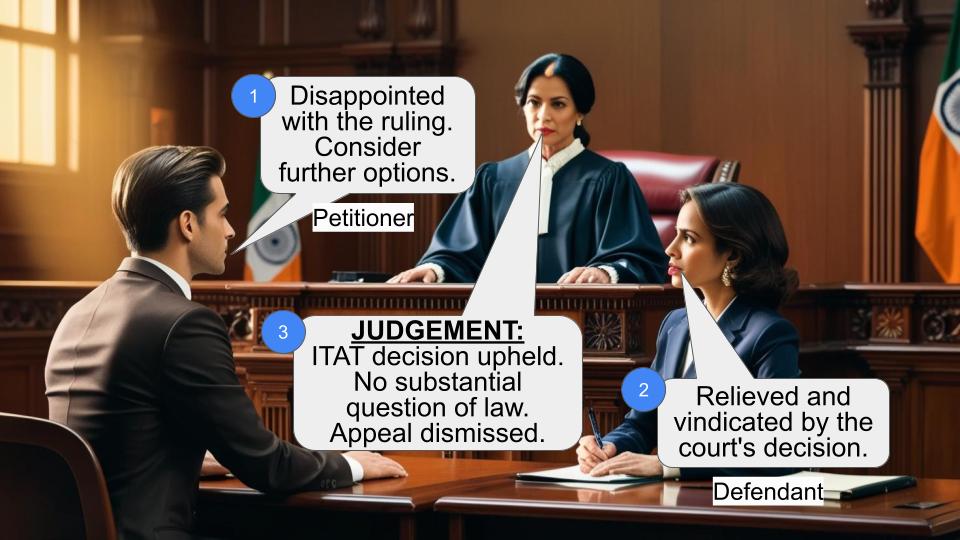
1. The High Court upheld the ITAT's decision in favor of the assessee.
2. The court found that the ITAT had given cogent reasons for why the transaction couldn't be held as bogus.
3. The court didn't find any perversity in the ITAT's order that would warrant interference.
4. The appeal was dismissed, with no substantial question of law arising for determination.
FAQs:
Q1: Why did the court side with the assessee?
A: The court agreed with the ITAT's reasoning that there was no basis for the AO to conclude the entire transaction was bogus, especially when similar transactions weren't questioned in previous years.
Q2: What was the significance of the previous assessment years?
A: The transactions in previous years (AY 2001-02, 2002-03, 2004-05) were not held to be bogus, which made it inconsistent for the AO to suddenly treat the transaction as bogus in AY 2006-07.
Q3: Did the Assessing Officer provide any evidence to support the claim of a bogus transaction?
A: The judgment mentions that the AO called for information from JPL under Section 133(6) (of Income Tax Act, 1961) but was unable to find any material to conclude that the transaction was bogus.
Q4: What does this judgment mean for taxpayers?
A: This judgment emphasizes the importance of consistency in tax treatment across assessment years. It also suggests that tax authorities need substantial evidence to prove a transaction is bogus, especially if similar transactions were accepted in previous years.
Q5: Can the tax department appeal this decision further?
A: While the judgment doesn't mention this specifically, generally, the tax department could potentially appeal to the Supreme Court if they believe there's a substantial question of law involved. However, given that the High Court found no such question, a further appeal might be challenging.

1. This appeal under Section 260A (of Income Tax Act, 1961) (‘Act’) is directed against the order dated 10th September 2014 passed by the Income Tax Appellate Tribunal (‘ITAT’) in ITA No. 729/Del/2011 for the Assessment Year (‘AY’) 2006-07.
2. The Respondent Assessee filed a return for the AY in question on 13th November 2006 declaring an income of Rs.90,88,891. The case was picked up for scrutiny. In the AY in question, the Assessee which is a non-banking finance company (‘NBFC’) engaged in the business of investments, trading of goods, loans and advances, claimed carry forward of a long term capital loss of Rs.41,81,03,448 on account of sale of 2% Redeemable Convertible Preference Shares (‘RCPS’) of Jindal Polyfilms Ltd. (‘JPL’), one of the sister concerns of the Assessee. No Security Transaction Tax (‘STT’) was paid on the shares and they were not listed on any stock exchange.
3. The background to the above claim was that during the Financial Year (‘FY’) 2000-01, the Assessee had purchased 6,60,00,000 shares [Optionally Convertible Preference Shares (‘OCPS’)] of JPL at Rs.10 each at a premium of Rs.5 per share aggregating to Rs.99 crores against which a sum of Rs.66 crores was paid on account of OCPS capital and Rs.33 crores on account of premium. The 0% OCPS was converted into 2% RCPS with effect from 3rd March 2004. During FY 2005-06, the 2% RCPS were redeemed at a face value of Rs.10 each. The share premium amount was forfeited. The resultant loss after taxation was claimed as long term capital loss.
4. The ITAT has in the impugned order reversed finding of the Commissioner of Income Tax (Appeals) [‘CIT (A)’] on this aspect and held that for AY 2001-02 when the loan was converted into OCPS, such conversion was not held to be a bogus or sham transaction. In the return for AY 2002-03, the loss shown from the sale of the part of the OCPS was allowed and not held to be a bogus or a sham transaction. In AY 2004-05, the conversion of 0% OCPS into 2% RCPS was again not held to be bogus. It is only when the Assessee received the sum of Rs.50 crores on redemption of the RCPS in the AY under consideration, that the AO held the transaction to be bogus. The ITAT pointed out that with no significant event having taken place, except redemption of the 2% RCPS, there was no basis for the AO to have concluded that the entire transaction to be bogus. The ITAT further noted that the AO called for information from JPL under Section 133(6) (of Income Tax Act, 1961) but was unable to find any material to conclude that the transaction between the Respondent Assessee and the JPL was bogus.
5. Having heard the submissions of learned counsel for the Revenue and having perused the orders of the AO, CIT (A) and ITAT, the Court finds that the ITAT has given cogent reasons why in the facts and circumstances the transaction in question cannot be held to be bogus. The Court is unable to be find any perversity vitiating the said order.
6. No substantial question of law arises for determination.
7. The appeal is dismissed.
S. MURALIDHAR, J
VIBHU BAKHRU, J
AUGUST 19, 2015
×
Similar Ripples
Questions
Court Upholds ITAT's Decision: AO's "Bogus Transaction" Claim Dismissed
Write your CommentSimilar Posts

Generic
- Reportdata/3519.pdf
