


Court Upholds No Penalty for Assessee's Bona Fide Tax Classification Error


Full News
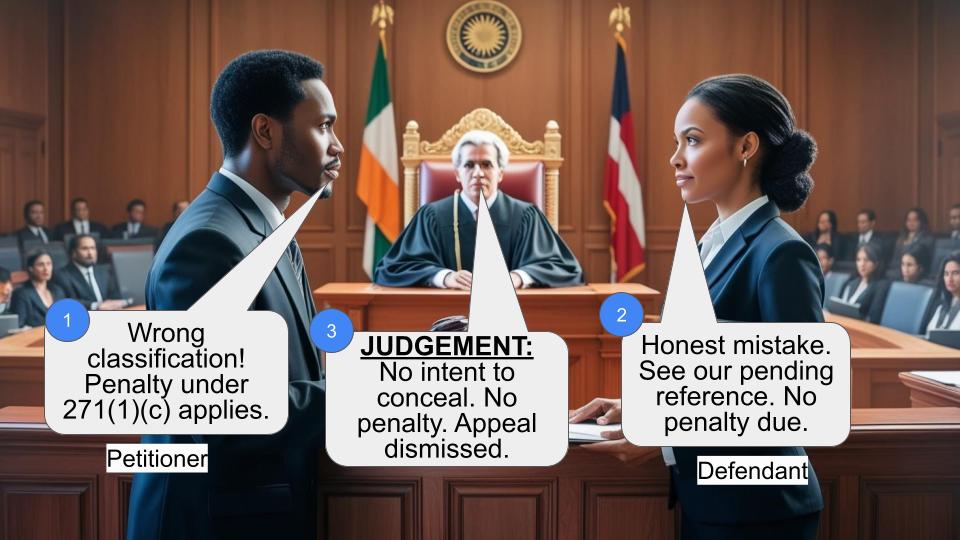
Court Upholds No Penalty for Assessee's Bona Fide Tax Classification Error
Court Upholds No Penalty for Assessee's Bona Fide Tax Classification Error
This case involves a dispute between the Commissioner of Income Tax (the appellant) and an assessee (a partnership firm) regarding the imposition of a penalty under Section 271(1)(c) (of Income Tax Act, 1961). The assessee had classified income from service charges under the wrong head in their tax return. The court ultimately ruled in favor of the assessee, confirming that no penalty should be imposed due to the absence of deliberate misconduct.
Get the full picture - access the original judgement of the court order here
Case Name:
Commissioner of Income Tax Vs Tarapore & Co. (High Court of Madras)
Tax Case (Appeal) No. 1462 of 2007
Date: 3rd December 2007
Key Takeaways
1. Bona fide errors in tax classification may not warrant penalties under Section 271(1)(c) (of Income Tax Act, 1961).
2. The absence of deliberate and malicious conduct is crucial in determining whether to impose penalties.
3. Higher courts are generally reluctant to overturn factual findings of lower authorities without compelling reasons.
Issue
Was the Income Tax Appellate Tribunal correct in holding that no penalty under Section 271(1)(c) (of Income Tax Act, 1961) was leviable when the assessee had challenged the Tribunal's order on merits for earlier years by filing a Reference application before the High Court, even though such reference had been dismissed before the passing of the assessment order?
Facts
1. The assessee is a partnership firm engaged in civil engineering contracts and hotel business.
2. For the assessment year 2000-2001, the assessee reported income from service charges (Rs.48,71,536/-) under the head "income from house property."
3. In previous years, this income was assessed under "other sources," which was confirmed by the Income Tax Appellate Tribunal.
4. The Assessing Officer imposed a penalty under Section 271(1)(c) (of Income Tax Act, 1961) for incorrect classification.
5. The assessee had filed a reference application before the High Court regarding the classification of this income.
Arguments
Assessee's Arguments:
1. The assessee had a bona fide belief that service charges should not be taxed as income from house property due to the pending reference application.
2. All particulars regarding service charges were duly furnished with the return.
3. There was no deliberate attempt to conceal income or furnish inaccurate particulars.
Revenue's Arguments:
1. The assessee did not bring the disposal of the reference application to the notice of authorities while framing the assessment for 2000-01.
2. The incorrect classification warranted a penalty under Section 271(1)(c) (of Income Tax Act, 1961).
Key Legal Precedents
T. Ashok Pai vs. CIT (2007) 210 CTR (SC) 259 : (2007) 292 ITR 11 (SC) - This case was relied upon by the High Court in its decision not to take a different view from the lower authorities.
Judgment
1. The High Court dismissed the appeal filed by the Revenue.
2. The court upheld the findings of the Commissioner of Income Tax (Appeals) and the Income Tax Appellate Tribunal that there was no deliberate and malicious conduct on the part of the assessee to conceal income.
3. The court found that the assessee's explanation for the incorrect classification was acceptable and that all particulars were available in the file.
4. The High Court refused to take a different view from the statutory authorities and the Tribunal, citing the Supreme Court judgment in T. Ashok Pai vs. Commissioner of Income Tax.
FAQs
Q1: Why didn't the court impose a penalty on the assessee?
A: The court found no evidence of deliberate or malicious conduct to conceal income. The assessee's explanation for the incorrect classification was deemed acceptable, and all relevant information was provided in the tax return.
Q2: What is the significance of Section 271(1)(c) (of Income Tax Act, 1961)?
A: This section allows for penalties to be imposed on taxpayers who conceal income or furnish inaccurate particulars of their income. However, this case demonstrates that bona fide errors may not warrant such penalties.
Q3: How important was the assessee's pending reference application in this case?
A: The pending reference application supported the assessee's claim of having a bona fide belief about the correct classification of the income, which helped in establishing that there was no intentional misconduct.
Q4: Can higher courts easily overturn factual findings of lower tax authorities?
A: This case shows that higher courts are generally reluctant to overturn factual findings of lower authorities unless there are compelling reasons to do so.
Q5: What lesson can taxpayers learn from this case?
A: It's crucial to maintain transparency with tax authorities, provide all relevant information, and have legitimate reasons for tax-related decisions. Even if errors occur, honest mistakes made in good faith may not result in penalties.

This appeal is filed against the order of the Income Tax Appellate Tribunal in I.T.A.No.2753/Mds/2004, dated 25.1.2007. The assessment year is 2000-2001.
2. The appellant is a partnership firm doing civil engineering contracts and hotel business. For the assessment year 2000-2001, the assessee admitted income from service charges amounting to Rs.48,71,536/- under the head income from the house property. In the earlier years, this income was assessed under other sources and the same has been confirmed by the Income Tax Appellate Tribunal. Therefor,e the Assessing Officer imposed the penalty under Section 271(1)(c) (of Income Tax Act, 1961). The Commissioner of Income Tax (Appeals) while adjudicating the assessee's appeal against the assessment order, upon hearing the assessee's explanation that the assessee had filed a reference application before the High Court and therefore, the assessee had a bona-fide belief that its claim for service charges should not be taxed as income from house property. Accepting the assessee's explanation, the Commissioner of Income Tax (Appeals) dropped the penalty proceedings on the ground that the assessee had admitted income from the service charges and there is no deliberate and malicious conduct on the part of the assessee for speculation of the Act. Aggrieved by the said order of the Commissioner of Income Tax (Appeals), an appeal was filed before the Income Tax Appellate Tribunal and the Tribunal confirmed the order of the Commissioner of Income Tax (Appeals). Hence the present appeal at the instance of the Revenue by formulating the question of law with the following effect:-
" Whether, in the facts and circumstances of the case, the Tribunal was right in holding that no penalty under Section 271(1)(c) (of Income Tax Act, 1961) was leviable in this case, as the assessee had challenged the Tribunal's order on merits for the earlier years by filing a Reference application before this Court, when such reference had been dismissed even before passing of the assessment order?"
3. We heard the arguments of the learned counsel for the Revenue.
4. The only contention that has been raised by the learned counsel for the Revenue is that even after the disposal of the case against the assessee in the reference application, the assessee has not brought to the same to the notice of the authorities concerned while framing the assessment for the year 2000-01. The ultimate fact finding authority has recorded a finding to that effect that the assessee had made a reference against the decision of the Tribunal before the High Court and therefore, the assessee had a bona fide belief that its claim for service charges should not be taxed as income from the house property. All the particulars regarding the service charges were duly furnished along with the return. Therefore, it could not be said that the assessee had furnished inaccurate particulars of income or concealed its income.
The Commissioner of Income Tax (Appeals) in his order has extracted the letter of the assessee dated 12.8.2004, and also recorded a finding that all the particulars were available in the file and that the appellant stated that it had not made any deliberate attempt on its part to conceal the particulars of income and that it had cooperated in agreeing with the view of the Department after Tribunal and the High Court order and also paid the taxes. The Commissioner of Income Tax (Apeals) also recorded a finding to the effect that there was no deliberate and melicious conduct of cealing the income and the reason offered by the assessee was acceptable.
5. When that being the factual position, we are not able to take a different view than the one taken by the statutory authorities under the Act and also the Tribunal. Useful reference can be made to the judgement of the Supreme Court in T. ASHOK PAI VS. COMMISSIONER OF INCOME TAX reported in (2007) 292 ITR 11. Hence, the tax case appeal is dismissed. No costs.
(K.R.P., J.) (C.V.,J.)
×
Similar Ripples
Questions
Court Upholds No Penalty for Assessee's Bona Fide Tax Classification Error
Write your CommentSimilar Posts

Generic
- Reportdata/5121_.pdf
