


Full News
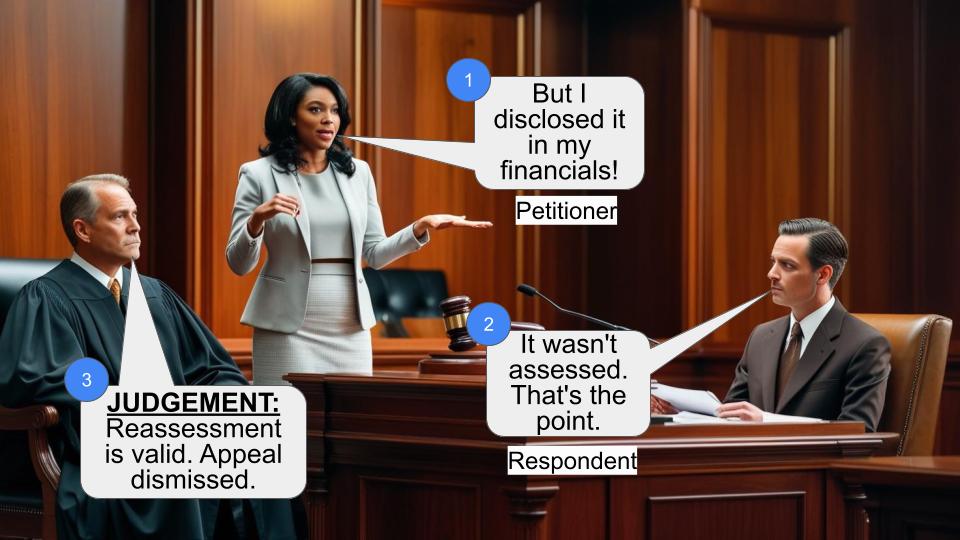
Court Upholds Reassessment of Undisclosed Interest Income, Despite Initial Oversight
Court Upholds Reassessment of Undisclosed Interest Income, Despite Initial Oversight
An appeal case where the main issue was whether the Income Tax Appellate Tribunal (ITAT) was right to support the Assessing Officer's decision to reassess some "interest income" that wasn't initially included in the tax assessment. The court ended up agreeing with the ITAT and dismissed the appeal. Let's break it down further!
Get the full picture - access the original judgement of the court order here
Case Name:
Suresh Chand Gupta vs Principal Commissioner of Income Tax and Another (High Court of Allahabad)
Income Tax Appeal No.11 of 2020
Date: 10th February 2020
Key Takeaways:
1. The court affirmed that reassessment of income under sections 147 (of Income Tax Act, 1961)/148 of the Income Tax Act is valid, even if the initial oversight was due to a mistake.
2. Disclosure of income in financial statements doesn't prevent reassessment if it wasn't included in the original tax computation.
3. The court emphasized that recent amendments to the Income Tax Act have changed how these reassessments are viewed.
Issue:
The main question here was: Is it legally justified for the Income Tax Appellate Tribunal (ITAT) to uphold the Assessing Officer's decision to reassess "interest income" under sections 147 (of Income Tax Act, 1961)/148 of the Income Tax Act, even when the Assessing Officer initially failed to assess this income due to an oversight or mistake?
Facts:
1. The appellant (Suresh Chand Gupta) had some interest income from Fixed Deposit Receipts (FDRs).
2. This interest income was disclosed in the audited Profit & Loss Account and Balance Sheet filed with the tax return.
3. However, the Assessing Officer initially missed including this interest income in the assessment, focusing only on contract and sub-contract income.
4. Later, the tax department decided to reassess this income under sections 147 (of Income Tax Act, 1961)/148 of the Income Tax Act.
5. The reassessment was triggered by an audit objection raised by the revenue audit party.
Arguments:
The appellant's side argued:
1. The interest income was already disclosed in the financial statements.
2. Reassessment based on an audit objection isn't allowed as it's just a change of opinion.
The tax department's stance:
1. The income was clearly shown in the balance sheet but wasn't included in the initial assessment due to an oversight.
2. This isn't a case of double addition, just correcting a missed assessment.
Key Legal Precedents:
The appellant tried to use a Supreme Court case, Commissioner of Income-Tax v. Corporation Bank Ltd. (2002) 122 Taxman 826 (SC), to support their argument. However, the court said this case wasn't applicable because:
1. It was decided before several amendments were made to the relevant sections of the Income Tax Act.
2. The facts of that case were different from the current situation.
Judgement:
The court sided with the tax department here. They said:
1. The ITAT was right to uphold the Assessing Officer's reassessment of the interest income.
2. Even though the initial miss was due to an oversight, it's still valid to reassess under sections 147 (of Income Tax Act, 1961)/148 of the Income Tax Act.
3. This isn't a case of double addition, so it's okay to include the missed income now.
4. The appeal was dismissed, confirming the ITAT's earlier decision.
FAQs:
1. Q: Does disclosing income in financial statements protect you from reassessment?
A: Not necessarily. If the income wasn't included in the original tax computation, it can still be reassessed.
2. Q: Can the tax department reassess based on an audit objection?
A: Yes, in this case, the court allowed it as it wasn't seen as a mere change of opinion but correcting a missed assessment.
3. Q: What if the Assessing Officer made a mistake in the initial assessment?
A: The court's decision suggests that mistakes or oversights can be corrected through reassessment procedures.
4. Q: How important are recent amendments to the Income Tax Act?
A: Very important! The court emphasized that older case laws might not apply due to recent amendments, so it's crucial to stay updated on the latest changes.

This appeal under section 260-A (of Income Tax Act, 1961), 1961 (as amended till date), is in respect of a judgment and order dated 3rd September, 2019, passed by the learned Income Tax Appellate Tribunal, Agra Bench, Agra in I.T.A. No. 284 / Agra / 2017. The appellant has framed two substantial questions of law, which read as follows:-
(i) “Whether the ITAT was legally justified in upholding the action of Assessing Officer reassessing the "interest income" of the appellant u/s 147 (of Income Tax Act, 1961) / 148 of the Act, when A.O. admittedly on account of oversight / mistake failed to assess the interest income which was duly disclosed in the books of accounts of the appellant?”
(ii) “Whether on the basis of audit objection raised by the revenue audit party reassessment is permissible u/s 147 (of Income Tax Act, 1961) / 148 of the Act being change of opinion when the interest income of FDR's has been duly disclosed in the audited Profit & Loss A/c and Balance sheet filed along with the return of income?”
The provision of law which is relevant in the facts of the present case, is section 147 (of Income Tax Act, 1961), as it deals with income escaping assessement. This particular provision of law has since undergone several amendments whereby several provisos have been introduced. The Assessing Officer, being the Deputy Commissioner of Income Tax-6, New Circle-2(3)(1) Jhansi, in the facts of the instant case made the following observations:-
"From the perusal of above computation it is clear that the Assessing Officer has work out profit on the basis of contract income and sub contract income and not added interest income by mistake. From the perusal of audited balance sheet of the assessee it is clear that the assessee himself shown Rs. 47,34,000/- as other income in schedule 12 of audited balance sheet. The case laws is not applicable in the case of assessee because the assessee himself shown interest on FDR's as other income and fact of the case is deferent. Therefore, no question arise of double addition in this case. Considering the above discussion the reply of the assessee is not acceptable and Rs.47,34,000/- is added in the income of the assessee."
The question as to whether the learned Tribunal was legally justified in upholding the action of the Assessing Officer reassessing the “interest income” of the appellant under sections 147 (of Income Tax Act, 1961) / 148 of the Income Tax Act, 1961, has to be answered in the affirmative notwithstanding the fact that the Assessing Officer, admittedly, on account of oversight / mistake failed to assess the interest income since there was no question of double addition which had arisen in this case.A judgment of the Hon'ble Supreme Court which was referred to and relied upon by the learned advocate representing the appellant rendered on 3rd February, 1999, in Commissioner of Income-Tax v. Corporation Bank Ltd., reported in (2002) 122 Taxman 826 (SC), has no manner of application at all in the facts of the instant case, since that judgment was rendered prior to the applicable law having undergone several amendments.
The questions of law, as framed by the appellant, are answered accordingly and the instant appeal, being Income Tax Appeal No.11 of 2020 is disposed of by affirming the judgment and order dated 3rd September, 2019, passed by the learned Income Tax Appellate Tribunal, Agra Bench, Agra in I.T.A. No.284 / Agra / 2017.
×
Similar Ripples
Questions
Court Upholds Reassessment of Undisclosed Interest Income, Despite Initial Oversight
Write your CommentSimilar Posts
Generic
- Reportdata/6286.pdf
