


Court Upholds Rental Income as Business Income for IT Park Owner, Allowing Tax …


Full News
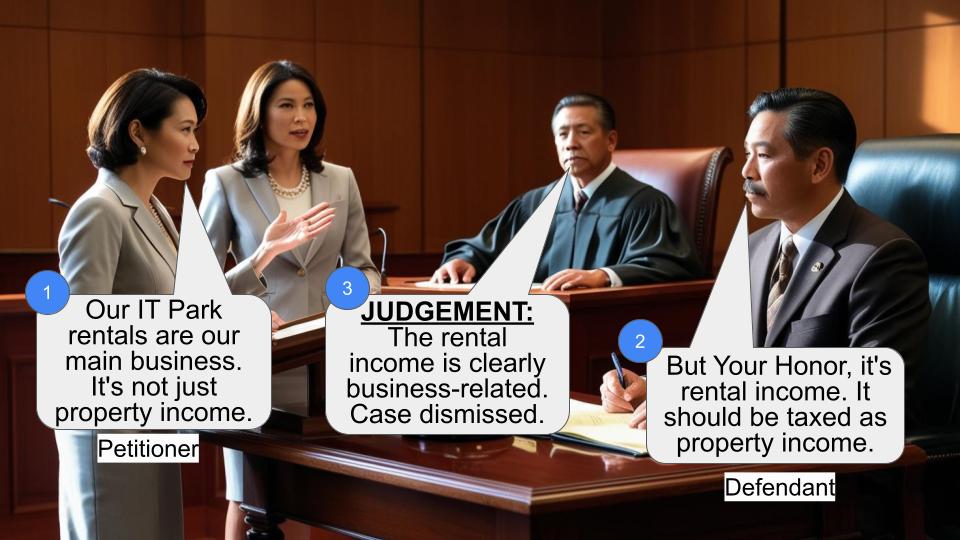
Court Upholds Rental Income as Business Income for IT Park Owner, Allowing Tax Deductions
Court Upholds Rental Income as Business Income for IT Park Owner, Allowing Tax Deductions
The Income Tax Department (the Revenue) appealed against M/s. Khivraj Motors Pvt. Ltd. The main issue was whether the rental income from an IT Park should be taxed as "Income from House Property" or "Income from Business." The court sided with the company, saying it's business income, which means they can claim some nice tax deductions.
Get the full picture - access the original judgement of the court order here
Case Name:
Principal Commissioner of Income Tax vs M/s. Khivraj Motors Pvt. Ltd. (High Court of Madras)
TCA Nos.314 and 315 of 2017 a nd C MP 8709/2017
Date: 27th July 2020
Key Takeaways:
1. Rental income can be treated as business income if it's the main business activity of a company.
2. The nature of the property (like an IT Park) and how it's used matters in determining the type of income.
3. The court emphasized following precedents set by higher courts to avoid unnecessary litigation.
Issue:
The main question here was: Should the rental income from an IT Park be taxed as "Income from House Property" or "Income from Business"?
Facts:
M/s. Khivraj Motors Pvt. Ltd. developed an IT Park called Olympia Tech Park. They were earning rental income from software companies using this park. The Income Tax Department wanted to tax this as "Income from House Property," but the company said, "Hold up, this is our business income!" The case went through various stages - from the Assessing Officer to the Income Tax Appellate Tribunal, and finally to the High Court.
Arguments:
The Revenue (that's the tax folks) argued:
1. The development of the IT Park wasn't the main business of the company.
2. The rental income should be taxed under "Income from House Property."
The Company (M/s. Khivraj Motors) said:
1. The IT Park development and rental income was their main business activity.
2. This income should be treated as "Income from Business," allowing them to claim deductions under Section 80IA (of Income Tax Act, 1961).
Key Legal Precedents:
1. M/s. PSTS Heavy Lift and Shift Ltd. vs. M/s. CeeDeeYes IT Parks Pvt. Ltd. (2020): This case established that if rental income is the main business of a company, it should be taxed as business income.
2. CIT v. Elnet Technologies Ltd. [(2012) 213 Taxman 129]: Another case supporting the treatment of rental income as business income in similar circumstances.
Judgement:
The court sided with M/s. Khivraj Motors. They said:
1. The company's main business was earning rental income from the IT Park.
2. This income should be taxed as "Income from Business," not "Income from House Property."
3. The company can claim deductions under Section 80IA (of Income Tax Act, 1961).
4. The court criticized the tax authorities for not following previous court decisions, saying this creates unnecessary litigation.
FAQs:
1. Q: Why does it matter if the income is classified as business income or property income?
A: It affects the deductions a company can claim. Business income allows for more deductions, potentially reducing the tax burden.
2. Q: Does this mean all rental income will now be treated as business income?
A: Not necessarily. It depends on whether earning rental income is the main business activity of the company.
3. Q: What's the significance of the IT Park in this case?
A: The specialized nature of an IT Park suggests it's not just a regular property but a business venture, supporting the "business income" classification.
4. Q: Why did the court criticize the tax authorities?
A: The court felt they should have followed previous similar judgments instead of creating unnecessary litigation.
5. Q: Could this decision affect other companies with rental income?
A: Yes, companies with similar business models might use this case to argue for their rental income to be treated as business income.

The Court was held by Video Conference, as per the Resolution of the Full Court dated 3 July 2020, by Judges at their respective residence and the counsel, staff of the Court appearing from their respective residences.
2. The Revenue has filed the present appeals aggrieved by the order of the learned Income Tax Appellate Tribunal, Madras B Bench, dated 5.8.2016 in ITA Nos.1179/Mds/2015 and 1180/Mds/2015 for the assessment years, 2010-11 and 2011-12, dismissing the appeals of the Revenue and upholding the order of the learned Commissioner of Income Tax (Appeals) II, Chennai, dated 3.11.2014 for the assessment years 2010-11 and 2011-12 and holding that the rental income from the I.T. Park, namely, Olympia Tech Park is taxable under the head “Income From Business” and under the head "income from house property".
3. The following purported substantial questions of law are sought to be raised in the present appeals filed by the Revenue :-
1. Whether on the facts and in the circumstances of the case and in law the Appellate Tribunal is correct in upholding the order of CIT(A) directing the Assessing Officer to treat the rental income from the letting out of property as "income from business" and to allow the claim on deduction u/ s.80IA(4)(iii)of the Income Tax Act?
2. Whether on the facts and circumstances of the case and in law, Tribunal was justified in holding that the rental receipts to be assessed under the head "Income from Business" when assessee was not engaged in any business activity and as the condition for chargeability of property income as provided under the provision of Section 22 (of Income Tax Act, 1961) are satisfied in the present case and thereby to be assessed under the head "Income from house property" only?
3. Whether on the facts and circumstances of the case, the Appellate Tribunal was correct in disregarding the fact that the assessee has not developed or developed and maintained an Industrial Park by 31.03.2006 as stipulated by the Industrial Park Scheme-2002, and hence the same has not yet been notified by the CBDT, therefore the assessee is not eligible for claiming deduction u/ s.80IA(4)(iii) of the Income Tax Act?
4. Whether the Appellate Tribunal is right in not following the ratio of Apex Court's decision in Keyaram Hotels vs.CIT (2015) 63 taxmann.com 301 (SC) wherein the Apex Court has uphleld the Madras High Court's decision 373 ITR 494 that where assessee was not engaged in any business activity, rental income earned out of letting out of commercial complex would be assessed as “income from house property” and not as «business income" and further whether non-appreciation/ ignorance of the ratio of decision of Hon'ble Apex Court, while deciding the issue, had made the order of ITAT perverse, both in law and facts ?
4. The finding of the learned Tribunal in this regard are quoted below from its order.
10. We have considered the rival submissions on either side and perused the relevant material available on record. Admittedly, the assessee disclosed dividend income of Rs.6,77,302/- and claimed as exempted. As rightly submitted by the Ld. O.R., when the assessee earned exempted income or income which does not form part of total income and claimed expenditure, the Assessing Officer may compute the disallowance if he is not satisfied about the claim made by the assessee. In the case before us, the Assessing Officer computed the disallowance under Rule 80 (of Income Tax Rules, 1962). A perusal of the assessment order, more particularly at page 5, clearly shows that the Assessing Officer has adopted the method prescribed under the Rule 80(2) (of Income Tax Rules, 1962). The only contention of the assessee now before this Tribunal is that the investment in deep discount bonds does not result in any exempted income and the income from deep discount bonds is taxable. However, no details of investments said to be made by the assessee which earned taxable income are available either before the Assessing Officer or before this Tribunal. Moreover, the so-called investments in subsidiary companies are also not available on record. In the absence of any such details either before this Tribunal or before the CIT(Appeals) or before the Assessing Officer, the claim of the assessee that the investment made in deep discount bonds and subsidiary companies has to be excluded cannot be accepted. When the assessee claims that investment in deep discount bonds resulted in taxable income, it is for the assessee to file necessary material to substantiate its case. In the absence of any such material, this Tribunal do not find any reason to interfere with the order of the lower authority and accordingly the same is confirmed.
5. Having heard the learned counsel for the petitioner, we are of the clear opinion that the controversy is no longer res integra and it is squarely covered by the recent judgment of the Division Bench of this Court in the case of M/s. PSTS Heavy Lift and Shift Ltd., Wavoo Mansion, 2nd Floor 48, (Old No.39), Rajaji Salai vs. M/s. CeeDeeYes IT Parks Pvt. Ltd., decided on 30 January 2020, in Tax Case Appeal Nos.2193 to 2195 of 2008 & 979 of 2009. Paragraphs 17 to 22 of that judgment are quoted below for ready reference :-
“17. We are of the clear opinion that once the property in question is used as business asset and the exclusive business of the assessee company or firm is to earn income by way of rental or lease money, then such rental income can be treated only as the “Business Income of the Assessee” and not as “Income from House Property”. The Heads of Income is divided in various six heads, including “Income from House Property”, which defines the specific source of earning such incomes. The income from house property is intended to be taxed under that head mainly if such income is earned out of idle property, which could earn the rental income by user thereof from the lessees. But, where the income from the same property in the form of lease rentals is the main source of business of the Assessee, which has its business exclusively or substantially in the form of earning of the rentals only from the Business Assets in the form of such landed properties, then, in our opinion, the more appropriate Head of Income applicable in such cases would be “Income from Business”.
18. A bare perusal of the Scheme of the Income Tax Act, 1961, would reveal that while computing the taxable income under the Head “Income from business or profession”, the various deductions, including the actual expenditure incurred and notional deductions like depreciation etc. are allowed vis-a-vis incentives in the form of deductions under Chapter VIA. But, the deductions under the Head “Income from House Property”; are restricted to those specified in Section 24 (of Income Tax Act, 1961), like 1/6th of the annual income towards repairs and maintenance to be undertaken by landlords, interest on capital employed to construct the property etc. Therefore, in all cases, such income from property cannot be taxed only under the head “Income from House Property”. It will depend upon the facts of each case and where such income is earned by the Assessee by way of utilisation of its business assets in the form of property in question or as an idle property which could yield rental income by its user, by the lessees. In the earlier provisions of Income from House Properties, even the notional income under the Head “Income from House Property”; was taxable in the case of self-occupied properties by landlords, is a pointer towards that.
19. Since, in the present cases, it is not even in dispute that all the exclusive and main source of income of the Assessee was only the rentals and lease money received from the lessees in both the cases and the Assessing Authority took a different and contrary view mainly to deny the claim of depreciation out of such business income in the form of rentals, without assigning any proper and cogent reason. Merely because the lease income or rental income earned from the lessees, could be taxed as “Income from House Property”, ignoring the fact that that such rentals were the only source of “Business Income”; of the Assessee, the Authorities below have fallen into the error in holding that the income was taxable under the Head Income from house property. The said application of the Head of Income by the Authorities below was not only against the facts and evidence available on record, but against the common sense itself.
20. The amended definition under Section 22 (of Income Tax Act, 1961), now defines the “Income from House Property”; as the annual value of property, as determined under Section 23 (of Income Tax Act, 1961), consisting of buildings or lands appurtenant thereto of which the assessee is the owner, other than such portions of such property, as he may occupy for the purposes of any business or profession carried on by him, the profits of which are chargeable to income tax, shall be chargeable to Income Tax under the head “Income from house property”. Thus, even the amended definition intends to tax the notional income of the self occupied portion of the property to run Assessee's own business therein as business income. Therefore, the other rental income earned from letting out of the property, which is the business of the Assessee itself, cannot be taxed as Income from house property.
21. Moreover, the Heads of Income, as defined in Section 14 (of Income Tax Act, 1961) do not exist in silos or in watertight compartments under the Scheme of tax and thus, these Heads of Income, as we have noted above, are fields and heads of sources of income depending upon the nature of business of the Assessee. Therefore, in cases where the earning of the rental income is the exclusive or predominant business of the Assessee, the income earned by way of lease money or rentals by letting out of the property cannot be taxed under the Head “Income from house property”, but can only be taxed under the Head “Income from business income”.
22. In view of the aforesaid, where the facts of the cases are undisputed that both the Assessees in the present case carry on the business of earning the rental income, as per the Memorandum of Associations only and the fact is that they were not carrying on any other business, compels us to come to the conclusion that the present appeals of the Assessees are required to be allowed. The same are accordingly allowed and the question of law framed above is answered in favour of the Assessee and against the Revenue. No costs.
6. Though the learned counsel for the Revenue Mr.Karthik Ranganathan, sought to urge before us that the development of I.T. Park was not the main business activity of the Assessee company, he failed to establish his contention with the help of any relevant evidence, including the memorandum of association of the company or any other relevant documents.
7. On the contrary, we found from the discussion in the order of the Commissioner of Income Tax (Appeals) as well as the learned Tribunal that the Assessee has not only shown part of its income as income from other property,but has only allowed the claim of the Assessee to tax the income from the software companies in the form of lease rentals from Olympia Tech Park as income from business and thereupon allowing this deduction under Section 80IA (of Income Tax Act, 1961), which is allowed only if the income from business is taxed under the head “Income from business” at the hands of the Assessee. We do not find any material on record to establish that such income of the Assessee during the relevant year was from any of its idle properties and the Assessee company used to enjoy such properties as a landlord from only earning the rental income.
8. On the contrary, it seems that the Assessee diversified and added its business line for the development of real estate of particular type, namely software companies and even though the name of the company continue to remain as M/s. Khivraj Motors Pvt. Ltd. The burden of the argument of the learned counsel for the Revenue, perhaps emanated from only the name of the company, forgetting that the main business activity of the company from its motor business had been diversified into developing a special kinds of property and earning lease rental income as its main business income. By no stretch of imagination, could a software park developed with the special facilities and amenities for software companies, be described or believed to be a property created for earning rental income as income from house property. The Tribunal not only relied upon an earlier decision of Madras High Court in the case of CIT v. Elnet Technologies Ltd. [(2012) 213 Taxman 129], but also having considered all these aspects in great detail, the Division Bench of this Court to which one of us (VKJ) was a member, in M/s. PSTS Heavy Lift and Shift Ltd., had clearly held that where the main business of the company is to earn rental income as its business income, the income would be taxable under the head “Income” entitling the petitioner Assessee to have the deductions of notional expenses like depreciation and special deductions like Section 80IA (of Income Tax Act, 1961) etc.
9. It appears that just to take a contrary view in favour of the Revenue,the authorities unneccesarily create a forum for litigation for the assessee by taking different and divergent views, despite there being binding precedents from the jurisdictional high Court. This tendency of the revenue authorities not to follow the judgments of superior Constitutional Courts deserves to be strongly deprecated by imposition of suitable costs on them.
10. We would have imposed costs on the Assessing Authority for not following the binding precedents of the Court, but, at the repeated request of the learned counsel for the Revenue, we are making it cost easy for the appellant Revenue with the hope that the Revenue will understand the ratios of the judgments clearly and apply the same in its letter and spirit truthfully.
11. With the above observations, we dismiss the appeals. No costs. Consequently, connected miscellaneous petition is also dismissed.
DR.VINEET KOTHARI, J.
and KRISHNAN RAMASAMY, J.
×
Similar Ripples
Questions
Court Upholds Rental Income as Business Income for IT Park Owner, Allowing Tax Deductions
Write your CommentSimilar Posts


Generic
- Reportdata/6205.pdf
