


Court Upholds Reopening of Tax Assessment, Allows Deduction for Home Improvemen…


Full News

Court Upholds Reopening of Tax Assessment, Allows Deduction for Home Improvements
Court Upholds Reopening of Tax Assessment, Allows Deduction for Home Improvements
The High Court ruled on an income tax case involving Rahana Siraj and the Commissioner of Income Tax. The court upheld the reopening of a tax assessment due to discrepancies in property valuation but allowed the taxpayer to claim deductions for home improvements under Section 54F (of Income Tax Act, 1961).
Get the full picture - access the original judgement of the court order here.
Case Name:
Rahana Siraj vs Commissioner of Income Tax (High Court of Karnataka)
ITA No.232 of 2013
Date: 5th January 2015
Key Takeaways:
1. The court validated the reopening of tax assessment under Section 148 (of Income Tax Act, 1961) when there's evidence of income escaping assessment.
2. The court interpreted "cost of new asset" under Section 54F (of Income Tax Act, 1961) to include expenses for improvements and modifications, even if the property was initially habitable.
3. This ruling potentially broadens the scope of deductions allowable under Section 54F (of Income Tax Act, 1961) for capital gains tax purposes.
Issue:
1. Was the reopening of the tax assessment under Section 148 (of Income Tax Act, 1961) valid?
2. Should expenses for improvements and modifications to a newly purchased habitable property be considered as part of the "cost of new asset" under Section 54F (of Income Tax Act, 1961)?
Facts:
1. The assessee, Rahana Siraj, sold a property in Bangalore and received Rs. 92,80,350/- as her share.
2. She declared a capital gain of Rs.34,31,912/- and claimed exemption under Section 54F (of Income Tax Act, 1961) for investing in another property.
3. The tax authorities issued a notice under Section 148 (of Income Tax Act, 1961) to revise the return, questioning the declared capital gains of Rs.44,04,743/-.
4. The assessee had claimed a fair market value of Rs.280/- per sq. ft. as of 01.04.1981, while the government notification stated it was Rs.45/- per sq. ft.
5. The assessee spent about Rs. 18 lakhs on improvements to the newly purchased property, including marble flooring, kitchen alterations, and compound wall construction.
Arguments:
1. The assessee argued that the reopening of assessment was without jurisdiction as the tax authority sought information from the Sub-Registrar after issuing the notice.
2. The assessee contended that expenses for improvements should be considered in calculating the cost of investment under Section 54F (of Income Tax Act, 1961).
3. The Revenue argued that the tax authority had the government notification showing the market rate at Rs.45/- per sq. ft. when issuing the notice, justifying the reopening.
4. The Revenue also argued that improvements not required for making the premises habitable should not be considered for the cost of acquisition.
Key Legal Precedents:
The judgment refers to I.T.A. Nos. 425 & 462/2010, which was considered by the Tribunal in relation to another co-owner's case. However, specific details of this precedent are not provided in the given context.
Judgement:
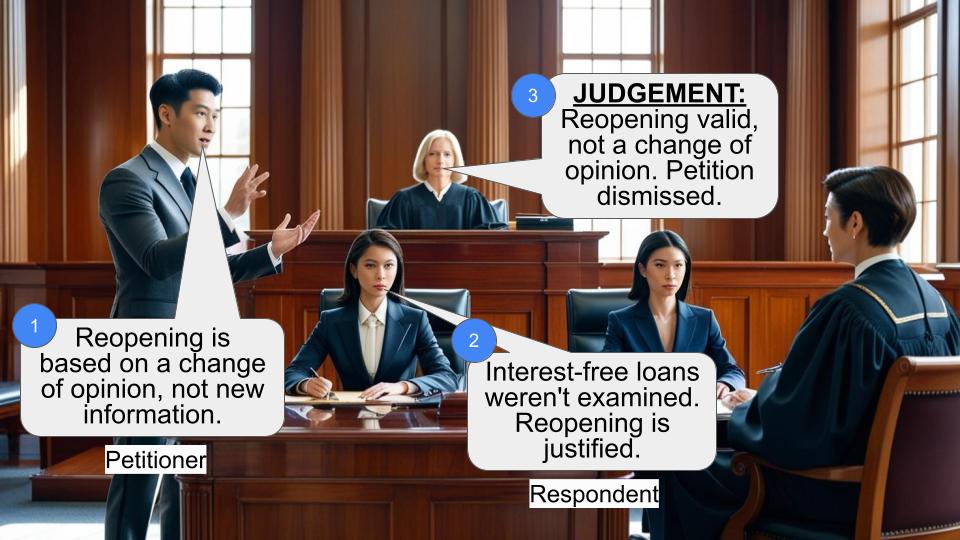
1. The court upheld the validity of reopening the assessment under Section 148 (of Income Tax Act, 1961), ruling in favor of the Revenue.
2. The court ruled in favor of the assessee regarding the inclusion of improvement costs in the "cost of new asset" under Section 54F (of Income Tax Act, 1961).
FAQs:
Q1: What was the main issue in this case?
A1: The main issues were the validity of reopening a tax assessment and whether improvement costs for a newly purchased property can be included in the "cost of new asset" for tax deduction purposes.
Q2: How did the court interpret "cost of new asset" under Section 54F (of Income Tax Act, 1961)?
A2: The court interpreted it broadly to include not just the purchase price, but also expenses for improvements and modifications, even if the property was initially habitable.
Q3: What impact might this judgment have on future tax cases?
A3: This judgment may allow taxpayers to claim broader deductions under Section 54F (of Income Tax Act, 1961), including costs for improvements made to newly purchased properties.
Q4: Did the court agree with the reopening of the tax assessment?
A4: Yes, the court found that the tax authority had sufficient reason to reopen the assessment based on the discrepancy in property valuation.
Q5: How much did the assessee spend on property improvements?
A5: The assessee spent approximately Rs.18 lakhs on improvements such as marble flooring, kitchen alterations, and compound wall construction.

1. The assessee has preferred this appeal against the order passed by the Tribunal holding that only the expenses incurred to make the residential house habitable is entitled to benefit under Section 54F (of Income Tax Act, 1961), but not any additions made to the newly acquired building.
2. The assessee is an individual. Assessee was the
owner of immovable property bearing No.96, Brigade
Road, Civil Station, Bangalore. When the said property
was sold, she received a sum of Rs.92,80,350/- towards
her share as a co-owner. She declared a capital gain of
Rs.34,31,912/-. She claimed exemption under Section
54F of the Act as she invested the said amount in
purchase of another property. Return was processed
under Section 143(1)(a) (of Income Tax Act, 1961). Later on, a notice
under Section 148 (of Income Tax Act, 1961) was issued on 24.11.2006
calling upon her to show-cause as to why the return of
Income should be revised, as the income declared under
the head capital gains as Rs.44,04,743/- is not correct.
She filed a reply. The assessee had claimed the fair
market value as on 01.04.1981 at Rs.280/- per sq. ft.
According to the assessee as per the Government
notification, it was only Rs.45/- per sq.ft. Aggrieved by
the same, the assessee preferred an appeal to the
Commissioner of Income-tax (Appeals), who assessed
the fair market value at Rs.175/- per sq. ft. Both the
assessee and the Revenue preferred an appeal to the Tribunal.
3. The Tribunal, by the impugned order remanded
the matter to the Assessing authority to consider the
case in the light of the judgment of the Tribunal in
respect of another co-owner in I.T.A. Nos. 425 &
462/2010. Insofar as the determination of the market
value of the property is concerned, the assessee also
had claimed benefit of the amounts, which she invested
by way of laying marble flooring and re-painting of the
house and improving kitchen, constructing compound
wall and other additions. The said claim was rejected
by the Tribunal on the ground that when admittedly,
the property, which was purchased by the assessee was
habitable, any amounts invested by way of improvement
is not liable for the benefit under Section 54F (of Income Tax Act, 1961).
Aggrieved by the said order of the Tribunal, the assessee
is before this Court.
4. The learned counsel for the assessee, assailing
the impugned order contended that the records disclose
that after issue of notice under Section 148 (of Income Tax Act, 1961)
and after receiving the reply from the assessee, the
assessing authority addressed a letter to the Sub-
Registrar to furnish the market value of the property as
on 01.04.1981. It shows that without any material
before him, he had initiated proceedings for re-opening
and therefore, the very initiation of proceedings in re-
opening was one without jurisdiction and it is set-aside.
Alternatively, he has contended that though the
property purchased was habitable, the assessee spent
money on the property purchased by way of
improvements to make the premises convenient for her
living which also should be taken into consideration in
calculating the cost of investment, which has not been
done by the authorities. Therefore, he submits that the
impugned order requires to be set-aside.
5. The learned counsel for the Revenue submitted
that on the day the notice under the Act was issued, the
Assessing Authority had in its possession, the
Government notification showing the market rate of the
property at Rs.45/- per sq. ft. It is on the basis of that
material, as the assessment order was under Section
143(1) of the Act, proceedings were initiated for re-
opening. Merely because he wrote a letter subsequently
to the Sub-Registrar calling upon him to furnish the
particulars regarding the market value, that would in no
way vitiate the initiation of proceedings and therefore,
the authorities were justified in rejecting the said
contentions. Insofar as the improvements carried out
by the assessee after acquiring the property is
concerned, as the same was not required for making the
premises habitable, the authorities were justified in
refusing to take into consideration the amount so
invested for acquisition of new asset.
6. In the light of the aforesaid rival contentions,
the substantial questions of law that arise for our
consideration in this appeal are as under:
(i) Whether, the order of the Appellate Tribunal
in arriving at the finding that there was
sufficient reasons and material to re-open the
assessment, by issue of notice under Section
148 of the Act is sustainable in law?
(ii) Whether the Tribunal is right in holding that
the appellant is not entitled to make a
deduction in respect of additions/alterations
made to the property after purchase in order
to have a normal living in computing the
deduction under Section 54F (of Income Tax Act, 1961), when
no such restriction has been provided under
Section 54F (of Income Tax Act, 1961)?
7. Insofar as the extracts made in the order of the
Tribunal is concerned, it discloses that the assessing
authority, before issuing notice under Section 148 (of Income Tax Act, 1961) of the
Act was satisfied that the assessee, while computing
indexed cost of acquisition has taken the value as on
01.04.1981 as Rs.280/- per sq.ft., but as per the
Government notification, the value is at Rs.45 per sq. ft.
Therefore, he came to the conclusion that the assessee
has taken higher value while working out indexation
and therefore, he recorded an opinion that the income
chargeable to tax has escaped assessment under
Section 147 (of Income Tax Act, 1961). Merely because, he addressed a
letter to the Sub-Registrar asking him to furnish the
particulars would not lead to the conclusion that on the
day he issued notice, he had no material to show that
the assessee has over valued the asset. Rightly, the
authorities have rejected the said contention and the
proceedings initiated is valid and legal and do not suffer
from any legal infirmity. Therefore, the first substantial
question of law is answered in favour of the revenue and
against the assessee.
8. Insofar as the second substantial question of
law is concerned, it is not in dispute that the property
purchased by the assessee was habitable but had
lacked certain amenities. The assessee has spent nearly
about Rs.18 lakhs towards removal of mosaic flooring
and laying of marble flooring, alteration of the kitchen,
putting up compound wall, protecting the property with
grill work and attending to other repairs. Section 54F (of Income Tax Act, 1961) of
the Act provides that if the cost of the new asset, which
is to be taken into consideration while determining the
capital gain, the words used is “cost of new asset” and
not “the consideration for acquisition of the new asset”.
In law, it is permissible for an assessee to acquire a
vacant site and put up a construction thereon and the
cost of the new asset would be cost of land plus (+) cost
of construction. On the same analogy, even though he
purchased a new asset, which is habitable but which
requires additions, alterations, modifications and
improvements and if money is spent on those aspects, it
becomes the cost of the new asset and therefore, he
would be entitled to the benefit of deduction in
determining the capital gains. The approach of the
authorities that once a habitable asset is acquired, any
additions or improvements made on that habitable asset
is not eligible for deduction, is contrary to the statutory
provisions. The said reasoning is unsustainable. To
that extent, the impugned order passed by the Tribunal
as well as the Lower authorities require to be set-aside
and it is to be held that in arriving at cost of the new
asset, Rs.18 lakhs spent by the assessee for
modification, alterations and improvements of the asset
acquired is to be taken note of. Thus, the second
substantial question of law is answered in favour of the
assessee and against the Revenue. Hence, we pass the
following order:
Appeal is allowed in part.
Sd/-
JUDGE
Sd/-
JUDGE
×
Questions
Court Upholds Reopening of Tax Assessment, Allows Deduction for Home Improvements
Write your CommentSimilar Posts


Generic
- Reportdata/4179.pdf
