


Court Upholds Tax Addition on Undisclosed Investments, Rejecting Perversity Cla…


Full News

Court Upholds Tax Addition on Undisclosed Investments, Rejecting Perversity Claim
Court Upholds Tax Addition on Undisclosed Investments, Rejecting Perversity Claim
This case involves Laxmi Business Promotions P. Ltd. appealing against a decision by the Income Tax Appellate Tribunal. The Tribunal had upheld an addition of Rs. 4,82,750 to the company’s income, treating it as undisclosed investments. The High Court dismissed the appeal, finding no perversity in the Tribunal’s order.
Get the full picture - access the original judgement of the court order here
Case Name:
Laxmi Business Promotions P. Ltd. vs Commissioner of Income Tax (High Court of Calcutta)
ITA No.416 of 2005
Date: 15th April 2016
Key Takeaways:
- The court emphasized the importance of evidence in challenging tax assessments.
- Perversity in a tribunal’s order must be clearly demonstrated to warrant interference.
- Undisclosed investments, even if made through related entities, can be added to taxable income.
Issue:
Was the Income Tax Appellate Tribunal correct in law in upholding the Assessing Officer’s decision that Rs. 4,82,750 was an undisclosed investment of the petitioner company?
Facts:
- The case covers the block period 1989-1990 to 1998-1999 and 01-04-1998 to 19-08-1998.
- During a search, documents (marked A-1/1) were seized showing certain investments.
- These investments were not reflected in the company’s books of accounts (marked A-3/31 and 32).
- The disputed amounts were:
- Rs. 60,000 (dated 17-5-96)
- Rs. 3,30,000 (dated 20-7-96)
- Rs. 92,750 (dated 30-7-96)
Arguments:
Petitioner’s arguments:
- The Rs. 60,000 was paid by a sister concern, Barelia Coke Industries, and the deal didn’t materialize.
- For the other amounts, they claimed the land price was renegotiated due to it being low-lying.
Revenue’s arguments:
- No evidence was provided to support the return of Rs. 60,000 or the renegotiation claim.
- The seized documents showed higher investments than recorded in the books.
Key Legal Precedents:
The court referred to the case of Collector of Customs, Calcutta & Ors. vs. Biswanath Mukherjee (1974 CLJ 251) to define when an order can be considered perverse. The judgment lists eight scenarios where a tribunal’s finding can be deemed perverse, including basing findings on no evidence, excluding relevant materials, or considering irrelevant materials.
Judgement:
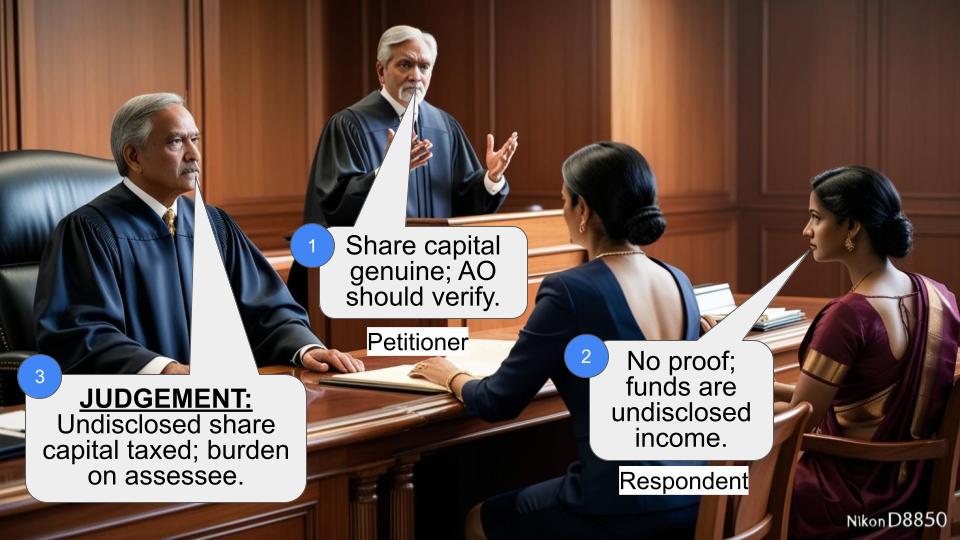
- The High Court dismissed the appeal, finding no perversity in the Tribunal’s order.
- The court agreed with the Tribunal’s reasoning for all three disputed amounts.
- For the Rs.60,000, the court noted that even if paid by a sister concern, it should have been recorded in the company’s books.
- For the other amounts, the court found the Tribunal’s inference of undisclosed payments reasonable, given the lack of evidence supporting renegotiation.
FAQs:
Q: What does “perverse” mean in this legal context?
A: In this context, “perverse” refers to a decision that is unreasonable, illogical, or based on irrelevant factors or ignoring relevant evidence.
Q: Why was the Rs. 60,000 considered undisclosed income?
A: Even if paid by a sister concern, it should have been recorded in the company’s books. The lack of any entry suggested an intention to hide this transaction from tax authorities.
Q: What evidence could have helped the petitioner’s case?
A: Evidence of the return of the Rs. 60,000, documentation of land price renegotiation, or entries in the books showing transactions with the sister concern could have strengthened their case.
Q: What’s the significance of the seized documents in this case?
A: The seized documents (A-1/1) showed higher investment amounts than the company’s official books (A-3/31 and 32), which formed the basis for the tax department’s case of undisclosed income.
Q: Can investments made by related entities be considered undisclosed income?
A: Yes, if these investments are made on behalf of the assessee and not properly recorded in the assessee’s books, they can be treated as undisclosed income.

The subject matter of challenge in the appeal is a judgment and order dated 7th October, 2004 passed by the learned Income Tax Appellate Tribunal, “D” Bench, Calcutta in respect of the block period 1989-1990 to 1998-1999 and 01-04-1998 to 19-08-1998.
The assessee is aggrieved by the order of the learned Tribunal by which the addition of a sum of Rs.4,82,750/- on the ground of undisclosed income was upheld. The assessee has questioned the order of the learned Tribunal on the basis of the following question of law:-
“Whether on the facts and in the circumstances of the case, the Learned Tribunal was right in law in upholding the decision of the Assessing Officer that the amount of Rs.4,82,750/- was “Undisclosed” investment of the petitioner Company by totally giving no credence to the fact produced by the petitioner Company which were substantial nature and thereafter the order passed by the Learned Tribunal ignoring the relevant facts and in taking into consideration irrelevance materials is perverse.”
When can an order be said to be perverse has elaborately been discussed by this Court in its judgment in the case of Collector of Customs, Calcutta & Ors. vs. Biswanath Mukherjee reported in 1974 CLJ 251 at p. 313 as follows:-
“It is, however, equally well settled that even in a writ petition under Article 226, the Court is entitled to interfere with the finding of the Tribunal on any question of fact which the Tribunal is competent to decide, if the Court is satisfied that the finding of the Tribunal is perverse and the finding of the Tribunal is considered to be perverse, if-
a) The Tribunal has come to the finding on no evidence.
b) The Tribunal has based the finding on materials not admissible and has excluded relevant materials.
c) The Tribunal has not applied its mind to all the relevant materials and has not considered the same in coming to the conclusion.
d) The Tribunal has come to the conclusion by considering material which is irrelevant or by considering material which is partly relevant and partly irrelevant.
e) The Tribunal has disabled itself in reaching a fair decision by some considerations extraneous to the evidence and the merits of the case.
f) The Tribunal has based its finding upon conjectures, surmises and suspicion.
g) The Tribunal has based the finding upon a view of the facts which could not reasonably be entertained or the facts found were such that no person acting judicially and properly instructed as to the relevant law could have found.
h) If the Tribunal in conducting the enquiry has acted in flagrant disregard of the rules of procedure or has violated the principles of natural justice, where no particular procedure is prescribed. 81. In any of the above cases and in any other case where the Court, in the particular facts of the case, considers the finding of the Tribunal to be perverse and where the Court is of the opinion that justice of the case so requires, the Court is entitled to interefere and set aside the finding of the Tribunal on any question of fact. In such cases, the Court holds that there is an error of law on any of the above grounds.”
In the light of the views quoted above, one has to find out whether the views taken by the learned Tribunal are perverse.
Mr.Sen, learned advocate, appearing for the assessee submitted that an order is perverse when irrelevant evidence or irrelevant material has been taken into account and an order can also be perverse when the relevant evidence has been ignored. Even assuming that Mr.Sen is correct,he was unable to demonstrate that the learned Tribunal in arriving at its conclusion either took into account any irrelevant evidence or material or ignored any relevant material or evidence. What we find is that certain investments appeared to have been made by the assessee from the papers seized during the search which were marked Ext.A-1/1. The books of accounts maintained by the assessee marked Ext.A-3/31 and 32 did not reflect the investments appearing to have been made by the assessee from the seized documents marked Ext.A-1/1. In that background the learned Tribunal has opined as follows:-
“2. .......The A.O. found that certain investments were made in the factory in 1996-97 which were found recorded in the seized paper marked A-1/1(p.36). On examination of the seized cash book and ledger, marked A-3/31 and 32, for the said period and comparing the same with the seized paper, the following differences with regard to the investments were found:
Date of investment
Amount as per seized paper A-1/1(P.36)
Amount as per seized ledger mark A-3/31 (P.76)
Diff.
17-5-96 60,000/- Nil 60,000/-
22-6-96
24-6-96
20-7-96
30-7-96
7,61,653/-
19,32,720/-
5,16,600/-
1,37,750/-
3,10,000/-
8,12,100/-
1,86,600/-
45,000/-
4,51,655/-
11,20,625/-
3,30,000/-
92,750/-
3. On being asked to explain the difference, the assessee stated that the difference of Rs.60,000/- in investment as on 17-5-96 was the amount paid in cash out of M/s.Barelia Coke Industries and ultimately the transaction did not materialise. So no entry was recorded in the books. As regards the difference of Rs.3,30,000/- and Rs.92,750/- found in investment made on 20-7-96 and 30-7-96 respectively, the assessee claimed that it agreed to buy high land at the above price, but on inspection of the land, it was found that the land was low and huge expenditure would have to be incurred on filling of the land. The agreed consideration to be paid was reduced on re-negotiation and only the reduced amount was paid to the seller. The assessee submitted that the land purchased by the assessee was supported by purchase deeds. It was submitted that the assessee had to incur expenditure of Rs.4,92,380/- for land filling and development expenses and this proved that the land was a low land and the investment recorded in the regular books of account were the actual investments made. The A.O. did not accept the said explanation as no evidence was produced by the assessee in support of the contentions.
4. The CIT(A) has observed that the assessee has claimed that Rs.60,000/- was paid for acquiring the land and the amount was said to have been recorded in the books of Barelia Coke Industries. Since the deal did not materialise, the amount should have been returned to Barelia Coke Industries. The assessee did not submit any evidence regarding return of money from the prospective seller of land. He, therefore, did not accept the explanation of the assessee as it was not substantiated by any evidence.
Therefore, the addition of Rs.60,000/- was upheld by the CIT(A). As regards addition of Rs.3,30,000/- and Rs.92,750/-, the assessee admitted that it had entered into transaction for acquiring land. It was also true that the said land was low land and the assessee had to incur substantial expenditure in filling of the land and for the development of the land. The amount as per seized paper marked A/1 in respect of the transactions dated 29-7-96 is Rs.5,16,000/-. The addition of Rs.3,30,000/- is based on the material found in the search from which it is evident that this amount was paid over and above the amount shown in the Deed. The CIT(A) held that since the addition has been made on the basis of evidence found during the search, the addition was justified and he sustained the same. For the same reason, the addition made of Rs.92,750/- was also upheld.
5. Having heard the rival submissions and perused the orders of both the lower authorities we find that during the course of search a paper was seized marked as A/1 and also cash book and ledger were seized which were marked A-3/31 and 32 respectively. The difference was found in the amount shown towards purchase of land between the said seized paper and the seized ledger. The assessee has explained that the sum of Rs.60,000/- paid was paid out of the cash of M/s. Barelia Coke Industries and since the transaction did not materialise, no entry was passed for the same in the books of the assessee. The A.O. has observed that the assessee did not file any evidence from the seller that the said amount was returned when the sale did not materialse and, therefore, made addition to the income of the assessee. No material in respect of the same was also filed before us.
Further, full amount has been claimed to have been paid out of the cash of M/s.Barelia Coke Industries and hence the assessee should have made an entry showing Barelia Coke Industries as a creditor in the books of account.
Since the assessee did not pass this entry either in its books of account nor in the books of the said concern, it can be held that the assessee did not have the intention to disclose the said amount to the income tax department.
Hence, it is an undisclosed income of the assessee as per Section 158B(b) (of Income Tax Act, 1961). As regards Rs.3,30,000/- and Rs.92,750/-, the CIT(A) has held that from the seized paper marked A-1/1, the amount for purchase of land is shown as Rs.5,16,000/-. Further, this addition of Rs.3,30,000/- is based on the material found during the course of search. It is also an admitted fact that in the seized ledger marked A-3/31, the amount recorded in the books of account is Rs.1,86,600/- as against the amount shown in the seized paper at Rs.5,16,600/-. Thus the fact of investment for purchase of land on the seized paper has been corroborated with the seized books of accounts.
Further, it is also admitted fact that the paper was seized from the possession of the assessee and primarily it has to be presumed that it belongs to the assessee. As the fact of purchase of land as entered in the seized paper has been corroborated with that of the seized books of account,the inference drawn by the A.O that the sum of Rs.3,30,000/- was paid over and above the amount of Rs.1,86,600/- which is out of the undisclosed source of the assessee is found to be a plausible one. No agreement or material could be produced to show that the price of land were re-negotiated as claimed by the assessee. The explanation of the assessee that the purchase of land is supported by purchase Deeds is of no relevance as the undisclosed amount paid for acquiring the land would definitely be not reflected in the said purchase Deed. Therefore, in view of the seized paper and in the absence of any convincing evidence, the argument of the assessee that on re-negotiation on the ground that as the said land was a low land, a lesser price was paid for the acquisition of the land cannot be accepted. For the same reason, in respect of the addition of Rs.92,750/-, the argument of the assessee cannot be accepted. Hence, we are in agreement with the order of the CIT(A) which is hereby upheld and the ground of appeal of the assessee is dismissed.”
We have repeatedly requested Mr. Sen to identify the evidence, which, according to him, was not taken into account by the learned Tribunal. But he was unable to draw our attention to any such piece of evidence, which the learned Tribunal did not consider or omitted to consider. We have also called upon Mr.Sen to identify the document which the learned Tribunal should not have taken into account. To that also he was unable to give any answer, except that the sum of Rs.60,000/- was not paid by the assessee before us. But he does not dispute that from the records seized marked A-1/1, it appeared that the sum of Rs.60,000/- was invested for the purpose of buying the land for the assessee and this sum was not debited to the books of accounts of the assessee.
Mr. Sen contends that this sum of Rs.60,000/- was not paid by the assessee. That amount was paid, according to him, by the sister concern of the assessee, namely, M/s.Barelia Coke Industries. Even assuming that the money was paid by the Barelia Coke Industries, the assessee should have in that case credited the account of Barelia and debited the account of the seller of the land.
Mr. Sen replied by stating that this was not done because the deal did not ultimately fructify. If the deal did not fructify then the question remains whether the money paid to the seller of land was recovered. If the money was not recovered from the vendor then the amount of Rs.60,000/-continues to have been spent on behalf of the assessee, for which the assessee received benefit.
Mr. Sen has no answer to the question as to whether the sum of Rs.60,000/- was recovered from the vendor. We are, as such, of the opinion that the order passed by the learned Tribunal affirming the addition is an unimpeachable order. Therefore the challenge on the ground of perversity is altogether unmeritorious.
The order of the learned Tribunal is based on evidence and is a possible view.
For the aforesaid reasons the question is answered in the negative and in favour of the revenue.
(GIRISH CHANDRA GUPTA,J.)
(ASHA ARORA,J.)
×
Similar Ripples
Questions
Court Upholds Tax Addition on Undisclosed Investments, Rejecting Perversity Claim
Write your CommentSimilar Posts


Generic
- Reportdata/2916.pdf
