


Court Upholds Tax Addition on Unexplained Gold Jewelry in Income Tax Appeal


Full News
Court Upholds Tax Addition on Unexplained Gold Jewelry in Income Tax Appeal
Court Upholds Tax Addition on Unexplained Gold Jewelry in Income Tax Appeal
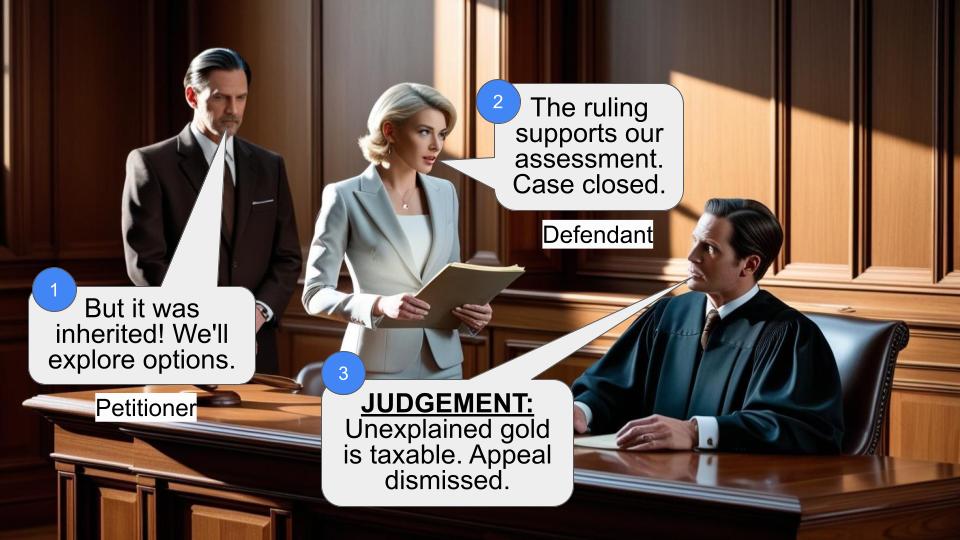
This case is about Amita Kochar appealing against an Income Tax Department decision. The department found excess gold jewelry during a search and treated it as undisclosed investment. Kochar tried to explain it as inherited jewelry, but the court didn't buy it and dismissed her appeal. It's basically a story of "show me the money... err gold.
Get the full picture - access the original judgement of the court order here
Case Name:
Amita Kochar Vs Assistant Commissioner of Income Tax (High Court of Patna)
Miscellaneous Appeal No.69 of 2009
Date: 9th May 2016
Key Takeaways:
1. Timely disclosure of assets is crucial in tax matters.
2. Consistent and credible explanations are essential when dealing with tax authorities.
3. Courts are unlikely to re-appreciate evidence in appeals under Section 260A (of Income Tax Act, 1961).
4. Concurrent findings by lower authorities are hard to overturn without proving perversity.
Issue:
The main question here is: Was the Income Tax Department justified in treating the excess gold jewelry found during a search as undisclosed investment, despite the assessee's explanation of it being inherited family jewelry?
Facts:
1. On May 6, 2003, the Income Tax Department searched Amita Kochar's locker and found 2,740.230 grams of gold jewelry.
2. The department found this amount exceeded what Kochar and her family had previously disclosed in their tax returns by 618.530 grams.
3. Kochar claimed the excess was part of undistributed inheritance from her late mother-in-law and grandmother-in-law, who had passed away 8-9 years earlier.
4. She made this claim in a written submission during the hearing, not in her initial block return filed on August 11, 2004.
5. The Assessing Officer, Commissioner of Income Tax (Appeals), and the Income Tax Appellate Tribunal all rejected her explanation and treated the excess as undisclosed investment.
Arguments:
Kochar's side:
- The excess jewelry was inherited and kept for distribution among family members.
- Family members had disclosed their share in their respective tax returns.
- She wasn't required to explain assets from before the search period.
- Two brothers-in-law filed affidavits supporting her claim.
Tax Department's side:
- Kochar's explanation came too late and wasn't included in her block return.
- It's unnatural for substantial jewelry to remain undistributed for 8-9 years.
- The amounts shown in family members' returns don't match Kochar's claim.
- Concurrent findings of fact by lower authorities shouldn't be interfered with unless perverse.
Key Legal Precedents:
The court relied on Hazari Lal vs. Commissioner of Income-Tax: (2011) 336 ITR 290 (P & H). This case established that:
1. Concurrent findings by lower authorities shouldn't be disturbed unless proven perverse.
2. High Courts shouldn't re-appreciate evidence in appeals under Section 260A (of Income Tax Act, 1961).
Judgement:
The court dismissed Kochar's appeal, agreeing with the Tax Department. They found that:
1. Kochar's explanation should have been given when filing the block return, not later during the hearing.
2. The figures in her explanation didn't match the jewelry actually found.
3. The court can't re-appreciate evidence at this stage unless the findings are proven perverse, which Kochar failed to do.
FAQs:
1. Q: Why didn't the court accept Kochar's explanation about inherited jewelry?
A: The explanation came too late, wasn't consistent with the evidence, and didn't match the amounts found during the search.
2. Q: Can't the High Court review the evidence again?
A: Generally, no. Under Section 260A (of Income Tax Act, 1961), the High Court doesn't re-appreciate evidence unless the findings are proven to be perverse.
3. Q: What's the takeaway for taxpayers from this case?
A: It's crucial to disclose all assets promptly and provide consistent, credible explanations from the beginning of any tax proceedings.
4. Q: Could Kochar have done anything differently to strengthen her case?
A: Yes, she could have included her explanation about the inherited jewelry in her initial block return or immediately after filing it, rather than waiting until the hearing.
5. Q: Does this case set any new legal precedent?
A: Not really. It reinforces existing principles about the limited scope of High Court intervention in tax appeals and the importance of timely, consistent explanations in tax matters.

Heard learned counsel for the appellant and learned Senior Standing Counsel for the Income-tax Department.
The appeal under Section 260A (of Income Tax Act, 1961) has been filed against the order dated 29.08.2008 passed by the Income-tax Appellate Tribunal, Patna Bench Patna, in I.T.A. No.102(Pat)/2006 pertaining to the block period from 01.04.1997 to 24.04.2003.
A search operation was carried out under Section 132(1) (of Income Tax Act, 1961) (in short “Act”) at Locker No.1210D, New Delhi Vaults Ltd. on 06/05/2003 belonging to the appellant. Notice under Section 158BC (of Income Tax Act, 1961) was issued on 27.08.2003 and ultimately the return in the prescribed form was filed on 11.08.2004 declaring the loss of Rs.12,980/-. In the course of search, the assessee was found in possession of gold jewellery to the extent of 2740.230 gms. For the first time in a written submission dated 14.04.2003 in course of hearing, the stand was taken by the assessee that the gold and diamond jewellery found during the search and seizure operation were part of the family jewelleries disclosed in regular return during the block period. It was also the stand taken in the said submission that apart from the gold jewelleries filed in their returns of income of different families, she was in possession of 1500 gms. of gold ornament and jewelleries belonging to her sister-in-law after the death of her mother-in-law, Late Urvashi Devi, but the physical distribution of the same was not done and both of them were regular income-tax and Wealth Tax assessees. The assessing officer on the basis of the regular returns submitted by the husnad and children of the assessee as also the assessee found that they had disclosed only 2121.700 gms of gold jewellery in their account and thus the gold jewellery found during the course of search was excess by 618.530 gms. The assessing officer also noticed that Sri Vijay Kochar, the brother of the husband of the assessee, has also claimed to have got gold jewellery from her mother-in-law and grand mother-in-law and thus came to the conclusion that the assessee and Smt. Rama Kochar and Shri Vijay Kochar, the brother-in-law, cannot take the benefit at the same time about their ancestral legacies. Moreover, there was no evidence that the jewelleries left by the mother-in-law and grand mother-in-law were exclusively her legacy. Even the same ought to have been duly disclosed in her statement filed along with her returns. Thus, it was found that she cannot claim the benefit of her legacies of 1500 gms. of jewelleries which she did not disclose in her statement filed along with the return. Accordingly, 618.530 gms gold jewellery was found to be undisclosed investment with effect from 2004-05 to the extent of Rs.3,51,016/-.
Aggrieved by the same, the assessee filed an appeal before the Commissioner of Income-tax (Appeals)-I, Patna, which was rejected. The further appeal filed before the Tribunal met with the same fate. Thereafter, the present appeal has been preferred before this Court.
While admitting the appeal, this Court has framed the following substantial questions of law:-
“(I) Whether in the facts and circumstances of the case the addition made on account of gold ornaments ostensibly not explained without the revenue disclosing the source of information forming the basis of such addition and evidence found to reject the explanation given to account for the entire quantum of ornaments found during search is legal, proper and in accordance with law?
(II) Whether the revenue was justified in rejecting the explanation of the assessee solely on the ground that the quantum of jewellery found in both the places belonging to the appellant was much less than the amount of jewellery disclosed in the explanation as lying on account of the death of late mother-in-law and grand- mother-in-law of the appellant apart from the quantum of jewellery previously disclosed solely on the ground that the appellant had not indicated where the balance jewelleries were on the date of search?”
Before us, learned counsel for the appellant has mainly sought to argue that the mother-in-law of the assessee had died on 06.01.1994 leaving behind 1220 gms. net weight of gold jewellery and the grand-mother-in-law died on 06.02.1995 leaving behind 1112.140 gms. net weight of gold jewellery, and the entire amount from the former and half of the latter were in physical possession of the appellant as the eldest daughter-in-law of the family, which was kept with the appellant for distribution among the rightful heirs. It is further submitted that the physical possession of some of jewelleries remained with the appellant pending distribution among the rightful heirs who disclosed the said gold jewellery as per their entitlement in their respective income tax returns, for which reliance is placed upon two of the returns, which have been annexed and were part of the paper submitted before the I.T.A.T at the time of hearing. It is contended by learned counsel for the appellant that the amounts shown as inherited along with the quantum of jewellery shown in the regular returns filed by the family members, were clearly sufficient to explain the gold jewellerlies found in possession of the appellant and thus, there was no undisclosed investment having been made by the assessee. It is also the submission of learned counsel for the appellant that the assessee was not required to explain assets coming from before and even then she had done so at the first written submission on 14.04.2005, whereas no statement was taken from her at the time of raid.
It is also contended by learned counsel for the appellant that two of the brothers-in-law of the assessee filed affidavits before the assessing officer stating the fact of the gold jewelleries of their share lying with the appellant and since their returns brought on the record go to show that gold jewelleries inherited by them from their mother was to the extent of about 698 gms. the same fully explains the jewellery in the possession of the appellant.
Learned Senior Standing Counsel for the Revenue, on the other hand, submits that the right time for the appellant to have explained the entire matter was at the time when she had filed the block return on 11.08.2004 but she did not take any benefit of the said opportunity and only as an after thought during the course of hearing the written submission was made, in which it was stated that the excess jewelleries on account of the undistributed jewelleries were bequeathed by the mother-in-law and grand-mother-in-law, who died eight-nine years earlier. It is submitted by learned counsel that it is not at all natural that such substantial amount of jewelleries would have remained undistributed for such a long period of time, when the family members were admittedly living in the houses at Patna and Delhi respectively. Thus, there was no occasion for the gold jewelleries to remain undistributed. It is also contended by learned counsel for the Income-tax Department that the fact that two of the brothers of the husband of the assessee had filed their returns showing approximately 300 gms. each goes to show that the same was on the basis of actual distribution of gold jewelleries which had come in their possession.
It is submitted that if the return had been filed on the basis of notional share, each of the brother would have shown 1/4th share of the total jewellery left as the share of the family by the two elderly ladies which would come 444 gms. each, but a much less quantity of 300 gms. each approximately has been shown.
It is urged that in the said circumstances, since the evidence on the record did not match the stand taken, that too belatedly at the stage of hearing before the assessing officer and the appellate court, therefore, they were fully justified in rejecting the explanation and treating the same as undisclosed investment.
Learned counsel for the Income-tax Department further submits that in the present matter concurrent findings of fact have been recorded right up to the Tribunal and it is not open to the appellant to assail the same in an appeal under Section 260A (of Income Tax Act, 1961) and this court at this stage does not re-appreciate the evidence and unless there is a perversity in the finding, which the appellant has been unable to show, there can be no interference by this Court in the order under appeal.
In support of the said stand, learned counsel for the Revenue has placed reliance upon a decision in the case of Hazari Lal vs. Commissioner of Income-Tax: (2011) 336 ITR 290 ( P & H), in paragraph Nos. 6 and 7 of which it has been held as follows:-
“6, The only point that arises for consideration in the appeal is, whether the addition which has been made by the Assessing Officer on account of unexplained investment in miscellaneous items amounting to Rs.3,18,000/- and affirmed by the Commissioner of Income-tax (Appeals) and upheld by the Tribunal, is valid or not. The Assessing Officer had made this addition of Rs.3,18,000/- on the ground that in the seized documents in the third column therein various miscellaneous items like Rs.40,000 in Indira Vikas Patras, etc. had been written, the total of which was Rs.3,18,000 and the reply furnished by the assessee was not satisfactory which led to addition of this amount in the undisclosed income. The Tribunal while rejecting the explanation of the assessee had recorded as under:
“With respect to the addition of Rs.3,18,000 also, we find that no specific explanation has been furnished before the lower authorities. The assessee has not denied the relevance of the amounts in question and, thus, the onus was on the assessee to offer credible explanation in this regard. The explanations furnished by the assessee on this count have not been found to be satisfactory and, thus, the addition has been rightly sustained by the learned Commissioner of Income-tax (Appeals).”
7. Learned counsel for the assessee was unable to point out that the findings concurrently recorded by the Assessing Officer, the Commissioner of Income-tax (Appeals) and the Tribunal while sustaining the addition of Rs.3,18,000 were erroneous or perverse in any manner. Only an effort was made by the counsel for re-appreciation of evidence by this Court which is not within the ambit of Section 260A (of Income Tax Act, 1961). As noticed earlier, the explanation furnished by the assessee was not accepted by any of the authorities below. The Tribunal has taken a plausible view.”
On a consideration of the rival submissions of learned counsels for the parties, we do not find any force in the submissions of learned counsel for the appellant.
The explanation that was sought to be raised belatedly at the time of hearing by the assessee ought to have been given at the time of filing of the block returns. It has been submitted by learned counsel for the appellant that there is no column in the block return to make any such explanation. This court can take judicial notice of the fact that at the relevant time, the block returns in question were being filed on a manual basis and it was certainly open to the appellant to have added any such explanation by way of a separate statement or note attached, which has not been done. Even otherwise, if such a plea is taken to be correct, then immediately after filing of the block return such an explanation could have been submitted before the Department unlike in the instant case when much later the stand has been taken by getting the affidavits from the brothers-in-law.
As a matter of fact, none of the figures given even in the belated explanation matches with the gold jewelleries actually found in possession of the appellant. The clear stand in the submission of the assessee was that as much as 1500 gms. of gold jewellery by net weight was still lying with the appellant but much less gold jewelleries have been shown in the returns filed by the family members of the appellant than what has been actually found in the course of search. A deviation between the same or inconsistency in the figures was for the assessee to explain and upon failure to do so, the explanation could have been found to be unsatisfactory by the assessing officer or at the appellate stage and could have been rejected, which has been done in the present matter.
Before us, learned counsel for the appellant sought to argue that approximately 300 gms. net weight each shown by the two brothers of the husband of the assessee could add up to the figure of defence in the present matter. The same does not match the stand taken before the assessing officer and is a last ditch effort to show the consistency in a manner to seek re-appreciation of the evidence, for which the last forum of facts was the Tribunal.
We are also in agreement with the stand taken by learned counsel for the Revenue that learned counsel for the appellant has been unable to show as to how the findings of the lower appellate authorities are perverse, as the appeal is based on the evidence on the record.
Thus, for the aforesaid reasons, we are of the view that both the substantial questions of law framed above have to be answered in the affirmative in favour of the Revenue and against the assessee. The appeal is, accordingly, dismissed.
V.P.Sinha/-
(Ramesh Kumar Datta, J)
(Sudhir Singh, J)
×
Similar Ripples
Questions
Court Upholds Tax Addition on Unexplained Gold Jewelry in Income Tax Appeal
Write your CommentSimilar Posts


Generic
- Reportdata/2850.pdf
