


Court Upholds Tax Deductions for Sleeper Transportation and Interest on RBI Bon…



Full News

Court Upholds Tax Deductions for Sleeper Transportation and Interest on RBI Bonds
Court Upholds Tax Deductions for Sleeper Transportation and Interest on RBI Bonds
The Income Tax Department (the Revenue) challenged some tax deductions claimed by a company (the Assessee). The main issues were about deductions under Sections 80HHB (of Income Tax Act, 1961) and 80-IA (of Income Tax Act, 1961). The court sided with the company, allowing the deductions. It's a win for the business, basically saying that certain incidental incomes can still qualify for tax benefits.
Get the full picture - access the original judgement of the court order here
Case Name:
Commissioner of Income Tax vs. Arvind Construction Co. Ltd. (High Court of Delhi)
ITA No. 1388/2006
Date: 4th December 2007
Key Takeaways:
1. Interest on RBI bonds, when part of a settlement package, can qualify for deduction under Section 80HHB (of Income Tax Act, 1961).
2. Transportation of manufactured goods (in this case, sleepers) is considered part of the business activity and eligible for deduction under Section 80-IA (of Income Tax Act, 1961).
3. The court took a broad view of what constitutes "business activities" for tax deduction purposes.
Issue:
The main questions were:
1. Is interest earned on RBI Bonds eligible for deduction under Section 80HHB (of Income Tax Act, 1961)?
2. Can receipts from transportation of sleepers qualify for deduction under Section 80-IA (of Income Tax Act, 1961)?
Facts:
Our company, Arvind Construction, was doing some work in Iraq as a subcontractor for IRCON (Indian Railway Construction Corporation). But then, boom! War breaks out in Iraq, and payments get held up. Eventually, the Indian and Iraqi governments work out a deal for deferred payments.
For the 1997-98 assessment year, the company was due about 54.93 crores rupees. This included:
- RBI Bonds: ₹42,69,91,452
- ECGC Bonds: ₹5,61,12,153
- Interest on RBI bonds: ₹6,61,83,046
The company also had a separate agreement for transporting sleepers (those concrete things that support railway tracks) to railway sites, earning them ₹54,92,85,651.
Arguments:
The company said, "Hey, we should get tax deductions on the interest from RBI bonds under Section 80HHB (of Income Tax Act, 1961) and on the sleeper transportation income under Section 80-IA (of Income Tax Act, 1961)."
The tax department disagreed, arguing:
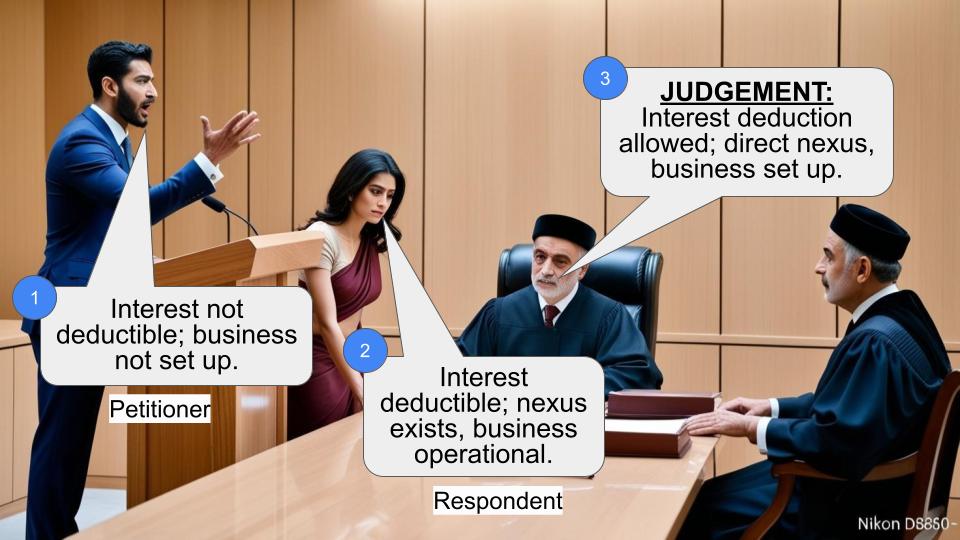
1. The interest on RBI bonds isn't income from business activities.
2. The transportation charges are from a separate agreement and don't involve manufacturing, so they shouldn't get the 80-IA deduction.
Key Legal Precedents:
The court referred to the case of Commissioner of Income Tax v. Govinda Choudhary and Sons [1993] 203 ITR 881 (SC). This case dealt with income that was incidental to and attributable to the business carried on by the assessee.
Judgement:
The court sided with the company on both issues. Here's why:
1. On the RBI bond interest: The court said this was part of the overall settlement package for the Iraq work. It's not separate from the company's business activities.
2. On the sleeper transportation: The court agreed that this was part of the company's business. They said the business includes not just manufacturing but all activities until delivery is complete.
The court didn't find any errors in the earlier decisions by the CIT(A) and the Tribunal, so they dismissed the tax department's appeals.
FAQs:
1. Q: Does this mean all interest income can be considered business income?
A: Not necessarily. In this case, the interest was part of a specific settlement package related to the company's work.
2. Q: Can transportation always be considered part of manufacturing for tax purposes?
A: It depends on the circumstances. Here, the court considered it part of the business because it was directly related to delivering the manufactured goods.
3. Q: What's the significance of this judgment for other businesses?
A: It suggests courts might take a broader view of what constitutes business activities for tax deductions, potentially benefiting businesses with similar income structures.

1. ITA No. 1388/2007 is directed against an order dated 31st March, 2006 passed by the Income Tax Appellate Tribunal, New Delhi Bench G ( Tribunal ) in ITA No. 492/Del/2001 for the Assessment Year 1997-98. ITA No. 705/2007 is directed against an order dated 19th January, 2007 passed by the Tribunal (Bench F ) in ITA No. 1263/Del/2004 for the Assessment Year 2000-01. Since the same question of law is urged by the Revenue in both the appeals, they are being disposed by this common order.
2. The questions that have been urged by the Revenue for consideration in both these appeals are under:
(1) Whether interest earned by the Assessee on RBI Bonds is the income derived by it from the business of industrial undertaking so as to be eligible for deduction under Section 80HHB (of Income Tax Act, 1961).
(2) Whether the Tribunal was correct in law in allowing deduction under Section 80-IA (of Income Tax Act, 1961) to the Assessee on receipts from transportation of sleepers? 3. The Assessee carried out certain construction works in two different projects in Iraq as a sub-contractor of the Indian Railway Construction Corporation ( IRCON ). On account of the outbreak of war in Iraq, the payments to IRCON were held up. Subsequently, by an agreement between the Governments of India and Iraq, a settlement was arrived at by which the payments would be made to IRCON on the deferred basis. The total sum due to the Assessee together with interest was calculated at Rs.54.93 crores for the Assessment Year 1997-98 and the said sum was settled as under:
(i) RBI Bonds Rs.42,69,91,452/-
(ii) ECGC Bonds Rs.5,61,12,153/-
(iii) Interest on RBI bonds Rs.6,61,83,046/-
4. The Assessee claimed a deduction under Section 80HHB (of Income Tax Act, 1961), inter alia, in respect of the interest on RBI bonds to the extent of Rs.6,61,83,046/-. The Assessee also claimed deduction under Section 80-IA (of Income Tax Act, 1961). The Assessing officer ( AO ) declined the deduction on the ground that the interest on the RBI bonds was not the income derived from the business activities of the Assessee. Likewise, the AO also disallowed the deduction under Section 80-IA (of Income Tax Act, 1961) in relation to transportation charges of Rs.54,92,85,651 which the Assessee had received for transportation of certain sleepers made by it to the railway sites. The AO noted that there was a separate agreement for transportation of sleepers and therefore, the income therefrom was not derived from an industrial undertaking as the transportation did not involve any manufacturing or production.
5. The Commissioner of Income Tax (Appeals) [ CIT(A) ] reversed the AO and allowed the deduction to the Assessee under Section 80HHB (of Income Tax Act, 1961) in respect of the interest on RBI bonds as well as the deduction under Section 80-IA (of Income Tax Act, 1961) in respect of the transportation charges received by it. The Tribunal concurred with the view taken by the CIT (A) on both issues and that is how the Revenue has filed the present appeals.
6. It is contended by Ms. Prem Lata Bansal, learned Senior Standing counsel appearing on behalf of the Revenue, that the interest on RBI bonds could never been considered to be the income derived from the business activities of the Assessee. She drew a distinction between income from an activity which is attributable to an industrial undertaking and income that is derived from the business activities. She submitted that the CIT (A) erred in placing reliance upon the judgment in Commissioner of Income Tax v. Govinda Choudhary and Sons [1993] 203 ITR 881 (SC) because in the said case the Supreme Court was in fact dealing with the income that was incidental to and, therefore, attributable to the business carried on by the Assessee and not income that was derived from the business activity of the Assessee. Likewise, as regards the deduction claimed under Section 80-IA (of Income Tax Act, 1961) in respect of the transportation charges received by the Assessee for transportation of sleepers to the railway sites, she submitted that since there was a separate agreement for this purpose, such income could not qualify for the purposes of such deduction. Ms. Bansal further submitted that as regards the connected appeal (ITA No. 705/2007) in respect of the Assessment Year 2000-01 it stood on a different footing since the interest earned on the RBI bonds was not relatable to the said assessment year.
7. We are unable to agree with the submissions advanced made by learned counsel for the Revenue. We find that as regards the interest on the RBI bonds,this was part of the total settlement package by which the Assessee was to receive Rs.54.93 crores for the works undertaken in Iraq as a sub-contractor of the IRCON. In the facts and circumstances of the case, it is not possible to view the interest received on the RBI bonds as payment de hors the activity of the Assessee pursuant to the execution of the contract. We do not find any error in the orders of the CIT (A) as well as the Tribunal warranting any interference. No substantial question of law arises on this issue.
8. As regards the payment received on account of transportation charges, the Tribunal has, in our view, rightly observed that the Assessee is transporting sleepers only to the railways at different sites and to no other entity. We are agree with the view expressed by the CIT(A), concurred with by the Tribunal, that business of the Assessee included not only manufacturing but all incidental activities undertaken till the delivery of the manufactured goods was effected. The benefit of the deduction to the Assessee in terms of Section 80-IA (of Income Tax Act, 1961) cannot be denied since the receipts on account of transportation is a part of its business receipts. No substantial question of law arises in this regard either.
9. As regards the connected appeal (ITA No. 705 of 2007) for the Assessment Year 2000-01, we find that in para 6 of the order dated 19th January, 2007 it has been observed by the Tribunal that there is no dispute that facts of the case in the year under consideration are identical with the facts of the Assessment Year 1997-98. In that view of the matter, it is not possible to accept the submissions made by learned counsel for the Revenue that the facts of the Assessment Year 2000-01 stood on different footing warranting a different treatment.
10. For the aforementioned reasons, there is no merit in these appeals and they are dismissed as such.
MADAN B. LOKUR, J
MURALIDHAR, J DECEMBER 04, 2007
×
Similar Ripples
Questions
Court Upholds Tax Deductions for Sleeper Transportation and Interest on RBI Bonds
Write your CommentSimilar Posts

Generic
- Reportdata/5112_.pdf
