


Court Upholds Tax Exemption for Housing Project Meeting Section 80IB(10) (of In…


Full News

Court Upholds Tax Exemption for Housing Project Meeting Section 80IB(10) (of Income Tax Act, 1961) Criteria
Court Upholds Tax Exemption for Housing Project Meeting Section 80IB(10) (of Income Tax Act, 1961) Criteria
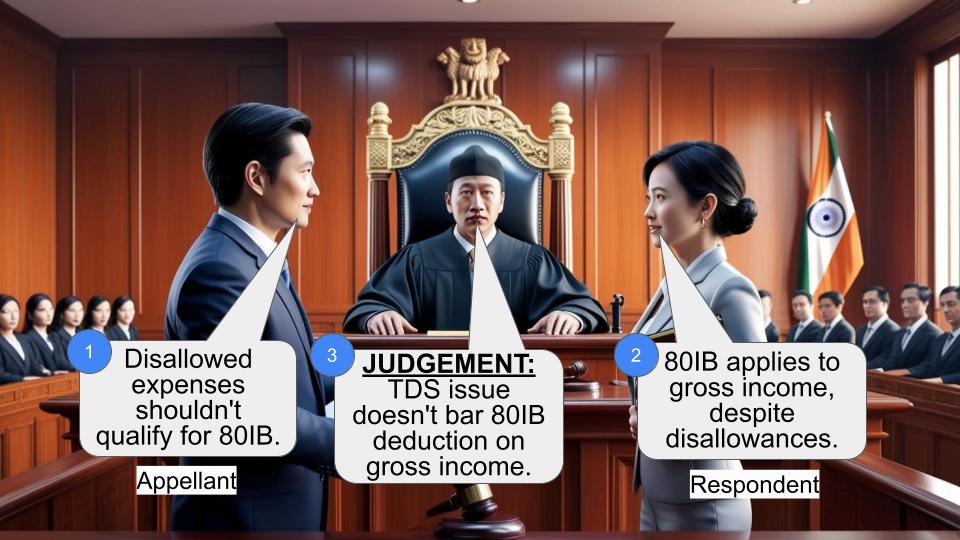
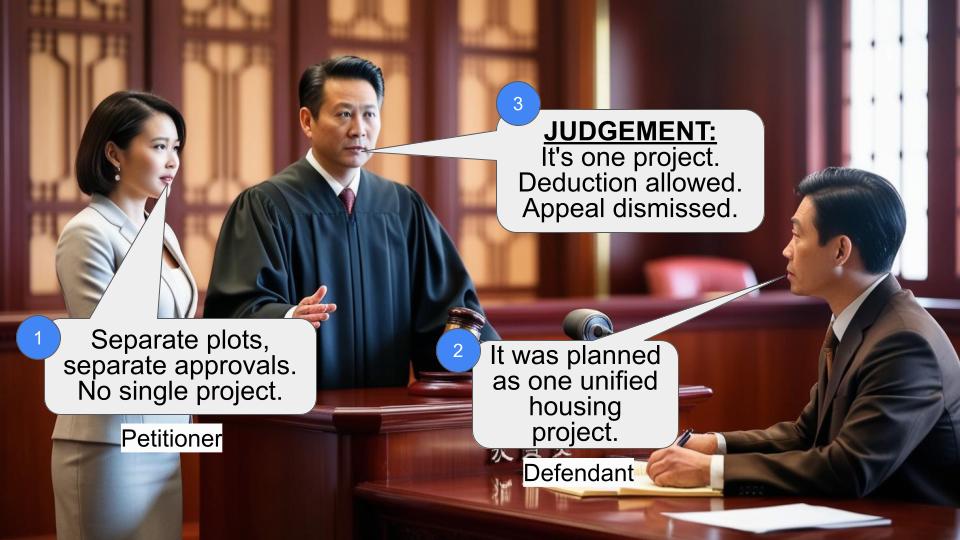
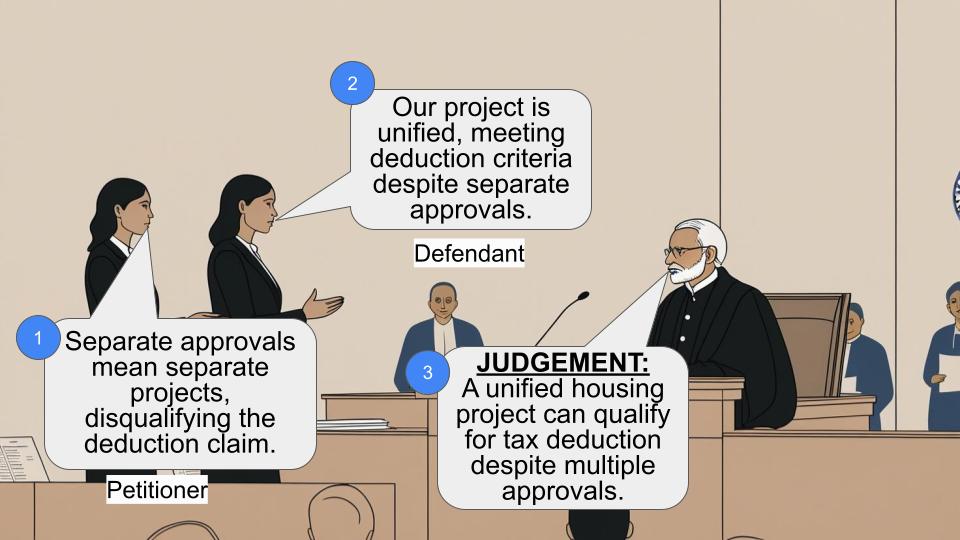
The Income Tax Department (the revenue) appealed against a decision that allowed a tax exemption to Suresh L. Wadhwa (HUF), who's in the property development business. The High Court sided with Wadhwa, confirming that his housing project met all the requirements for a tax deduction under Section 80IB(10) (of Income Tax Act, 1961). The revenue's appeal was dismissed, which is a win for the developer.
Get the full picture - access the original judgement of the court order here
Case Name:
Commissioner of Income Tax Vs Suresh L. Wadhwa (HUF) (High Court of Bombay)
Income Tax Appeal No. 1474 of 2013
Date: 22nd April 2014
Key Takeaways:
1. Compliance with all conditions of Section 80IB(10) (of Income Tax Act, 1961) is crucial for claiming tax exemption.
2. The court emphasized the importance of considering each project separately, even if they're part of a larger initial plan.
3. The decision reinforces the tax benefits available to housing projects meeting specific criteria, potentially encouraging more such developments.
Issue:
The main question here was: Did the assessee (Wadhwa) meet all the requirements of Section 80IB(10) (of Income Tax Act, 1961) to be eligible for the tax exemption on his housing project?
Facts:
1. Suresh L. Wadhwa (HUF) is the owner of M/s. Ashish Developers, a property development business.
2. They started a project on October 1, 1998, and completed it before March 31, 2008.
3. The project was on a 1.33-acre plot, within 25 km of Mumbai city limits.
4. They built flats of about 1,500 sq. ft. and had less than 2,000 sq. ft. of commercial space.
5. Initially, there was a larger plan for 14 buildings, but Wadhwa only developed 6 buildings.
6. The Income Tax Department initially disallowed the exemption claim, adding Rs.76,94,360/- to the taxable income.
Arguments:
The Income Tax Department (Revenue) argued:
1. The entire 14-building project should be considered as one, which would exceed the allowed specifications.
2. They referred to a similar case (Vidhi Developers) where questions of law were raised.
Wadhwa (Assessee) argued:
1. They only developed 6 buildings, which complied with all Section 80IB(10) (of Income Tax Act, 1961) requirements.
2. The project should be considered separately from other developments on the originally larger plot.
Key Legal Precedents:
The court mentioned the case of Vidhi Developers (Income Tax Appeal No.812 of 2012), but noted that its facts were different from the current case. In Vidhi's case, the plot size was less than 1 acre, which didn't meet a basic condition of Section 80IB(10) (of Income Tax Act, 1961).
Judgement:
The High Court dismissed the revenue's appeal, agreeing with the Income Tax Appellate Tribunal's decision. Here's why:
1. Wadhwa's project met all Section 80IB(10) (of Income Tax Act, 1961) criteria:
- Started on October 1, 1998, and completed before March 31, 2008
- Built on a 1.33-acre plot (meeting the 1-acre minimum)
- Located within 25 km of Mumbai city limits
- Flats were about 1,500 sq. ft.
- Commercial space was less than 2,000 sq. ft.
2. The court emphasized that Wadhwa's project should be considered separately from other developments on the originally larger plot.
3. They found no substantial questions of law arising from the case.
FAQs:
1. Q: What's Section 80IB(10) (of Income Tax Act, 1961) all about?
A: It's a section of the Income Tax Act that offers tax deductions for housing projects meeting specific criteria like plot size, completion time, and building specifications.
2. Q: Why was the Vidhi Developers case different?
A: In that case, the plot size was less than 1 acre, which didn't meet a basic requirement of Section 80IB(10) (of Income Tax Act, 1961). Wadhwa's project, on the other hand, met all the criteria.
3. Q: Does this decision apply to all housing projects?
A: Not automatically. Each case is judged on its own merits, but this decision reinforces the importance of meeting all Section 80IB(10) (of Income Tax Act, 1961) criteria for claiming the tax exemption.
4. Q: What's the significance of the 1.33-acre plot size?
A: Section 80IB(10) (of Income Tax Act, 1961) requires a minimum plot size of 1 acre. Wadhwa's 1.33-acre plot comfortably met this requirement, unlike the Vidhi Developers case.

1. The above appeals are filed by the revenue for the assessment years 2005-06 and 2006-07. Two common questions of law are said to be substantial questions of law.
2. Since in Income Tax Appeal No,1474 of 2013 has additional questions, we shall deal with the facts in that case:-
The Respondent-assessee is the proprietor of M/s. Ashish Developers carrying on the business of development of properties. An assessment order under section 143(3) (of Income Tax Act, 1961) ('the Act') was passed on 29th December, 2008 which records that the assessee was to develop a project of 14 buildings and had acquired development rights from M/s.Jayshree Builders in respect of land admeasuring 5318.46 sq. mtrs. As on 29th September, a plan was sanctioned by the Kalyan Dombivli Municipal Corporation (KDMC) for the project comprising 14 buildings. The Respondent made a claim under section 80IB(10) (of Income Tax Act, 1961) for deduction which came be disallowed and an addition came to be made to the extent of Rs.76,94,360/-. According to the Assessing Officer, the project exceeded the prescribed limit of 2000 sq. ft. of commercial space in building Nos.4, 6 & 10.
3. Being aggrieved by the order, the assessee filed an appeal before the Commissioner of Income Tax (Appeals) who allowed the appeal holding that the assessee has complied with the conditions laid down for claiming deductions. The revenue filed an appeal before the Tribunal, which was dismissed on 31st December, 2012. The Commissioner observed that the assessee had only constructed building Nos.1 to 6 for which separate approval has been obtained and occupancy certificate is also obtained during the time limit prescribed in section 80IB(10) (of Income Tax Act, 1961).
4. Being dissatisfied, the revenue filed an appeal before the Tribunal which dismissed the appeal confirming the order of the Commissioner. It appears that the Tribunal also relied upon the decision of a co-ordinate bench of the Tribunal in the case of Vidhi Developers. The Tribunal found that the assessee had undertaken the work only in building Nos.1 to 6 on a plot admeasuring 5318.46 sq. mtrs. equivalent to 1.33 acres. The Tribunal observed that the assessing officer found that the project had initially been approved as early as 2nd July, 2003 for 14 buildings. However, only six buildings were completed by the assessee and these were completed before 31st March, 2008. It had constructed a housing complex situated 25 Kms. away from the municipal limits of Mumbai. It is also observed that the built-up of commercial space area included in the project did not exceed 2000 sq. ft. The Assessing Officer had proceeded on a misunderstanding of facts. He found that the land was originally belonging to Krishna Balu Manerkar and the development rights therein was originally purchased by M/s. Jayashree Developers and the plan for the entire land was sanctioned by KDMC on 25th January, 2001 and 5th April, 2003.
5. M/s. Jayshree Developers were however, not able to develop the entire land and it disposed off development rights in respect of the construction of six buildings to the assessee and some others to M/s. Vidhi Developers. Three independent developers have developed three different projects on the land. The assessee did so in the name and style of Shiv Amrut Dham. Vidhi was developed by Vidhi Developers and Amrut Dham by Jayshree Builders. The Tribunal found that the Assessing Officer has treated all the three projects as one because a common plan had been initially approved by KDMC. Thus, it was on this basis, the Assessing Officer chose to disallow the exemption on the ground that the project exceeded the specifications. In the instant case, both the Commissioner and the Tribunal both fact finding authorities held that the assessee developed only building 1 to 6 on plot admeasuring 5318.46 sq, meters equivalent to 1.33 acres vide approval dated 29th September, 2004. Furthermore, commercial area was not in excess of 2,000 sq. ft. and the project was completed on or before 31st March, 2008 and the completion certificate was obtained within time.
6. Mr.Tevjeer Singh appearing for the revenue has submitted that substantial questions of law arise in the case at hand. He further submitted that in the case of Vidhi Builders, this Court in Income Tax Appeal No.812 of 2012 vide order dated 10th March, 2014 to which one of us (S.C.Dharmadhikari, J.) was a party has admitted the appeal where the following questions of law were framed as substantial questions of law :-
(I) Whether on the facts and in the circumstances of the case and in law, the ITAT failed to consider the fact that the area of the plot for Vidhi Complex is below 1 acre and as such the primary condition for claim of deduction under Section 801B(10) (of Income Tax Act, 1961) has not been fulfilled?
(II) Whether on the facts and in the circumstances of the case and in law, the Hon'ble ITAT erred in coming to a conclusion that the exclusion of DP Road does not reduce the size of the plot, while on the contrary accepting the fact that the plot in question was originally a larger plot which was trifurcated with passing of two DP roads and thus, treating one of the 3 plots i.e. the plot in question being an independent plot with net area of 3461.68 sq.mtrs.?
7. Mr. Tejveer Singh further submitted that the Tribunal was wrong in having dismissed the revenue's appeal. On the other hand, Mr.Hadade appearing for the assessee submitted that the facts in the case of Vidhi Builders were not applicable in the present case although on the first brush it seems identical.
8. Having heard counsel for both sides and having perused the records, including the orders of the Assessing Officer, the Commissioner of Income Tax (Appeals) and the Tribunal, we are of the view that the orders passed by the Tribunal cannot be faulted. It is true that reliance placed on the case of Vidhi Builders is not entirely correct. Vidhi complex was constructed and completed on a land which was less than 1 acre in size. It failed to comply with a basic condition of section 80IB(10) (of Income Tax Act, 1961). In the present case, we find that the assessee has complied with all the requirement of provisions of Section 80IB(10) (of Income Tax Act, 1961) since he has undertaken to commence the development project on 1st October, 1998 and completed the project on or before 31st March, 2008. Furthermore, it is seen that the project completion has been complied by by virtue of section 80IB(10)(d) (of Income Tax Act, 1961) on a plot of land which is 1.33 acres. The criteria of minimum area of 1 acre required under section 80IB(10)(a) (of Income Tax Act, 1961) had been met. It also complied with section 80IB(10)(c) (of Income Tax Act, 1961) since the area was situated within 25 kms. from the limits of Mumbai city and, therefore, the eligible for exemption of the flat of the size of 1,500 sq. ft. approximately. The Commissioner and the Tribunal also found that the commercial establishment in the present project was less than 2,000 sq. ft. Hence we are of the view that the no fault can be found with the order of the Tribunal. No substantial questions of law arise in the present case.
9. In Appeal No.1474 of 2013 two additional questions have been framed which again do not raise any substantial question of law. It is a matter of record that it has been found that the area of the commercial space and the plot developed by Vidhi Developers are different which raised questions of law. In the present set of facts, none of the questions proposed by the revenue raise any substantial questions of law. Both the appeals are, therefore, dismissed. No order as to costs.
(A.K. MENON, J.) (S.C.DHARMADHIKARI, J.)
×
Similar Ripples
Questions
Court Upholds Tax Exemption for Housing Project Meeting Section 80IB(10) (of Income Tax Act, 1961) Criteria
Write your CommentSimilar Posts
Generic
- Reportdata/3820.pdf
