


Court upholds taxation of arbitration interest on accrual basis, rejecting Reve…


Full News
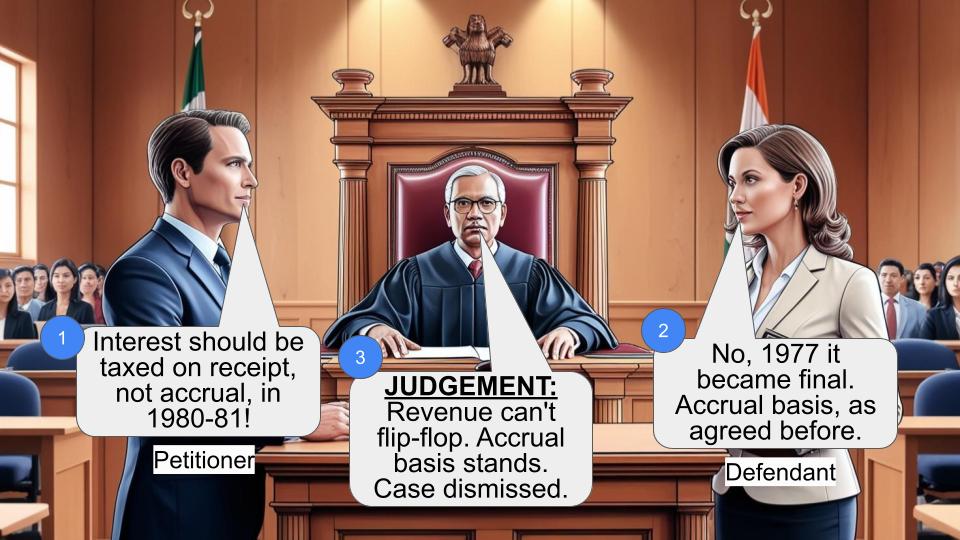
Court upholds taxation of arbitration interest on accrual basis, rejecting Revenue's flip-flop
Court upholds taxation of arbitration interest on accrual basis, rejecting Revenue's flip-flop
This case is all about a dispute between Dalmia Dairy (the assessee) and the Commissioner of Income Tax (the Revenue) over how and when to tax interest from an arbitration award. The High Court sided with Dalmia Dairy, saying the interest should be taxed on an accrual basis, not when it was received. The court basically told the Revenue, "You can't change your mind after 17 years.
Get the full picture - access the original judgement of the court order here
Case Name:
Dalmia Dairy Vs Commissioner of Income Tax (High Court of Delhi)
ITR 203/1987
Date: 4th January 2008
Key Takeaways:
1. Consistency matters in tax disputes - the Revenue can't suddenly change its stance after years.
2. The court upheld that interest from arbitration awards should be taxed on an accrual basis.
3. The specific date when an award becomes final (in this case, when appeal was denied) is crucial for determining the tax year.
Issue:
The main question here was: Should the interest from the arbitration award be taxed on an accrual basis (when it became due) or on a receipt basis (when it was actually received)?
Facts:
1. Dalmia Dairy owned cement factories in Pakistan.
2. They sold these factories in 1962 for about 2.33 crore Pakistani Rupees.
3. Due to India-Pakistan hostilities in 1965, payments got stuck.
4. Dalmia Dairy went to arbitration and won.
5. The National Bank of Pakistan challenged the award but lost in various courts.
6. The House of Lords finally refused to hear an appeal on July 20, 1977.
7. The Revenue tried to tax the interest in different years, causing this whole mess.
Arguments:
- Dalmia Dairy said: "Hey, the interest should be taxed in the 1978-79 assessment year because that's when it became final on July 20, 1977."
- The Revenue initially agreed with this accrual basis approach.
- But then, in this case, the Revenue suddenly argued: "No, no, we should tax it in 1980-81 when Dalmia actually received the money."
Key Legal Precedents:
The court heavily relied on its own previous decision in ITC No. 159/1987, decided on November 8, 1990. In that case, the court had already established that for this very assessee (Dalmia Dairy), the interest should be taxed on an accrual basis.
Judgement:
The court was like, "Come on, Revenue, you can't change your tune now!" They said:
1. The interest became due on July 20, 1977, when the House of Lords refused the appeal.
2. This falls in the 1978-79 assessment year.
3. It should be taxed on an accrual basis, as previously agreed by both parties.
4. The Revenue can't suddenly argue for taxation on a receipt basis after 17 years.
The court answered the question in favor of Dalmia Dairy and against the Revenue.
FAQs:
1. Q: Why was the date July 20, 1977, so important?
A: That's when the House of Lords refused to hear the appeal, making the arbitration award final and enforceable.
2. Q: What's the difference between accrual basis and receipt basis?
A: Accrual basis means you're taxed when you earn the right to the money, even if you haven't received it yet. Receipt basis means you're taxed when you actually get the money in hand.
3. Q: Why did the court emphasize the Revenue's change in stance?
A: It shows that consistency is important in tax matters. The Revenue can't keep changing its position, especially after such a long time, as it creates uncertainty for taxpayers.
4. Q: Does this judgment apply to all arbitration awards?
A: While it sets a precedent, each case can have unique circumstances. It's always best to consult with a tax professional for specific situations.
5. Q: What lesson can other taxpayers learn from this case?
A: Keep good records and be consistent in your tax positions. If the tax department agrees with your approach, make sure to document it for future reference.

In these references pertaining to the Assessment Year 1980-81 the following questions of law have been referred for our opinion: -
1. Whether on the facts and in the circumstances of the case, the Appellate Tribunal was justified in law in holding that the Income by way of outstanding price, contractual interest and interest as per the awards up to 20.7.77 arose in the assessment year 1978-79 and therefore the question of taxability of the amount computed on that basis could not arise for consideration in the assessment year 1980-81 in question?
2. Whether on the facts and in the circumstances of the case, it was relevant or necessary for the Tribunal while considering the appeals for the assessment year 1980-81 to give a finding that income by way of outstanding price, contractual interest and interest as per the awards up to 20.7.77 arose in the assessment year 1978-79?
2. In so far as the second question is concerned, learned counsel for the Assessee, at whose instance the question is referred to us, does not press this question and, therefore, we return the reference in this regard unanswered.
3. In so far as the first question is concerned, the sum and substance is whether the amount of interest in terms of the awards which were eventually upheld by the House of Lords by dismissing the Special Leave to Appeal filed by the National Bank of Pakistan on 20th July, 1977 could be taxed on accrual basis or on receipt basis.
4. Broadly the facts are that the Assessee owned and possessed cement factories in Districts Jhelum and Karachi, both being in Pakistan. The Assessee entered into a Sale Agreement dated 24th July, 1962 with a party in Karachi and in terms of the agreement as well as the supplemental agreements entered into, both the factories were sold for an amount of Rs.2,33,66,678/- (Pakistani Rupees). The amount was to be paid to the Assessee in India and in the event of failure to make the payment, the disputes between the parties could be referred to arbitration of the International Chamber of Commerce.
5. Armed hostilities broke out between India and Pakistan on 5th September, 1965 with the result that a state of emergency was declared in Pakistan and there was a prohibition of exports to India. At this stage, it may be mentioned that a part of the sale consideration was to be made by exporting cement manufactured in Pakistan to the Assessee in India. As a result of the embargo placed by the Government of Pakistan, the amounts that were due to the Assessee in cash and in kind were not remitted. Consequently, disputes arose between the parties and they were referred for arbitration to the International Chamber of Commerce.
6. The Arbitrator gave a decision in favour of the Assessee and the National Bank of Pakistan, which had stood guarantee for payment to the Assessee, challenged the arbitration awards. The High Court in London, in the first instance, by its order dated 14th April, 1976 held the awards to be valid, binding and enforceable. While upholding the award of the principal amount to the Assessee, interest and costs were also directed to be paid to the Assessee.
In compliance with the decision of the High Court in London, the National Bank of Pakistan deposited the entire decretal amount with the London branch of the Bank of India on 3rd May, 1976. In terms of the direction given by the High Court in London, the Assessee placed the amount in fixed deposit for 18 months.
7. The National Bank of Pakistan filed an appeal against the decision of the High Court. The appeal was taken up by the Court of Appeal (Civil Division) and dismissed on 4th May, 1977. The National Bank of Pakistan then took the matter to the House of Lords but it refused to grant leave to appeal on 20th July, 1977.
8. It is the contention of the Assessee, on these facts, that the interest amount became due and payable to the Assessee on 20th July, 1977 when the House of Lords declined to grant leave to the National Bank of Pakistan to file an appeal against the order of the Court of Appeal (Civil Division).
9. Nevertheless, the Revenue sought to tax the interest amount in the assessment year 1977-78 on receipt basis notwithstanding the fact that the Revenue had earlier taxed the interest amount due and payable to the Assessee on accrual basis. This was, of course, objected to by the Assessee and eventually the Income Tax Appellate Tribunal took a decision in favour of the Assessee and came to the conclusion that the interest amount was liable to be taxed on accrual basis.
10. Feeling aggrieved, the Revenue preferred an application for referring some questions of law to this Court under Section 256(1) (of Income Tax Act, 1961),1961 (for short the Act) said to be arising out of the decision of the Tribunal.
However, it appears that the Tribunal declined to refer any question of law and, therefore, the Revenue preferred a petition under Section 256(2) (of Income Tax Act, 1961) in this Court being ITC No. 159/1987 requiring the High Court to direct the Tribunal to refer certain questions of law to this Court.
11. One of the questions of law that the Revenue sought reference of was to the effect whether the Tribunal was correct in law in deleting the addition of Rs.2,11,51,264/- taxed as interest income on receipt basis.
12. The petition filed by the Revenue was dismissed by this Court by an order dated 8th November, 1990 and it was held as follows: -
Question No.3 arises from the fact that interest awarded by the arbitrator was being taxed both on accrual and receipt basis. According to the department, the interest was chargeable on accrual basis while the assessee had been contending that it was chargeable on receipt basis. Counsel for the respondent informs us that the respondent has accepted the contention of the department and as a result thereof, the said interest is chargeable in the hands of the respondent on accrual basis. The question now proposed, therefore, would not arise because this interest is to be taxed on accrual basis.?
We are given to understand that the view expressed by this Court has been accepted by the Revenue and, therefore, the interest income is finally required to be taxed on accrual basis.
13. In these references that we are now dealing with, the Tribunal has also come to the same conclusion. The Tribunal has held in paragraph 18 of its order under consideration that the relevant date is 20th July, 1977 when the House of Lords refused to grant leave to appeal to the National Bank of Pakistan. It is only on this date that the Assessee was entitled to receive the decretal amount as well as the interest thereon. The date (20th July, 1977) falls in the Assessment Year 1978-79 and, therefore, the amount could be taxed only in the Assessment Year 1978-79 on an accrual basis.
14. Learned counsel for the Revenue has contended before us that since the amount was to be received by the Assessee in India, the amount is liable to be taxed on receipt basis and in the Assessment Year under consideration, that is,1980-81 because the amount was actually received by the Assessee in the previous year relevant to the assessment year 1980-81.
15. We find that this contention urged by learned counsel for the Revenue is completely contrary to the contention urged by the Revenue for the last several years, namely, that the amount is liable to be taxed on an accrual basis. We say this because as held by this Court on 8th November, 1990 while disposing of ITC No.159/1987 that the stand of the Revenue is that the interest is taxable on accrual basis. Even the Assessee had accepted this contention of the Revenue and, therefore, there can be no doubt that the amount is liable to be taxed only on accrual basis. It is now too late in the day, after 17 years,for the Revenue to raise the contention that the amount is liable to be taxed on receipt basis. Even otherwise, we find no reason to differ with the view already expressed by this Court on an earlier occasion.
16. Following the view expressed by this Court in the case of the Assessee in ITA No. 159/1987 decided on 8th November, 1990, we answer the question of law referred to us in the affirmative, in favour of the Assessee and against the Revenue.
17. The references are disposed of accordingly.
MADAN B. LOKUR, J JANUARY 04, 2008 V.B. GUPTA, J
×
Similar Ripples
Questions
Court upholds taxation of arbitration interest on accrual basis, rejecting Revenue's flip-flop
Write your CommentSimilar Posts



Generic
- Reportdata/5049.pdf
