


Court Upholds Taxation of Profit, Not Entire Sales, in Undisclosed Income Case


Full News

Court Upholds Taxation of Profit, Not Entire Sales, in Undisclosed Income Case
Court Upholds Taxation of Profit, Not Entire Sales, in Undisclosed Income Case
The case involves the Commissioner of Income Tax vs Hariram Bhambhani, where the court upheld the decision to tax only the profit attributable to unrecorded sales, rather than the entire sales consideration, in a case of undisclosed income.
Get the full picture - access the original judgement of the court order here.
Case Name:
Commissioner of Income Tax Vs Hariram Bhambhani (High Court of Bombay)
Income Tax Appeal No.313 of 2013
Key Takeaways:
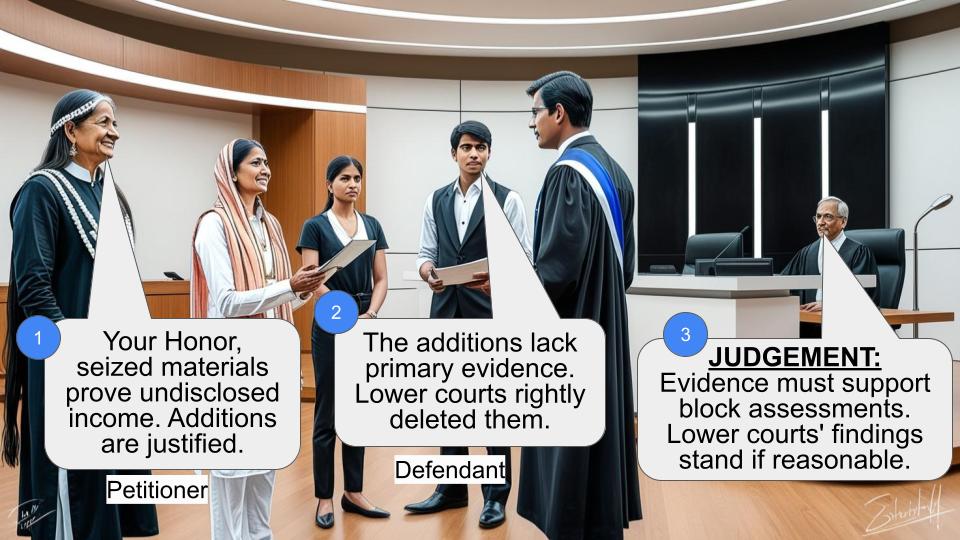
1. Only the profit from unrecorded sales is taxable, not the entire sales amount.
2. The court affirmed the importance of considering evidence and circumstances beyond mere statements.
3. The judgment emphasizes a reasonable approach to taxation in cases of undisclosed income.
Issue:
Whether the entire amount of undisclosed sales should be taxed, or only the profit attributable to those sales?
Facts:
1. A survey operation under Section 133A (of Income Tax Act, 1961) was conducted on the Respondent-Assessee on September 21, 2006.
2. The survey revealed unaccounted sales in the total turnover.
3. The Director of the Respondent-Assessee initially declared Rs. 35 lakhs to be offered for tax.
4. Later, the Respondent-Assessee provided an explanation for this amount, breaking it down into different components.
5. The Assessing Officer brought the entire Rs.35 lakhs to tax under 'income from undisclosed sale'.
Arguments:
Respondent-Assessee:
- Argued that the entire Rs.35 lakhs should not be taxed.
- Provided a breakdown of the amount, including a sale invoice and an explanation of a misstatement.
- Claimed that the director who made the statement was not fully aware of tax implications.
Revenue:
- Sought to tax the entire Rs.35 lakhs as undisclosed income.
- Argued that Section 69C (of Income Tax Act, 1961) should be invoked.
Key Legal Precedents:
The judgment doesn't mention specific legal precedents but refers to the decisions made by the CIT(A) and the Tribunal, which formed the basis for the High Court's decision.
Judgement:
1. The High Court upheld the decisions of the CIT(A) and the Tribunal.
2. It was determined that only the profit attributable to the unrecorded sales should be taxed, not the entire sales amount.
3. The court found this view to be reasonable and possible.
4. The appeal by the Revenue was dismissed.
FAQs:
Q1: Why wasn't the entire Rs.35 lakhs taxed?
A1: The court determined that only the profit from unrecorded sales should be taxed, not the entire sales amount, as the purchases were already accounted for.
Q2: What was the significance of the survey operation?
A2: The survey revealed unaccounted sales, which led to the tax dispute.
Q3: How did the CIT(A) calculate the taxable amount?
A3: The CIT(A) determined that 4% of the Rs.35 lakhs (Rs.1.40 lakhs) should be added as profit from unaccounted sales.
Q4: Why was Section 69C (of Income Tax Act, 1961) not applicable?
A4: The court clarified that Section 69C (of Income Tax Act, 1961) deals with unexplained expenditure, which was not relevant to this case about undisclosed sales.
Q5: What's the main principle established by this judgment?
A5: The judgment establishes that in cases of undisclosed income from sales, it's the profit from those sales that should be taxed, not the entire sales amount.

1. This Appeal under Section 260 (of Income Tax Act, 1961)A of the Income Tax Act, 1961 (the Act), challenges the order dated 8th August, 2012 passed by the Income Tax Appellate Tribunal (the Tribunal) for the Assessment Year 2006-07.
2. The Revenue has formulated the following question of law for our consideration:
“ Whether on the facts and in the circumstances of the case and in law, the Tribunal was justified in upholding the order of the CIT(A) in which he had directed the Assessing Officer to tax 4% net profit on unaccounted sales of Rs.35 lakhs even though no evidence of unaccounted purchases/ expenses against such unaccounted sales was detected at the time of survey?”
3. On 21st September, 2006, there was a survey operation under Section 133A (of Income Tax Act, 1961) on the RespondentAssessee. During the course of the survey, it was noticed that the RespondentAssessee has not accounted some of the sales in the total turnover. In the statement recorded at the time of survey, the Director of RespondentAssessee declared a sum of Rs.35 lakhs should be offered to tax. However, thereafter, Respondent- Assessee explained the statement as follows:
“ Please refer to question No.11 in the statement given by the director wherein it was declared that the sum of Rs.35 lakhs would be offered to tax for A. Y. 200506. However, bill amounting to Rs.14,97,970/ was raised on 31.3.2006 on M/s. Global Services Middle East for supply of provision time to time on Vesser “MV Pooja 1 & MV Stephanie. Copy of the Sale invoice for same made to M/s. Global Services Middle East for Rs.14,97,970 is enclosed herewith.
Also sum of Rs.20,00,000 was towards sales in M/s. Global (India) Hospitality Services Pvt. Ltd. and was wrongly mentioned in declaration given by the director as turnover belonging to Royal Marine Co.
Further, we wish to add that the statement was made by Mr. Hariram Bhambhani who is a matriculate in vernacular language and is not aware of the intricacies and implications of the Income Tax Act and Rules and statement made by him.”
4. The RespondentAssessee did not accept the Appellant's above explanation, seeking to reconcile the statement made during the course of survey and facts actually existing. Accordingly, the entire amount of Rs.35 lakhs was brought to tax under the head 'income from undisclosed sale'.
5. Being aggrieved, RespondentAssessee filed an Appeal before the CIT(A). In its order, the CIT(A) recorded that during the course of survey, no unaccounted invoices were impounded. Although there was unaccounted sale bills which were not recorded in the books of account on the date of survey, no document was impounded. However, later in its return filed with the Revenue, it declared turn over at Rs.3.27 Crores, showing a net profit of Rs.36.76 lakhs. The CIT(A) relied upon its decision to hold that the Assessing Officer cannot add the amount of Rs.35 lakhs only on the statement made without considering the surrounding circumstances and evidence to uphold the addition. In the circumstances, the CIT(A) held that in the facts of the case, that only 4% being the profit earned on sales of Rs.35 lakhs can be added to net profit of the applicant. Therefore, only Rs.1.40 lakhs was the profit on unaccounted sales which could be added. Thus, the balance addition of Rs.33.63 lakhs was deleted.
6. On further Appeal, the Tribunal by the impugned order held that the entire sales which are unaccounted cannot be undisclosed income of the assessee, particularly as the purchase had been accounted for. It was held that only net profit which would arise on such unaccounted sales can rightly be taken as the amount which could be added to the RespondentAssessee's income for the purpose of tax.
7. The grievance of the Revenue is that Section 69C (of Income Tax Act, 1961) is to be invoked and entire amount of undisclosed sales has to be brought to tax. We are unable to appreciate how Section 69C (of Income Tax Act, 1961) which speaks of unexplained expenditure is all at relevant for this appeal. We are not concerned with any unexplained expenditure in this case.
8. In any view of the matter, the CIT(A) and Tribunal have came to the concurrent finding that the purchases have been recorded and only some of the sales are unaccounted. Thus, in the above view, both the authorities held that it is not the entire sales consideration which is to be brought to tax but only the profit attributable on the total unrecorded sales consideration which alone can be subject to income tax. The view taken by the authorities is a reasonable and a possible view.
Thus, no substantial question of law arises for our consideration. 9 Appeal dismissed. No order as to costs.
(G.S.KULKARNI,J.) (M.S.SANKLECHA,J.)
×
Similar Ripples
Questions
Court Upholds Taxation of Profit, Not Entire Sales, in Undisclosed Income Case
Write your CommentSimilar Posts


Generic
- Reportdata/4033.pdf
