


Court Upholds Taxpayer's Right to Full Deduction on Export Profits


Full News

Court Upholds Taxpayer's Right to Full Deduction on Export Profits
Court Upholds Taxpayer's Right to Full Deduction on Export Profits
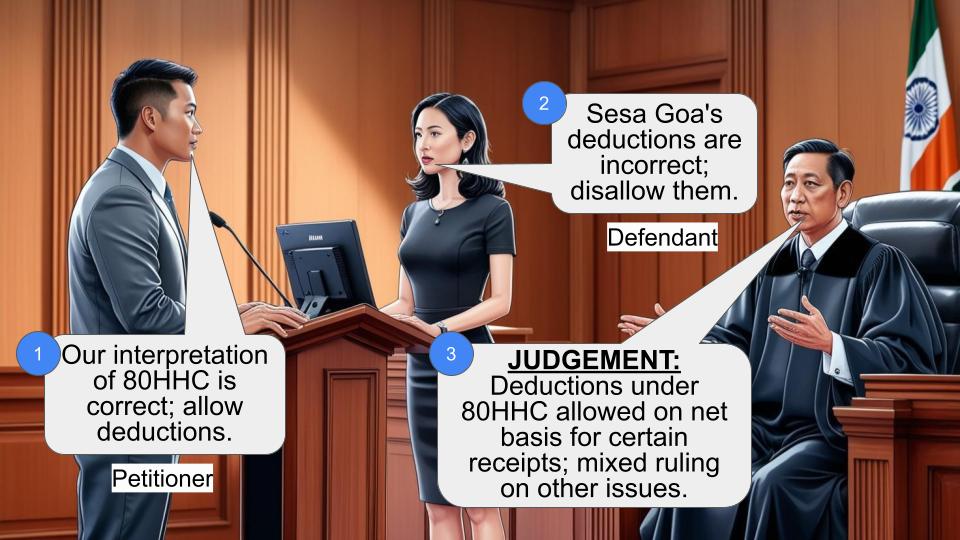
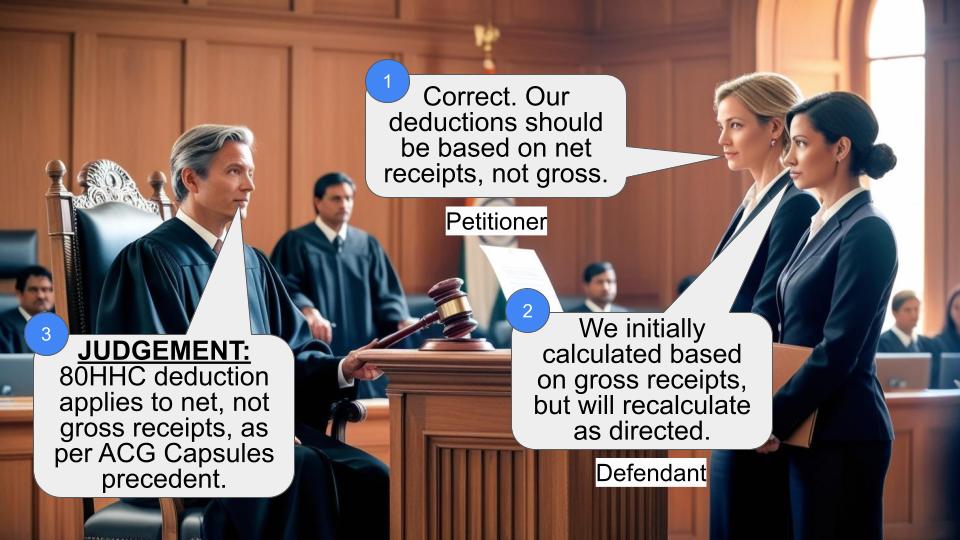
In this case, V. M. Salgaocar & Brother Pvt. Ltd. appealed against the Income Tax Department's decision to restrict their deduction under Section 80HHC (of Income Tax Act, 1961). The High Court ruled in favor of the taxpayer, allowing deduction up to the gross total income rather than limiting it to business profits.
Get the full picture - access the original judgement of the court order here
Case Name:
V. M. Salgaocar & Brother Pvt. Ltd. vs Assistant Commissioner of Income Tax (High Court of Bombay)
Tax Appeal No. 25 of 2007
Date: 22nd April 2015
Key Takeaways:
1. Deductions under Chapter VI-A of the Income Tax Act should be limited to gross total income, not just business profits.
2. Once the Assessing Officer determines the quantum of deduction, it cannot be arbitrarily restricted.
3. The court's decision reinforces the interpretation of Sections 80A, 80AB, and 80HHC of the Income Tax Act.
Issue:
Was the Assessing Officer justified in restricting the deduction under Section 80HHC (of Income Tax Act, 1961) to Rs.17,40,33,719/- (business profits) instead of allowing it up to Rs.19,78,94,900/- (gross total income)?
Facts:
- V. M. Salgaocar & Brother Pvt. Ltd. is engaged in the export of processed iron ore.
- For the Assessment Year 1995-96, their gross total income was determined to be Rs.19,78,94,900/-.
- The Assessing Officer computed the deduction under Section 80HHC (of Income Tax Act, 1961) at Rs. 19,92,39,981/-.
- However, the deduction was restricted to Rs.17,40,33,719/-, which was the profit from business.
- The appellant appealed this decision through various levels of the tax system before reaching the High Court.
Arguments:
Appellant (V. M. Salgaocar & Brother Pvt. Ltd.):
- The deduction should be allowed up to the gross total income as per Section 80A(2) (of Income Tax Act, 1961).
- Once the quantum of deduction is determined, it cannot be arbitrarily restricted.
Respondent (Income Tax Department):
- The deduction should be restricted to the profits and gains of the export business.
- Relied on the Andhra Pradesh High Court judgment in CIT v. Visakha Industries Ltd.
Key Legal Precedents:
1. CIT v. Tridoss Laboratories Limited (judgment dated 04.02.2010)
2. CIT v. Eskay Knit India Limited (Income Tax Appeal No. 184 of 2007)
3. CIT v. J.B. Boda and Company Private Limited (Tax Appeal No. 3224 of 2009)
These precedents supported the view that deductions under Chapter VI-A should be capped at the gross total income, not just business profits.
Judgement:
The High Court ruled in favor of the appellant, stating that:
1. The Assessing Officer was not justified in restricting the deduction to Rs.17,40,33,719/-.
2. The deduction should be allowed up to the gross total income of Rs. 19,78,94,900/-.
3. The court answered both substantial questions of law in favor of the assessee/appellant and against the revenue department.
FAQs:
1. Q: What is the significance of this judgment?
A: It clarifies that deductions under Chapter VI-A of the Income Tax Act should be limited to gross total income, not just business profits.
2. Q: How does this affect other taxpayers?
A: This judgment may be used as a precedent for similar cases where taxpayers seek deductions up to their gross total income under Chapter VI-A.
3. Q: What sections of the Income Tax Act were crucial in this case?
A: Sections 80A, 80AB, and 80HHC were key to the court's decision.
4. Q: Does this judgment apply to all types of deductions under Chapter VI-A?
A: While the case specifically dealt with Section 80HHC (of Income Tax Act, 1961), the court's reasoning may be applicable to other deductions under Chapter VI-A as well.
5. Q: What should taxpayers do if they face a similar situation?
A: Taxpayers in similar situations may consider appealing if their deductions under Chapter VI-A are restricted to business profits instead of gross total income. However, they should consult with a tax professional for specific advice.

1. Heard Mr. P. Pardiwalla, learned Senior Counsel appearing for the appellant and Ms. A. Dessai, learned counsel appearing for the respondent.
2. The above appeal came to be admitted by an order dated 16.04.2007 on the following substantial questions of law :
1. Whether when the Assessing Officer has himself computed the deduction allowable under Section 80HHC (of Income Tax Act, 1961) at Rs.19,92,39,981/- was he justified in restricting the deduction that he allowed at Rs. 17,40,33,719/- ?
2. Whether on the facts and in the circumstances of the case and on a harmonious construction of Sections 80HHC, 80A(2), 80AB and 80B(5) could the deduction allowable under Section 80HHC (of Income Tax Act, 1961) be restricted to the extent of business profits and not to the extent of the gross total income as canvassed for by the appellant ?
3. Mr. Pardiwalla, learned Senior Counsel appearing for the appellant in support of the above appeal points out that the question in the present appeal is whether once the Assessing Officer determined the quantum of deduction which the appellant is entitled to be a sum of Rs. 19,92,39,981/- was it justified to restrict such amount to Rs.17,40,33,719/- which according to him was the profit of the business. The learned Senior Counsel further pointed out that the appellant is engaged in the business of export of processed iron ore which is manufactured and produced by the appellant as well as ore in which the appellant trades. The learned Senior Counsel further pointed out that there was a first round of litigation in connection with the amount which the appellant is entitled as a deduction in terms of Section 80HHC (of Income Tax Act, 1961) ( herein after referred to as 'the said Act') which this Court had partially modified the directions of the Tribunal though that aspect is not relevant for deciding the above appeals. The learned Senior Counsel further pointed out that thereafter the Assessing Officer by an order dated 05.06.2002 gave effect to the order of the Tribunal dated 28.09.2001 and for the Assessment year 1995-96 the Assessing Officer has determined the income chargeable under the head “Profits and gains of business or profession” at Rs.17,63,97,551/-. The learned Senior Counsel further submits that the income chargeable under the head “Income from House property” was determined at Rs.13,008/- and the income chargeable under the head “Income from other sources” at Rs.2,14,84,346/-. According to the learned Senior Counsel the gross total income was determined by the Assessing Officer was a sum of Rs.19,78,94,900/-. The learned Senior Counsel further submits that the appellant was entitled to a deduction under Section 80I (of Income Tax Act, 1961) which he quantified at Rs.1,95,298/- and under Section 80HHC (of Income Tax Act, 1961) which was quantified at Rs.19,92,49,981/-. The learned Senior Counsel further submits that when it came to giving a deduction on the said amount, the Assessing Officer had restricted the deduction under Section 80HHC (of Income Tax Act, 1961) to Rs.17,40,33,719/-. The learned Senior Counsel further pointed out that being aggrieved by the said determination, the appellant had preferred an appeal to the Commissioner of Income Tax (Appeals) who by order dated 30.09.2004 rejected the appellant's contention having regard to the judgment of the Apex Court in Ipca Laboratory Ltd., V/s Deputy CIT 266 ITR 521 where the provisions under Section 80AB (of Income Tax Act, 1961) were applicable. The learned Senior Counsel further submits that relying upon the judgment of the Andhra Pradesh High Court in CIT V/s Visakha Industries Ltd., 251 ITR 471, the Commissioner of Income Tax (Appeals) held that the deduction under Chapter VI-A is to be computed with reference to the profits of a particular undertaking and not with reference to the gross total income of the assessee. Being aggrieved by the said order, the learned Senior Counsel has pointed out that the appellant had preferred an appeal before the Tribunal which met with the same fate and dismissed such appeal. Accordingly, the appellant has preferred the above appeals which were admitted on the aforesaid substantial questions of law. The learned Senior Counsel has further taken us through the scheme of the said Act to point out that first one has to compute the income that is earned from different sources under each of the heads and thereafter, the relevant set off of the loss from one source or head against the income from another source or another head is to be given effect to in terms of Sections 70 to 74 of the said Act. The learned Senior Counsel further submits that the resulted figures are the aggregated and gross total income determined which is specially defined in Section 80B(5) (of Income Tax Act, 1961). Thereafter, according to the learned Senior Counsel in Chapter VI-A of the Act, the deductions are allowed and sub section (1) of Section 80A (of Income Tax Act, 1961) provides that in computing the total income of an assessee, there shall be allowed from his gross total income in accordance with and subject to the provisions of the Chapter which are the deductions specified in Section 80C (of Income Tax Act, 1961) to Section 80U (of Income Tax Act, 1961). The learned Senior Counsel further submits that sub section (2) provides that the quantum of deduction allowable is the aggregate amount of deductions under the Chapter which shall not in any case, exceed the gross total income of the assessee. The learned Senior Counsel further pointed out that Part 'C' of the said Chapter determine specified deductions allowable and that in such part, Section 80HHC (of Income Tax Act, 1961) provides for a deduction in respect of the profits derived from the export of the goods or merchandise. According to the learned Senior Counsel sub -section (1) as it stood then provides that where an assessee is an Indian Company engaged in the business of export out of India of any goods or merchandise, there shall be in accordance with and subject to the provisions of the Section in computing the total income of the assessee be allowed, a deduction of the profits derived by the assessee from the export of such goods or merchandise. The learned Senior Counsel pointed out that the respondent by applying the methodology provided in Section 80HHC(3) (of Income Tax Act, 1961) has determined the profits derived from the export of goods and merchandise at Rs.19,92,49,981/-. But however, the respondents have erroneously restricted the deductions in terms of Section 80HHC(1) (of Income Tax Act, 1961) to a sum of Rs.17,40,33,719/- by relying upon Section 80AB of the said Act which was introduced by the Finance Act, 1980 w.e.f. 01.04.1981. By relying upon the Circular No. 281 of 1980 dated 22.09.1980 which has no application to interpret the relevant provisions of the said Act the learned Senior Counsel further pointed out that in the context of Sections 80IA and 80O of the said Act, this Court had occasion to consider whether the deductions under these provisions are to be restricted to the income under the head “Profits and gains of business or profession” or is to be allowed to the extent of the gross total income. In this connection, in the case of CIT V/s Tridoss Laboratories Limited, by judgment dated 04.02.2010 this Court had dismissed the appeal of the revenue on a similar issue. The learned Senior Counsel further pointed out that the said principles were reiterated by this Court in CIT V/s Eskay Knit India Limited by judgment dated 25.03.2010 in Income Tax Appeal No. 184 of 2007. The learned Senior Counsel thereafter has taken us through another judgment of this Court in CIT v/s J. B. Boda and Company Private Limited dated 18.10.2010 in Tax Appeal No. 3224 of 2009 wherein this Court has upheld the view taken by the Tribunal that there was no basis in law to restrict the deduction to the extent of the business income. The learned Senior Counsel further pointed out that the judgment of the Andhra Pradesh High Court relied upon by the revenue is misplaced as the High Court was concerned with a case where the assessee had an asbestos cement division in which it had earned a profit but had incurred a loss in its spinning division. After setting off the loss against the profits, it had a gross total income of Rs.48,31,526/-. The learned Senior Counsel further pointed out that the Andhra Pradesh High Court therein held that the loss could not be set off from the profit of the asbestos division and as such upheld the stand of the assessee that it was entitled to a deduction under Sections 80HH (of Income Tax Act, 1961) and 80I of the profits computed on a standalone basis of the asbestos division. The learned Senior Counsel further pointed out that the Tribunal in para 8 of its order accepts that the deduction is to be allowed is to the extent of the profits and gains of export business but after having said so impliedly restricts it to the income assessed under the head “profits and gains of business or profession” overlooking that the profits and gains of the export business are computed by the Assessing Officer himself at Rs.19,92,49,981/- and as such the appellants are entitled for a deduction of the said sum in terms of Section 80A(2) (of Income Tax Act, 1961) by restricting its claim to Rs.19,78,94,900/-. The learned Senior Counsel thereafter has taken us through the orders passed by the Commissioner as well as by the Tribunal and pointed out that both the said authorities have misconstrued the relevant provisions of the Income Tax Act and have accordingly erroneously rejected the contentions by restricting the deductions as effected by the Assessing Officer. The learned Senior Counsel as such submits that the appeals be allowed and the substantial questions of law be answered in favour of the appellants.
4. On the other hand, Ms. Asha Desai, learned counsel appearing for the respondent has supported the impugned order. The learned counsel has taken us through the provisions of Section 80HHC of the said Act as well as the provisions of Section 80I (of Income Tax Act, 1961) to point out that the deductions which are allowed in terms of the said provisions are to be restricted to the profits and gains of income of the appellant and as such, the deductions are restricted by the authorities below cannot be faulted. The learned counsel further pointed out that the Andhra Pradesh High Court has clearly held that full deduction is not permissible and full deductions of net profit are not permissible and that the deductions are to be restricted only to the profits and gains in respect of the export business after computing the profits of export business. The learned counsel further pointed out that the Tribunal has rightly held that in case of deduction under Section 80HHC (of Income Tax Act, 1961) the incentive has been given to boost export activities and deduction should be restricted to the profits and gains of the export business as specified in the provisions of the said Act and not with reference to the gross total income of the assessee. The learned counsel as such submits that the substantial questions of law framed by this Court are to be answered in favour of the respondent.
5. We have considered the submissions of the learned counsel and we have also gone through the records. In order to appreciate the contentions of the learned counsel, we shall examine the relevant provisions of the said Act.
Sub Section (1) to Section 80A of the said Act provides that in computing the total income of an assessee, there shall be allowed from his gross total income in accordance with and subject to provisions of the Chapter, the deductions specified in Section 80C (of Income Tax Act, 1961) to Section 80U (of Income Tax Act, 1961). Sub section (2) of Section 80A (of Income Tax Act, 1961) provides that the aggregate amount of the deductions under this Chapter shall not in any case exceed the gross total income of the assessee. Reading the said provisions of the Act, one finds that the gross total income means the total income computed in accordance with the provisions of the said Act before making any deductions under this Chapter.
6. Section 80AB (of Income Tax Act, 1961) then in force reads thus :
“80AB. Where any deduction is required to be made or allowed under any section ( except section 80M (of Income Tax Act, 1961)) included in this Chapter under the heading “C.—Deductions in respect of certain incomes” in respect of any income of the nature specified in that section which is included in the gross total income of the assessee, then, notwithstanding anything contained in that section, for the purpose of computing the deduction under that section, the amount of income of that nature as computed in accordance with the provisions of this Act (before making any deduction under this Chapter) shall alone be deemed to be the amount of income of that nature which is derived or received by the assessee and which is included in his gross total income.”
7. Section 80B(5) of the said Act defines the gross total income thus :
“80B(5)”gross total income” means the total income computed in accordance with the provisions of this Act, before making any deduction under this Chapter”.
8. On going through the said provisions, we find that sub- section (2) of Section 80A (of Income Tax Act, 1961) clearly provides that the deductions shall not exceed such gross total income. In such circumstances, the only point for determination in the present appeals is whether the restrictions as determined by the Assessing Officer are in accordance with the provisions of the said Act. Part C of Chapter VI-A of the said Act provides for deductions in respect of the certain income and one of such Sections which fall within the said part is Section 80HHC (of Income Tax Act, 1961) which provides for deductions in respect of the profits determinable by the assessee from the export of goods or merchandise. Sub Section (1) of Section 80HHC (of Income Tax Act, 1961) as it stood then provides that the profit that an assesse Indian company engaged in the business of export of any goods or merchandise to which this section applies, there shall, in accordance with and subject to provisions of Section, a deduction of the profits derived by the assessee from such export of goods or merchandise be allowed in computing the total income of the assessee. Sub- section (3) sets out the manner in which the profits derived from export business of the goods or merchandise is to be determined. In the present case, the respondent by applying the methodology as provided in Section 80HHC(3) (of Income Tax Act, 1961) has determined the profits derived from the export of goods or merchandise as far as the appellant is concerned to be a sum of Rs.19,92,39,981/-. Once the respondents themselves have arrived at the said figure after applying the methodology as provided in Section 80HHC(3) of the said Act, such amount of deduction has to be allowed. But however, taking note of the provisions of Section 80A(2) (of Income Tax Act, 1961) referred to herein above, such deduction has to be restricted to the gross total income which in the present case is a sum of Rs.19,78,94,900/-. But however, the respondents have restricted the said deduction only to Rs. 17,40,33,719/- by relying upon the provisions of Section 80AB (of Income Tax Act, 1961). However, we find that once the income has been determined by applying the methodology as provided in Section 80HHC(3) of the said Act, the question of restricting the deduction in terms of Section 80AB of the said Act would not arise. This is so in terms of Section 80AB (of Income Tax Act, 1961), as the appellant is claiming deductions on its export profits alone, which is included in computing its gross total income. Section 80HHC(3) (of Income Tax Act, 1961) was introduced when the provisions of Section 80AB (of Income Tax Act, 1961) were already on the statute. Even upon reading the provisions of Section 80AB of the said Act, the determination of the amount as provided therein would have to be effected for the purpose of computing the deductions under each of the respective sections specified in Part C of the said Act. As such, while computing the deduction under Sections 80HHB (of Income Tax Act, 1961), 80HHC, 80HHD, 80I, 80IB, 80IA, 80IB etc., one would have to apply Section 80AB of the said Act. On perusal of Annexure A, we find that the deduction under Section 80HHC (of Income Tax Act, 1961) to which the appellant was entitled has been arrived at a sum of Rs.19,92,49,981/- by the respondents themselves. In terms of Section 80AB(2) (of Income Tax Act, 1961), the restriction of the deduction is to the gross total income and in such circumstances, the restriction to the total profit of business in a sum of Rs.17,40,33,719/- is not at all justified. The restriction is on the gross total income of Rs.19,78,94,900/- and as such we find that the restriction effected by the Assessing Officer on the deduction is not at all justified.
9. This Court has had occasion to deal with the issue arising herein in the context of Section 80IA (of Income Tax Act, 1961) and 80O ( also a part of Chapter VI-A of the said Act ) viz. whether the deductions under these provisions are to be restricted to income under the head profits of business or to the gross total income in the case of Tridoss Laboratories (supra ), Eskay Knit India Ltd., ( supra ) and M/s. J. B. Boda ( supra ). All of them have taken a view that the cap for deduction is gross total income. This also leads support to the appellant's case.
10. Even on perusal of the judgment of the Division Bench of this Court in the case of M/s Tridoss Laboratories Ltd., (supra ) it is observed at para 5 thus :
“5. Section 80IA (of Income Tax Act, 1961) provides that where the gross total income of an assessee includes any profits and gains derived by an undertaking or an enterprise from any business referred to in sub-section (4) ('the eligible business'), there shall, in accordance with and subject to the provisions of this section, be allowed, in computing the total income of the assessee, a deduction of an amount equal to hundred per cent of the profits and gains derived from such business for ten consecutive assessment years. The section contemplates a deduction of an amount representing hundred per cent of the profits and gains derived from the eligible business in computing the total income of the assessee. The expression 'gross total income' is defined by section 80B(5) (of Income Tax Act, 1961), for the purposes of Chapter VIA., to mean the total income computed in accordance with the provisions of the Act before making any deduction under the Chapter. The expression total income has been defined in section 2(45) (of Income Tax Act, 1961) to mean that total amount of income referred to in Section (5), computed in the manner laid down in the Act. Section 5(1) (of Income Tax Act, 1961) enunciates that subject to the provisions of the Act, the total income of any previous year of a person who is a resident, includes all income from whatever source derived. In computing the total income of the assessee, there is no basis in the provisions of section 80IA (of Income Tax Act, 1961) to restrict the expression to total income derived from an eligible business. Having regard to the provisions noted above, the submission which has been urged on behalf of the revenue cannot be accepted.”
11. In the judgment of this Court in the case of M/s. J. B. Boda and Co. Pvt. Ltd., ( supra ), it has been observed at paras 2 and 3 thus :
“2. The question sought to be raised in this appeal relates to the deduction under section 80-O (of Income Tax Act, 1961) ( “Act” for short ). The Tribunal has considered this question taking into account the calculations made by the Assessing Officer; wherein he has determined the deduction under section 80-O (of Income Tax Act, 1961) in the sum of Rs.1,29,41,830/- being the 50% of the income so received or brought into India. This figure is not disputed by the learned counsel for the Revenue. The only question sought to be canvassed is that out of these deductions the admissible deduction under Section 80-O (of Income Tax Act, 1961) ought to be limited to the extent of Rs.69,70,127/- which represents business income. In other words, the income from interest and dividend shall not form part of the gross total income as defined under section 80B(5) (of Income Tax Act, 1961). The submission is misconceived. If one turns to the definition of the 'gross total income” under section 80B (of Income Tax Act, 1961)-5, it reads as under :
“ 80B(5) “gross total income” means the total income computed in accordance with the provisions of this Act, before making any deduction under this Chapter.”
3. Considering the definition of the gross total income, it is difficult to hold that the interest income and the dividend income would not form part of the gross total income computed in accordance with the provisions of the Act. The view taken by the Tribunal, in our considered view, is in consonance with what is stated herein. No substantial question of law is involved. In the result, appeal is dismissed in limine with no order as to costs.”
12. The Division Bench of this Court in another judgment in the case of M/s. Eskay K'N''IT ( India) Ltd., dated 25.03.2010 has observed at para 3 thus :
“3. Section 80-IA (of Income Tax Act, 1961) as it stood at the material time provided that where the gross total income of the assessee included any profits and gains derived from the eligible business, to which the Section applies, he would in accordance with, but subject to the provisions of the section, be allowed in computing the total income, a deduction from such profits and gains of an amount equal to the amount specified in sub section (5) and for the Assessment Years specified in sub section (6). By the provisions of Section 80-A(2) (of Income Tax Act, 1961) the aggregate amount of the deductions under Chapter VI-A shall not, in any case, exceed the gross total income. It was in view of the provisions of Section 80-A(2) (of Income Tax Act, 1961) that the assessee restricted its claim of deduction under Section 80-IA (of Income Tax Act, 1961) to the gross total income. There was no basis or justification for the Assessing Officer to confine the deduction only to the extent of the profits and gains of business. In this regard our attention has been drawn to a judgment of this Court dated 4th February, 2010 in The Commissioner of Income Tax Vs M/s. Tridoss Laboratories Ltd., (ITA 2432 of 2009 ). Section 80-IA (of Income Tax Act, 1961) allows a deduction in computing the total income of the assessee and the expression 'total income' is as defined in Section 2(45) (of Income Tax Act, 1961) viz. The total amount of income referred to in Section 5 (of Income Tax Act, 1961), computed in the manner laid down in the Act. Following the view which we have taken in Tridoss Laboratories, we answer the question of law which has been raised in the present appeal against the Revenue and in favour of the assessee. The appeal is accordingly disposed of. There shall be no order as to costs.”
13. Taking note of the observations of this Court in the above cases and for the reasons aforesaid, we find that the Assessing Officer was not justified to restrict the deduction at a sum of Rs.17,40,33,719/- being the profits and gains of the business and not in a sum of Rs.19,78,94,900/- which was the gross total income of the appellant/ assessee.
14. In view of the above, both the substantial questions of law are answered in the negative i.e. in favour of the assessee/appellant herein and against the respondent-revenue. The impugned orders passed by the authorities below stand accordingly modified. The appeal stands disposed of accordingly with no order as to costs.
K. L. WADANE, J F. M. REIS, J
×
Similar Ripples
Questions
Court Upholds Taxpayer's Right to Full Deduction on Export Profits
Write your CommentSimilar Posts

Generic
- Reportdata/3819.pdf
