


Court Upholds Transfer of Tax Case from Mumbai to Delhi, Citing Procedural Fair…


Full News
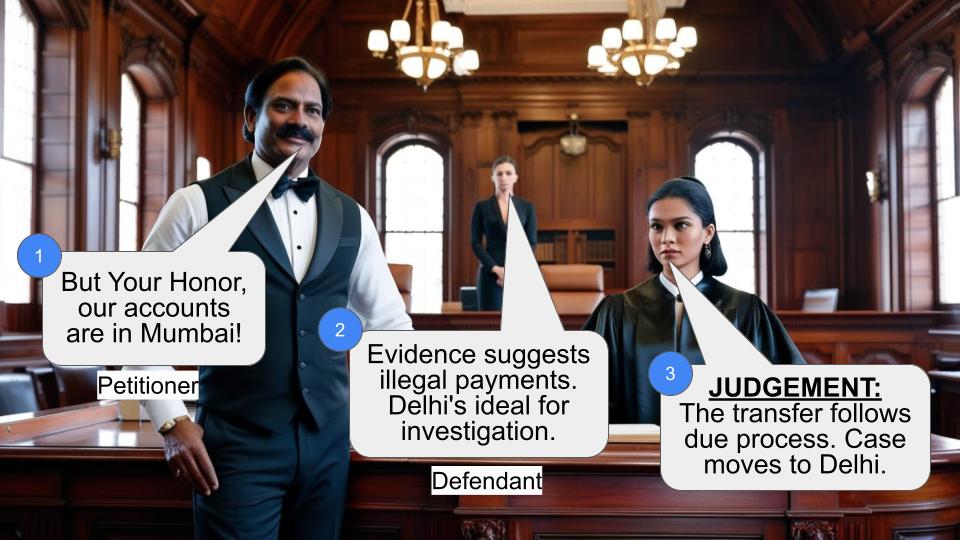
Court Upholds Transfer of Tax Case from Mumbai to Delhi, Citing Procedural Fairness
Court Upholds Transfer of Tax Case from Mumbai to Delhi, Citing Procedural Fairness
A company called Kesar Enterprises Ltd. challenged the transfer of their tax assessment case from Mumbai to New Delhi. The court ultimately decided that the transfer was justified and followed proper procedures, so they rejected the company's petition. It's a bit of a bureaucratic tangle, but it's got some interesting points about how tax cases can be moved around.
Get the full picture - access the original judgement of the court order here
Case Name:
Kesar Enterprises Ltd. Vs K.C. Sarangi, Commissioner of Income Tax & Ors.(High Court of Bombay)
Writ Petition No.2490 of 2007
Date: 18th December 2007
Key Takeaways:
1. The court emphasized the importance of following proper procedures and natural justice principles when transferring tax cases.
2. Prima facie evidence of potential tax irregularities can justify the transfer of a case to a different jurisdiction.
3. The court showed reluctance to interfere with administrative decisions when proper procedures are followed.
Issue:
The main question here was: Was the transfer of Kesar Enterprises Ltd.'s tax assessment case from Mumbai to New Delhi justified and procedurally correct?
Facts:
1. On November 8, 2006, Kesar Enterprises got a letter saying their tax assessment might be moved to New Delhi.
2. They were given a chance to object, which they did.
3. An order was made to transfer the case anyway.
4. Kesar Enterprises wasn't happy, so they went to court.
5. The court initially set aside the transfer order on April 30, 2007, but allowed the tax authorities to try again with proper notice.
6. On July 31, 2007, a new notice was issued explaining why they wanted to transfer the case.
7. One big reason was that Kesar Enterprises was part of an association (UPDA) that was suspected of making illegal payments to public servants.
8. Kesar Enterprises got to respond and even had a hearing.
9. On October 4, 2007, a new order was passed transferring the case to New Delhi.
10. Kesar Enterprises filed this petition on November 27, 2007, challenging the transfer.
Arguments:
Kesar Enterprises' side:
- They argued that the transfer was unjustified.
- They pointed out that they have various divisions in different places, but their accounts are consolidated in Mumbai.
Tax authorities' side:
- They said they had evidence of illegal payments made by distilleries in Uttar Pradesh, including one owned by Kesar Enterprises.
- They argued that centralizing all related cases in New Delhi would help in a more coordinated investigation.
Key Legal Precedents:
Interestingly, this judgment doesn't cite specific legal precedents. Instead, it focuses on the procedural aspects and the principles of natural justice. The court refers to Section 127(1) (of Income Tax Act, 1961) and Section 127(2) (of Income Tax Act, 1961), which deal with the transfer of cases.
Judgement:
The court sided with the tax authorities here. They said:
1. The transfer followed proper procedures and principles of natural justice.
2. The tax authorities had enough prima facie evidence to justify the transfer.
3. Kesar Enterprises got a fair chance to present their case.
4. The reasons for transfer were clearly explained in a "speaking order" (that's legal jargon for a detailed, reasoned order).
5. The court didn't see any reason to use its "extraordinary jurisdiction" to interfere with the transfer.
So, in the end, the court rejected Kesar Enterprises' petition and upheld the transfer of the case to New Delhi.
FAQs:
Q1: Why did the tax authorities want to transfer the case?
A1: They suspected a wider scheme of illegal payments by distilleries in Uttar Pradesh and wanted to centralize related cases for a more coordinated investigation.
Q2: Did Kesar Enterprises get a fair chance to object to the transfer?
A2: Yes, they were given multiple opportunities to present their objections and were even granted a personal hearing.
Q3: What's a "speaking order"?
A3: It's a legal term for an order that clearly explains the reasons and logic behind a decision, which the court found was issued in this case.
Q4: Does this mean Kesar Enterprises is guilty of making illegal payments?
A4: No, the court only ruled on the transfer of the case. The actual investigation into any potential wrongdoing would happen separately.
Q5: What's the significance of this judgment for other companies?
A5: It shows that tax authorities have the power to transfer cases if they have prima facie evidence and follow proper procedures, even if the company objects.

1. The petitioner received a letter dated 8th November, 2006 from the Respondent No.1 that his assessment has to be centralised with the Respondent No.3. The petitioner was informed that under the provisions of Section 127(1) (of Income Tax Act, 1961) an opportunity was being given to give their say as to whether they have any objection to the proposed transfer. The petitioner replied to the same. Accordingly an order was made for transfer of the case. An application was made styling it as a Review of the order dated 14th March, 2007. A petition came to be filed before this Court being Writ Petition Lodging No.1008 of 2007. By order dated 30th April, 2007 the order of 14th March, 2007 was set aside. However, liberty was given to the Respondents to issue proper show cause notice giving reasons as to why assessee’s case should be transferred from Mumbai to New Delhi by following due process, etc., set out thereunder.
2.On 31st July, 2007 notice came to be issued to the petitioner that the Commissioner of Income Tax -I, Mumbai, proposes to transfer their case to New Delhi for the reasons set out therein. One of the reasons set out was that search action was taken on Radico Khaintan Group. A survey was also conducted on UPDA of which the petitioner was a member. During the search it was found that UPDA acted as a Nodal Agency to make illegal payments to various public servants and politicians on behalf of the distilleries situated in U.P.and that all the distilleries adopted different methods for generation of these illegal payment amounts and as such it was felt that all the U.P. based distilleries who are Members of UPDA be centralised with one Assessing Officer in the interest of revenue to carry out pointed and coordinated investigation leading to a logical and meaningful assessment. Various other reasons were cited including that from the seized documents it was seen that the petitioners had one unit which had made illegal payments. The petitioners replied to the same. The documents seized were also made available. A personal hearing was granted. An order thereafter came to be passed on 4th October, 2007 under Section 127(2) (of Income Tax Act, 1961) transferring the case from Commissioner of Income Tax-1, Mumbai to the Assessing Officer set out thereunder. It was set out that the order would take effect from 4th October, 2007. This petition came to be filed on 27th November, 2007.
3.At the hearing of the petition it was the contention of the petitioners that the transferring of the petitioner’s case from respondent No.2 to Respondent No.3 with effect from 4th October, 2007 is unjustified. The respondents filed their reply of one R.N. Iyer. It is pointed out that the petitioner has a distillery at Baheri U.P.. That search and seizure actions were conducted under Section 132 (of Income Tax Act, 1961) at the residence of Shri Miglani, Secretary General of U.P. Distillery Association (UPDA) which resulted in recovery of certain incriminating documents and revealed that payments were made to various distilleries to various public servants for which UPDA has acted as a Nodal agency and the inadmissible expenditure worked out to Rs.246 crores. Various other reasons have been given including the petitioner having business activities in U.P. In answer the petitioner has filed a rejoinder pointing out that petitioner company is having various divisions in various places and that the trial balances and accounts of the said divisions are consolidated at Mumbai H.O.
4.The question is whether this should be a fit case for this Court to exercise its extra ordinary jurisdiction.In the instant case subsequent to the order of this Court apart from the notices full opportunity was given to the petitioners. The petitioners participated and were also heard. After hearing by detailed order the proceedings have been transferred setting out the reasons as to why the case had to be transferred.
5.There is neither any violation of principles of natural justice or fair play nor any procedural irregularity. There is material with the respondents to prima facie show inadmissible expenditure by various distilleries in U.P. to various public servants. The petitioners distillery prima facie is also shown as a unit which has made payments between the years 2002-03 to 2005-06 till January. The mere fact that the petitioners subsequently have resigned from membership of UPDA, therefore, by itself is no answer. The question is whether there was material in possession of the respondents based on which the proceedings could have been initiated for transfer. In our opinion there was sufficient material and after complying with the procedural requirements a speaking order has been made. The argument that the order is merely to give effect to a pre-planned decision cannot be sustained as subsequent to the order of this Court the petitioners were given an opportunity to meet the case based on which the respondents proposed to transfer the case.
6.In our opinion on the facts and circumstances this would not be a fit case where this Court should invoke its extra ordinary jurisdiction. Petition accordingly rejected. Rule discharged. There shall be no order as to costs.
(R.S.MOHITE, J.) (F.I.REBELLO, J)
×
Similar Ripples
Questions
Court Upholds Transfer of Tax Case from Mumbai to Delhi, Citing Procedural Fairness
Write your CommentSimilar Posts


Generic
- Reportdata/5069.pdf
