


Court Upholds Tribunal's Decision on Interest-Free Funds Availability



Full News

Court Upholds Tribunal's Decision on Interest-Free Funds Availability
Court Upholds Tribunal's Decision on Interest-Free Funds Availability
The High Court dismissed appeals by the revenue department, affirming the Income Tax Appellate Tribunal's decision to delete disallowances of interest made by the Assessing Officer under section 36(1)(iii) (of Income Tax Act, 1961). The court ruled in favor of the assessee, agreeing that interest-free funds were available for non-business purposes.
Get the full picture - access the original judgement of the court order here.
Case Name:
Commissioner of Income Tax vs. Torrent Leasing & Finance Pvt. Ltd (High Court of Gujarat)
Tax Appeal No. 620 of 2006
Date: 17th December 2014
Key Takeaways:
1. If total interest-free advances (including partners' debit balances) don't exceed total interest-free funds available, no interest is disallowable for non-business use of funds.
2. The court affirmed the principle that investments are presumed to be made from interest-free funds if such funds are sufficient.
3. Commercial expediency is a key factor in determining the allowability of interest on borrowed funds.
Issue:
Whether the Income Tax Appellate Tribunal was correct in law and facts in holding that interest-free funds were available with the assessee, thereby deleting the disallowance of interest made by the Assessing Officer under section 36(1)(iii) (of Income Tax Act, 1961)?
Facts:
1. The assessees filed income tax returns for the relevant assessment years.
2. During assessment, the Assessing Officer made disallowances/additions regarding interest amounts and stamp charges.
3. The assessees appealed to the CIT(A), which partly allowed the appeals.
4. Both the assessee and revenue appealed to the Tribunal, which deleted the disallowance of interest amount.
5. The revenue department challenged the Tribunal's decision in the High Court.
Arguments:
1. Revenue's Argument:
The Tribunal didn't provide sufficient reasons for allowing the assessee's appeals and the matter should be remanded for reconsideration.
2. Assessee's Argument:
The Tribunal considered all aspects in detail, including transactions with M/s. Mehta Financiers. Since interest-free funds available exceeded the balance, no disallowance of interest was necessary.
Key Legal Precedents:
1. Commissioner of Income-tax vs. Raghuvir Synthetics Ltd [2013] 354 ITR 222
2. Commissioner of Income-tax – I vs. Amod Stamping (P.) Ltd [2014] 45 taxmann.com 427 (Gujarat)
3. Commissioner of Income-Tax vs. Gujarat State Fertilizers and Chemicals Ltd [2013] 358 ITR 323 [Guj]
4. S.A. Builders Ltd. v. Commissioner of Income Tax (Appeals) 288 ITR 1 (SC)
5. CIT vs. Dalmia Cement (Bhart) Ltd. (2002) 254 ITR 377
Judgement:
1. The High Court dismissed the revenue's appeals, affirming the Tribunal's decision.
2. The court agreed that interest-free funds were available to the assessee, justifying the deletion of interest disallowance made by the Assessing Officer under section 36(1)(iii) (of Income Tax Act, 1961).
3. The court confirmed that if total interest-free advances (including partners' debit balances) don't exceed total interest-free funds available, no interest is disallowable for non-business use of funds.
FAQs:
Q1: What is the significance of "commercial expediency" in this case?
A1: Commercial expediency is a key factor in determining whether interest on borrowed funds should be allowed as a deduction, even if the funds were lent interest-free to a sister concern.
Q2: How does the availability of interest-free funds affect the disallowance of interest?
A2: If the total interest-free advances don't exceed the total interest-free funds available, no interest is disallowable for non-business use of funds.
Q3: What principle did the court affirm regarding investments and interest-free funds?
A3: The court affirmed that investments are presumed to be made from interest-free funds if such funds are sufficient to cover the investments.
Q4: Can the Income Tax Authorities decide what constitutes reasonable expenditure for a business?
A4: No, the court emphasized that Income Tax Authorities should not put themselves in the position of the businessman or board of directors to decide what is reasonable expenditure.
Q5: What is the relevance of the S.A. Builders Ltd. case in this judgment?
A5: The S.A. Builders Ltd. case established that the key test for allowing interest on borrowed funds is whether the lending was done as a measure of commercial expediency, even if it was to a sister concern at no interest.

1. Being aggrieved and dissatisfied with the impugned judgment and order passed by the Income Tax Appellate Tribunal, Ahmedabad Bench (hereinafter referred to as ‘the Tribunal’), the revenue has preferred the present Tax Appeals assailing the following orders
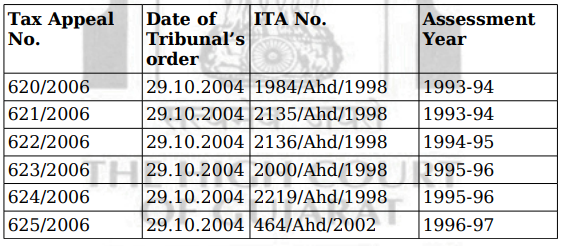
1.1 These appeals were admitted by this Court on 11.10.2006 for consideration of the following substantial question of law:
“Whether the Appellate Tribunal is right in law and on
facts in holding that interest free funds were available
with the assessee and thereby deleting the disallowance
of interest made by the Assessing Officer u/s. 36(1)(iii) (of Income Tax Act, 1961)
of the Act?”
2. The assessees filed their return of income for the
respective assessment years in question. During the course of
assessment proceedings the Assessing Officer made
disallowances/addition with regard to interest amount and
stamp charges.
2.1 Being aggrieved by the same, the assessee filed appeal
before CIT(A). The CIT(A) partly allowed the appeals. The
assessee as well as revenue therefore preferred appeals
before the Tribunal. The Tribunal deleted the disallowance of
interest amount which is being challenged by the revenue in
the present set of appeals.
3. Mr. Varun Patel, learned advocate appearing for the
revenue contended that the Tribunal has not assigned any
reasons for allowing the appeals filed by the assessee and
therefore the appeals may be remanded to the Tribunal for
reconsideration of the matters and decision afresh with
cogent and convincing reasons.
4. Mr. B.S. Soparkar, learned advocate appearing for the
respondents supported the impugned order passed by the
Tribunal and submitted that the Tribunal has not committed
any error in passing the same. He has drawn our attention to
paragraphs no. 31.1, 3.2, 3.4 & 3.5 of the impugned order and
contended that the Tribunal has considered each and every
aspect of each of the matters in detail and the transactions
carried out between M/s. Mehta Financiers. He submitted
that since the interest free funds available with the assessees
were much more than the balance no disallowance of interest
was called for.
3.1 In support of his submissions, Mr. Soparkar has relied
upon the decision of this Court in the case of Commissioner
of Income-tax vs. Raghuvir Synthetics Ltd reported in
[2013] 354 ITR 222 and in the case of Commissioner of
Income-tax – I vs. Amod Stamping (P.) Ltd reported in
[2014] 45 taxmann.com 427 (Gujarat).
5. We have heard learned advocates for the parties and
gone through the records of the case. At the outset we think
it appropriate to have a look at section 36(1)(iii) (of Income Tax Act, 1961)
and the same is reproduced hereunder:
"(iii) the amount of the interest paid in respect of
capital borrowed for the purposes of the business
or profession. Explanation.- Recurring
subscriptions paid periodically by shareholders, or
subscribers in Mutual Benefit Societies which fulfil
such conditions as may be prescribed, shall be
deemed to be capital borrowed within the meaning
of this clause; “
5.1 An identical issue had come up before this Court in the
case of Amod Stamping (supra) and this Court has observed
as under:
“[3.2] Similar observations are made by the learned
ITAT with respect to the assessment years 2005-06
and 2006-07. In the case of Reliance Utilities and
Power Ltd. (Supra), the Bombay High Court has
held that if there are funds available both interest-
free and overdraft and/or loans taken, then a
presumption would arise that investments would be
out of the interest-free funds generated or
available with the company, if the interest-free
funds were sufficient to meet the investments and
therefore, interest was deductible. Similar view has
been taken by the Division Bench of this Court in
the case of Commissioner of Income-Tax vs.
Gujarat State Fertilizers and Chemicals Ltd.
reported in [2013] 358 ITR 323 [Guj]. Applying
the ratio/law laid down by the Bombay High Court
in the case of Reliance Utilities and Power Ltd.
(Supra) as well as Division Bench of this Court in
the case of Gujarat State Fertilizers and Chemicals
Ltd. (Supra) to the facts of the case on hand and
when it has been found that the assessee was
having interest-free funds far in excess of
investments and therefore, it can be said that the
investments are made out of interest-free funds
and therefore, the AO was not justified in making
additions and/or making disallowance under
section 36(1)(iii) (of Income Tax Act, 1961). Under the
circumstances, no error and/or illegality has been
committed by the learned ITAT in deleting the
disallowance made by the AO under section 36(1) (of Income Tax Act, 1961)
(iii) of the IT Act. No question of law much less
substantial question of law arise with respect to
deletion of the disallowance made by the AO under
section 36(1)(iii) (of Income Tax Act, 1961). “
5.2 Similarly in the case of Raghuvir Synthetics Ltd (supra),
this Court has held as under:
“9. We may refer to the judgment of Apex Court
at this stage given in case of S.A.Builders Ltd. v.
Commissioner of Income Tax (Appeals)
reported in 288 ITR 1 (SC) where the question was
whether interest on funds borrowed by the
assessee to give an interest free loan to sister
concern should be allowed as deduction and the
Apex Court ruled thus :
“We have considered the submission of the
respective parties. The question involved in
this case is only about the allowability of the
interest on borrowed funds and hence we are
dealing only with that question. In our
opinion, the approach of the High Court as
well as the authorities below on the aforesaid
question was not correct.
In our opinion, the High Court in the
impugned judgment, as well as the Tribunal
and the Income Tax Authorities have
approached the matter from an erroneous
angle. In the present case, the assessee
borrowed the fund from the bank and lent
some of it to its sister concern (a subsidiary)
on interest free loan. The test, in our opinion,
in such a case is really whether this was done
as a measure of commercial expediency.
The expression "commercial expediency" is an
expression of wide import and includes such
expenditure as a prudent businessman incurs
for the purpose of business. The expenditure
may not have been incurred under any legal
obligation, but yet it is allowable as a
business expenditure if it was incurred on
grounds of commercial expediency.
We agree with the view taken by the Delhi
High Court in CIT vs. Dalmia Cement (Bhart)
Ltd. (2002) 254 ITR 377, that once it is
established that there was nexus between the
expenditure and the purpose of the business
(which need not necessarily be the business
of the assessee itself), the Revenue cannot
justifiably claim to put itself in the arm-chair
of the businessman or in the position of the
board of directors and assume the role to
decide how much is reasonable expenditure
having regard to the circumstances of the
case. No businessman can be compelled to
maximize its profit. The Income Tax
Authorities must put themselves in the shoes
of the assessee and see how a prudent
businessman would act. The authorities must
not look at the matter from their own
viewpoint but that of a prudent businessman.
As already stated above, we have to see the
transfer of the borrowed funds to a sister
concern from the point of view of commercial
expediency and not from the point of view
whether the amount was advanced for
earning profits.”
10. Accordingly, the question is answered in
favour of the assessee by the Apex Court. In this
Tax Appeal it is to be specified here that
considering the material on record and keeping in
view substantial interest free funds and business
expediency that the CIT(A) and Tribunal held the
issue in favour of assessee.
6. The question raised in the present appeals is squarely
governed by these two abovementioned decisions. In view of
the above, we are of the opinion that the Tribunal was
justified in holding that interest free funds were available with
the assessee and thereby deleting the disallowance of interest
made by the Assessing Officer u/s. 36(1)(iii) (of Income Tax Act, 1961). The
Tribunal has rightly considered that the assessees have
clearly demonstrated that it had interest free funds available
and the balance amount of interest free advances after
reducing the advance of M/s. Mehta Financiers was given for
purchase of shares. The Tribunal proceeded on the footing
that if total interest-free advances including debit balances of
partners do not exceed the total interest-free funds available
with the assessee, no interest is disallowable on account of
utilisation of fund for non-business purposes and if it exceeds,
the proportionate disallowance can be made. We are in
complete agreement with the findings of fact arrived at by the
Tribunal.
7. In the premises aforesaid, we answer the question raised
in the present appeals in the affirmative i.e. in favour of
assessee and against the revenue. We hold that the Tribunal
was justified in holding that the interest free funds were
available with the assessee and thereby deleting the
disallowance of interest made by the Assessing Officer u/s.
36(1)(iii) of the Act. The impugned order passed by Tribunal
is confirmed. Appeals stand dismissed accordingly.
(K.S.JHAVERI, J.)
(K.J.THAKER, J)
×
Similar Ripples
Questions
Court Upholds Tribunal's Decision on Interest-Free Funds Availability
Write your CommentSimilar Posts

Generic
- Reportdata/4227.pdf
