


Court Upholds Tribunal's Finding: Reassessment Notice Without Prior Approval In…



Full News

Court Upholds Tribunal's Finding: Reassessment Notice Without Prior Approval Invalid
Court Upholds Tribunal's Finding: Reassessment Notice Without Prior Approval Invalid
This case involves the Commissioner of Income Tax (appellant) challenging a decision made by the Income Tax Appellate Tribunal (ITAT) regarding the validity of a reassessment notice issued to Smt. Suman Waman Chaudhary (respondent). The High Court dismissed the appeal, affirming the ITAT's finding that the reassessment notice was invalid due to lack of proper approval.
Get the full picture - access the original judgement of the court order here
Case Name:
Commissioner of Income Tax vs. Smt. Suman Waman Chaudhary (High Court of Bombay)
Income Tax Appeal No.398 of 2001
Key Takeaways:
1. A reassessment notice issued by an Assessing Officer below the rank of Assistant Commissioner of Income Tax (CIT) requires prior approval from a higher authority.
2. Failure to obtain such approval renders the notice invalid.
3. The ITAT's finding on this matter is considered a finding of fact, not giving rise to a substantial question of law for High Court interference.
Issue
Was the reassessment notice issued under Section 148 (of Income Tax Act, 1961) valid without obtaining prior approval from the higher authority as required by Section 151 (of Income Tax Act, 1961)?
Facts
1. An Income Tax Officer (ITO) recorded reasons for issuing a reassessment notice on December 6, 1989.
2. The notice was issued on the same day (December 6, 1989).
3. The assessee (Smt. Suman Waman Chaudhary) contended that the approval of the Deputy Commissioner was not obtained before issuing the notice.
4. The ITAT found that the mandatory prior approval was not obtained, rendering the notice invalid.
Arguments
Assessee's Argument:
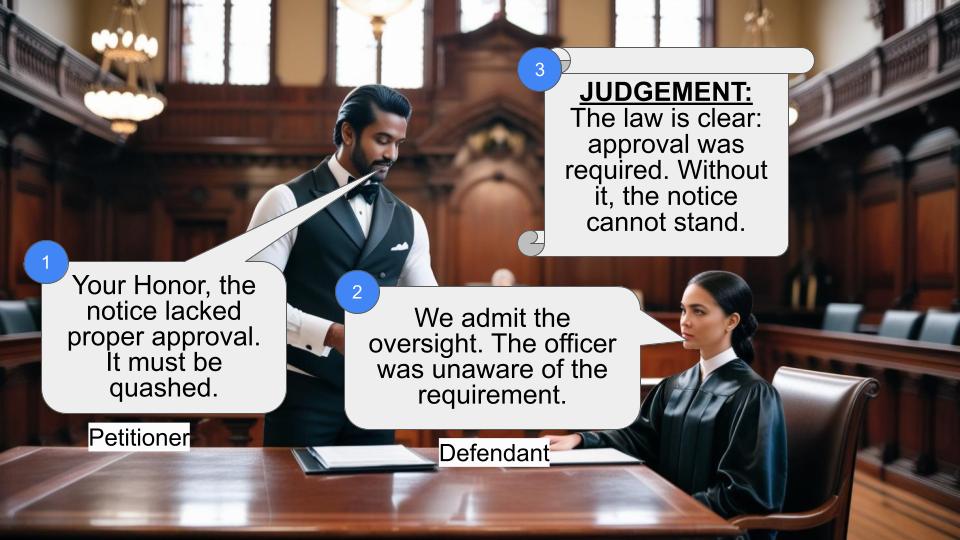
- The reassessment notice was issued without obtaining prior approval from the Deputy Commissioner, making it invalid.
Commissioner's Argument:
- The specific ground made in the appeal was that the ITAT proceeded erroneously concerning Section 151(2) (of Income Tax Act, 1961).
Key Legal Precedents
While no specific legal precedents are mentioned in the provided text, the case heavily relies on the interpretation and application of Sections 148 and 151 of the Income Tax Act.
Judgement
1. The High Court dismissed the appeal, upholding the ITAT's decision.
2. The court agreed that under Section 151(2) (of Income Tax Act, 1961), prior approval of the concerned authority is required before issuing a reassessment notice.
3. The ITAT's finding that the mandatory prior approval was not obtained was considered a finding of fact, not warranting interference by the High Court.
4. The court found no fault with the ITAT's order and consequently dismissed the appeal.
FAQs
Q1: What makes a reassessment notice under Section 148 (of Income Tax Act, 1961) valid?
A1: For a reassessment notice to be valid, it must be issued by an Assessing Officer of appropriate rank or with prior approval from a higher authority as specified in Section 151 (of Income Tax Act, 1961).
Q2: Why didn't the High Court interfere with the ITAT's decision?
A2: The High Court considered the ITAT's finding about the lack of prior approval to be a finding of fact, which doesn't give rise to a substantial question of law warranting the High Court's interference.
Q3: What is the significance of Section 151 (of Income Tax Act, 1961) in this case?
A3: Section 151 (of Income Tax Act, 1961) requires that an Assessing Officer below the rank of Assistant Commissioner or Deputy Commissioner must obtain approval from a higher authority before issuing a reassessment notice. This provision ensures proper scrutiny of the reasons for reassessment.
Q4: Can the Income Tax Department appeal this decision further?
A4: While the judgment doesn't mention further appeal options, generally, decisions of High Courts can be appealed to the Supreme Court if there's a substantial question of law involved.
Q5: What lesson can tax authorities learn from this case?
A5: This case emphasizes the importance of following proper procedures, especially obtaining necessary approvals before issuing reassessment notices. Failure to do so can render the entire reassessment process invalid.

1. While holding that the notice issued was without jurisdiction, the tribunal noted that under Section 151 (of Income Tax Act, 1961) the Assessing Officer who is below the rank of Asstt. Commissioner or Dy.Commissioner has to record the reasons and the said reasons require approval of the Dy. Commissioner or the Joint Commissioner and he has to satisfy that the reasons recorded by the A.O. are sufficient for issue of such notice. The tribunal has recorded a finding of fact that I.T.O. has recorded the reasons on 6.12.1989 and on the same date notice was issued. The tribunal has further held that the contention of the assessee that the approval of the Dy. Commissioner was not obtained by the I.T.O. before issuance of notice has not been controverted by the learned D.R. and on this and other reasons it is held that the notice is not with conformity with action and is without jurisdiction. This finding of the ITAT that prior approval was required has not been controverted. Only ground made is that the ITAT concerning Section 151(2) (of Income Tax Act, 1961) proceeded erroneously. In our opinion, this is a clear finding and under Section 151(2) (of Income Tax Act, 1961) prior approval of the concerned authority before issuance of notice is required. Considering the finding recorded by the ITAT under Section-151 (of Income Tax Act, 1961), it is not necessary to discuss the finding on the point of issue of notice under Section 292 (of Income Tax Act, 1961) B.
2. In view of the above facts, the order of the ITAT cannot be faulted and consequently the appeal dismissed.
(R.S. MOHITE, J.) (F.I. REBELLO, J.)
×
Questions
Court Upholds Tribunal's Finding: Reassessment Notice Without Prior Approval Invalid
Write your CommentSimilar Posts

Generic
- Reportdata/4825.pdf
