


Export incentives: Deduction allowed in year of receipt, calculated based on ex…


Full News

Export incentives: Deduction allowed in year of receipt, calculated based on export year
Export incentives: Deduction allowed in year of receipt, calculated based on export year
This case involves an appeal by an assessee (a manufacturing and exporting firm) against an order by the Income Tax Appellate Tribunal. The main issue was whether the assessee was entitled to deduction under Section 80HHC (of Income Tax Act, 1961) for export incentives received in a later year, while following a cash system of accounting. The High Court ruled in favor of the assessee, allowing the deduction in the year of receipt but calculated based on the export year's turnover.
Case Name**: BARCLEYS INTERNATIONAL VS COMMISSIONER OF INCOME TAX
**Key Takeaways**:
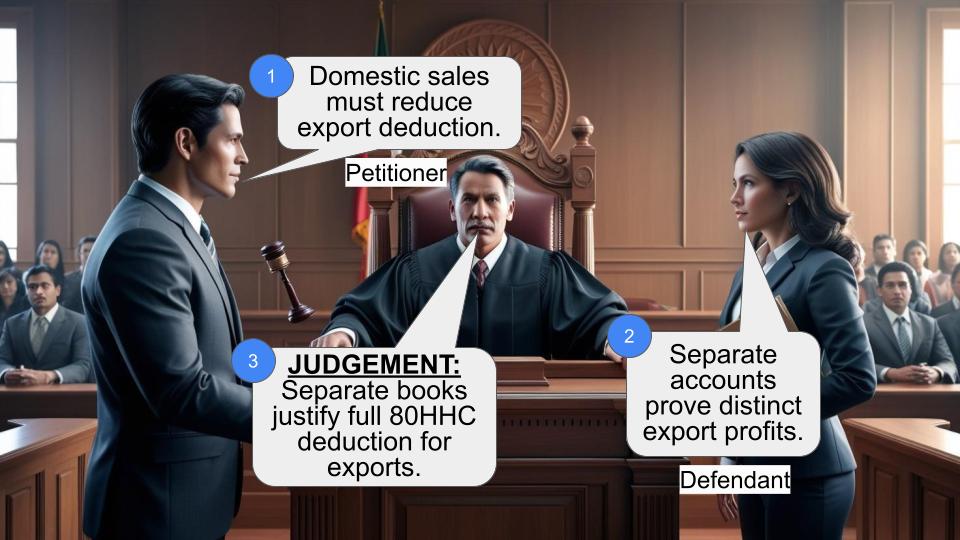
1. Deduction under Section 80HHC (of Income Tax Act, 1961) is allowable in the year of actual receipt of export incentives when following a cash system of accounting.
2. The calculation of the deduction should be based on the export turnover and total turnover of the year in which the exports were made.
3. The court relied on the Supreme Court's decision in B. Desraj v. Commissioner of Income Tax (2008) to reach its conclusion.
**Issue**:
Is the assessee entitled to statutory benefits under Section 80HHC (of Income Tax Act, 1961) for exports made in earlier years when the export incentives are received in a later assessment year, particularly when following a cash system of accounting?
**Facts**:
1. The assessee is a firm engaged in manufacturing and exporting hand tools.
2. The firm follows a cash system of accounting for export incentives.
3. In the assessment year 1992-93, the assessee received cash incentives of ₹2,11,205 and IPRS of ₹19,98,599 for exports made in 1988-89 and 1989-90.
4. The assessee claimed deduction under Section 80HHC (of Income Tax Act, 1961) for these incentives in the 1992-93 assessment year.
5. The Assessing Officer initially declined to allow the deduction.
6. The case went through various stages of appeal before reaching the High Court.
**Arguments**:
Assessee's argument:
- The deduction under Section 80HHC (of Income Tax Act, 1961) should be allowed in the year of actual receipt (1992-93) as they follow a cash system of accounting.
- The calculation should be based on the export turnover and total turnover of the years when exports were made (1988-89 and 1989-90).
Revenue's argument:
- The Tribunal's order, which disallowed the deduction, should be upheld.
**Key Legal Precedents**:
1. B. Desraj v. Commissioner of Income Tax (2008) 301 ITR 439: This Supreme Court case held that even when an assessee had not done any export business during the assessment year, they were entitled to deduction under Section 80HHC (of Income Tax Act, 1961) for export incentives received that year, relating to exports made in earlier years.
**Judgement**:
1. The High Court allowed the appeal in favor of the assessee.
2. The court held that the assessee is entitled to deduction under Section 80HHC (of Income Tax Act, 1961) in the year of receipt of export incentives (1992-93).
3. The calculation of the deduction should be based on the export turnover and total turnover of the years in which the exports were made (1988-89 and 1989-90).
4. The case was remanded to the Assessing Officer to determine the deduction admissible under Section 80HHC (of Income Tax Act, 1961) as per the court's observations.
**FAQs**:
1. Q: What is Section 80HHC (of Income Tax Act, 1961)?
A: Section 80HHC (of Income Tax Act, 1961) provides for deductions on profits derived from the export of goods or merchandise.
2. Q: Why was the deduction allowed in a different year than when the exports were made?
A: The assessee followed a cash system of accounting for export incentives, so the deduction was allowed in the year the incentives were actually received.
3. Q: How does this judgment affect other exporters?
A: This judgment clarifies that exporters following a cash system can claim deductions in the year of receipt of incentives, while basing calculations on the export year's turnover.
4. Q: What is the significance of the B. Desraj case in this judgment?
A: The B. Desraj case set a precedent that allowed deductions under Section 80HHC (of Income Tax Act, 1961) even when no exports were made in the assessment year, as long as export incentives were received that year.
5. Q: Does this judgment apply to all types of accounting systems?
A: This specific judgment applies to businesses following a cash system of accounting for export incentives. Different rules may apply for other accounting systems.

1. This appeal has been preferred by the assessee under Section 260A (of Income Tax Act, 1961) (in short, “the Act”) against the order dated 15.9.2006 passed by the Income Tax Appellate Tribunal, Amritsar Bench, Amritsar in ITANo.511(ASR)/1996 for the assessment year 1992-93. Vide order dated July 14, 2008, the appeal was admitted to consider the following substantial question of law:-
“Whether the assessee is entitled to the statutory benefits under section 80 (of Income Tax Act, 1961) HHC in respect of the exports made during the years 1988-89 and 1989-90, even when the amount representing the incentives is received during the assessment year 1992-93 particularly when he was following the cash/receipt system of accounting for the years 1988-89 and 1989-90?”
2. Briefly, the facts as narrated in the appeal may be noticed. The assessee firm is engaged in the business of manufacturing and export of hand tools. It is following mercantile system of accounting. During the assessment year 1992-93, the appellant filed its income tax return declaring an Income of ` 24,29,694/- which concluded cash incentive amounting to ` 2,11,205/- and IPRS amounting to ` 19,98,599/-. During the assessment proceedings, it was submitted before the Assessing officer that in the past there had been a dispute as to whether receipt of cash incentive and IPRS etc. was a revenue receipt or a capital receipt. Therefore, in order to put an end to this controversy, an amendment in law vide Finance Act, 1990 was made wherein sub section (iiib) was retrospectively inserted in section 28 (of Income Tax Act, 1961) w.e.f 1.4.1967 according to which cash assistance received or receivable was to be treated as income chargeable to tax w.e.f 1.4.1967. Thus, it was submitted that in the light of the aforesaid retrospective amendment in law, export incentive was to be treated as part of the trading account for the year to which it related i.e. assessment years 1988-89 and 1989-90. The assessee also submitted before the Assessing Officer that deduction under Section 80HHC (of Income Tax Act, 1961) was to be allowed out of the profits derived from the export of such goods. The Assessing Officer declined to exclude the aforesaid amounts while framing the assessment. The Assessing officer further disallowed an amount of ` 40,500/- being the interest on an amount of Rs.6 lacs that had been given as an advance by the assessee firm to one M/s Chopra Property dealer, New Delhi for the purchase of a plot at New Delhi. Aggrieved by the assessment order, the assessee filed an appeal before the CIT(A). The CIT(A) excluded the export incentives received by the assessee firm in the financial year relevant to the assessment year 1992-93 from the scope of total income for the said year with a direction that the said amounts were to be assessed in the hands of the assessee firm in the assessment years 1988-89 and 1989- 90 i.e. the period in which the said Export incentives had become receivable. The CIT(A) further deleted the disallowance of ` 40,500/- made by the Assessing officer. Aggrieved by the order, the department filed an appeal before the Tribunal. It was held that though the said export incentives had become receivable in the assessment years 1988-89 and 1989-90, but the same were liable to be included in the total income of the assessee firm for the assessment year 1992-93 and allowed the appeal. Hence this appeal by the assessee.
3. Learned counsel for the assessee submitted that as the assessee was following cash system of accountancy for export incentives, the assessee would be entitled to deduction under Section 80HHC (of Income Tax Act, 1961) on the cash incentive and the IPRS received by the assessee during the assessment year 1992-93. Learned counsel relied upon judgment of the Apex court in B.Desraj v. Commissioner of Income tax, (2008) 301 ITR 439 to submit that calculation had to be made by working out the deduction keeping in view the export turnover and total turnover of the year in which the assessee had earned the export incentive though it was not received during that year. In other words, it was submitted that the deduction under Section 80HHC (of Income Tax Act, 1961) had to be calculated with reference to export turnover and total turnover of the assessment years 1988-89 and 1989-90 but the same was admissible in the year of actual receipt of export incentive i.e. assessment year 1992-93.
4. Learned counsel for the revenue supported the order passed by the Tribunal.
5. After giving thoughtful consideration to the rival submissions, we find force in the submissions made by learned counsel for the appellant.
6. It is not disputed that the authorities had concurrently recorded that the assessee was following cash system of accountancy in respect of export incentives. Now the residuary question left for consideration would be whether in such circumstances the assessee would be entitled to any deduction under Section 80HHC (of Income Tax Act, 1961) or not in the current assessment year in respect of cash incentive and IPRS received by the assessee. This question stands answered by the Hon'ble Apex Court in B.Desraj's case (supra) in favour of the assessee. The assessee therein before the Hon'ble Supreme Court was maintaining his accounts under the cash system and had exported textiles/fabrics in the accounting year relevant to assessment year 1990-91 and had received cash compensatory allowance and duty draw back therefor in the next accounting year. Though, the assessee had not done any export business during the assessment year 1991- 92, yet the assessee was held entitled to deduction under Section 80HHC (of Income Tax Act, 1961) in relation to those items during the assessment year 1991-92. In view of the Apex Court decision in B.Desraj's case (supra), the assessee is entitled to the deduction under Section 80HHC (of Income Tax Act, 1961) by taking the export turnover and the total turnover of the year in relation to which the export incentive has been received.
7. Accordingly, the appeal is allowed and the substantial question of law is answered in favour of the assessee. The Assessing Officer shall determine the deduction admissible to the assessee under Section 80HHC (of Income Tax Act, 1961) in terms of the observations made hereinabove.
(Ajay Kumar Mittal)
Judge
July 26, 2012 (Gurmeet Singh Sandhawalia)
Judge
×
Questions
Export incentives: Deduction allowed in year of receipt, calculated based on export year
Write your CommentSimilar Posts


Generic
- Reportdata/5625.pdf
