


Financing Charges Not Automatically Interest for Tax Purposes


Full News

Financing Charges Not Automatically Interest for Tax Purposes
Financing Charges Not Automatically Interest for Tax Purposes
The case involves a dispute between the Income Tax Department and Kuber Mutual Benefit Ltd. regarding the classification of financing charges as interest for tax purposes. The court ruled in favor of the assessee, stating that such classification requires a fact-based determination and cannot be based solely on revenue officials' suspicions.
Get the full picture - access the original judgement of the court order here.
Case Name:
Commissioner of Income Tax vs. Kuber Mutual Benefit Ltd. (High Court of Delhi)
ITA 96/2006
Key Takeaways:
1. Financing charges cannot be automatically classified as interest for tax purposes.
2. Classification of charges as interest requires a fact-based determination.
3. Revenue officials' suspicions alone are insufficient for such classification.
4. One-time charges are less likely to be considered as interest.
5. The agreement between parties is crucial in determining the nature of charges.
Issue:
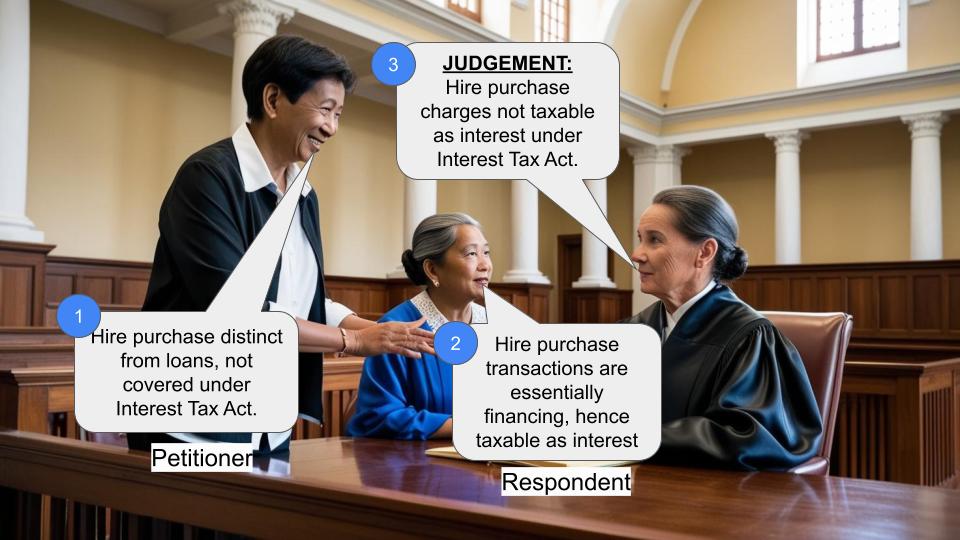
Whether the charges or amounts received by Kuber Mutual Benefit Ltd. from borrowers or subscribers of schemes should be classified as "interest" under the Interest Tax Act, 1974?
Facts:
1. Kuber Mutual Benefit Ltd. was carrying on financial business, including accepting deposits and lending money.
2. The company charged borrowers certain amounts under different heads, including "financing charges".
3. For the assessment year 1996-97, the Assessing Officer (AO) opined that the amount claimed as processing charges was actually interest.
4. The AO added back Rs. 3,17,52,377/- and brought it to tax under the Interest Tax Act.
5. The assessee's appeal partly succeeded, with the added amount halved.
6. The Income Tax Appellate Tribunal (ITAT) ruled in favor of the assessee, stating that the financing charges could not be treated as interest.
Arguments:
Assessing Officer's Argument:
- The financing charges were unusually high, suggesting they were actually interest.
- The inclusive nature of the definition of interest under Section 2 of the Interest Tax Act supports this classification.
Assessee's Argument:
- The financing charges were not payable as interest on loans and advances as per the agreement between parties.
- These were one-time charges, not recurring payments.
- There was no material to conclude that the financing charges were in the nature of interest.
Key Legal Precedents:
1. Commissioner of Income Tax v. State Bank of Indore (1988) 172 ITR 24:
The Madhya Pradesh High Court held that charges for delayed payment of loans and advances could not be treated as interest, as they were payable as damages.
Judgement:
The court dismissed the appeal, ruling in favor of the assessee. Key points of the judgment include:
1. The classification of charges as interest must be based on a fact-to-fact determination and cannot rest on the suspicions of revenue officials.
2. The Assessing Officer should have made further enquiries about the ordinary rates charged by the assessee from non-members and rates charged by similar entities.
3. The court emphasized that the agreement between parties is crucial in determining the nature of charges.
4. The fact that these financial charges were one-time charges and not recurring was considered significant.
5. The court found no error in the ITAT's conclusions and stated that no question of law arises in this case.
FAQs:
Q1: What is the main issue in this case?
A1: The main issue is whether financing charges can be automatically classified as interest for tax purposes.
Q2: Why did the court rule in favor of the assessee?
A2: The court ruled in favor of the assessee because it found that classifying charges as interest requires a fact-based determination and cannot be based solely on revenue officials' suspicions.
Q3: What is the significance of this judgment?
A3: This judgment emphasizes the need for a thorough investigation and fact-based approach when classifying financial charges for tax purposes, rather than relying on assumptions or suspicions.
Q4: How does this judgment affect the interpretation of the Interest Tax Act?
A4: It suggests a more nuanced interpretation of what constitutes "interest" under the Act, requiring a closer examination of the nature of charges and the agreements between parties.
Q5: What factors did the court consider important in this case?
A5: The court considered factors such as the one-time nature of the charges, the agreement between parties, and the need for comparative data on rates charged to non-members and by similar entities.

1. The substantial question of law stated to be urged is “whether the ITAT’s conclusions with respect to the applicability of the provisions of Interest Tax Act were erroneous?”
2. The assessee, at the relevant time, was carrying on financial business which included accepting deposits as a mutual benefit fund company. It also used to lend money and, for that purpose, charged from its borrowers certain amounts under different heads which included “financing charges”. The AO was of the opinion – for assessment year 1996-97, that the amount claimedas processing charges was in fact interest, and liable to be treated as such for the purposes of the Interest Tax Act, 1974. To say so, the AO relied upon the inclusive nature of definition of interest under Section 2 (of Income Tax Act, 1961) of the said Act.
Consequently, the sum of Rs.3,17,52,377/- was added back and brought to tax under the Interest Tax Act. The assessee’s appeal partly succeeded in that the amount added back was halved. The further appeal to the ITAT however succeeded.
3. The ITAT, relying upon the decision of the Madhya Pradesh High Court in Commissioner of Income Tax V. State Bank of Indore (1988) 172 ITR 24, held that the financing charges could not be treated as interest. The relevant findings of the ITAT in this regard are as follows :
“It is apparent from the definition of interest that it is only the interest on loans and advances made in India that would be considered as interest within the meaning of the I. T. Act 974 (sic). Section 5 of the Interest Tax Act, contemplates interest accruing or arising to the assessee in the previous year. It is generally the agreement between the parties, which will determine the quantum of interest to be paid on loans and advances. Admittedly, the financing charges which were considered as interest by the revenue authorities was not payable as interest on the loans and advances given by the assessee as per agreement between the parties. The Ld. CIT(A) while setting aside the original order of assessment framed by the AO had specifically given a direction that AO should place before the assessee all aspects of the case for their comments acceptance repudiation and explanation. In the order of assessment framed deno vo, the AO has merely a made to an observations that the financing charges shown to have been received from the members actually in the nature of interest charged from its members. This was apparently not a proper compliance with the direction the Ld. CIT(A). Be that as it may. There is no material brought by the AO to come to a conclusion that the financing charges shown by the assessee were infect in the nature of interest on loans advanced by the assessee to its members. A perusal of the order of the Ld. CIT(A), shows that he has gone by the fact that the market rate of financing charges charged by the assessee was much higher and to the extent to which it is higher than the market rate there was a diversion of chargeable interest to that extent. He further, corroborated his findings by the fact that the borrowers were members of the assessee and that as lender, the assessee would be in a position to exercise undue influence over its borrowers. This was not enough to come to a conclusion that the financing charges collected by the assessee were in the nature of interest payable on loans. As clearly stated, payment of interest would governed by the agreement between the parties. Admittedly, it is not the case of the revenue that there was any such agreement between the assessee and its borrowers. The financing charges were a one time charge. It is therefore, not possible to construe then as interest on loans and advances. Apart from the above, the Ld. CIT(A) has not given any basis of coming to the conclusion that 50% of the financing charges should be treated as chargeable interest. The quantum of 50% is adopted without any basis and purely as a guess work. This was not permissible in law. Since there was no material to come to the conclusion that the processing fees charged by the assessee was in the nature of interest and that the assessee by charging excess processing fees attempted to divert the chargeable interest by claiming higher processing fees, the addition sustained by the Ld. CIT(A) was without any business and the same deserves to be deleted and the same is directed to be deleted. The 8th ground of appeal in both the appeal are allowed.”
4. Section 2(7) of the Interest Tax Act reads as follows :
(7) "Interest" means interest on loans and advances made in India and includes :
(a) commitment charges on unutilized portion of any credit sanctioned for being availed of in India; and
(b) discount on promissory notes and bills of exchange drawn or made in, India,but does not include-
(i) interest referred to in sub- section (1B) of the Reserve Bank of India Act, 1934 ; (2 of 1934)
(ii) discount on treasury bills;
What is chargeable interest is provided for by Section 5 (of Income Tax Act, 1961) of enactments which reads as follows :
“Scope of chargeable interest”
Subject to the provisions of this Act, the chargeable interest any previous year of a credit institution shall be the total amount of interest other than interest on loans and advances made to (other credit institutions or to any cooperative society engaged in carrying on the business of banking) accruing or arising to the credit institution in that previous year.
Provided that any interest in relation to categories of bad or doubtful debts referred to in section 43D of the Income- tax Act shall be deemed to accrue or arise to the credit institution in the previous year in which it is credited by the credit institution to its profit and loss account for that year or, as the case may be, in which it is actually received by the credit institution, whichever is earlier.”
5. In State Bank of Indore (supra) the Madhya Pradesh High Court decided to deal with the issue as to whether charges for delayed payment of loan and advances would be treated as interest. The High Court was of the opinion that it could not so be treated given that it was by way of damages that the amounts were payable. In the present circumstance, what swayed the AO to bring the income in question to tax, was what he considered to be unusual high rates of financing charges, from assessee by its members.
6. Whilst such a factor might itself constitute a suspicious circumstance,by no means can it be determinative or conclusive. In order to support his conclusions, the AO ought to have made further enquiries such as what was the ordinary rate which the assessee charged from non-members for similar services and what did other similar placed companies or entities charge from their members or borrowers. The conclusions, based on mere suspicion in such circumstances, could not have withstood the scrutiny of law. However,the Appellate Commissioner chose to give partial relief, based, again, on a similar line of logic. However, this cannot result in our holding that the ITAT can be faulted in its conclusions. As to whether charges or amounts received from borrowers or subscribers of schemes, are truly, “interest” necessarily has to be dependent on a fact to fact determination, and cannot rest on the suspicions of the revenue officials. Another important factor in the present case is that these financial charges were one time charges and were not recurring. For these reasons the Court is of the opinion that no question of law arises. The appeal is accordingly dismissed.
7. Pending application is also disposed of as infructuous.
S. RAVINDRA BHAT
(JUDGE)
R.K.GAUBA
(JUDGE)
FEBRUARY 05, 2015
×
Similar Ripples
Questions
Financing Charges Not Automatically Interest for Tax Purposes
Write your CommentSimilar Posts

Generic
- Reportdata/4032.pdf
