


Goodwill is an asset eligible for depreciation under Income Tax Act


Full News
Goodwill is an asset eligible for depreciation under Income Tax Act
Goodwill is an asset eligible for depreciation under Income Tax Act
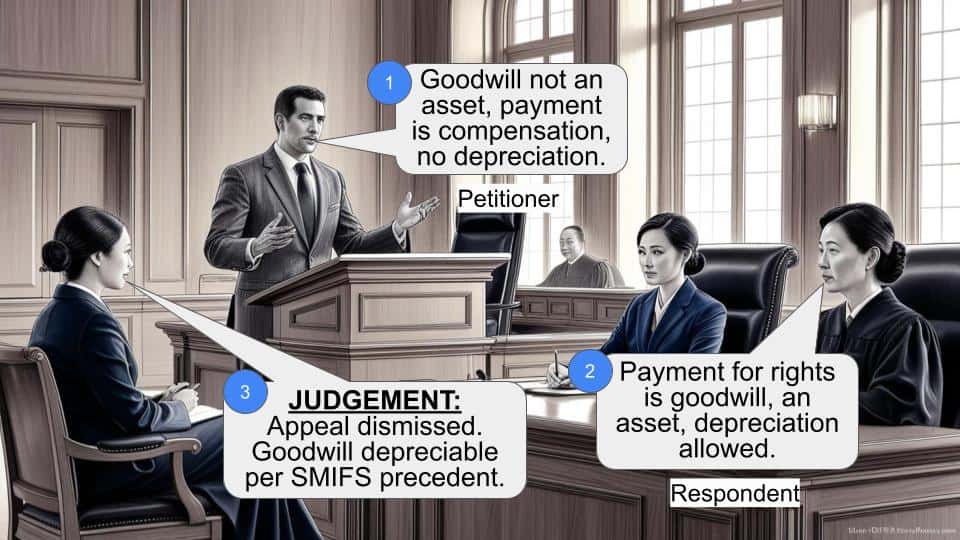
This case involves an appeal by the revenue department against a decision by the Income Tax Appellate Tribunal (ITAT) that allowed depreciation on goodwill. The High Court dismissed the appeal, affirming that goodwill is indeed an asset eligible for depreciation under Section 32(1) (of Income Tax Act, 1961).
Get the full picture - access the original judgement of the court order here
Case Name:
Principal Commissioner of Income Tax Vs Swastik Industries (High Court of Gujarat)
Tax Appeal No. 153 & 157 of 2016
Date: 21st March 2016
Key Takeaways
1. Goodwill is considered an intangible asset under Section 32(1) (of Income Tax Act, 1961).
2. Depreciation can be claimed on goodwill as per the Supreme Court's ruling in the SMIFS Securities Ltd. case.
3. Payments made to retiring partners, when recorded as goodwill, can be eligible for depreciation.
Issue
Can goodwill be considered an asset eligible for depreciation under Section 32(1) (of Income Tax Act, 1961)?
Facts
1. The assessee, a partnership firm, claimed depreciation on goodwill in their tax return.
2. The firm had paid Rs.35,00,000 to retiring partners as compensation, which they recorded as goodwill in their books.
3. The Assessing Officer initially disallowed the depreciation claim on goodwill.
4. The case went through appeals, reaching the Income Tax Appellate Tribunal (ITAT).
5. The ITAT allowed the depreciation claim, which the revenue department then challenged in the High Court.
Arguments
Here's what both sides were saying:
Assessee's side:
- The payment to retiring partners was for acquiring commercial rights and should be treated as an intangible asset.
- As an intangible asset, it should be eligible for depreciation under Section 32(1) (of Income Tax Act, 1961).
Revenue's side:
- The payment to retiring partners was compensation, not goodwill.
- Goodwill isn't an asset that qualifies for depreciation under the Income Tax Act.
- Even if it's considered goodwill, it's a capital expenditure and not eligible for depreciation.
Key Legal Precedents
The big game-changer here was a previous Supreme Court case:
Commissioner of Income Tax v. SMIFS Securities Ltd., (2012) 348 ITR 302
In this case, the Supreme Court ruled that goodwill falls under the category of "any other business or commercial rights of similar nature" mentioned in Explanation 3(b) to Section 32(1) (of Income Tax Act, 1961). This means goodwill is considered an intangible asset eligible for depreciation.
Judgement
The High Court sided with the assessee here. They said:
1. The ITAT was right to allow depreciation on goodwill.
2. The Supreme Court's decision in the SMIFS Securities case clearly states that goodwill is an asset under Section 32(1) (of Income Tax Act, 1961).
3. There was no error in the ITAT's order that would warrant the High Court's interference.
As a result, the High Court dismissed the revenue department's appeal.
FAQs
1. Q: What exactly is goodwill in this context?
A: In this case, goodwill refers to the amount paid to retiring partners, which was recorded as an intangible asset in the firm's books.
2. Q: Why was this case significant?
A: It reinforced the Supreme Court's earlier ruling that goodwill is an intangible asset eligible for depreciation under the Income Tax Act.
3. Q: Does this mean all payments to retiring partners can be claimed as goodwill?
A: Not necessarily. The treatment would depend on the specific circumstances and how the payment is recorded in the company's books.
4. Q: What's the practical implication of this judgment for businesses?
A: Businesses may now have more clarity on claiming depreciation on goodwill, potentially leading to tax benefits.
5. Q: Could this decision be challenged further?
A: While it's always possible, the fact that it aligns with a Supreme Court decision makes it less likely to be overturned.

1. In all these appeals under section 260A (of Income Tax Act, 1961) (hereinafter referred to as “the Act”), the appellant – revenue has called in question the common order dated 29.05.2015 made by the Income Tax Appellate Tribunal, Ahmedabad “C” Bench (hereinafter referred to as “the Tribunal”) in the corresponding appeals, by proposing the following common question, stated to be a substantial question of law :
“Whether on facts and in the circumstances of the case and in law, the ITAT was right in treating the payments made to retiring partners in the nature of compensation can be termed as goodwill and subsequently eligible for depreciation?”
2. The assessment years are 2003-04 to 2006-07 and 2008- 09. The facts and circumstances of all the five cases are similar except for the assessment years and the amounts. Since the controversy involved in all these appeals is common, the same were heard together and are disposed of by this common order.
3. For the sake of convenience, reference is made to the facts as appearing in ITA No.203/Ahd/2012 for assessment year 2003-04. The assessee is a partnership firm engaged in the business of doing job work of embroidery. The assessee filed its return of income for assessment year 2003-04 on 30.06.2003 declaring total loss of Rs.2,18,480/-, which came to be accepted under section 143(1) (of Income Tax Act, 1961). Thereafter, the assessment came to be reopened by issuing notice under section 148 (of Income Tax Act, 1961). The Assessing Officer, upon perusing the depreciation chart furnished by the assessee along with return of income, noticed that the assesses had claimed depreciation of Rs.4,86,443/- on goodwill. The Assessing Officer was of the view that the assessee was not eligible to claim depreciation of goodwill and accordingly, by an order dated 22.10.2010 under section 147 (of Income Tax Act, 1961) read with section 143(3) (of Income Tax Act, 1961) disallowed the claim of depreciation on goodwill and made an addition of Rs.4,86,443/-. The assessee carried the matter in appeal before the Commissioner of Income Tax (Appeals), who held that the assessee was not eligible for depreciation on goodwill and upheld the disallowance. The assessee carried the matter in further before the Tribunal and succeeded.
4. Mr. Sudhir Mehta, learned Senior Standing Counsel for the appellant reiterated the grounds stated in the memorandum of appeal and submitted that the Tribunal has failed to appreciate that the assessee had made payment to retiring partners which was in the nature of compensation and had been brought in the books as goodwill, and as such the same would by no stretch of imagination fall within the purview of the expression goodwill. It was submitted that the payment of compensation for surrendering rights in the firm was a capital expenditure on which no depreciation was allowable, and hence, the depreciation claimed on goodwill cannot be allowed. It was, accordingly, urged that the appeals do give rise to a question of law, as proposed or as may be formulated by the court.
5. This court has considered the submissions advanced by the learned counsel for the appellant and has also perused the impugned order passed by the Tribunal as well as the orders passed by the lower authorities.
6. The facts as emerging from the record are that the assessee had shown acquisition of goodwill of an amount of Rs.19,45,774/- and had claimed depreciation of Rs.4,86,443/- @ 25% on the goodwill in assessment year 2003-04. It was the case of the assessee that an amount of Rs.35,00,000/- had been paid to the retiring partners as compensation on retirement from the business of the firm and in the books of account, the payment was technically shown as goodwill. In fact, the same was paid for acquiring commercial rights and was, therefore, eligible for depreciation under the head “intangible assets”. The Assessing Officer was of the view that under section 32 (of Income Tax Act, 1961), depreciation on goodwill is not an allowable expense, as goodwill is neither a tangible asset nor an intangible asset. He, accordingly, disallowed the claim of depreciation of Rs.4,86,443/- on goodwill for the said assessment year and added the same to the total income of the assessee. The Commissioner (Appeals), upon appreciation of the evidence on record, found that the assessee had mentioned the payment made to the retiring partners in the fixed assets schedule as goodwill. That no commercial rights over and above the rights already enjoyed by the firm were acquired by it by virtue of making payment to the retiring partners and hence, the payments made by the firm cannot be said as made for acquiring any commercial right. The Commissioner (Appeals), accordingly, held that since no commercial rights have been acquired by the firm, no depreciation was admissible on goodwill and accordingly, disallowed the depreciation. Thus, both the Commissioner (Appeals) as well as the Assessing Officer have proceeded on the footing that the amount paid to the retiring partners constituted ‘goodwill’ on which depreciation was not allowable. The contention raised in the memorandum of appeal with regard to the amount not being ‘goodwill’, therefore, is not borne out from the findings recorded by the Assessing Officer and the Commissioner (Appeals). The Tribunal, in the impugned order, has not accepted the assessee’s contention that the payment was for acquiring commercial rights and has proceeded on the footing that the payment was in the nature of ‘goodwill’ and placing reliance upon the decision of the Supreme Court in the case of Commissioner of Income Tax v. SMIFS Securities Ltd., (2012) 348 ITR 302, has allowed the claim for depreciation.
7. The Supreme Court in the case of Commissioner of Income Tax v. SMIFS Securities Ltd. (supra) was dealing with the question as to whether ‘goodwill’ is an asset within the meaning of section 32 (of Income Tax Act, 1961), and whether depreciation on ‘goodwill’ is allowable under the said section. The Assessing Officer had held that ‘goodwill’ is not an asset falling under Explanation 3 to section 32(1) (of Income Tax Act, 1961).
The Supreme Court held that Explanation 3 states that the expression “asset” shall mean intangible assets, being know- how, patents, copyrights, trademarks, licences, franchises or any other business or commercial rights of similar nature. A reading of the words “any other business or commercial rights of similar nature” in clause (b) of Explanation 3 indicates that goodwill would fall under the expression “any other business or commercial rights of similar nature”. The principle of ejusdem generis would strictly apply while interpreting the said expression which finds place in Explanation 3(b). The court was, accordingly, of the view that “goodwill” is an asset under Explanation 3(b) to section 32(1) (of Income Tax Act, 1961), and accordingly, answered the question in favour of the assessee.
8. In the present case, from the findings recorded by the Assessing Officer, the Commissioner (Appeals) as well as the Tribunal, it is an undisputed fact that the payment made to the retiring partners has been considered to be goodwill. The Supreme Court in the above decision has held that goodwill is an asset under Explanation 3(b) to section 32(1) (of Income Tax Act, 1961). Thus, the Tribunal has merely applied the above decision of the Supreme Court to the facts of the present case. Under the circumstances, it is not possible to state that there is any infirmity in the impugned order passed by the Tribunal so as to give rise to a question of law, much less, a substantial question of law, warranting interference.
9. The appeals, therefore, fail and are, accordingly, dismissed.
(HARSHA DEVANI, J.)
(G.R.UDHWANI, J.)
×
Similar Ripples
Questions
Goodwill is an asset eligible for depreciation under Income Tax Act
Write your CommentSimilar Posts


Generic
- Reportdata/2984.pdf
