


Full News
High Court Allows Tribunal to Rectify Mistakes Despite Pending Appeal
High Court Allows Tribunal to Rectify Mistakes Despite Pending Appeal
The case involves R.W. Promotions P. Ltd. challenging an Income Tax Appellate Tribunal (ITAT) order. The main issue was whether the ITAT could rectify its order under Section 254(2) (of Income Tax Act, 1961), despite an appeal being filed under Section 260A (of Income Tax Act, 1961) before the High Court. The High Court ruled that the ITAT retains the power to rectify mistakes even if an appeal is pending.
Get the full picture - access the original judgement of the court order here.
Case Name:
R.W. Promotions P. Ltd. vs. Income Tax Appellate Tribunal & Ors.(High Court of Bombay)
Writ Petition No.2238 of 2014
Key Takeaways
- The ITAT can rectify any mistake apparent from the record under Section 254(2) (of Income Tax Act, 1961), even if an appeal under Section 260A (of Income Tax Act, 1961) is pending before the High Court.
- The Tribunal's refusal to rectify the mistake solely because an appeal was pending was deemed incorrect by the High Court.
- The High Court emphasized that rectifying mistakes can save judicial time for both the Tribunal and higher courts.
Issue
Can the Income Tax Appellate Tribunal rectify its order under Section 254(2) (of Income Tax Act, 1961), even if an appeal under Section 260A (of Income Tax Act, 1961) is pending before the High Court?
Facts
- R.W. Promotions P. Ltd. filed an application under Section 254(2) (of Income Tax Act, 1961) to rectify mistakes in an ITAT order related to the assessment year 2007-08.
- The ITAT rejected the application, citing that an appeal under Section 260A (of Income Tax Act, 1961) was pending before the High Court.
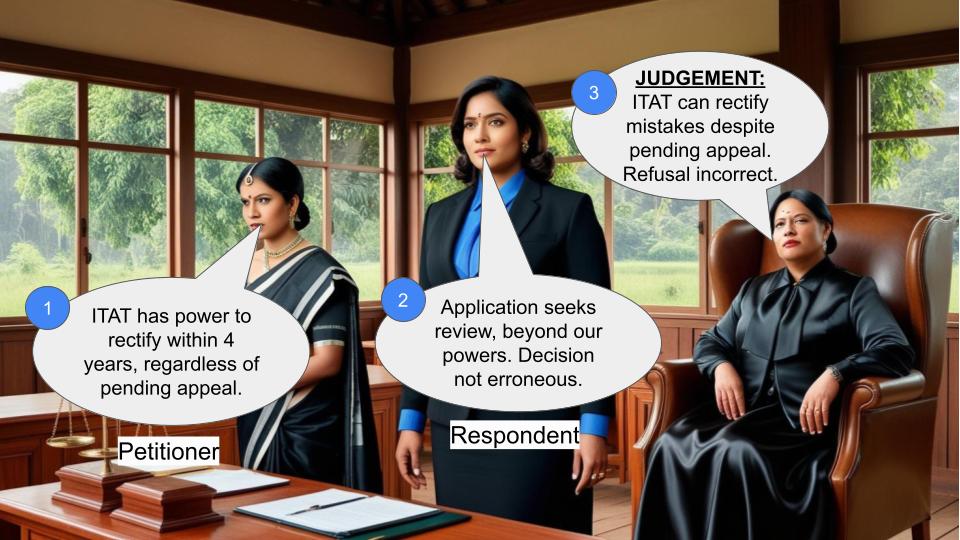
- The petitioner argued that the ITAT's understanding of the law was incorrect and that the Tribunal could still rectify mistakes despite the pending appeal.
Arguments
- Petitioner (R.W. Promotions P. Ltd.):
Argued that the ITAT has the power to rectify mistakes within four years of the order, regardless of a pending appeal under Section 260A (of Income Tax Act, 1961). The petitioner emphasized that the Tribunal's refusal was based on a misinterpretation of the law.
- Respondent (Revenue):
Contended that the application sought a review and recall of the initial order, which was beyond the Tribunal's powers. They argued that the Tribunal's decision was neither erroneous nor perverse.
Key Legal Precedents
- Section 254(1) (of Income Tax Act, 1961) and (2) of the Income Tax Act, 1961:
These sections empower the ITAT to pass orders and rectify any mistakes apparent from the record within four years of the order.
- Section 260A (of Income Tax Act, 1961):
Allows for an appeal to the High Court if a substantial question of law is involved.
Judgement
The High Court ruled that the ITAT's refusal to rectify the mistake solely because an appeal was pending was incorrect. The court clarified that the ITAT retains the power to rectify mistakes under Section 254(2) (of Income Tax Act, 1961) even if an appeal under Section 260A (of Income Tax Act, 1961) is pending. The writ petition was allowed, and the ITAT was directed to hear and decide the rectification application on its merits within six weeks.
FAQs
Q1: Can the ITAT rectify its order if an appeal is pending before the High Court?
A1: Yes, the ITAT can rectify any mistake apparent from the record under Section 254(2) (of Income Tax Act, 1961), even if an appeal under Section 260A (of Income Tax Act, 1961) is pending before the High Court.
Q2: What was the main issue in this case?
A2: The main issue was whether the ITAT could rectify its order under Section 254(2) (of Income Tax Act, 1961) despite an appeal being filed under Section 260A (of Income Tax Act, 1961) before the High Court.
Q3: What did the High Court decide?
A3: The High Court decided that the ITAT's refusal to rectify the mistake solely because an appeal was pending was incorrect. The court directed the ITAT to hear and decide the rectification application on its merits.
Q4: What sections of the Income Tax Act were relevant in this case?
A4: Sections 254(1), 254(2), and 260A of the Income Tax Act, 1961, were relevant in this case.

1] Though the order passed by this Court on 10th November, 2014 directs that the Writ Petition No.2238 of 2014 filed by the petitioner-assessee and the Appeal being Income Tax Appeal No.1489 of 2013 be taken up together, what we find that the Writ Petition impugns the order dated 12th March, 2014 of the Income Tax Appellate Tribunal.
2] That order was passed on the petitionerassessee's application invoking powers of the Tribunal under section 254(2) (of Income Tax Act, 1961).
3] The Misc. Application No.194/M/2013 was filed by the petitioner- assessee seeking a rectification of the mistake in the initial order passed by the Tribunal under Income Tax Appeal No.3969/Mum/2012 for assessment year 200708. In the application by the assessee, petitioner before us, it was pointed out that there are certain mistakes and which need to be rectified. That application and copy of which has been annexed to this Writ Petition paper book at page 119 to 127 requests the Tribunal to correct such errors. The ultimate prayer therein is that the order on 16th January, 2013 in the above Income Tax Appeal suffers from mistakes which are apparent and deserve to be rectified.
4] It is this application filed on 28th May, 2013 which was placed before the Tribunal. The Tribunal passed the impugned order which reads as under:
“The assessee has moved an instant Miscellaneous Application (MA) against the order of the ITAT in ITAT No.3969/Mum/2012.
2. At the time of hearing, the AR for the assesseeappellant informed that the assessee has filed an appeal u/s 260A (of Income Tax Act, 1961), before the Bombay High Court, but is yet to be admitted. Since the appeal has been filed before the Bombay High Court, the judicial propriety does not allow the assessee to seek efficacious remedy simultaneously before two authorities and in particular where the issue is seized by a higher judicial forum, even if pending admission.
3. On this ground, the instant MA is rejected.
4. We, therefore, reject the MA as filed.”
5] We have heard Dr. Shivram, the learned Senior Counsel appearing on behalf of the petitioner in support of this Writ Petition, he invited our attention to section 264 (of Income Tax Act, 1961) and particularly sub- section(2) thereof. In his submission, the above view taken by the Tribunal is patently incorrect. He would submit that the power conferred in the Appellate Tribunal in terms of the sub section(2) of section 254 (of Income Tax Act, 1961) can be invoked at any time within 4 years from the date of the order and with a view to rectify any mistake apparent from the record. If such is the position, then, the Tribunal can amend its initial order passed under sub- section(2) of section 254 (of Income Tax Act, 1961). That can be done by the Tribunal if the mistake is brought to its notice by the assessee or the Assessing Officer.
6] These two provisions, namely, subsection (1) and (2) of section 254 (of Income Tax Act, 1961) read as under:
“Section 254(1) (of Income Tax Act, 1961). The Appellate Tribunal may, after giving both the parties to the appeal an opportunity of being heard, pass such orders thereon as it thinks fit.
(2) The Appellate Tribunal may, at any time within four years from the date of the order, with a view to rectifying any mistake apparent from the record, amend any order passed by it under subsection (1), and shall make such amendment if the mistake is brought to its notice by the assessee or the Assessing Officer:
Provided further that any application filed by the assessee in this subsection on or after the 1st day of October, 1998, shall be accompanied by a fee of fifty rupees.”
7] Dr. Shivram further submits that merely because from the initial order of the Tribunal and passed under subsection (1) of section 254 (of Income Tax Act, 1961) the aggrieved Assessee has filed the Appeal to the High Court and which is pending for admission does not mean that the power either under sub- section (2) cannot be invoked by the parties or having been invoked the Tribunal’s power, cannot be exercised by the Tribunal. He would further submit that the understanding of the Tribunal of the legal provision is patently erroneous and perverse. There is nothing contrary to judicial propriety if the Tribunal exercised its power under subsection (2) of section 254 (of Income Tax Act, 1961). Dr. Shivram further assails the view of the Tribunal that it holds that the assessee in this case cannot pursue the remedy simultaneously before two authorities. He would submit that the Appeal under section 260A (of Income Tax Act, 1961) lies before this Court provided this Court is satisfied that the case involves a substantial question of law. Merely because such an Appeal has been filed does not mean that the Tribunal is prevented in law from dealing with an application under subsection (2) of section 254 (of Income Tax Act, 1961). Dr. Shivram also submits that the Tribunal may dismiss the application under subsection (2) of section 254 (of Income Tax Act, 1961) if the same seeks a relief beyond its powers under that provision or is seeking complete recall or review of the initial order. On such grounds and similar to those raised in a Appeal one can understand the approach of the Tribunal in not granting the application but the application cannot be thrown out at the threshold merely because a Appeal under section 260A (of Income Tax Act, 1961) of the Income Tax has been filed before this Court and is pending. Dr. Shivram submits that this understanding of the legal provision by the Tribunal as reflected in the impugned order ought to be immediately setright and corrected or the Tribunal would perpetuate the above view even in further matters.
8] Mr. Pinto, the learned counsel, appearing on behalf of the revenue submits that the application of the present nature as is filed by the petitioner assessee cannot be granted for it seeks review and recall of the initial order. Therefore the view taken by the Tribunal is neither erroneous nor perverse and the petition deserves to be dismissed.
9] After hearing both sides and perusing the two legal provisions, namely, under section 254 (of Income Tax Act, 1961) as reproduced above, and section 260A (of Income Tax Act, 1961) we are of the view that the Tribunal’s order and impugned in the Writ Petition cannot be sustained. This Court also has clarified the legal position in an order passed copy of which is annexed at page 146 of the petition paper book. We have noted that such a power is possessed by the Court or Tribunal and even after it disposes of the main matter and application of the nature made and to seek rectification or correction of an apparent mistake cane be entertained. The legal provision before us is plain and clear. Subsection(2) of section 254 (of Income Tax Act, 1961) enables the Tribunal to entertain the application of the above nature but what orders ought to be passed on such an application depends upon the facts and circumstances of each case. No general rule can be laid down in that behalf. The Tribunal can rectify any mistake apparent from the record and amend its order passed under section (1) of section 254 (of Income Tax Act, 1961). If the amendment has the effect of enhancing an assessment or reducing a refund or otherwise increasing the liability of the assessee, then, such an amendment shall not be made under this subsection unless the Appellate Tribunal has given notice to the assessee of its intention to do so and has allowed the assessee a reasonable opportunity of being heard. We are not confronted with such a situation. What we are called upon to decide is the correctness of the view taken by the Tribunal and that the judicial propriety does not allow the petitioner assessee to seek a full remedy similar before two authorities and in particular where the issue is pending for admission before higher forum.
10] The least that can be said about the understanding of the legal provision by the Tribunal is that it is ex facie incorrect and erroneous. Merely because the assessee has challenged the order of the Tribunal in an Appeal under section 260A (of Income Tax Act, 1961) before the High Court does not mean that the power under section (2) of section 254 (of Income Tax Act, 1961) cannot be invoked either by the assessee or by the revenue/Assessing Officer. Such a power enables the Tribunal to rectify any mistake apparent from the record and make amendments. That in a given case would not only save precious judicial time of the Tribunal but even of the higher Court. Only when the assessee or the Assessing Officer calls upon the Tribunal to undertake an exercise which is not permissible within the meaning of section (2) of section 254 (of Income Tax Act, 1961) that the Tribunal can rely on the principle of judicial propriety or its reluctance or refusal to take upon itself the powers of the higher Court of Appeal. We can understand if the Tribunal had passed an order after considering the application made by the peritioner assessee on its merits and in accordance with law.
However, the refusal of the Tribunal to go ahead and reject the application only on the ground that the petitionerassessee has invoked the appellate powers of higher Court cannot be sustained. That is contrary to the plain language of the two statutory provisions and which have been brought to our notice. Nothing contrary having been pointed out and such a view of the Tribunal may affect and prejudicially the interest of the revenue that all the more we cannot sustain the impugned order. The Writ Petition is allowed. The petitioners misc. application seeking to invoke the powers under sub section (2) of section 254 (of Income Tax Act, 1961) being Misc. Application No.194/M/2013 shall now be heard by the Tribunal and it shall be decided in accordance with law. The Tribunal shall hear both sides and passed a reasoned order on the said application as expeditiously as possible and, in any event, within a period of six weeks from the date of receipt of the copy of this order. We clarify that beyond the issue of maintainability and jurisdiction of the Tribunal to deal with the application of the above nature, we have observed nothing on the merits or demerits of this application. All contentions of both sides on the merits of the rectification application are kept open. They can be raised before the Tribunal.
(A. K. MENON, J.) (S. C. DHARMADHIKARI, J.)
×
Similar Ripples
Questions
High Court Allows Tribunal to Rectify Mistakes Despite Pending Appeal
Write your CommentSimilar Posts

Generic
- Reportdata/3874.pdf
