


High Court dismisses Revenue’s appeal on Section 14A (of Income Tax Act, 1961) …


Full News

High Court dismisses Revenue’s appeal on Section 14A (of Income Tax Act, 1961) disallowance limits
High Court dismisses Revenue’s appeal on Section 14A (of Income Tax Act, 1961) disallowance limits
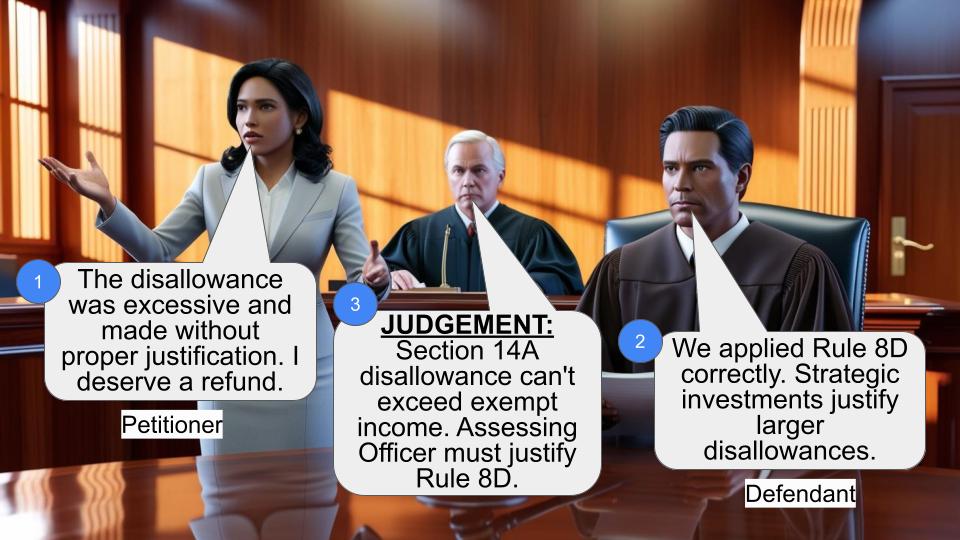
This case involves the Principal Commissioner of Income Tax challenging a tribunal decision that favored M/s. EWS Finance & Investments Pvt Ltd. The Revenue was upset because the tribunal limited the disallowance under Section 14A (of Income Tax Act, 1961) (which deals with expenses related to exempt income) to only the amount of exempt income actually earned. The High Court dismissed the Revenue’s appeals, essentially saying “we’ve already decided this issue before, and the tribunal got it right.”
Get the full picture - access the original judgement of the court order here
Case Name
Principal Commissioner of Income Tax vs M/s. EWS Finance & Investments Pvt Ltd. (High Court of Madras)
Tax Case Appeal Nos.140 & 141 of 2021 and C.M.P.No.2625 of 2021 in T.C.A.No.141 of 2021
Date: 15th February 2021
Key Takeaways
- Disallowance under Section 14A (of Income Tax Act, 1961) cannot exceed the exempt income earned - this is a significant protection for taxpayers
- The court followed its own precedent from Commissioner of Income Tax Vs. M/s.Tidel Park Limited, showing consistency in judicial decisions
- CBDT circulars don’t override judicial interpretations when they conflict with established legal principles
- The Assessing Officer must first examine the taxpayer’s claim before mechanically applying Rule 8D (of Income Tax Rules, 1962)
Issue
The central legal questions were:
- Can disallowance under Section 14A (of Income Tax Act, 1961) exceed the exempt income earned?
- Should CBDT Circular No. 5/2014 override the principle that disallowance cannot exceed exempt income?
Facts
- This case covers assessment years 2008-09 and 2009-10
- The Income Tax Appellate Tribunal had ruled in favor of the assessee (EWS Finance) on December 21, 2017
- The Revenue (tax department) wasn’t happy with this decision and filed appeals raising two substantial questions of law
- The main dispute was about how much expense disallowance could be made under Section 14A (of Income Tax Act, 1961)
Arguments
Revenue’s Arguments:
- They argued that disallowances under Section 14A (of Income Tax Act, 1961) should not be capped at the exempt income amount
- They relied on CBDT Circular No. 5/2014, claiming it clarified that disallowance under Section 14A (of Income Tax Act, 1961) read with Rule 8D (of Income Tax Rules, 1962) must be made even if no exempt income was earned in a particular year
- They believed the tribunal was wrong in limiting the disallowance
Assessee’s Arguments:
- The assessee’s position (though not explicitly detailed in this judgment) would have been that disallowance cannot logically exceed the exempt income earned
- They likely argued that the tribunal’s decision was correct and legally sound
Key Legal Precedents
The court relied heavily on several important cases:
- Commissioner of Income Tax Vs. M/s.Tidel Park Limited (T.C.A.Nos.732 and 733 of 2018 dated 07.07.2020) - This was the key precedent where the same High Court had already decided identical issues
- Joint Investments Private Limited Vs. CIT (2015) 372 ITR 0694 (Del) - The Delhi High Court decision that supported limiting disallowances
- Commissioner of Income Tax VI Vs. Taikisha Engineering India Limited [ITA No.115/2014 decided on 25.11.2014] - Referenced by the Delhi High Court
- Godrej & Boyce Manufacturing Company Limited, Mumbai Vs. Deputy Commissioner of Income Tax (2010) 328 ITR 0081 (Bombay High Court) - This case laid down detailed principles for Section 14A (of Income Tax Act, 1961) application
The Bombay High Court in Godrej & Boyce established crucial principles, including that the AO must first determine whether the assessee’s claim is correct before applying prescribed methods, and that the AO’s satisfaction must be arrived at on an objective basis.
- CIT Vs. Elnet Technologies Limited (2013) 30 Taxmann.com 63 (Mad) - Used for determining business income classification
- CIT Vs. Chennai Properties and Investments Limited (2005) 274 ITR 117 - Referenced for income classification principles
Judgement
The High Court dismissed the Revenue’s appeals and ruled in favor of the assessee. Here’s their reasoning:
- On the disallowance issue: The court noted that identical substantial questions had already been decided against the Revenue in the Tidel Park Limited case
- Legal consistency: The court applied the well-established principle from the Godrej & Boyce case that emphasized proper procedure must be followed under Section 14A (of Income Tax Act, 1961)
- Final order: “The Tax Case Appeals are dismissed and the substantial questions of law are answered against the Revenue and in favour of the assessee”
FAQs
Q1: What does this mean for taxpayers facing Section 14A (of Income Tax Act, 1961) disallowances?
A: This is good news for taxpayers. It confirms that the tax department cannot disallow expenses under Section 14A (of Income Tax Act, 1961) that exceed the actual exempt income you’ve earned. It’s a reasonable limitation that prevents excessive disallowances.
Q2: Can the tax department ignore this decision and continue making excessive disallowances?
A: No, this High Court decision creates a binding precedent for lower authorities in that jurisdiction. However, the department could potentially appeal to the Supreme Court.
Q3: What about CBDT Circular No. 5/2014 that the Revenue relied on?
A: The court essentially said that CBDT circulars cannot override established judicial principles. When there’s a conflict between a circular and court decisions, the court decisions prevail.
Q4: Does this apply only to this specific taxpayer?
A: No, this creates a precedent that can be used by other taxpayers facing similar Section 14A (of Income Tax Act, 1961) disallowance issues, especially in the same High Court’s jurisdiction.
Q5: What should taxpayers do if they face excessive Section 14A (of Income Tax Act, 1961) disallowances?
A: They can cite this judgment and the Tidel Park Limited case to argue that disallowances cannot exceed exempt income earned. However, each case depends on its specific facts, so professional advice is recommended.

These appeals, filed by the Revenue, are directed against the order
dated 21.12.2017 made in ITA.No.2461/Mds/2017 for the assessment year
2008-09 and ITA.No.2462/Mds/2017 for the assessment year 2009-10 on
the file of the Income Tax Appellate Tribunal, Madras 'B' Bench (for
brevity, the Tribunal).
2. The appellant-Revenue in both the appeals has raised the
following substantial questions of law for consideration:
"1.Whether on the facts and circumstances of
the case and in law, the Hon'ble ITAT is right in
deleting the addition made u/s 14A (of Income Tax Act, 1961) by
holding that disallowances made u/s 14A (of Income Tax Act, 1961) cannot
exceed the exempt income, when the provisions of
the said section as well as Rule 8D (of Income Tax Rules, 1962) does not
provide for any such exceptions?
2.Whether on the facts and circumstances of
the case and in law, the Hon'ble ITAT is right in
not appreciating the CBDT Circular No. 5/2014
wherein it's clarified that, disallowance u/s 14A (of Income Tax Act, 1961)
r.w.r 8D has to be made even if the tax payer in a
particular year not earned any exempt income?"
3. We have heard Mr.R.Karthik Ranganathan, learned Senior
Standing Counsel for the appellant-Revenue and Mr.N.Devanathan, learned
counsel for the respondent-assessee.
5. It is not disputed before us that the substantial questions of law
raised by the Revenue in these appeals have been decided against the
Revenue in T.C.A.Nos.732 and 733 of 2018 dated 07.07.2020 in the case
of Commissioner of Income Tax Vs. M/s.Tidel Park Limited. The
operative portion of the judgment reads as follows:
"4. We take up for consideration the
substantial question of law no.2 referred above. The
tribunal in paragraph No.8.1, held that the Assessing
Officer is not justified in making excessive
disallowance and that the CIT(A) rightly restricted
the disallowance to the extent the dividend income
declared by the assessee. In fact the tribunal records
that the revenue could not controvert the findings
rendered by the High Court of Delhi in the case of
Joint Investments Private Limited Vs. CIT, reported
in (2015) 372 ITR 0694 (Del).
5. It is relevant to point out that in the said
decision the Division Bench of the Delhi High Court
referred the decision in the case of Commissioner of
Income Tax VI Vs. Taikisha Engineering India
Limited [ITA No.115/2014 decided on 25.11.2014].
6. Further, the Bombay High Court in the
case of Godrej & Boyce Manufacturing Company
Limited, Mumbai Vs. Deputy Commissioner of
Income Tax, reported in (2010) 328 ITR 0081, has
elaborated the procedure to be followed by the
Assessing Officer under Section 14A (of Income Tax Act, 1961) in the following
terms.
“The following principles would emerge from s.
14A : (a) the mandate of s. 14A is to prevent
claims for deduction of expenditure in relation
to income which does not form part of the total
income of the assessee; (b) sec. 14A(1) (of Income Tax Act, 1961) is
enacted to ensure that only expenses incurred
in respect of earning taxable income are
allowed; (c) the principle of apportionment of
expenses is widened by s. 14A to include even
the apportionment of expenditure between
taxable and non-taxable income of an
indivisible business; (d) the basic principle of
taxation is to tax net income. This principle
applies even for the purposes of s. 14A and
expenses towards non-taxable income must be
excluded; (e) once a proximate cause for
disallowance is established —which is the
relationship of the expenditure with income
which does not form part of the total income—a
disallowance has to be effected. All expenditure
incurred in relation to income which does not
form part of the total income under the
provisions of the Act has to be disallowed under
s. 14A. Income which does not form part of the
total income is broadly adverted to as exempt
income as an abbreviated appellation. Under
sub-s. (2), the AO is required to determine the
amount of expenditure incurred by an assessee
in relation to such income which does not form
part of the total income under the Act in
accordance with such method as may be
prescribed. The method, having regard to the
meaning of the expression 'prescribed' in s.
2(33), must be prescribed by rules made under
the Act. What merits emphasis is that the
jurisdiction of the AO to determine the
expenditure incurred in relation to such income
which does not form part of the total income, in
accordance with the prescribed method, arises
if the AO is not satisfied with the correctness of
the claim of the assessee in respect of the
expenditure which the assessee claims to have
incurred in relation to income which does not
form part of the total income. Moreover, the
satisfaction of the AO has to be arrived at,
having regard to the accounts of the assessee.
Hence, sub-s. (2) does not ipso facto enable the
AO to apply the method prescribed by the rules
straightaway without considering whether the
claim made by the assessee in respect of the
expenditure incurred in relation to income
which does not form part of the total income is
correct. The AO must, in the first instance,
determine whether the claim of the assessee in
that regard is correct and the determination
must be made having regard to the accounts of
the assessee. The satisfaction of the AO must be
arrived at on an objective basis. It is only when
the AO is not satisfied with the claim of the
assessee, that the legislature directs him to
follow the method that may be prescribed. Sub-
s. (3) of s. 14A provides for the application of
sub-s. (2) also to a situation where the assessee
claims that no expenditure has been incurred by
him in relation to income which does not form
part of the total income under the Act."
7. The above legal position has been rightly
followed by the tribunal while deciding the assessee's
case and therefore, rightly dismissed the appeal filed
by the revenue. Thus, we find that the Substantial
Question of Law No.2 has to be answered against the
revenue and in favour of the assessee.
8. So far as Substantial Question of Law
No.1 is concerned, it has to be seen as to whether the
income derived from letting out of the property in an
industrial park/SEZ including the amenities and the
income received by the owners for such property and
the amenities therein would be business income in the
hands of the owner of the property.
9. We need not labour much on this issue,
on account of the circular No.16 of 2017 issued by the
CBDT dated 25.04.2017. The CBDT after taking note
of the two decisions of the Karnataka High Court held
that it is now a settled position that in the case of an
undertaking which develops, develops and operates or
maintains and operates an industrial park/SEZ
notified in accordance with the scheme framed and
notified by the Government, the income from letting
out the premises/developed space along with other
facilities in an industrial park/SEZ is to be charged to
tax under the head 'Profits and Gains of Business'.
10. As rightly pointed out by Mr.R.Vijaya
Raghavan, the emphasis is on not only letting out of
the premises/ developed space but along with other
facilities in an industrial park/SEZ. The tribunal in
this regard followed a decision of the Division Bench
of this Court in the case of CIT Vs. Elnet
Technologies Limited, reported in (2013) 30
Taxmann.com 63 (Mad). In the said decision, at
paragraph No.11, the Division Bench, has held as
follows:
"11. In considering whether the income arising
on the leasing of the property was business of the
assessee, one has to get into the nature of the
business of the assessee, to find out the receipts
are assessable under the head of income from
house property or as business income and if
receipts does not fall in any of those classified
heads, would fall consideration under the
residuary head of income as income from other
sources."
11. After referring to the decision in the
case of CIT Vs. Chennai Properties and Investments
Limited, reported in (2005) 274 ITR 117, it was
pointed out that income derived from letting out of the
property with all amenities and facilities would be
income from business and cannot be assessed either
as income from house property or as income from
other sources. The said decision of the Hon'ble
Division Bench was appealed against by the revenue
before the Hon'ble Supreme Court in SLP No.11638
of 2013 and we are informed that the appeal was
dismissed on 27.01.2020 on the ground of Low Tax
Effect.
12. Considering all those facts as wells as
the circular issued by CBDT, substantial question of
law No.1, has to be answered against the revenue and
in favour of the assessee. The Tax Case Appeals are
dismissed and the Substantial Questions of Law are
answered against the revenue. No Costs."
6. Thus, by applying the law laid down in the above case, the
present Tax Case Appeals are dismissed and the substantial questions of law
are answered against the Revenue and in favour of the assessee.
Consequently, connected miscellaneous petition is closed. No costs.
×
Similar Ripples
Questions
High Court dismisses Revenue’s appeal on Section 14A (of Income Tax Act, 1961) disallowance limits
Write your CommentSimilar Posts


Generic
- Reportdata/6504_compressed.pdf
