High Court Issues Notice in Income Tax Appeal on Interest Disallowance




Full News

High Court Issues Notice in Income Tax Appeal on Interest Disallowance
High Court Issues Notice in Income Tax Appeal on Interest Disallowance
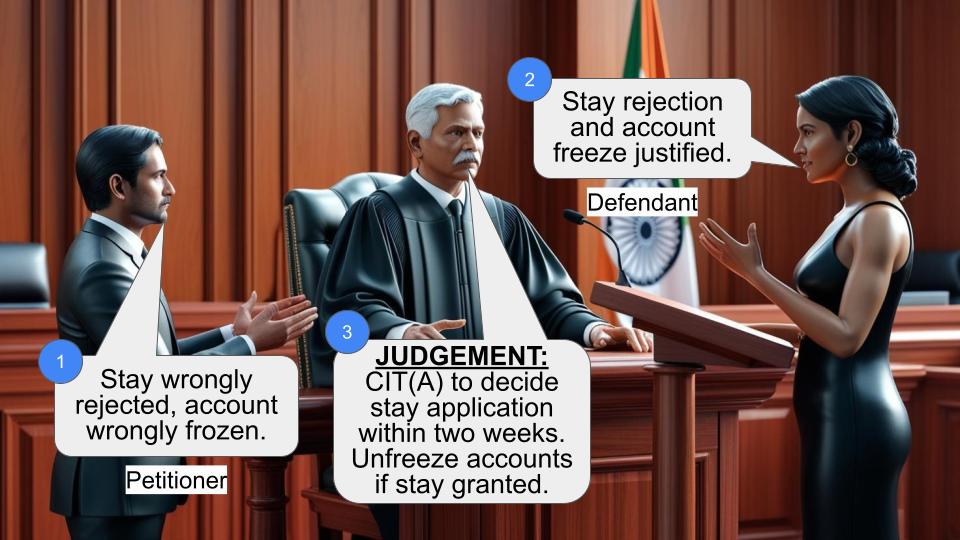
This case involves an appeal by the Revenue (Income Tax Department) against Gaursons Realty Private Limited regarding the disallowance of interest expenditure on loans. The Income Tax Appellate Tribunal (ITAT) had allowed the assessee's appeal, deleting the disallowance. The High Court decided to issue a notice for a detailed hearing instead of dismissing the appeal outright.
Dive into the details by reading the original court order's judgement here.
Case Name:
Principal Commissioner of Income Tax Vs Gaursons Reaty Private Limited (High Court of Delhi)
Income Tax Appeal No. 1159/2018
Key Takeaways:
1. The case revolves around the allowability of interest expenditure on loans when the company has given interest-free loans to sister concerns.
2. The Supreme Court's decision in S.A. Builders case is crucial, emphasizing the concept of "commercial expediency" in such situations.
3. The High Court decided that the case merits a detailed hearing rather than dismissal at the admission stage.
Issue:
Whether the interest expenditure on loans should be disallowed when the assessee has given interest-free loans to sister concerns?
Facts:
1. Gaursons Realty Private Limited (the assessee) had taken loans from banks totaling Rs. 16,55,00,00,000/- and paid interest of Rs. 15,37,76,696/-.
2. The assessee gave interest-free loans to sister companies, including SKA Realtech (P) Ltd, Gaursons Sportswood (P) Ltd, and others.
3. The assessee also gave advances to sister companies for land purchase and paid share application money to Gaursons Infratech (P) Limited.
4. The case relates to the Assessment Year 2014-15.
Arguments:
The assessee argued that:
1. The short-term loans and advances to sister concerns were part of managing the group's fund position.
2. These advances were not from borrowed funds but from the company's own funds, including booking deposits from flat buyers and matured fixed deposits.
3. It's a settled position of law that the Revenue cannot dictate how a businessman should conduct business.
The Revenue contended that:
1. The assessee had not furnished copies of alleged agreements with some sister companies.
2. The interest expenditure should be disallowed due to the diversion of funds as interest-free loans to sister companies.
Key Legal Precedents:
1. S.A. Builders versus Commissioner of Income Tax and Another, (2007) 288 ITR 1 (SC): This case emphasized the concept of "commercial expediency" in giving interest-free loans to sister companies.
2. Punjab Stainless Steel Industries versus Commissioner of Income Tax and Another, (2010) 324 ITR 396 (Del.)
3. Principal Commissioner of Income Tax-7 versus Reebok India Company, ITA No. 1130/2017, decided on 25th September, 2018
4. Principal Commissioner of Income Tax-7 versus Basti Sugar Mills Company Limited, ITA No.205/2018, decided on 28th September, 2018
Judgement:
The High Court decided not to dismiss the appeal at the admission stage. Instead, they issued a notice for a detailed hearing of the case, returnable on 14th March, 2019. The court felt that the assertions made by the Revenue and the findings recorded by the Tribunal warranted a more in-depth examination.
FAQs:
Q1: What is the main issue in this case?
A1: The main issue is whether interest expenditure on loans should be disallowed when a company gives interest-free loans to its sister concerns.
Q2: What is the significance of the S.A. Builders case in this judgment?
A2: The S.A. Builders case emphasized the concept of "commercial expediency" in giving interest-free loans to sister companies, which is crucial in determining the allowability of interest expenditure.
Q3: Did the High Court make a final decision in this case?
A3: No, the High Court didn't make a final decision. They issued a notice for a detailed hearing of the case, feeling that it shouldn't be dismissed outright at the admission stage.
Q4: What is meant by "commercial expediency" in this context?
A4: "Commercial expediency" refers to business decisions made for commercial reasons that indirectly facilitate the carrying on of the business, even if they don't provide immediate benefit.
Q5: What sections of the Income Tax Act are relevant to this case?
A5: The case involves Sections 36(1)(iii) and 37 of the Income Tax Act, 1961, which deal with allowable deductions for interest paid on borrowed capital.

1. This appeal by the Revenue under Section 260A (of Income Tax Act, 1961) („Act‟, for short) in the case of Gaursons Realty Private Limited (Respondent-assessee for short) relates to Assessment Year 2014-15 and arises from the order of the Income Tax Appellate Tribunal („Tribunal‟, for short) dated 7th May, 2018.
2. By the impugned order, the Tribunal has allowed the appeal of the respondent-assessee and deleted disallowance of interest expenditure of Rs.5,68,97,378/- on interest bearing loans, on account of diversion and advances and interest free loans to sister companies.
3. The respondent-assessee had taken following loans from banks:- “ Name of the Bank Loans Raised (Rs.) Interest Paid (Rs.) Andhra Bank 78,00,00,000/- 7,80,04,772/-
Bank of Baroda 87,50,00,000/- 7,57,71,924/-
Total 16,55,00,00,000/- 15,37,76,696/- ” 4. The respondent-assessee had given interest free loans to its sister companies as per details given below:- “ Name Amount outstanding as on 31.3.2014 (Rs.)
SKA Realtech (P) Ltd 3,00,00,000/-
Gaursons Sportswood (P) Ltd 2,00,00,076/-
Gaursons Realtech (P) Ltd 8,59,44,137/-
Shri Shyam Buildcon (P) Ltd 1,00,00,000/-
Banwari Lal Gaur 1,50,00,000/-
Gaursons Infratech P Limited 18,000/- ”
5. The respondent-assessee had also given following advances to sister companies for purchase of land:- “
Name Amount outstanding as on 31.3.2014 (Rs.)
Gaursons Realtech (P) Ltd 79,65,00,000/-
Gaursons India Limited 2,36,18,780/- UP Township (P) Ltd 1,00,00,000/- ” 6. In addition, the respondent-assessee had paid share application money of Rs.53,25,00,000/- to M/s Gaursons Infratech (P) Limited.
7. Issue of disallowance of interest paid and allowable as a deduction under Sections 36(1)(iii) (of Income Tax Act, 1961) and 37 (of Income Tax Act, 1961) was examined by the Supreme Court in S.A. Builders versus Commissioner of Income Tax and Another, (2007) 288 ITR 1 (SC) and it was held:-
“25. Thus in Atherton v. British Insulated & Helsby Cables Ltd. [(1925) 10 TC 155 : 1 KB 421 : 132 LT 288 (CA)] it was held by the House of Lords that in order to claim a deduction, it is enough to show that the money is expended, not of necessity and with a view to direct and immediate benefit, but voluntarily and on grounds of commercial expediency and in order to indirectly facilitate the carrying on of the business. The above test in Atherton case [(1925) 10 TC 155 : 1 KB 421 : 132 LT 288 (CA)] has been approved by this Court in several decisions e.g. Eastern Investments Ltd. v. CIT[(1951) 20 ITR 1 : AIR 1951 SC 278] , CIT v. Chandulal Keshavlal & Co. [(1960) 38 ITR 601 : AIR 1960 SC 738] , etc.
26. In our opinion, the High Court as well as the Tribunal and other Income Tax Authorities should have approached the question of allowability of interest on the borrowed funds from the above angle. In other words, the High Court and other authorities should have enquired as to whether the interest-free loan was given to the sister company (which is a subsidiary of the assessee) as a measure of commercial expediency, and if it was, it should have been allowed.”
Thus, distinction was made between loans and advances given for business purposes as distinguished from personal interest. This aspect has been also highlighted in judgments of Delhi High Court in Punjab Stainless Steel Industries versus Commissioner of Income Tax and Another, (2010) 324 ITR 396 (Del.), Principal Commissioner of Income Tax-7 versus Reebok India Company, ITA No. 1130/2017, decided on 25th September, 2018 and ITA No.205/2018, Principal Commissioner of Income Tax-7 versus Basti Sugar Mills Company Limited, decided on 28th September, 2018.
8. However, learned counsel for the appellant-Revenue has relied upon and referred to submissions made by the respondent-assessee before the Assessing Officer, which read as under:-
“Assessee Company is a construction company engaged in construction of flats & selling the same to the proposed buyers. Short Terms Loans & Advances by Gaursons Realty Pvt Ltd. to its sister concerns as a part to manage fund position of the Group. Short Term Loans & Advances has not been provided by the company from loan borrowed during the year by the company but it is used for financing the construction project only, these advances have been given by the assessee to its group companies as part of their overall business plan to manage the fund flows of the group and has no connection with the project loan taken from Bank which has been incurred entirely for the project expenditure and as such the expenditure claimed by the way of interest on project loan are incurred for the business purpose and are eligible as business expenditure under section 36(1)(iii) (of Income Tax Act, 1961).
Short Term Loans & Advance is provided to its sister- concern mainly from companies own fund available with the enterprise. Booking deposit from flat buyers and Advances from customers (Rs.1,144,695,481-) available also the assessee company received the amount from the maturity of Fixed Deposit. This means that Advance was not given from the borrowed fund/interest bearing fund. It is respectfully submitted that it is a settled position of law that it is not for the Revenue to dictate to the businessman how to carryon business. Various Courts have, repeatedly, held in the following cases that reasonableness of the expenditure has to be seen from the point of view of businessman and that the Revenue cannot seek to put itself in the armchair of the businessman:
i. CIT vs. Walchand & Co.: 65
ii. J.K. Woollen Manufactures vs. CIT: 72 ITR 612 (SC)
iii. CIT vs PanipatWoollen & General Mills Co. Ltd.: 103 ITR 666(SC)
iv. S.A. Builders Ltd. vs. CIT: 288 ITR 1 (SC) approving v. Dalmia Cement (P) Ltd. : 254 ITR 377 (Del.)
v. CIT vs. Padmani Packaging (P) Ltd.: 155 Taxman 268 (Del.)”
9. It was also alleged that the respondent-assessee had not furnished copies of alleged agreements with M/s Gaursons India Limited and M/s U.P. Township Private Limited. The Tribunal in the impugned order has referred to different amounts paid with reference to other advances and observed as under:-
“All the above advances even if it is presumed that they are not given by the assessee for the non-business purposes they do not exceed the funds available with the assessee without interest.”
10. Keeping in view the assertions made by the Revenue on the findings recorded by the Tribunal, we feel that the appeal should not be dismissed in limine at the admission stage itself but should be heard in detail. Therefore, without expressing any opinion, we are issuing notice in this appeal returnable on 14th March,2019.
(SANJIV KHANNA)
JUDGE
(ANUP JAIRAM BHAMBHANI)
JUDGE
JANUARY 17th , 2019
×