Full News
High Court: Reimbursement of Expenses Not Income, Section 194J (of Income Tax Act, 1961) TDS Not Applicable
High Court: Reimbursement of Expenses Not Income, Section 194J (of Income Tax Act, 1961) TDS Not Applicable
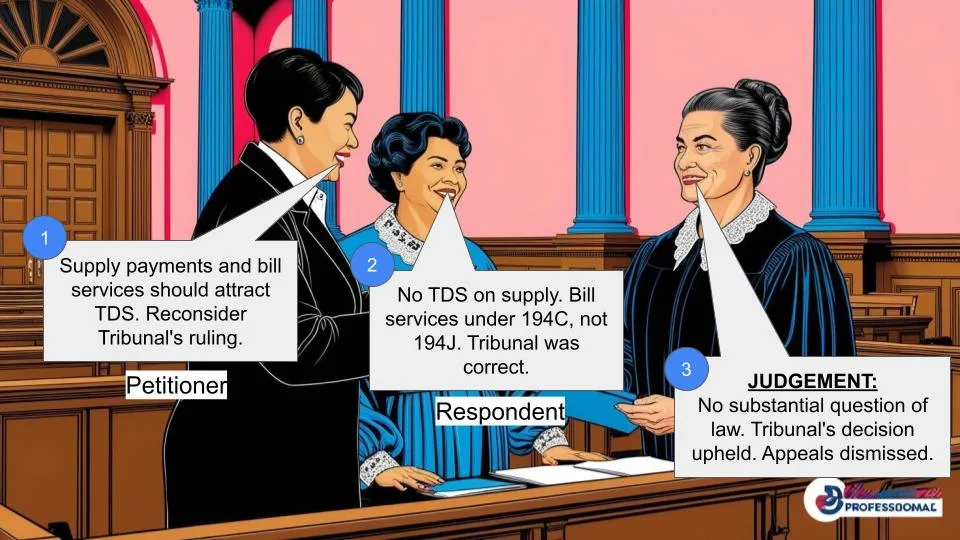
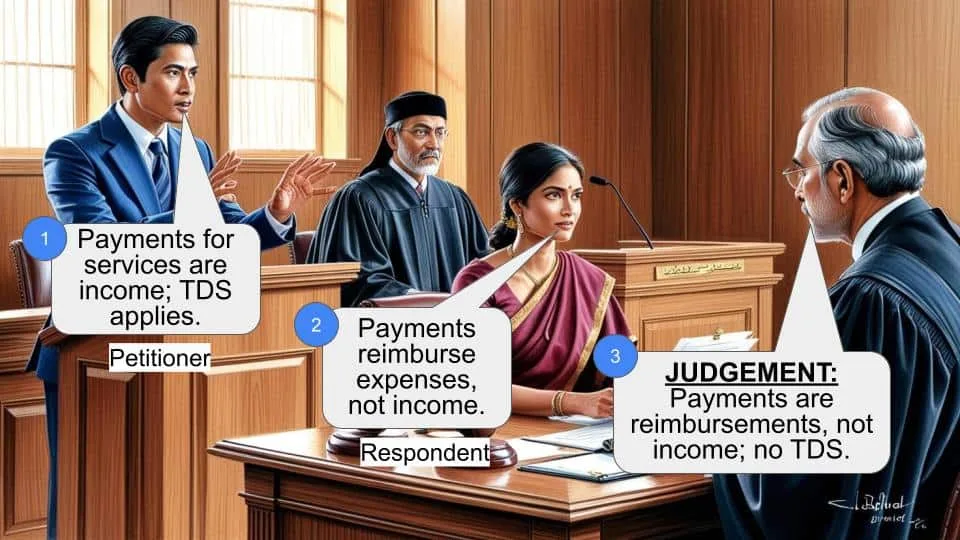
The Karnataka High Court dismissed appeals filed by the revenue department against Kalyani Steels Ltd. The case revolved around payments made by Kalyani Steels to Hospet Steel Limited (HSL) for managing and operating an integrated steel plant. The court ruled that these payments were reimbursements of expenses, not income, and therefore not subject to Tax Deducted at Source (TDS) under Section 194J (of Income Tax Act, 1961).
Get the full picture - access the original judgement of the court order here
Case Name:
Commissioner of Income Tax & Anr. vs. Kalyani Steels Ltd - High Court of Karnataka (High Court of Karnataka)
ITA No. 260/2013 c/w ITA No. 289/2014, 263/2013, 265/2013, 2008/2014 & 262/2013
Date: 12th February 2018
Key Takeaways:
1. Reimbursement of expenses doesn't constitute income for TDS purposes.
2. Section 194J (of Income Tax Act, 1961) only applies when there's an income component.
3. The court emphasized the importance of examining the nature of payments rather than just their nomenclature.
4. A 1995 CBDT circular was cited, clarifying that reimbursements shouldn't be subject to TDS.
Issue:
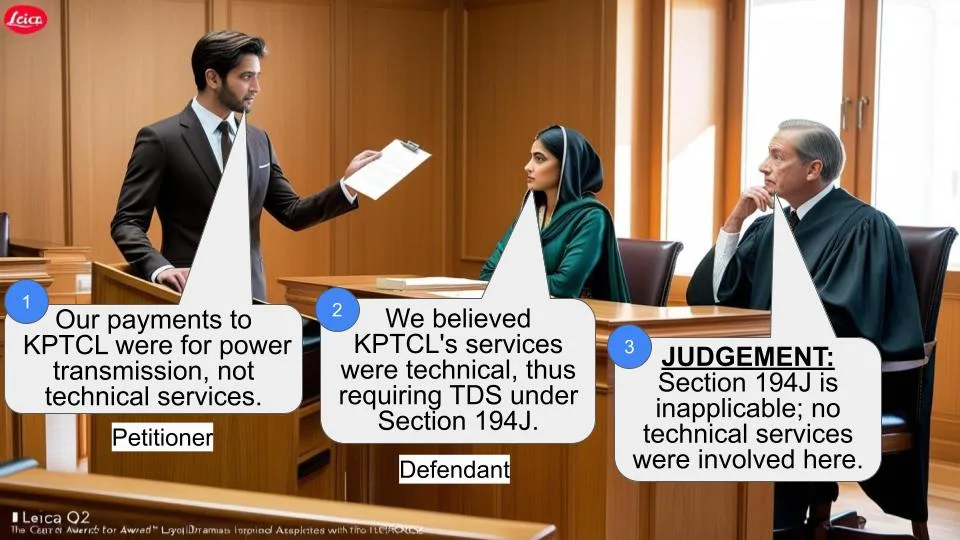
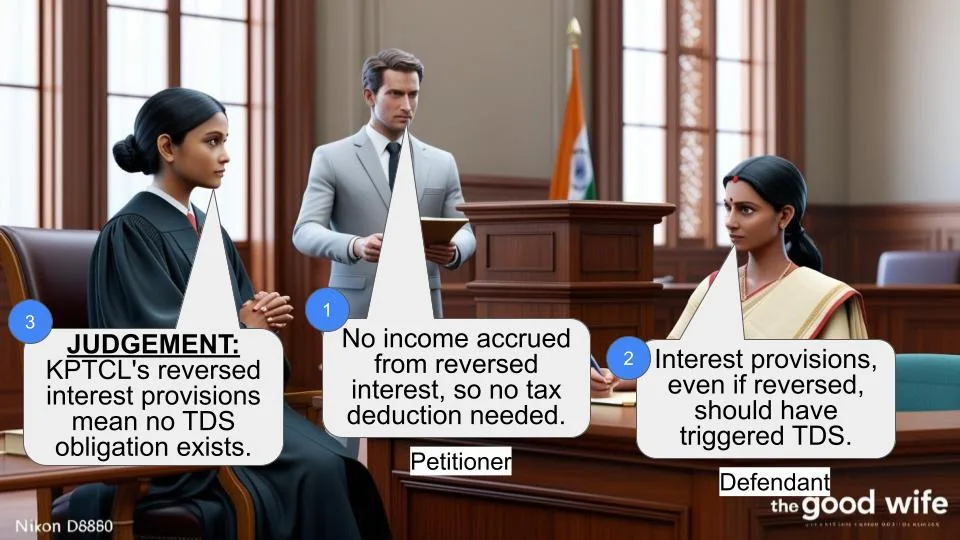
Does the payment made by Kalyani Steels Ltd to Hospet Steel Limited for managerial and technical services constitute income subject to TDS under Section 194J (of Income Tax Act, 1961)?
Facts:
- Kalyani Steels Ltd made payments to Hospet Steel Limited for operating and maintaining an integrated steel plant during assessment years 2008-09, 2009-10, and 2010-11.
- A survey under Section 133A (of Income Tax Act, 1961) was conducted.
- The Assessing Officer initially held that the assessee (Kalyani Steels) was in default for not deducting TDS under Section 194J (of Income Tax Act, 1961).
- The case went through appeals, reaching the High Court of Karnataka.
Arguments:
Revenue's Arguments:
- HSL was carrying on business independently, not as an agent of Kalyani Steels and Mukund Limited.
- The entire payment was for rendering managerial and technical services.
- The nomenclature of the payment doesn't change the applicability of TDS provisions.
Assessee's Arguments:
- HSL acts as an agent of Kalyani Steels and Mukund Limited to manage the steel plant.
- The payments were reimbursements of expenses as per the Strategic Alliance Agreement.
- There was no income component in the hands of HSL.
Key Legal Precedents:
1. The court referred to the case of Hyderabad Industries Ltd. vs. Income Tax Officer and Another 188 ITR 749 (Kar), which held that an amount not included in total income cannot be considered "income" for TDS purposes.
2. A 1995 circular from the Central Board of Direct Taxes (CBDT) was cited, clarifying that reimbursement cannot be deducted from the bill amount for TDS purposes.
Judgement:
The High Court dismissed the revenue's appeals, ruling in favor of Kalyani Steels Ltd. The court held that:
- The payments were reimbursements of expenses, not income.
- Section 194J (of Income Tax Act, 1961) was not applicable.
- The assessee falls outside the scope of Section 194J (of Income Tax Act, 1961) read with Section 200 (of Income Tax Act, 1961).
- Consequently, the provisions of Sections 201 and 201(1A) (of Income Tax Act, 1961) are not attracted.
FAQs:
1. Q: What was the main issue in this case?
A: The main issue was whether payments made by Kalyani Steels to HSL for managing a steel plant were subject to TDS under Section 194J (of Income Tax Act, 1961).
2. Q: Why did the court rule in favor of Kalyani Steels?
A: The court determined that the payments were reimbursements of expenses, not income, and therefore not subject to TDS under Section 194J (of Income Tax Act, 1961).
3. Q: What's the significance of this ruling for businesses?
A: This ruling clarifies that genuine reimbursements of expenses should not be treated as income for TDS purposes, potentially simplifying tax compliance for some business arrangements.
4. Q: Did the court consider any specific evidence to reach its decision? A: Yes, the court considered the Strategic Alliance Agreement between the parties, which showed that HSL was acting as a conduit for Kalyani Steels and Mukund Limited.
5. Q: How does this ruling impact the interpretation of Section 194J (of Income Tax Act, 1961)?
A: It emphasizes that for Section 194J (of Income Tax Act, 1961) to apply, there must be an income component in the payment, not just a reimbursement of expenses.

1. These appeals are filed by the revenue under Section 260A (of Income Tax Act, 1961) (‘the Act’for short) challenging the order of the Income Tax Appellate Tribunal, Bangalore Bench ‘A’ (‘the Tribunal’ for short) in ITA Nos.861/Bang/2011 dated 18.12.2012, 1041/Bang/2013 dated 21.02.2014, 862/Bang/2011 dated 18.12.2012, 859/Bang/2011 dated 18.12.2012, 1040/Bang/2013 dated 17.12.2013 and 860/Bang/2011 dated 18.12.2012 respectively.
2. Since the substantial questions of law raised in these appeals are identical, the same are heard together and disposed of by this common judgment.
3. The assessee is engaged in the business of manufacture of steel. During the assessment year 2008-09,2009-10 and 2010-11 the assessee has made payment to M/s Hospet Steel Limited (‘HSL’ for short)towards managerial and technical services rendered by way of operating and maintaining an integrated steel plant. Survey under Section 133A (of Income Tax Act, 1961) was conducted. Subsequent to survey, proceedings under Section 201(1) (of Income Tax Act, 1961) and Section 201(1A) (of Income Tax Act, 1961) were initiated. Orders under Sections 201(1) (of Income Tax Act, 1961) and 201 (of Income Tax Act, 1961)+1A) of the Act were passed holding that, HSL and M/s Kalyani Steel Limited (‘KSL’ for short)and M/s Mukund Limited (‘ML’ for short) are independent entities. HSL is a service company and managed an integrated steel plant for KSL and ML. The required labour and staff for the services has been employed by HSL. HSL has used its assets and machineries for rendering the agreed services.The amounts received towards service charges has been accounted in the P & L account of HSL and the same is offered to tax. Hence, the Assessing Officer held that, assessee is in default under Section 201 (of Income Tax Act, 1961) for not deducting TDS under Section 194J (of Income Tax Act, 1961) and consequently, interest under Section 201(1A) (of Income Tax Act, 1961) was computed. Being aggrieved by the same, appeal was preferred by the assessee/respondent before the Appellate Commissioner. The Appellate Commissioner arrived at a conclusion that the payment made by the assessee to HSL is reimbursement of expenses and there was no liability to deduct TDS under Section 194J (of Income Tax Act, 1961) and hence, Section 201(1) (of Income Tax Act, 1961) and 201(1A) (of Income Tax Act, 1961) are not justifiable. Being aggrieved by the same, revenue has preferred these appeals raising following substantial questions of law:
i) Whether the Appellate Authorities were correct in holding that, the payments made by the assessee to M/s Hospet Steel Limited are reimbursement of expenses on cost to cost basis and does not constitute income component, hence, provisions of Section 194J (of Income Tax Act, 1961) are not attracted?
ii) Whether the Appellate Authorities failed to take into consideration that, entire payment made to M/s Hospet Steel Limited was towards rendering of managerial and technical services by way of operating and maintaining an integrated steel plant and the provisions of Section 194J (of Income Tax Act, 1961) are attracted, consequently, Section 201 (of Income Tax Act, 1961) is attracted?
4. Learned counsel Sri.Y.V.Raviraj appearing for the revenue would contend that, both appellate authorities failed to take into consideration that HSL is carrying on business independently and not as an agent of KSL and ML. The entire staff and manpower required for operating and maintaining the integrated steel plant for rendering services were employed by HSL. Both the appellate authorities have failed to take into consideration that, while examining the applicability of the TDS provisions, the payment should be examined with reference to the services for which payment is made. The nomenclature given by the assesses or HSL does not change the applic ability of the provisions. Any amount credited towards fee for professional or technical services attracts the provisions of Section 194J (of Income Tax Act, 1961). Taxability or otherwise of the said amount in the hands of the recipient is not the requirement of Section to be looked into while applying the said provisions.
5. Learned counsel Sri.Chythanya K.K. appearing for the assessee submitted that HSL acts as an agent of KSL and ML to manage the affairs of the steel plant. Strategic Alliance Agreement (SAA) entered into between KSL and ML with HSL indicates that both companies installed their plants in close by and in pursuance of the said SAA, the assessee along with ML promoted HSL for effective functioning of all the plants as one composite manufacturing unit and accordingly, the assessee had installed iron making and steel roiling facilities and ML had installed steel making facilities with the following terms namely:
(i) the share capital of HSL was held by the assessee and ML in equal proportion and the investment in the said steel making facilities have been made by SAA constituents in the ratio of 41.38% (the assesse): 58.62% (by ML).
(ii) the assessee and ML have agreed to reimburse HSL the expenditure incurred on behalf of the assessee and ML in course of administering the plant operations on cost to cost basis, i.e., all the expenses for hot metal making and steel rolling activities were allocated to the assessee and the expenses incurred for steel making activities to ML; (iii) all other common expenses and corporate expenses except the provision for gratuity and leave encashment to staff etc., were recovered from SAA constituents in the ratio of 41.38% and 58.62% as agreed upon; It has been subscribed under the caption - C.Payments to JVC in the SAA as under: “The parties agree and undertake to pay the JVC in advance a sum of Rs.20.00 million in the products sharing ratio or such othe cum. as may be agreed from time to time to r facilitate the operation of the plants. All costs and expenses incurred by JVC shall be reimbursed by the parties in the products sharing ratio. ”The parties also agree to pay to JVC service charges as may be agreed upon between the parties and the JVC.”In the supplementary agreement (dated 10.08.1999) to SAA dated 16.05.1998, sub-para 2. 2(c) of Chapter 2 on Page 24 of the Principal Agreement was substituted by the following paragraph: “It is agreed by and between the parties to this Agreement that JVC is an outcome of the Strategic Alliance between the parties and will only be acting as conduit pipe for and on behalf of the Strategic Alliance constituents and no remuneration will be paid to JVC. ” 6. In terms of the aforesaid, share capita! of HSL was held by the assessee and ML in equal proportion and the investment in the said steel making facilities has been made by SAA constituents in the ratio of 41.38 and 58.62 by the assessee and ML respectively. As per the terms of SAA., the assesaee and ML have reimbursed the expenses incurred by HSL in performance of its obligations. The said payment did not comprise of any income component m the hands of HSL. It is only the reimbursement of such expenses incurred by HSL, the same cannot be categorized as fees towards professional and technical services. Thus, it was argued that, there being no income in the hands of HSL, Section 194J (of Income Tax Act, 1961) is not applicable. This factual aspect as well as legal aspects were rightly considered by the appellate authorities while arriving at a decision. Hence, the substantial questions of law raised by the revenue deserves to be answered in favour of the assesses rejecting the appeals. 7. Heard the learned counsel appearing for the parties and perused the material on record. 8. In order to answer the substantial questions of law raised by the revenue, it is apt to refer to Section 194J (of Income Tax Act, 1961), the relevant provision reads thus: 194J- Fees for professional or technical services. (1) Any person, not being an individual or a Hindu undivided family, who is responsible for paying to a resident any sum, by way of- (a) xxxxx (b) fees for technical services, (ba) xxxxx
(c) xxxxx (d) xxxxx shall, at the time of credit of such sum to the account of the payee or at the time of payment thereof in cash or by issue of a cheque or draft or by any other mode, whichever is earlier,deduct an amount equal to (ten) per cent of such sum as income-tax on income comprised therein: 9. A reading of this provision discloses that, an amount equal to ten percent of such sum as income-tax has to be deducted on income comprised therein, by a person not being an individual or a HUF, who is responsible for paying a resident any sum towards fees for technical services as per Clause (b) of Section 194J(1) (of Income Tax Act, 1961), the relevant factor is “income comprised”. To attract this provision, there must be an income comprised therein. Section 2(24) (of Income Tax Act, 1961) defines the income. The reimbursement of expenses incurred by HSL cannot be categorized as income under Section 2(24) (of Income Tax Act, 1961). 10. Section 190 (of Income Tax Act, 1961) provides for deduction at source and advance payment. The said provision reads thus:“190.
(1) Notwithstanding that the regular assessment in respect of any income is to be made in a later assessment year, the tax on such income shall be payable by deduction (or collection) at source or by advance payment (or by payment under sub-section (1A) of Section 192 (of Income Tax Act, 1961)), as the case may be, in accordance with the provisions of this Chapter. (2) Nothing in this section shall prejudice the charge of tax on such income under the provisions of sub-section (1) of section 4 (of Income Tax Act, 1961). ” 11. This provision makes it clear that deduction at source shall be on such income not otherwise. The primary factor to attract Section 194J (of Income Tax Act, 1961) is the ingredient of “income comprised therein”. If no income is reflected in the balance sheet and P & L account of HSL towards the reimbursement charges paid on cost to cost basis by KSL and ML, it ceases to have the character of income. As such, the assessee cannot be treated as the assessee in default in not deducting tax at source under Section 194J (of Income Tax Act, 1961). The arguments of the revenue that the fees paid by the assessee is towards technical services is imaginary one not established with substantial material. 12. The Assessing Officer proceeded to pass the orders under Sections 201 (of Income Tax Act, 1961) and 201(1A) of the Act on the footing that the assessee was required to deduct tax from the payments made to the HSL irrespective of the fact that the said payments include element of income or not. This approach of the Assessing Officer is contrary to Section 194J (of Income Tax Act, 1961), which in unequivocal terms describes deduction of income tax on income comprised therein, 13. It is trite that, if there is no income embedded in a payment, then TDS provisions would not apply as TDS is only an alternative method of collection of taxes. It is beneficial to refer to the judgment of this Court in the case of Hyderabad Industries Ltd., Vs Income Tax Officer and Another 188 ITR 749 (kar), wherein it is held that, “an amount which will not be included in the total income of a person cannot be considered as “income” for the purpose of deduction of tax at source at all. The purpose of deduction of tax at source is not to collect a sum which is not a tax levied under the Act, it is to facilitate the collection of tax lawfully leviable under the Act.” In view of the factual finding of the appellate authorities that the payment made by KSL and ML to HSL for various expenses incurred would be a reimbursement and not a fee for technical services, Section 194J (of Income Tax Act, 1961) is not attracted. 14. The CBDT in the circular number 715 dated 03.08.1995 has clarified that the reimbursement cannot be deducted out of the bill amount for the purpose of TDS. The Assessing Officer’s view is against the intent of the said circular. 15. This Court in Karnataka Power Transmission Corporation Ltd., Vs. Deputy Commissioner of Income-tax (TDS) Circle 16(2), Bangalore reported in (2016) 383 ITR 59 (Kar) while considering the applicability of Section 194A (of Income Tax Act, 1961) has observed that, Section 194A (of Income Tax Act, 1961) mandates the tax deductor to deduct ‘income tax’ on any income by way of interest other than income by way of interest on securities. The phrase ‘any income’ and ‘income tax thereon’ if read harmoniously, it would indicate that the interest which finally partakes the character of income, alone is liable for deduction of the income tax on that income by way of interest. If the said interest is not finally considered to be an income of the deductee, as per reversal entries of the provision. Section 194A(1) (of Income Tax Act, 1961) would not be made applicable, in other words, if no income is attributable to the payee, there is no liability to deduct tax at source in the hands of the tax deductor. 16. Under the circumstances, the assessee falls outside the scope of Section 194J (of Income Tax Act, 1961) r/w Section 200 (of Income Tax Act, 1961) during the relevant assessment years. Consequently, the provisions of Sections 201 and 201(1A) of the Act are not attracted. We do not find any material irregularity or infirmity in the orders passed by the appellate authorities. For the aforesaid reasons, we answer substantial questions of law against the revenue and in favour of the assessee.Accordingly, the appeals stand dismissed. *****
×