High Court Rules on Section 80-IA (of Income Tax Act, 1961) Deduction Eligibili…


Full News

High Court Rules on Section 80-IA (of Income Tax Act, 1961) Deduction Eligibility Without Yearly Review
High Court Rules on Section 80-IA (of Income Tax Act, 1961) Deduction Eligibility Without Yearly Review
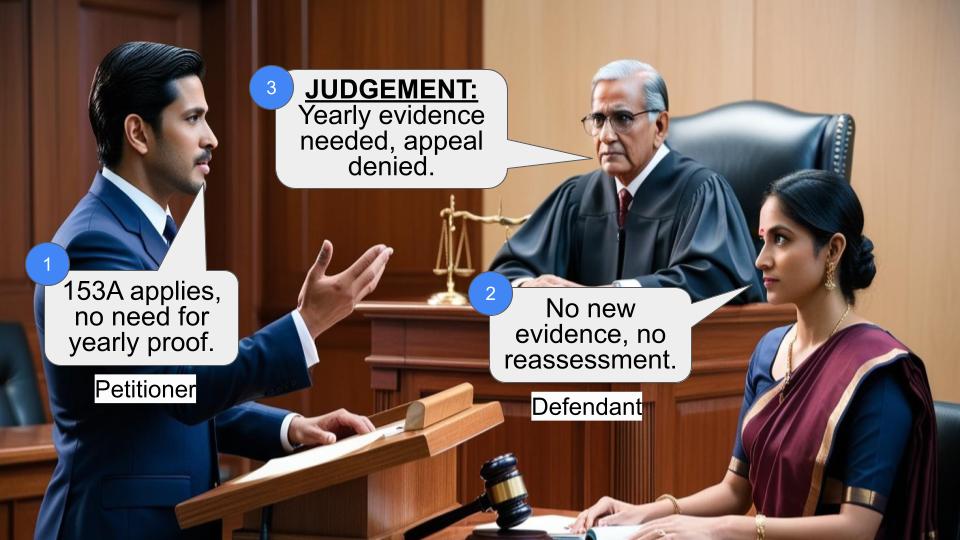
The case involves the Commissioner of Income Tax and International Tractor Ltd. The main issue was whether the eligibility for deductions under Section 80-IA (of Income Tax Act, 1961), 1961, required a yearly review. The court ruled that the ten-year period for claiming deductions starts from the initial assessment year (AY) 1997-98, even if no deduction was claimed that year due to losses. The court dismissed the Revenue's appeal, affirming that the eligibility conditions need not be met every year.
Get the full picture - access the original judgement of the court order here.
Case Name:
Commissioner of Income Tax vs. International Tractor Ltd.(High Court of Delhi)
ITA 497/2004
Key Takeaways
- The ten-year period for claiming deductions under Section 80-IA (of Income Tax Act, 1961) starts from the initial assessment year, regardless of whether a deduction was claimed in that year.
- The court ruled that there is no need for a yearly review to ensure eligibility conditions are met for each of the ten years.
- The decision aligns with previous rulings on similar issues, reinforcing the interpretation of Section 80-IA (of Income Tax Act, 1961).
Issue
Does Section 80-IA (of Income Tax Act, 1961), 1961, require a yearly review to ensure eligibility conditions are met for each of the ten years for which the deduction is allowed?
Facts
- The Assessee, International Tractor Ltd., did not claim a deduction under Section 80-IA (of Income Tax Act, 1961) for the initial AY 1997-98 due to losses.
- The Assessee claimed deductions for subsequent years.
- The Revenue argued that the eligibility conditions must be met every year for the ten-year period.
- The court had previously ruled on similar issues for other assessment years, consistently against the Revenue.
Arguments
Revenue's Arguments:
- The eligibility conditions under Section 80-IA (of Income Tax Act, 1961) should be met every year for the ten-year period.
- The Assessee did not claim the deduction in the initial year (AY 1997-98) and thus should not be eligible for subsequent years.
Assessee's Arguments:
- The ten-year period should start from the initial assessment year, regardless of whether a deduction was claimed that year.
- The eligibility conditions need not be met every year, only in the initial year.
Key Legal Precedents
- Commissioner of Income Tax v. Sudhir Choudhrie (2005) 278 ITR 490 (Del):
This case led to the insertion of Rule 34 (of Income Tax Rules, 1962) in the ITAT Rules, which was discussed in the context of the procedural aspects of the judgment.
- Common Judgment of 20.07.2017:
This judgment covered similar issues for other assessment years and was used as a precedent in the current case.
Judgement
The court ruled in favor of the Assessee, International Tractor Ltd., stating that the ten-year period for claiming deductions under Section 80-IA (of Income Tax Act, 1961) starts from the initial assessment year (AY 1997-98), even if no deduction was claimed that year due to losses. The court dismissed the Revenue's appeal and affirmed that the eligibility conditions need not be met every year.
FAQs
Q1: Does the ten-year period for claiming deductions under Section 80-IA (of Income Tax Act, 1961) start from the initial assessment year?
A1: Yes, the ten-year period starts from the initial assessment year, even if no deduction was claimed that year due to losses.
Q2: Is a yearly review required to ensure eligibility conditions are met for each of the ten years?
A2: No, the court ruled that a yearly review is not required. The eligibility conditions need to be met only in the initial assessment year.
Q3: What was the main argument of the Revenue?
A3: The Revenue argued that the eligibility conditions under Section 80-IA (of Income Tax Act, 1961) should be met every year for the ten-year period.
Q4: What was the court's decision regarding the Revenue's appeal?
A4: The court dismissed the Revenue's appeal and ruled in favor of the Assessee, affirming that the eligibility conditions need not be met every year.
Q5: Were there any previous rulings on similar issues?
A5: Yes, the court referred to a common judgment from 20.07.2017, which covered similar issues for other assessment years and ruled against the Revenue.

1. The following two questions of law were framed on 18.05.2006:
(i) Whether the Tribunal was correct in holding that for purposes of deduction U/s 80(1A) (of Income Tax Act, 1961), 1961, the assessee should be a small scale undertaking on the last day of the previous year relevant to the initial/first assessment year and that the said requirement need not be satisfied in the subsequent assessments?
(ii) Whether the impugned order dated 1.3.2004 could be validly made having regard to the fact that one of the members of the Tribunal who was a party to the said order had retired before the said date?”
2. As far as the substantive question i.e. with respect to permissibility of the deduction under Section 80 (of Income Tax Act, 1961)-1A of the Income Tax Act, 1961 (hereafter referred to as ‘the Act’), the ITAT’s decision for other years, i.e. A.Y. 2000-01, 2001-02 and 2002-03 were subject matter of other orders made by the ITAT (20.06.2008 for two years, 17.08.2007, 28.03.2005 and 05.09.2008 respectively). Those became the subject matter of appeals before this Court i.e. ITA Nos.1082/2005, 690/2008, 225/2009, 1189/2009 and 251/2010. All those appeals by the Revenue, urging common questions with respect to admissibility of the benefit/deduction under Section 80 (of Income Tax Act, 1961)-1A of the Act, were dismissed; the questions of law were answered against the Revenue.
3. The lone question which survives for the decision by this Court is as to the character of the determination made by the ITAT in this case. The order of 04.05.2017 somewhat deals and crystallizes the issue. In short, it is whether the signature appended to the order of one of the members i.e. Shri R.M. Mehta, who retired on 27.12.2003 can be said to bestow it the character of an order. The other member Shri Ram Bahadur signed the order on 01.03.2004. It was in the light of these facts that the Court framed the second question of law in these appeals. The order of 04.05.2017 noticed that the requirement of pronouncing the judgment in open court as it were, did not exist before the judgment in Commissioner of Income Tax v. Sudhir Choudhrie (2005) 278 ITR 490 (Del). As a result of that judgment, Rule 34 (of Income Tax Rules, 1962) was inserted in the ITAT Rules to facilitate that procedure. The Court, in its order of 04.05.2017 noticed and held that since the change of Rule was prospective, there was no illegality – to an order on account of signature of Shri Ram Bahadur on 01.03.2004 even though its author had signed it earlier.
4. In the opinion of this Court, the merits of the issue is covered by the common judgment of 20.07.2017 in the other appeals (Commissioner of Income Tax v. M/s International Tractors Ltd., ITA No.1082/2005 and connected appeals noticed earlier).
5. Learned counsel for the Revenue/appellant urged that on the merits the Court has to resolve whether in fact the Commissioner could be faulted for issuing the order under Section 263 (of Income Tax Act, 1961) because for the first year i.e. A.Y. 1997- 98, the deduction under Section 80 (of Income Tax Act, 1961)-1A of the Act had not been claimed by the assessee. It was contended that for the subsequent years too the assessee could not claim such status given the nature of its investment.
6. It is pointed out on behalf of the assessee, on the other hand, that the common judgment of this Court in M/s International Tractors Ltd. (supra), dated 20.07.2017 has in fact dealt with all issues including the permissibility of the benefit under Section 80 (of Income Tax Act, 1961)-1A of the Act for subsequent years, when in the eventuality of the assessee not being granted that benefit for the first year.
7. This Court has considered the common judgment of 20.07.2017 for the other years, discusses the issue elaborately and notices it as follows:-
“43. The ITAT in the said order agreed with the Assessee that Section 80-IA (of Income Tax Act, 1961) did not contemplate the carrying out of a yearly review to ensure that on the last date of other previous year, of the ten AYs for which the deduction was allowed, the eligibility condition stood fulfilled. As rightly pointed out by Mr. Vohra in the initial AY 1997- 98, the Assessee was facing a loss and, therefore, did not make a claim. Nevertheless that continued to remain the initial AY. The Assessee claimed deduction only in regard to the remaining years. The ten years would begin to be counted from the AY 1997-98 itself although the deduction was not claimed for that AY. It could not have been claimed for AY 1997-98 because under Section 80 (of Income Tax Act, 1961)- IA, the aggregate deduction claimed of the Assessee could not have exceeded its gross total income.
44. The question is whether on the last day of the previous relevant to AY 1997-98 the Assessee fulfilled the eligibility condition? It was repeatedly urged by Mr. Manchanda that the investment in P&M on the last date of previous year was above Rs. 60 lacs. He referred to an order dated 11th July, 2003 passed by the CIT under Section 263 (of Income Tax Act, 1961) for AY 1999-00. However, relevant to AY 1998-99, the factual determination by the CIT(A) and the ITAT is that the Assessee did fulfil the eligibility condition. The total investment in P&M was worked out to be Rs. 41.19 lacs. This fact has not been controverted by the Revenue.
63. In view of the authoritative pronouncements of the Courts as discussed hereinbefore, the Court is unable to accept the plea of the Revenue in the present case that:
(i) The Assessee here did not fulfil the eligibility condition for the initial AY i.e., 1997-98; and
(ii) That notwithstanding that it may have fulfilled the eligibility conditions in the initial AY, it nevertheless had to fulfil the such eligibility condition for every one of the ten consecutive AYs inclusive of the initial AY in order to be eligible for the deduction.”
8. It is thus apparent that on the merits of the treatment or rather the claim to the deduction under Section 80 (of Income Tax Act, 1961)-1A of the Act – in the Revenue’s appeals for subsequent and later years, this Court had ruled against the Revenue. The present case concerns A.Y. 1999-2000. The immediately preceding year i.e. 1998-99 and the succeeding year 2000-01, have been considered by this Court on identical issues. The facts in those appeals were that the claim in 80-1A of the Act was sought to be re-opened under Section 147 (of Income Tax Act, 1961)/148 and under Section 263 (of Income Tax Act, 1961) (for A.Y. 2000-01) of the Act. The Court also had the occasion to exercise power under Section 263 (of Income Tax Act, 1961) for A.Y. 2001-02 in circumstances similar or rather identical to the present one.
9. Given these facts, the ruling of this Court in its judgment of 20.07.2017 covers the merits of the appeal i.e. question No.1 framed for its merits for A.Y. 1999-00 in this appeal. In these circumstances, this Court is of the opinion that as to the character of the order, even if the Revenue were to succeed, upon remission which would be the best order it can claim, the ultimate result would be the same i.e. since the ITAT would be bound by the judgment of 20.07.2017.
10. Having regard to the above facts, the question No.1 framed for this appeal is answered against the Revenue and in favour of the assessee. In the peculiar circumstances of the case, question No.2 is kept open for the parties to contend.
11. The appeal is consequently dismissed.
S. RAVINDRA BHAT, J
SANJEEV SACHDEVA, J
NOVEMBER 30, 2017
×