


High Court Sets Aside Non-Speaking Tribunal Order in Tax Case


Full News

High Court Sets Aside Non-Speaking Tribunal Order in Tax Case
High Court Sets Aside Non-Speaking Tribunal Order in Tax Case
The High Court of Madras set aside orders by the Income Tax Appellate Tribunal in a case involving India Trimmings P. Ltd. and the Assistant Commissioner of Income Tax. The court found the Tribunal's orders to be non-speaking and failing to address key issues raised by both parties, particularly regarding compliance with Section 144C (of Income Tax Act, 1961).
Get the full picture - access the original judgement of the court order here.
Case Name:
India Trimmings P. Ltd. vs Assistant Commissioner of Income Tax (High Court of Madras)
T.C.(A).Nos.932 and 875 of 2014
Date: 16th December 2014
Key Takeaways:
1. The High Court emphasized the importance of tribunals addressing all issues raised by parties.
2. Non-speaking orders that fail to consider key arguments can be grounds for setting aside tribunal decisions.
3. Proper procedure under Section 144C (of Income Tax Act, 1961) is crucial in cases involving transfer pricing.
Issue:
Did the Income Tax Appellate Tribunal err in law by passing a non-speaking order without considering the key issues raised by both parties, particularly regarding compliance with Section 144C (of Income Tax Act, 1961)?
Facts:
1. India Trimmings P. Ltd., a wholly owned subsidiary of Conso International Corporation, USA, is engaged in manufacturing decorative trimmings.
2. For the assessment year 2007-08, the company filed a return admitting a total income of Rs.1,37,520/-.
3. The case was selected for scrutiny and referred to the Transfer Pricing Officer due to international transactions.
4. The Transfer Pricing Officer passed an order on 28.10.2010 under Section 92CA(3) (of Income Tax Act, 1961).
5. The Assessing Officer passed an assessment order on 30.12.2010 under Section 143(3) (of Income Tax Act, 1961).
6. The assessee challenged this order before the Commissioner of Income Tax (Appeals), arguing that a draft assessment order should have been issued as per Section 144C(1) (of Income Tax Act, 1961).
7. The CIT(A) set aside the Assessing Officer's order entirely on 30.08.2011.
8. The Department appealed to the Income Tax Appellate Tribunal.
9. The Tribunal initially passed an ex-parte order, which was later recalled.
10. The Department raised additional grounds, which the assessee objected to as belated.
Arguments:
1. Assessee's Arguments:
- The Assessing Officer failed to follow the procedure under Section 144C (of Income Tax Act, 1961) by not issuing a draft assessment order.
- The Tribunal should not admit the Department's belated additional grounds.
- The Tribunal's order was based on a misunderstanding that the assessee had conceded to a remand.
2. Department's Arguments:
- The CIT(A) erred in deleting the entire additions made in the assessment.
- Non-issuance of a draft order under Section 144C (of Income Tax Act, 1961) was merely a procedural irregularity.
Key Legal Precedents:
The judgment does not explicitly cite any legal precedents. However, it emphasizes the importance of following procedural requirements under Section 144C (of Income Tax Act, 1961).
Judgement:
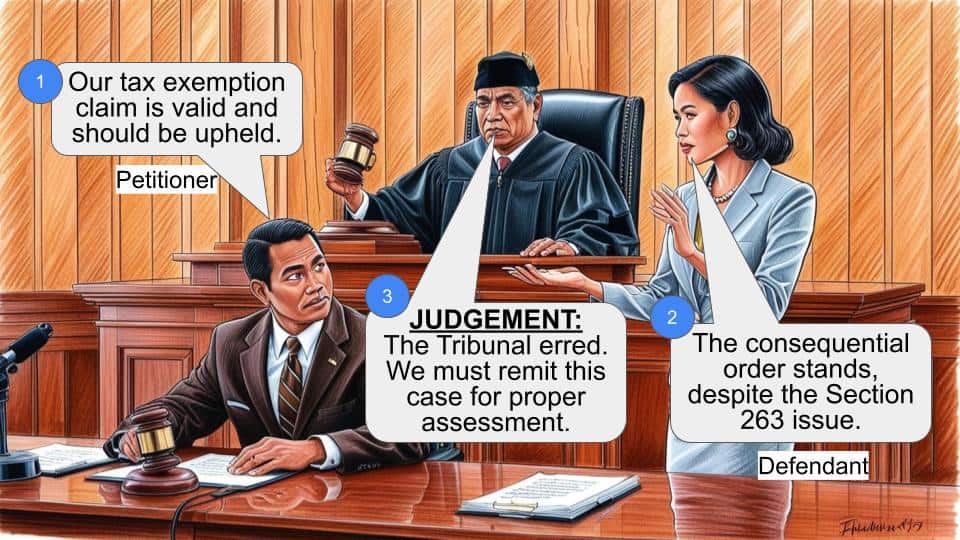
1. The High Court set aside the Tribunal's orders, finding them to be non-speaking and failing to address key issues raised by both parties.
2. The court remanded the matter back to the Tribunal for fresh consideration on merits.
3. The High Court emphasized that the Tribunal should have considered the scope of the appeal, the additional grounds raised, and the objections of the assessee.
FAQs:
Q1. What is a "non-speaking order"?
A1. A non-speaking order is a decision that doesn't provide sufficient reasons or address the key arguments raised by the parties.
Q2. Why is Section 144C (of Income Tax Act, 1961) important in this case?
A2. Section 144C (of Income Tax Act, 1961) requires the Assessing Officer to issue a draft assessment order in certain cases involving transfer pricing, allowing the assessee to file objections before finalization.
Q3. What is the significance of this judgment for future tax cases?
A3. This judgment emphasizes the importance of tribunals addressing all issues raised by parties and following proper procedures, particularly in cases involving transfer pricing.
Q4. Can additional grounds be raised at any time during appeal proceedings?
A4. While additional grounds can be raised, they may be objected to if filed belatedly without proper justification, as seen in this case.
Q5. What happens now that the case has been remanded to the Tribunal?
A5. The Tribunal will have to reconsider the case afresh, addressing all the issues raised by both parties and providing a reasoned order.

1. These appeals are filed by the assessee challenging the order of the
Income Tax Appellate Tribunal 'A' Bench, Chennai, dated 02.05.2014 in
I.T.A.No.1865/Mds/2011 and the order dated 25.7.2014 made in
M.P.No.95/Mds/2014 for the assessment year 2007-08, raising the following
substantial questions of law:
T.C.(A)No.932 of 2014:
(i) Whether the Income Tax Appellate Tribunal is correct
in law in setting aside the assessment framed by the
respondent which assessment order was framed
without adhering to the prescriptions of section 144C (of Income Tax Act, 1961)
of the Act, thereby proving and establishing the lapse
committed was fatal and not curable?
(ii) Whether the Appellate Tribunal was correct in law in
expanding the scope of the appeal of the Revenue
before them for considering and for passing the order
setting aside the assessment framed by the
respondent for adhering to the prescriptions of the
section 144C (of Income Tax Act, 1961) in spite of the non
consideration of the arguments of both sides on the
plea for admission of the additional grounds of appeal
filed which proved perversity in the order passed by
them?
T.C.(A)No.875 of 2014:
(i) Whether the Appellate Tribunal is correct in law in
not entertaining the plea for recall of the original
order passed within the scope of section 254(2) (of Income Tax Act, 1961) of the
Act in spite of the mistake apparent from the
record/order in not adjudicating the plea relating to
the admission of additional grounds of appeal for
expanding the scope of the appeal before them?
(ii) Whether the Appellate Tribunal is correct in law in
setting aside the assessment framed by the
respondent which assessment order was framed
without adhering to the prescriptions of section 144C (of Income Tax Act, 1961)
of the Act, thereby proving and establishing the lapse
committed was fatal and not curable?
(iii)Whether the Appellate Tribunal was correct in law in
expanding the scope of the appeal of the Revenue
before them for considering and for passing the order
setting aside the assessment framed by the
respondent for adhering to the prescriptions of section
144C of the Act in spite of the non consideration of
the arguments of both sides on the plea for admission
of the additional grounds of appeal filed which proved
perversity in the order passed by them?"
2. The following facts as found in the assessment order will be
relevant in disposing the above appeals.
The appellant/assessee is a wholly owned subsidiary of Conso
International Corporation, USA and is engaged in the manufacture of
Decorative Trimming, such as, Tie Backs, Tassels, Trimmings etc. and is a
100% Export Oriented Unit. The assessee company has filed their return of
income for the assessment year 2007-08 on 31.10.2007 admitting a total
income of Rs.1,37,520/- and value of fringe benefits of Rs.16,16,630/-. The
book profit under Section 115JB (of Income Tax Act, 1961), as returned by the assessee, worked out to
Rs.1,50,066/-. After processing the return under Section 143(1) (of Income Tax Act, 1961), as the case
was selected for scrutiny through CASS, notice under Section 143(2) (of Income Tax Act, 1961) was
issued to the assessee.
3. As international transactions were involved in this case, the case
was referred to the Transfer Pricing Officer, Chennai in order to compute the Arms Length Price with the approval of the Commissioner of Income Tax-II, Coimbatore. It appears that the Transfer Pricing Officer has passed an order on 28.10.2010 in terms of Section 92CA(3) (of Income Tax Act, 1961), which is recorded in the Assessment order, reads as follows:
"8. Vide her order in F.No.1510/TPO-IV/AY 2007-08 dt:
28-10-2010, the Transfer Pricing Officer -IV, Chennai, has
directed the Assessing Officer to adjust upwardly the total
income of the assessee by Rs.1,77,80,447/- (Rs.1,05,80,652
+ Rs.71,99,795) on account of determination of Arms Length
Price of transaction relating to payment carriage outward costs
and volume discount at Nil."
4. Thereafter, the Assessing Officer proceeded to pass an order under
Section 143(3) (of Income Tax Act, 1961) and accordingly passed the
assessment order on 30.12.2010, which includes the regular assessment and
the order of the Transfer Pricing Officer after affording opportunity to the
Authorised Representative of the assessee. The assessment order came to be
challenged by the assessee before the Commissioner of Income Tax
(Appeals) contending that the order of the Transfer Pricing Officer should
have culminated into a draft assessment order in terms of Section 144C(1) (of Income Tax Act, 1961) of
the Income Tax Act and since the Assessing Officer has not passed the
assessment order on the basis of the draft assessment order, the
proceedings under Section 143(3) (of Income Tax Act, 1961) passed by the Assessing Officer dated
30.12.2010 was bad.
5. The Commissioner of Income Tax (Appeals), by order dated
30.08.2011, set aside the order of the Assessing Officer in entirety holding
as follows:
"6. As per the provisions of section 144 (of Income Tax Act, 1961) C, the Assessing
Officer shall "notwithstanding anything to the contrary contained
in this Act, in the first instance, forward a draft of the proposed
order of assessment order (hereafter in this section referred to
as the draft order) to the eligible assessee if he proposes to
make, on or after the first day of October, 2009 in variation in
the income or loss returned which is prejudicial to the interest of
such assessee, the other sub-sections of section 144 (of Income Tax Act, 1961) C mention
about the further procedure of completion of assessment and
the reference to the Dispute Resolution Panel. As seen from the
assessment order, it was passed on 30.12.2010 without giving a
draft of the proposed order of assessment to the assessee, since
there was a variation in the income which is prejudicial to the
interest of the assessee. The Assessing Officer has directly
passed the Order u/s 143(3) (of Income Tax Act, 1961) thereby denying an opportunity to
the appellant to file his objections before the Dispute Resolution
Panel and also the Assessing Officer. Since the Assessing
Officer has not followed the provisions of section 144 (of Income Tax Act, 1961) C thereby
denying the opportunity to the appellant to approach the
Dispute Resolution Panel, the order u/s 143(3) (of Income Tax Act, 1961) is bad in law. In
view of this, the grounds of appeal as per additional grounds are
allowed."
6. Aggrieved by the order of the Commissioner of Income Tax
(Appeals), the Department filed an appeal on 18.11.2011 before the Income
Tax Appellate Tribunal raising the following grounds:
"1. The order of the learned Commissioner of
Income-tax (Appeals) is against facts and circumstances of
the case.
2. The learned Commissioner of Income-tax
(Appeals) erred in deleting the entire additions made in the
assessment on the ground that the order was not passed
in pursuance of the directions of DRP u/s 144C (of Income Tax Act, 1961).
3. The learned CIT(A) ought to have deleted the
addition made by the Transfer Pricing Officer rather than
deleting all the additions including additions made by the
Assessing Officer."
7. The Tribunal, by order dated 24.4.2012, disposed of the appeal
exparte by way of remand. However, at the behest of the assessee, who
filed an application to recall the exparte order on account of the non-
appearance, the Tribunal was inclined to accept the plea and the order dated
24.4.2012 was recalled and the appeal was restored to file. At that juncture, the Department has raised additional grounds raising a new plea, which was vehemently opposed by the appellant/assessee stating that it was belated. The said additional grounds and the objections of the assessee are as follows:
“During the course of the hearing the revenue filed the
additional grounds of appeal which was served on the
Respondent on 01.04.2014 after lapse of more than 2 years
(appeal filed on 18.11.2011) and admittedly there was no
petition for condoning the delay in filing the said additional
grounds of appeal.
The Respondent vehemently had objected to the
admission of the additional grounds of appeal especially to
change their stand totally in the present appeal proceedings.
For sake of easy reference, the said additional grounds of
appeal filed by the revenue is re-produced below:
“2. The learned Commissioner of Income Tax (Appeals)
erred in cancelling the assessment, since the provisions of
sec.144C (of Income Tax Act, 1961) was not followed.
3. The learned Commissioner of Income Tax (Appeals)
ought to have observed that non issue of draft order u/s. 144C (of Income Tax Act, 1961)
of the Act was on a procedural irregularity.”
On a plain reading of the said grounds of appeal it is crystal
clear that the revenue has put up a different case without
explaining bona fide reasons for belated change of their stand
and on the contrary revenue relied on two decisions to press
their plea for adjudication of the revised grounds of appeal so
as to get another round of proceedings for the Assessing
Officer.”
8. In effect, when the appeal was originally filed, the objection of the
Department was that the Commissioner of Income Tax (Appeals), while
passing the order dated 30.8.2011 ought not to have deleted the entire
addition on the premise that the procedure prescribed under Section 144C (of Income Tax Act, 1961)
was not followed. It is the contention of the appellant/assessee that the
grounds of appeal by the Department is that the jurisdiction of the
Commissioner of Income Tax (Appeals) to set aside the assessment order
passed under Section 143(3) (of Income Tax Act, 1961) dated 30.12.2010 should be limited to the issue
with regard to the order of the Transfer Pricing Officer and not otherwise.
Nevertheless, it is also the contention of the appellant that they are entitled to object the appeal filed by the Department on the ground of violation of the procedure and requirement under Section 144C (of Income Tax Act, 1961).
9. This issue that was canvassed vehemently by the appellant was
brushed aside by the Tribunal and we find that the first order of the Tribunal dated 02.05.2014 is merely proceeded on the basis that there was a
concession by the Authorised Representative of the assessee and
magnanimously agreed by the Department Representative in remanding the
matter and therefore, the Tribunal passed the following order:
“4. At the time of hearing the Ld. A.R., conceded for
remitting the case back to the file of Ld. Assessing Officer for
hearing the case afresh. The Ld. D.R. magnanimously agreed
for the same.
5. Considering the facts and circumstances of the case,
and in accordance with the request of both the parties, we
hereby remit back the matter to the file of Ld. Assessing Officer
for denovo consideration. We also make it clear that the
assessee shall co-operate with the Revenue in their proceedings
promptly without seeking unnecessary adjournments in order to
expedite the orders of the Revenue.
6. In the result, the appeal of the Revenue is allowed for
statistical purposes.”
10. Aggrieved by this order of the Tribunal the assessee filed an appeal
before this Court in T.C.(A)No.932 of 2014 raising the above-mentioned
substantial questions of law.
11. Thereafter, an application was filed before the Tribunal under
Section 254(2) (of Income Tax Act, 1961) by the assessee seriously contending that there was no
concession at any point of time and the matter was persuaded vehemently.
The appellant relied on the gist of arguments dated 05.04.2014 filed during
the course of argument on 08.04.2014, which has been taken note of by the
Tribunal The assessee has also raised an objection on the ground that
various legal facets of the case has not been considered by the Tribunal as
has been pointed out earlier.
12. The Tribunal taking note of the said objection came to hold that
the Tribunal had misunderstood the submissions and the gesture of the
Authorised Representative, which made them to pass such an order.
However, the Tribunal chose to rectify the order by passing a revised order
on 25.7.2014, which reads as follows:
"5. We have heard both the sides and perused the
materials on record. It appears that the Bench had
misunderstood the submissions and gesture of the Ld. A.R at
the time of hearing the appeal and had therefore observed in
the order that the Ld. A.R had conceded for remitting the case
back to the file of Ld. Assessing Officer for fresh hearing.
Therefore paras-4 & 5 of the order of the Tribunal in ITA
No.1865/Mds./2011 is accordingly modified and shall be
henceforth read as follows:-
"Para - 4 Ld. D.R taking cue from the
observations of the Bench magnanimously conceded
for remitting the case back to the file of the Ld.
Assessing Officer for hearing the case afresh. Ld.
A.R. on the other hand, stoutly opposed for
remitting back the matter and relied on the order of
Ld. CIT(A).
Para - 5 Considering the facts and
circumstances of the case, we hereby remit back
the matter to the file of Ld. Assessing Officer for
denovo consideration (since the Ld. Assessing
Officer had not followed the provisions of Sec.144C (of Income Tax Act, 1961)
of the Act). We also make it clear that the assessee
shall co-operate with the Revenue in their
proceedings promptly without seeking unnecessary
adjustment in order to expedite the order of the
Revenue."
6. In the result, the Miscellaneous Petition of the assessee is
allowed to the extent indicated herein above."
13. Aggrieved by this Miscellaneous order, the assessee filed an appeal
before this Court T.C.(A)No.875 of 2014 raising the above-mentioned
substantial questions of law.
14. Heard Mr.S.Sridhar, learned counsel appearing for the appellant
and Mr.T.R.Senthilkumar, learned Standing Counsel appearing for the
Revenue and perused the materials placed before this Court.
15. At the outset we have to point out that there is totally non-
application of mind by the Tribunal. The core issue raised in the appeal, the objections of the appellant and the non-consideration of the issue raised in appeal clearly makes the order of the Tribunal a non-speaking order.
16. We find from the arguments advanced by the appellant and the
respondent that there is no scope for passing such a non-speaking order of
remand, for which we record our reasons as under:
i) the order of assessment under Section 143(3) (of Income Tax Act, 1961) of the
Income Tax Act dated 30.10.2010 is also in relation to the order
passed by the Transfer Pricing Officer dated 28.10.2010 under
Section 92CA(3) (of Income Tax Act, 1961) and that was challenged
before the Commissioner of Income Tax (Appeals), which was
allowed in favour of the assessee. Against which, the
Department filed an appeal to the Tribunal, the scope of which
we have recorded earlier is limited to that portion of the order of
the Commissioner of Income Tax (Appeals) interfering with the
entire order passed under Section 143(3) (of Income Tax Act, 1961); in other words, it
should be limited only to the order relatable to the order of the
Transfer Pricing Officer dated 28.10.2010. That matter was
pending before the Tribunal for more than two years.
Thereafter, additional grounds have been raised, which was
objected to by the assessee saying that new plea was sought to
be raised and that issue has not been addressed by the Tribunal;
ii) the core issue raised by the assessee is with regard to
the order passed by the Assessing Officer under Section 143(3) (of Income Tax Act, 1961)
read with Section 92CA(3) (of Income Tax Act, 1961); the contention
of the assessee is that the requirement under Section 144C(1) (of Income Tax Act, 1961)
of the Income Tax Act has not been followed and the
Commissioner of Income Tax (Appeals) has accepted such a
stand and it is for the Tribunal to consider the objection of the
assessee in the light of the objection filed in relation to the non-
compliance of Section 144C (of Income Tax Act, 1961). That aspect
has not been considered by the Tribunal and therefore the
question of law which is raised by the assessee ought to have
considered by the Tribunal and there was no scope for passing a
non-speaking remand order; and
iii) The Tribunal ought to have considered the scope of
such appeal, the additional grounds raised and the objections of
the assessee and should have given a ruling on the same.
17. We, therefore, have no hesitation to hold, for the reasons stated
above, that the order of the Tribunal is a non-speaking order and the
Tribunal has not considered the issue raised and objected by either side.
Hence, we set aside the the order of the Tribunal and remand the matter to
the Tribunal for passing fresh orders on merits.
18. In the result, both the appeals are allowed by way of remand. No
costs.
R.SUDHAKAR,J.
and
R.KARUPPIAH,J.
×
Similar Ripples
Questions
High Court Sets Aside Non-Speaking Tribunal Order in Tax Case
Write your CommentSimilar Posts

Generic
- Reportdata/4232.pdf
