


Full News
High Court Upholds Deletion of Income Tax Additions Against Assessee
High Court Upholds Deletion of Income Tax Additions Against Assessee
This case involves an appeal by the Revenue (Income Tax Department) against the order of the Income Tax Appellate Tribunal (ITAT), which had upheld the deletion of several additions made by the Assessing Officer to the income of the assessee, Mr. Sunil M. Thakkar, for the block period from April 1, 1988 to February 13, 1999. The key issues were related to the assessee's alleged involvement in the sale of Naphtha, delivery orders, accommodation entries, foreign travel expenses, and household expenses.
Get the full picture - access the original judgement of the court order here
Case Name:
Principal Commissioner of Income Tax Vs Sunil M. Thakkar (High Court of Bombay)
Income Tax Appeal No.1499 of 2017
Date: 11th February 2020
Key Takeaways:
1. The High Court emphasized that in an appeal under Section 260A (of Income Tax Act, 1961), it can only interfere with the findings of fact if they are perverse or exhibit a total non-application of mind.
2. The High Court found no infirmity in the concurrent findings of the lower appellate authorities (CIT(A) and ITAT) in deleting the various additions made by the Assessing Officer.
3. The High Court reiterated that block assessment under Section 158BB (of Income Tax Act, 1961) must be based on the evidence and materials gathered during the search and seizure proceedings, which form the foundation of the proceedings.
Issue:
Whether the High Court should interfere with the ITAT's order that upheld the deletion of various additions made by the Assessing Officer to the assessee's income for the block period.
Facts:
- The Income Tax Department conducted a survey at the business premises of M/s. Galaxy Plasto O-Chen Industry Ltd., which revealed that the company belonged to the Vora family.
- During the investigation, it was found that the Thakkar family, including the assessee Mr. Sunil M. Thakkar, had taken accommodation entries from the Vora group.
- The Assessing Officer made several additions and disallowances to the assessee's income for the block period, which were later deleted by the CIT(A) and upheld by the ITAT.
- The Revenue challenged the deletions made by the CIT(A) and upheld by the ITAT before the High Court.
Arguments:
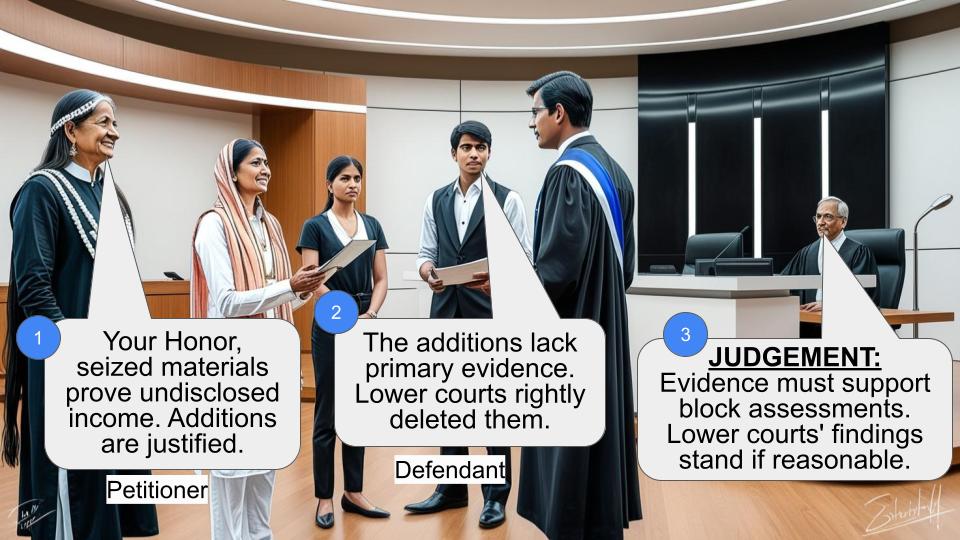
- The Revenue argued that the ITAT was wrong in deleting the additions made by the Assessing Officer, as there was sufficient evidence, including statements and seized materials, to implicate the assessee.
- The assessee contended that the additions were not supported by primary evidence and that the Assessing Officer had not properly investigated the matter.
Key Legal Precedents:
- Section 158BC (of Income Tax Act, 1961) and Section 158BB (of Income Tax Act, 1961), which govern the procedure for block assessment of undisclosed income.
- Precedents establishing that the High Court can only interfere with findings of fact if they are perverse or exhibit a total non-application of mind.
Judgment:
- The High Court found no infirmity in the concurrent findings of the CIT(A) and ITAT in deleting the various additions made by the Assessing Officer.
- The High Court held that the block assessment must be based on the evidence and materials gathered during the search and seizure proceedings, which form the foundation of the proceedings.
- The High Court dismissed the Revenue's appeal, finding that no substantial question of law arose from the ITAT's order.
FAQs:
Q1. Why did the High Court uphold the deletion of the additions made by the Assessing Officer?
A1. The High Court found that the lower appellate authorities (CIT(A) and ITAT) had thoroughly examined the evidence and materials on record and provided reasonable grounds for deleting the additions. The High Court did not find any perversity or total non-application of mind in the findings of the lower authorities.
Q2. What is the significance of the High Court's emphasis on the foundation of block assessment proceedings?
A2. The High Court reiterated that block assessment under Section 158BB (of Income Tax Act, 1961) must be based on the evidence and materials gathered during the search and seizure proceedings, as these form the foundation of the proceedings. This ensures that the assessment is grounded in the facts and evidence collected by the authorities.
Q3. Can the High Court interfere with the findings of fact made by the lower appellate authorities?
A3. The High Court clarified that in an appeal under Section 260A (of Income Tax Act, 1961), it can only interfere with the findings of fact if they are perverse or exhibit a total non-application of mind. The High Court found no such infirmity in the present case.
Q4. What are the key legal principles established in this case?
A4. The key legal principles established in this case are:
- The importance of basing block assessment on the evidence and materials gathered during the search and seizure proceedings.
- The limited scope of the High Court's interference with findings of fact made by the lower appellate authorities.
- The requirement of perversity or total non-application of mind for the High Court to interfere with the findings of fact.

1. This appeal has been preferred by the Revenue under Section 260A (of Income Tax Act, 1961) (hereinafter referred to as ‘the Act’) against the order dated 05th July 2016 passed by the Income Tax Appellate Tribunal, “J” Bench, Mumbai (hereinafter referred to as ‘the Tribunal’) in Income Tax (SS) Appeal No.173/Mum/2006 for the block period 01st April 1988 to 13th February 1999.
2. The Assessing Officer passed a detailed assessment order dated 28th February 2001 in respect of the block period and made several additions and dis-allowances to the income of the assessee for the block period. The first Appellant Authority i.e. Commissioner of Income Tax (Appeals) (hereinafter referred to as the CIT (A)) allowed the appeal of the assessee by deleting the additions under various heads made by the Assessing Officer to the income of the assessee. The revenue challenged the deletion made by the CIT (A) in respect of five heads before the Tribunal. The Tribunal by its order dated 05th July 2016 upheld the order passed by CIT (A).
3. The brief facts relevant for the purpose of deciding the present appeal are as follows :
3.1. On the basis of information received from the Investigation Wing of the Income Tax Department in the case of M/s. Galaxy Plasto O-Chen Industry Ltd., it was revealed that the said company belonged to one Vora family comprising of three brothers, viz Naresh B. Vora, Sudhir B. Vora and Nitin B. Vora. Under the provisions of Section 133A (of Income Tax Act, 1961), a survey was conducted at the business premises of the above company on 04th September 1998, pursuant to which books of accounts and other documents were seized and impounded on 25th September 1998.
3.2. The statements of Mr. Nitin B. Vora and Mr. Sudhir B. Vora were recorded on 25th September 1998, 15th November 1998 and 16th November 1998. Mr. Nitin B. Vora stated that he was in the Hawala business and he admitted to concealment of Rs.1.35 Crores and admitted to providing accommodation entries to various parties. Mr. Nitin B. Vora also stated that, he was holding a quota of “Naphtha” which he used to sell in the open market for cash at a high premium and would issue bogus bills to the seller of Naphtha and dealers of other chemicals and in return he would receive cash from Bank and cheques on commission basis.
3.3. Further investigation was carried out by the Income Tax Department and it was found that one of the party involved in the aforesaid business was the Thakkar family consisting of Manoj Thakkar and his three sons namely Atul M. Thakkar, Mayur M. Thakkar and Sunil M. Thakkar. Sunil M. Thakkar is the assessee in the present case. The Thakkar family members used to send cash to the Vora family for obtaining accommodation entries.
3.4. Further investigation was done, consequent upon which the Assessing Officer issued notice under Section 158BC (of Income Tax Act, 1961) on 13th December 1999 and called on the assessee (Mr. Sunil M. Thakkar) to file return covering the block period from 01st April 1988 to 13th February 1999.
3.5. The assessee filed return of income for the block period showing undisclosed income of Rs.12,58,739.00.
3.6. The Assessing Officer issued notice under Section 142(1) (of Income Tax Act, 1961) with a detailed questionaire served upon the assessee and reply was received from the assessee.
3.7. The Assessing Officer thereafter passed a detailed assessment order in respect of the block period and made a number of additions and dis-allowances to the income of the assessee.
3.8. The assessee filed appeal before the CIT (A). CIT (A) allowed the appeal of the assessee by deleting the additions made by the Assessing Officer. The Revenue challenged the deletion made by the CIT (A) in respect of five heads before the Tribunal.
3.9. The Tribunal passed its order dated 05th July 2016 and returned a finding that the deletion of the additions made by the CIT (A) were quite reasonable and did not require any interference. Appeal of the Revenue was dismissed.
3.10. Hence the present appeal by the revenue.
4. The Revenue has projected the following substantial questions of law :-
“(A) Whether on the facts and in the circumstances of the case and in law, the Hon. ITAT was right in deleting the addition made on account of sale of Naphtha ignoring the seized material and statement recorded u/s 131 (of Income Tax Act, 1961), which established that the assessee sold in open market the Naphtha products at hefty cash premium and part of which unaccounted sale consideration routed back in the books through accommodation entries and the component of cash premium never reflected in the books of accounts ?
(B) Whether on the facts and in the circumstances of the case and in law, the Hon. ITAT was right in deleting the addition made on account of sale of delivery orders purchased from M/s Reliance Industries Ltd. ignoring the seized material, on the ground that it is not primary, which established that the assessee earned unaccounted premium out of sale of goods ?
(C) Whether on the facts and in the circumstances of the case and in law, the Hon. ITAT was right in deleting the addition made on protective basis ignoring the statement of Shri Naresh Vora who had categorically alleged that some of the parties on whose behalf bogus invoices were raised by Thakkar brothers ?
(D) Whether on the facts and in the circumstances of the case and in law, the Hon. ITAT was right in deleting the addition made on account of foreign tour expenses ignoring the fact that the assessee has failed to adduce documentary evidence to prove the genuineness of the said expenses ?
(E) Whether on the facts and in the circumstances of the case and in law, the Hon. ITAT was right in deleting the addition made on account of household expenses ignoring the fact that the assessee has failed to explain the cash withdrawals which were unrecorded in the books of accounts ?”
5. Mr. Walve learned counsel appearing for the appellant has laid thrust on the assessment order and emphasized on the modus operandi between the public sector units, industries, illegal users of adulterated petrol, Vijan group, Vora group etc. for ascertaining the role of the assessee. He has drawn our attention to question No.8 and its answer in the statement of Shri. Naresh B. Vora, which was recorded under Section 131 (of Income Tax Act, 1961). Question No.8 and its answer reads thus :-
“Q.8. Can you explain the modus operandi as far the sale of Naphtha in open market is concerned ? Ans.The Naphtha is filled from the factory of M/s. RRPL which is located at Sinner, Nashik or at times directly from the refineries of the public undertakings and being sold to various petroleum dealers on cash basis which is exclusively devoid of any record. This Naphtha is used for various purposes and the most important among that is adulteration or mixing with petrol being sold at retail outlets.”
5.1. Mr. Walve has thereafter drawn our attention to contents of question No.19 and its answer in the statement of Naresh B. Vora which related to the assessee taking accommodation entries on behalf of various parties. Question No.9 and its answer reads thus :-
“Q.19. I am drawing your attention towards Vimal Deluse Note Book inventoried under Sl. No.1 of Annexure ‘A’ drawn at Vile Parle Office during the course of Survey Persal of this note book refers certain entries against ‘Sunil Carriers’ ‘Rama Atlas’ etc. kindly explain these entries.
Ans.All the entries appearing under Sunil Carriers, Rama and Atlas are the details of billed invoices and corresponding cash receipt from Sunil Thakkar. In other words, Sunil Thakkar has taken accommodation entries on behalf of Rama means M/s. RRPL, Atlas means Atlas Petrochemicals Ltd. Sunil Carriers is one of the concern of Sunil Thakkar and that as why reference is appearing in this note book for eg. I will explain page no.4 of this note book which shows :-
Sunil Carrier 13/9/97
Rama 1,01,640x5= 5,08,200/-
Bank Commission =500/-
Commission =21,000/-
Atlas 1,20,200 x 5 = 6,00,000/-
Bank Commission =1,200/-
Commission =21,000/-
3,74,960/-
Above mentioned entries are related to accommodation entries taken by Shri Sunil Thakkar for which the name ‘Sunil Carrier’ appears at the top. The figures against Rama (M/s. RRPL) are nothing but calculation of value of one invoice multiplied by number of 5 invoices amount comes to Rs.5,08,200/- and Rs.500/-, Bank commission for 5 pay orders issued for 5 invoices referred earlier. Rs.21,000/- is my commission on the total amount i.e. 5,08,200/-. Similar is the calculation shown against Atlas (Atlas Petrochemicals).
As a matter of fact all the transaction appearing in this note book against ‘Rama’ and ‘Atlas’ are transaction related to accommodation entries taken by Sunil Thakkar on behalf of M/s. RRPL & Atlas Petrochemicals Ltd.”
5.2. Mr. Walve submitted that the assessee was referred to in the books of the Vora group by several names such as Sunilbhai, Sunilbhai (baroda), Sunilbhai Bhanushali, Sunilbhai Bhanushali (baroda), Sunil Carrier, Sunil Transport and Sunil Agrawal and after reading the answers to the questions given by the Vora group members, it was established that, the assessee was involved in giving accommodation entries to various parties. He submitted that there was enough material on record to warrant implication and indictment of the assessee.
6. To appreciate the questions framed and the contentions advanced by the learned standing counsel, it would be necessary to advert to the orders passed by the statutory authorities.
7. During the block assessment proceedings, the modus operandi of the trade as unravelled by the Assessing Officer showed a complex networking between Public Sector Units like; (i) Bharat Petroleum Corporation Ltd., (ii) Indian Oil Corporation Ltd; (iii) Hindustan Petroleum Corporation Ltd; (iv)Gas Authority of India Ltd., and industries manufacturing petro products like (i) Reliance Industries Ltd., (ii) Ram Remedies Pvt. Ltd., (iii) Silver Chemical Industries (Bom.) Pvt. Ltd., (iv) M/s. Paschim Petrochemical Pvt. Ltd. on the one hand and illegal users mainly carrying out adulteration of petrol like (I) chain of petrol pumps scrupulously using "Naphtha" and "Naphtha based products" for adulteration of petrol procured from traders like the Thakkar group and the Vora group through their companies / concerns like; (i) Galaxy Plasto Chemical Industries Ltd., (ii) Thinsol Chemicals Pvt. Ltd. (iii) Minalshree Chemicals Pvt. Ltd. etc.
8. Assessing Officer scrutinized the books, notebook registers, loose papers, diaries and statements of various family members of the Vora and Thakkar groups and came to the following conclusion :- (i) that various concerns of the Vora family were floated with the sole intention of providing accommodation entries to several parties by way of furnishing fictitious bills showing purchase of petro-chemical products by such concerns leading to commission at pre- determined rate being received by the Vora family members in cash for the aforesaid service of providing accommodation entries; (ii) that a number of business concerns dealing in petro-chemical products either as manufacturers, dealers or traders had utilized accommodation entries from the concerns of Vora group; (iii) that these concerns procured petro chemicals either directly from pubic sector undertakings like; BPCL, HPCL, IOCL, GAIL etc, or through intermediaries providing accommodation entries and that the amounts involved were large.
9. The Assessing Officer duly scrutinized the statements made by the Vora and Thakkar family members and on the basis of facts, circumstances, evidence and transactions appearing in the seized books confronted the assessee (Mr. Sunil M. Thakkar) by notice under Section 131 (of Income Tax Act, 1961), inter-alia, providing the assessee an opportunity to examine Mr. Naresh B. Vora. Since the assessee did not avail of the opportunity at the first instance the assessee was provided a further opportunity on 20th February 2001 on which date the assessee examined Mr. Naresh B. Vora. During cross examination of Mr. Naresh B. Vora it was revealed that the assessee had been regularly depositing cash to avail accommodation entries for sale of "Naphtha" on behalf of M/s. Ram Remedies Pvt. Ltd. On the basis of corroborative evidence obtained from the seized books, documents, loose papers etc, the Assessing Officer concluded that there was a nexus of the assessee with the Vora group on the one hand and with M/s. Ram Remedies Pvt. Ltd. on the other hand. The Assessing Officer further scrutinized and analyzed various dealings between the parties on the basis of the following materials :-
(i) Account books from the Thakkar group, Vijan group and Vora group; (ii) Statements recorded of Vora group members;
(iii) Facts and circumstances evidencing transactions appearing in Vora group’s books as paper transactions only;
(iv) Cross examination of Mr. Naresh B. Vora; (v) Analysis of objection / observations, counter reply in the facts available on record made by the assessee; (vi) Corroborative evidences gathered during search and survey operations; (vii) Evidence relating to sale of premium as collected; (viii) Sale on delivery orders purchased from M/s. Reliance Industries Ltd.; (ix) Income earned from the business of hiring of tankers during the block period; (x) Expenses on foreign travel by the assessee on the basis of the scrutiny of his passbook and various other books; (xi) Computation of total income for the block period; (xii) Cash found from the residence of the assessee as appearing in the books of the Vora family.
10. After scrutiny and detailed analysis on the basis of the above, the Assessing Officer vide the assessment order dated 28th February, 2001 made the following additions to the income of the assessee for the block period 1st April 1988 to 13th February 1999 : (i) The Assessing Officer considered addition of undisclosed income at Rs.22,75,91,170.00 and added the income earnings on the sale of Naphtha amounting to Rs.48,61,834.00 to the income of the assessee; (ii) The Assessing Officer took 82% as the average rate of premium and made a further addition of Rs.36,38,634.00 towards unaccounted sale based on purchases made from Reliance Industries Ltd. to the income of the assessee; (iii) The Assessing Officer added a sum of Rs.22,11,000.00 as unexplained cash belonging to the income of the assessee and a further sum of Rs.30,00,000.00 towards unaccounted capital for starting unaccounted trade; (iv) The Assessing Officer added undisclosed cash deposits of Rs.6,27,97,057.00 on behalf of certain concerns in respect of accommodation entries; (v) The Assessing Officer added a sum of Rs.1,54,197.00 as income from the business of hiring of tankers to the income of the assessee; (vi) The Assessing Officer added a sum of Rs.2,00,000,00 spent by the assessee on a foreign trip to the income of the assessee as also Rs.21,83,010.00 towards household expenses of the assessee.
11. Being aggrieved by the above order, the assessee preferred appeal before the first appellate authority i.e. the CIT (A), Mumbai. The CIT (A) after considering the entire gamut of evidence placed before the Assessing Officer dealt with each and every addition made by the Assessing Officer and vide its order dated 14th March, 2006 returned its findings as under :-
11.1. In respect of addition of Rs.2,92,90,123.00 as undisclosed exempted income disclosed by the assessee, the assessee had claimed exempted income of Rs.1,96,50,420.00 for remittances on the basis of his residential status being a non resident Indian. For the year 1992 – 1993 and 1993 – 1994, the status of the appellant was non resident Indian and from assessment year 1994 – 1995 onwards for the next eight years, the status was “not ordinarily resident” and thus the assessee was assessed in regular assessments accordingly.
The Assessing Officer held exemption of Rs.78,31,157.00 being receipt of India Development Bond (IDB) being not exempt and the interest earned on the said IDB for 23 months at the rate of 12% per annum amounting to Rs.18,02,546.00, as income taxable in the hands of the assessee. The Assessing Officer held that Rs.1,71,20,932.00 had been actually remitted in the assessee’s account. The assesse submitted before the CIT (A) that no addition could be made on this account, since no incriminating document was found during search and that the proceeds of the Bonds could not be added as undisclosed income as the said bonds were issued by State Bank of India and the letter of State Bank of India and folio number of the bonds were made available to the Assessing Officer. The assessee also submitted that notional interest @ 12% per annum was considered wrongly by the Assessing Officer as against the actual interest received @ 9% per annum. After considering the evidence on record CIT (A) returned its finding in respect of the aforesaid issue in favour of the assessee on the ground that the assessee was a non resident Indian during the assessment year 1992 – 1993 and 1993 – 1994 and there was no incriminating material found during search on record indicting the assessee. The CIT (A) gave detailed findings deleting the above addition made by the Assessing Officer.
11.2. In respect of addition on account of sale of Naphtha on premium amounting to Rs.12,48,00,000.00 the CIT (A) considered the submissions of the assessee that no evidence was found by the Assessing Officer during search to suggest and implicate that the assessee was in the business of sale of Naphtha. Therefore, the CIT (A) held that the addition made under Section 159BB (of Income Tax Act, 1961) was uncalled for as it did not justify the said addition. The CIT (A) gave detailed findings after going through the seized material and the statements of various witnesses and returned a finding in favour of the assessee that the addition made by the Assessing Officer was not based on any documentary evidence whatsoever and not in conformity with reference to the seized materials gathered during search, thereby deleting the above addition made by the Assessing Officer.
11.3. In respect of addition on account of sale and delivery of Naphtha amounting to Rs.36,38,000.00 the CIT (A) once again came to the conclusion that, since there were no details / material available with respect to the vehicles owned by the assessee that were allegedly used for the transactions the finding of the Assessing Officer was not sustainable in the absence of direct involvement of the assessee, thereby deleting the above addition made by the Assessing Officer.
11.4. In respect of addition of cash amount of Rs.23,11,000.00 found during search in the assessee’s premises, which was claimed by Mr. Atul Thakkar (assessee's brother) admitting that the said cash belonged to him, the CIT (A) after considering the evidence on record came to the conclusion that since this amount was declared as undisclosed income in the block return by Mr. Atul Thakkar, it could not be made attributable to and foisted on the assessee. The CIT (A) therefore deleted this addition made by the Assessing Officer after considering the fact that Mr. Atul Thakkar had paid taxes on the said cash amount as it belonged to him and that there was no evidence on record to link the cash to the assessee.
11.5. In respect of unaccounted initial capital amounting to Rs.30,00,000.00, the CIT (A) came to the conclusion that, since the addition on account of alleged sale of Naphtha on premium had been deleted, this addition of unaccounted initial capital required for the said transaction could not be upheld. Hence, in the absence of any evidence of sale of Naphtha on premium by the assessee, the question of adding this unaccounted initial capital required to start the business did not arise and the same was deleted.
11.6. In respect of addition of Rs.4,99,36,298.00 made on protective basis by the Assessing Officer, the CIT (A) came to the conclusion that this addition was made without any material evidence on record. CIT (A) held that this addition was made on the basis of statements recorded by the Assessing Officer which stated that the assessee was working on behalf of certain concerns in Ahmedabad and cash deposits made in the name of "Sunil Baroda" appearing in the impounded books referred to the assessee i.e. Mr. Sunil M. Thakkar. The CIT (A) extensively referred to the reply filed by the assessee in this regard and the statement of Mr. Naresh Vora which was recorded by the Assessing Officer and came to the conclusion that there was no direct evidence available to establish that the concerns in Ahmedabad viz, M/s. Atlas Petrochemical Ltd., Ankini Petrochemical Pvt. Ltd. or Avani Petrochemical Ltd. belonged to the assessee. Hence, in the absence of any direct evidence linking the nexus of the assessee to the said firms / companies, the CIT (A) deleted the above addition of Rs.4,99,36,298.00 made by the Assessing Officer.
11.7. In respect of addition of Rs.2,00,000.00 towards foreign trip expenses by the assessee during the assessment year 1998 – 1999 being held taxable by the Assessing Officer, the CIT (A) after considering the entire evidence returned a finding that from the materials seized and the statements recorded during search proceedings no question was ever asked or investigation carried out regarding foreign travel of the assessee. The CIT (A) therefore concluded that in the absence of any evidence it could not be held that the above addition made to the income by the Assessing Officer was justified and therefore, this addition made by the Assessing Officer was deleted.
11.8. In respect of addition of Rs.21,83,010.00 towards household expenses, the Assessing Officer had on the basis of entries found in one Gandhi diary during the search of premises of Sunil Chemicals reflecting entries of monthly cash withdrawals had added the same to the income of the assessee. The CIT (A) held that, since no incriminating document or evidence was found which proved that the withdrawal was made by the family members of the assessee, it could not be held that the assessee had earned this undisclosed income. The assessee pleaded that there was no documentary evidence about concealing his household expenditure and that his household expenditure was much more than the expenditure appearing in the said books of accounts. It weighed with the CIT (A) that the Assessing Officer did not consider the total withdrawals by all the family members of the assessee's family. The CIT (A) held that in fact the Assessing Officer had added Rs.62,00,000.00 approximately to the income of all the members of the family of the assessee for the same period, and therefore considering these facts, the addition made by the Assessing Officer on account of withdrawal towards household expenses came to be deleted.
12. The revenue being aggrieved by the order passed by the CIT (A) approached the Income Tax Appellate Tribunal with respect to deletion of five additions made by the CIT (A). Before the Tribunal, the revenue pleaded that the deletion of the following five additions was wrongfully done by the CIT (A) namely :- (i) deletion of addition on account of sale of Naphtha on premium amounting to Rs.12.48,61,834.00; (ii) deletion of addition on account of sale and delivery orders amounting to Rs.36,38,634.00; (iii) deletion of addition on account of protective basis relying upon the statement of Naresh B. Vora as recorded by the Assessing Officer amounting to Rs.4,99,36,28.00; (iv) deletion of addition on account of foreign tour expenses by the assessee amounting of Rs.2,00,000.00 and (v) deletion of addition on account of household expenses on the basis of entry found in one Gandhi diary amounting to Rs.21,83,010.00.
13. The Tribunal after thoroughly considering the entire evidence on record and materials available, vide the order dated 5th July, 2016 held that the Assessing Officer had to determine the undisclosed income of the block period in the manner as required under Section 158BB (of Income Tax Act, 1961). The Tribunal held that block assessment has to be framed on the basis of the material coming into the hands of the Assessing Officer during the search which becomes the foundation of the proceedings. The Tribunal considered the challenge to the five deletions made by the CIT (A) and after thoroughly examining each of the five deletions did not find any illegality or infirmity in the order of the CIT (A) in deleting the said additions, thereby upholding the order passed by the CIT (A).
14. Before we advert to the impugned order passed by the Tribunal, at the outset, we would state that the appeal under Section 260A (of Income Tax Act, 1961) is required to be entertained only on “substantial question of law” arising out of the order of the Tribunal, keeping in mind that we cannot disturb findings of facts under Section 260A (of Income Tax Act, 1961) unless such findings are shown to be ex-facie perverse, unsustainable and exhibit a total non-application of mind. In the case before us, the additions / dis-allowances made by the Assessing Officer were deleted by the CIA(A) which order was not interfered with by the Tribunal.
15. Order dated 05th July, 2016 passed by the Tribunal :-
15.1. Tribunal considered the first challenge with respect to deletion of addition on account of sale on premium of Naphtha amounting to Rs.12,48,61,834.00 and concurred with the findings of the CIT (A) that this addition was merely based upon the statement of Naresh B. Vora. Tribunal held that not a single word had been written specifically relating to or pointing to the evidence by the Assessing Officer. Tribunal held that during the entire proceedings under Section 132 (of Income Tax Act, 1961) (search proceedings) no incriminating material was found or seized which could show or prove that the assessee was a quota holder of Naphtha or that he owned a factory manufacturing petrochemicals. Tribunal held that the assessee was not confronted with the alleged material and the statement of Naresh B. Vora which was used against him and no investigation was carried out by the Assessing Officer with respect to the nexus of the assessee with the alleged Ahmedabad and Baroda parties. Tribunal held that the CIT (A) specifically referred to the statement of Naresh B. Vora dated 15th October 1998 and in particular to question Nos.3,4 and 5 and their answers and the observation made by the Assessing Officer relating to collection of evidence during the the course of search and further details gathered during the block assessment proceedings. However, the Tribunal after scrutinizing the same found that the CIT (A) had correctly analyzed the facts and evidence and returned the finding that there was no illegality or infirmity in the order of CIT (A) in deleting the addition on account of sale of Naphtha on premium and thus this ground of challenge raised by the revenue came to be dismissed by the Tribunal.
15.2. Tribunal considered the second challenge with respect to deletion of addition on account of sale and delivery orders amounting to Rs.36,38,634.00. After looking into the evidence before the Assessing Officer which pertained to the file containing bills of Reliance Industries Ltd. in favour of Galaxy Petrochemicals and certain other bills in the name of the assessee and one Suresh Mayur, Tribunal accepted the fact that the assessee had totally denied his involvement. Tribunal confirmed the finding returned by the CIT (A) while deleting this addition and concluded that the addition on account of sale and delivery orders could not be sustained under Section 158BC (of Income Tax Act, 1961) in the absence of independent primary evidence. Tribunal held that the appearance of the name of “Sunil Bhai” on the two bills could not prove the involvement of the assessee and there were no reasons offered by the Assessing Officer as to how he arrived at the conclusion that the signature on the two bills was that of the assessee. The Tribunal agreed with the findings of the CIT (A) in respect of deletion of addition on account of sale and delivery orders amounting to Rs.36,38,634.00 and upheld the same. Thus this ground of challenge raised by the revenue before the Tribunal came to be dismissed.
15.3. Tribunal considered the third challenge with respect to deletion of addition of Rs.4,99,36,298.00 which was made on protective basis merely relying on the statement of Naresh B. Vora recorded by the Assessing Officer that the assessee was working on behalf of several parties in Ahmedabad and Baroda. This addition was made without any basis or specific evidence with respect to the nexus of the assessee with any party in Ahmedabad and Baroda. Therefore this addition was determined to be not justified. Tribunal considered the fact that the Assessing Officer had made no inquiries with the alleged parties in Ahmedabad and Baroda as to whether the assessee was working in Atlas Petrochemicals, Ankini Petrochemicals and / or Avani Petrochemicals. Therefore, the above addition which was made merely on the basis of the statement of Naresh B. Vora could not be sustained. Tribunal considered that there was no document to arrive at such a conclusion. Tribunal also considered the fact that in the entire statement of Naresh B. Vora, there was no allegation that the assessee was working on behalf of Atlas Petrochemicals, Ankini Petrochemicals and Avani Petrochemicals and therefore the Tribunal agreed with the findings given by the CIT (A) in deleting the addition of Rs.4,99,36,298.00 made on protective basis and thus this ground of challenge raised by the revenue also came to be dismissed by the Tribunal.
15.4. Tribunal considered the fourth challenge with respect to deletion of addition of Rs.2,00,000.00 on account of foreign tour expenses on the basis of evidence which was gathered. It was observed by the Tribunal that during the search and seizure proceedings no incriminating documents were found which could be linked with the foreign trips made by the assessee. Further the assessment order was silent about the evidence which could prove that the assessee had spent Rs.2,00,000.00 on foreign trips in the assessment year 1998 – 1999 and / or the said money was unaccounted income of the assessee. Tribunal concluded that the revenue failed to disclose that there was any material evidence available / seized in respect of unaccounted income for foreign travel during the search proceedings. Hence the Tribunal returned a finding that there was no infirmity in the order of CIT (A) in deleting the addition of Rs.2,00,000.00 on account of foreign tour expenses and thus this ground of challenge raised by the revenue also came to be dismissed.
15.5. Tribunal thereafter considered the final ground of challenge with respect to the deletion of addition of Rs.21,83,010.00 on account of household expenses in the income of the assessee. The sole basis for this addition was the entry found in one Gandhi diary in the premises of “Sunil Chemicals”. The said diary however was not found at the time of search operations. The said diary was not in the handwriting of the assessee or any of his family member. The nexus of the assessee to the said diary could not therefore be established. Tribunal held that the assessee was not directly concerned with the said diary and therefore the addition which was made by the Assessing Officer was made on his conjectures and surmises. Tribunal therefore returned a finding that the estimated addition cannot be made. Tribunal agreed with the finding of the CIT (A) that for making the above addition, no incriminating document or evidence was found that could prove that the withdrawals were made by the assessee or his family members for their household expenses. Further it was the assessee’s case that the aforesaid amount of Rs.21,83,010.00 was the total withdrawal made by the assessee's family and not by the assessee alone and this was not considered by the Assessing Officer. The Tribunal agreed with the finding of the CIT (A) in deleting the addition of Rs.21,83,010.00 on the ground that the said household expenditure incurred by the family members of the assessee was sufficient and did not require any interference. Thus this ground of challenge raised by the revenue came to be dismissed.
16. Section 158BC (of Income Tax Act, 1961) requires the Assessment Officer to determine the undisclosed income of the block period in the manner provided under Section 158BB (of Income Tax Act, 1961). Section 158BB(1) (of Income Tax Act, 1961) states that the undisclosed income of the block period shall be the aggregate of the total income of the previous years falling within the block period computed, in accordance with the provisions of the Act, on the basis of evidence found as a result of search or requisition of books of account or other documents and such other materials or information as are available with the Assessing Officer and relatable to such evidence, as reduced by the aggregate of the total income, or as the case may be, as increased by the aggregate of the losses of such previous years. Therefore, while determining / computing the undisclosed income of the block period, the Assessing Officer shall compute the income on the basis of evidence found as a result of search or on requisition of books of accounts. This is so because the correctness or otherwise of the return filed in pursuance of notice under Section 158BC(a) (of Income Tax Act, 1961) has to be examined with reference to the materials in possession of the Assessing Officer having nexus to the assessment of undisclosed income. Hence block assessment has to be framed in the light of material coming in to the possession of the assessing authority pursuant to the search, which is the foundation of the proceedings.
17. On a thorough consideration, we have no reason to believe that the above findings are otherwise incorrect or improper. From the above, it is clear that the findings returned by the Tribunal in respect of the five deletions exhibit due application of mind on the part of the Tribunal and on the basis of the factual evidence on record. We do not find any perversity, much less any ambiguity, in the findings returned by the Tribunal. We find that the CIT (A) has dealt with the related issues in great detail which have been affirmed by the Tribunal. Thus, there is concurrent findings of fact by the two lower appellate authorities. We are in agreement with the reasons recorded by the Tribunal in respect of deletion of the five additions made by the CIT (A) and upheld by the Tribunal.
18. In the circumstances, we find that the appeal filed by the revenue is devoid of merit and the same is liable to be dismissed. We therefore hold that no substantial question of law, much less any question of law, arises from the order of the Tribunal.
19. In view of the above findings, the appeal filed by the Revenue is therefore dismissed with no order as to costs.
(MILIND N. JADHAV, J.) (UJJAL BHUYAN,J.)
×
Similar Ripples
Questions
High Court Upholds Deletion of Income Tax Additions Against Assessee
Write your CommentSimilar Posts


Generic
- Reportdata/6057.pdf
