


High Court upholds deletion of unexplained share subscription money, citing con…


Full News
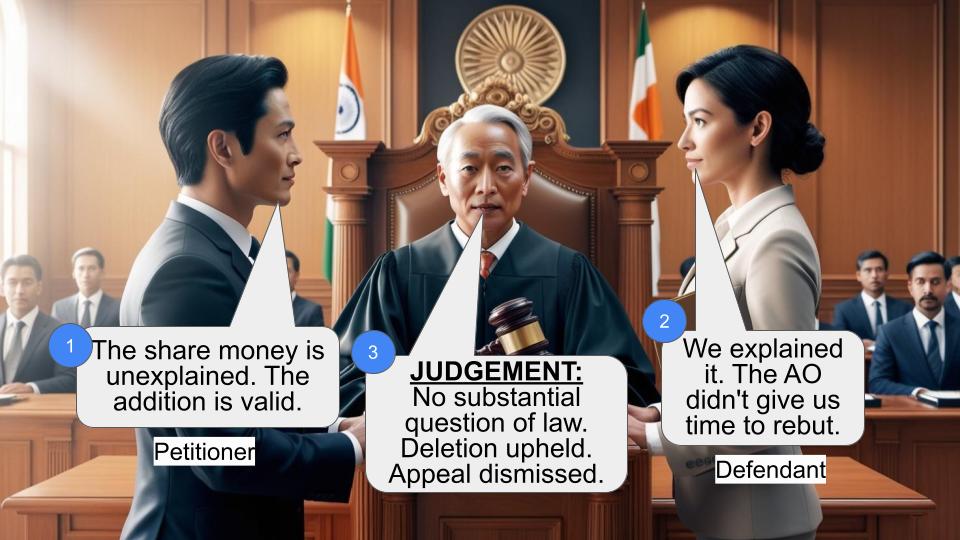
High Court upholds deletion of unexplained share subscription money, citing consistent reasoning
High Court upholds deletion of unexplained share subscription money, citing consistent reasoning
A case where the Income Tax Department (the Revenue) appealed against a decision made by the Income Tax Appellate Tribunal (ITAT). The ITAT had agreed with the Commissioner of Income Tax (Appeals) [CIT(A)] to delete additions made by the Assessing Officer under section 68 (of Income Tax Act, 1961). These additions were related to unexplained share subscription money for two companies. The High Court dismissed the Revenue's appeal, saying there was no substantial question of law involved.
Get the full picture - access the original judgement of the court order here
Case Name:
Commissioner of Income Tax vs. Dwarikadhish Investment (P) Ltd. (High Court of Delhi)
ITA 5/2007
Date: 30th October 2007
Key Takeaways:
1. The court emphasized the importance of giving taxpayers a fair chance to respond to tax authorities' findings.
2. It reinforced previous rulings on how to handle unexplained share application money under Section 68 (of Income Tax Act, 1961).
3. The judgment highlights that tax authorities need to conduct thorough investigations before making adverse inferences.
Issue:
The main question here was: Did the ITAT and CIT(A) err in law by deleting the additions made by the Assessing Officer under section 68 (of Income Tax Act, 1961) for unexplained share subscription money?
Facts:
1. We're dealing with two companies involved in financing and trading shares.
2. For the assessment year 1997-98, these companies declared losses.
3. The Assessing Officer added Rs.17.35 lakh and Rs.36.22 lakh to their incomes, claiming it was unexplained share application money.
4. The companies provided details like sale and purchase bills, shareholder confirmations, PAN numbers, and cheque details.
5. The Assessing Officer got an Income Tax Inspector to investigate, who reported that the applicants weren't found at the given addresses.
6. Here's the kicker - the Assessing Officer gave this report to the companies on February 22, 2000, and passed the assessment order the very next day! Talk about a tight deadline, right?
Arguments:
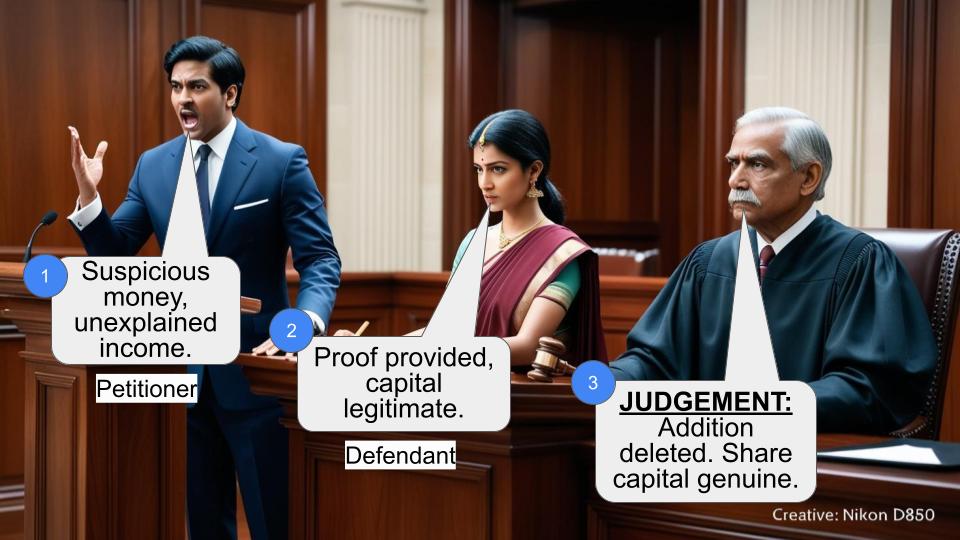
The companies (Assessees) argued:
1. They provided all necessary documentation.
2. They couldn't be faulted for not responding to the Inspector's report due to lack of time.
3. The share applicants were identified and confirmed their payments.
4. Transactions were made by cheques, and affidavits were provided.
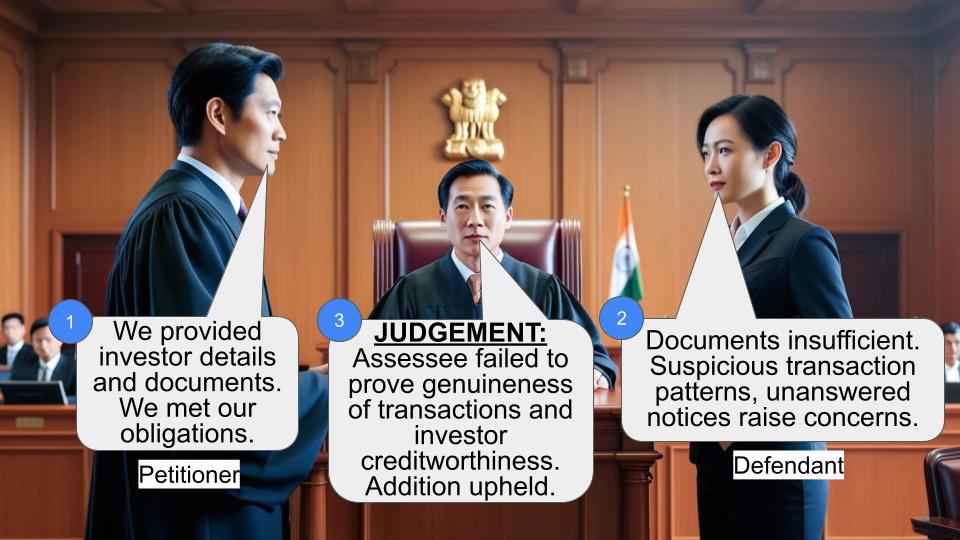
The Revenue argued:
1. The Assessing Officer's additions were justified based on the Inspector's report.
2. The companies failed to prove the genuineness of the transactions.
Key Legal Precedents:
1. CIT vs. Dwarkadhish Financial Services (2005) 197 CTR (Del) 202: This case, involving a group company of the current assessees, had similar facts and the addition was deleted.
2. CIT vs. Divine Leasing & Finance Ltd. (2007) 207 CTR (Del) 38: This case laid down important principles for dealing with Section 68 (of Income Tax Act, 1961) cases.
Judgement:
The High Court dismissed the Revenue's appeal. They found that:
1. The CIT(A) and ITAT's reasoning was consistent with previous High Court decisions.
2. The Assessing Officer didn't give the companies enough time to respond to the Inspector's report.
3. The companies had provided sufficient evidence to explain the share application money.
4. The reasoning of CIT(A) and ITAT wasn't perverse and didn't raise any substantial question of law.
FAQs:
1. Q: What's the significance of this judgment for taxpayers?
A: It reinforces the importance of giving taxpayers a fair chance to explain their financial transactions and the need for tax authorities to conduct thorough investigations.
2. Q: What are the key factors in proving the genuineness of share application money?
A: Based on the judgment, key factors include identifying the creditors, proving the genuineness of transactions through banking channels, and demonstrating the credit-worthiness of subscribers.
3. Q: Does the tax department have to accept all explanations provided by taxpayers?
A: No, but they need to conduct proper investigations and give taxpayers a fair chance to respond before making adverse inferences.
4. Q: What happens if share applicants don't respond to tax department notices?
A: The judgment suggests that the department shouldn't automatically draw adverse inferences just because applicants don't respond to notices.
5. Q: How important are previous court decisions in such cases?
A: They're crucial! This judgment heavily relied on previous decisions, especially the Divine Leasing case, to establish principles for dealing with unexplained credits under Section 68 (of Income Tax Act, 1961).

In these appeals under Section 260-A (of Income Tax Act, 1961), 1961 ('the Act'), the Revenue is aggrieved by the order dated 7th April, 2006 passed by the Income Tax Appellate Tribunal ('Tribunal') in ITA Nos. 2549/Del/2002 and 2550/Del/2002 relevant for the Assessment Year 1997-98.
Both the Assessee companies are engaged in the business of financing and trading in shares. For the Assessment Year in question, the Assessees declared a loss but were assessed at a positive income after making additions on account of unexplained share application money to the extent of Rs.17.35 lakh in respect of the Assessee company in ITA No. 2549 of 2002 and Rs.36.22 lakhs in respect of the Assessee company in ITA No. 2550 of 2002. The Assessing Officer required the Assessees to furnish details and documents. The Assessees produced copies of sale and purchase bills of the share brokers through whom the transactions took place and photocopies of confirmations of persons who had contributed the fresh share application money.
The Assessees furnished the PAN (GIR) numbers of the applicants, the details of the cheque numbers and dates. The Assessees contended that letters sent to the shareholders had not been responded to.
The Assessing Officer required the Assessee to furnish bank statement to substantiate the money availability with the Assessee and also to prove the genuineness of the transactions. This not having been done, the Assessing Officer got enquiries made through an Income Tax Inspector who found that none of the applicants were found to exist at the address given in the confirmations.
However, the report of the Income Tax Inspector was furnished to the Assessees on 22nd February 2000 and the Assessment order was passed on the very next day, that is, 23rd February 2000 giving the Assessees no time to respond.
Before the CIT (A) the Assessees furnished additional evidence, copies of which were sent by the CIT (A) to the Assessing Officer for comments. Despite reminders, no response was received from the Assessing Officer by the CIT(A) on the additional evidence. The CIT(A) then admitted the additional evidence.
After examining the entire record, the CIT(A) deleted the addition on account of the unexplained share application money for the following reasons:
(i) The applicants concerned were identified.
(ii) The applicants confirmed the payment of monies to the appellant for purpose of shares.
(iii) The transaction in question were by cheques.
(iv)The affidavits of the subscribers were filed indicating their full address, details of deposits made with the appellant and the source wherefrom money was obtained to make the deposits. Copies of Bank a/cs were furnished.
These affidavits were notarized. There was no ground for disbelieving the contents of the affidavits.
(v) If the Assessing Officer entertained any doubts regarding genuineness of the credits in respect of share application money, he could have issued summons to the subscribers or could have asked the assessee to produce them.
This was not done.
(vi) Most of the subscribers were companies incorporated with the Registrar of Companies. Proper enquiries would have revealed the true facts of the case. The appellant cannot be faulted if there was no time to give them an opportunity to rebut the Inspector's report made at the back of the appellant.
(vii) The deposits were not of an order that could not be believed.?
In the appeal by the Revenue, the Tribunal found that the facts of the case were no different from those in the case of the group company of the resent Assessee namely M/s. Dwarikadhish Financial Services. In the said case the Tribunal had deleted the addition made by the Assessing Officer on account of unexplained share application money. The said decision was upheld by this Court in its order in Commissioner of Income Tax v. Dwarkadhish Financial Services [2005] 197 CTR 202.
That apart, the Tribunal again examined the documents giving the details of each of the applicants. It noted that ?the above documents were available on the file of the AO.? Accordingly it dismissed the Revenue's appeals. Learned counsel for the Revenue sought to distinguish this Court's decision in the case of the group company of the Assessees, on the ground that the facts there were different. However, we find that the findings of the CIT(A) as extracted hereinabove are sufficient to show that the additions made by the Assessing Officer were not justified. The reasoning and conclusions arrived at concurrently by the CIT(A) and the Tribunal suffer from no perversity and are consistent with the law as explained by this Court in Commissioner o Income Tax v. Divine Leasing and Finance Limited (ITA No. 53/2005 decided on 16th November, 2006) reported in (2007) 207 CTR (Del) 38 and in particular para 16 which reads thus:
?In this analysis, a distillation of the precedents yields the following propositions of law in the context of Section 68 (of Income Tax Act, 1961). The Assessee has to prima facie prove .
(1) the identity of the creditor/subscriber;
(2) the genuineness of the transaction, namely, whether it has been transmitted through banking or other indisputable channels;
(3) the credit worthiness or financial strength of the creditor/subscriber;
(4) if relevant details of the address or PAN identity of the creditor/subscriber are furnished to the Department along with copies of the Shareholders Register, Shared Application Forms, Share Transfer Register etc., it would constitute acceptable proof or acceptable explanation by the Assessee;
(5) The Department would not be justified in drawing an adverse inference only because the creditor/subscriber fails or neglects to respond to its notices;
(6) the onus would not stand discharged if the creditor/subscriber denies or repudiates the transaction set up by the Assessee nor should the AO take such repudiation at face value and construe it, without more, against the Assessee.
(7) The Assessing Officer is duty-bound t investigate the credit worthiness of the creditor/subscriber the genuineness of the transaction and the veracity of the repudiation.?
We are of the view that no substantial question of law arises in these appeals. Accordingly, these appeals are dismissed.
MADAN B. LOKUR, J
S. MURALIDHAR, J
OCTOBER 30, 2007
×
Similar Ripples
Questions
High Court upholds deletion of unexplained share subscription money, citing consistent reasoning
Write your CommentSimilar Posts

Generic
- Reportdata/5216.pdf
