"High Court Upholds Non-Disclosure of 'Reason to Believe' in Income Tax Seizure…


Full News

"High Court Upholds Non-Disclosure of 'Reason to Believe' in Income Tax Seizures"
"High Court Upholds Non-Disclosure of 'Reason to Believe' in Income Tax Seizures"
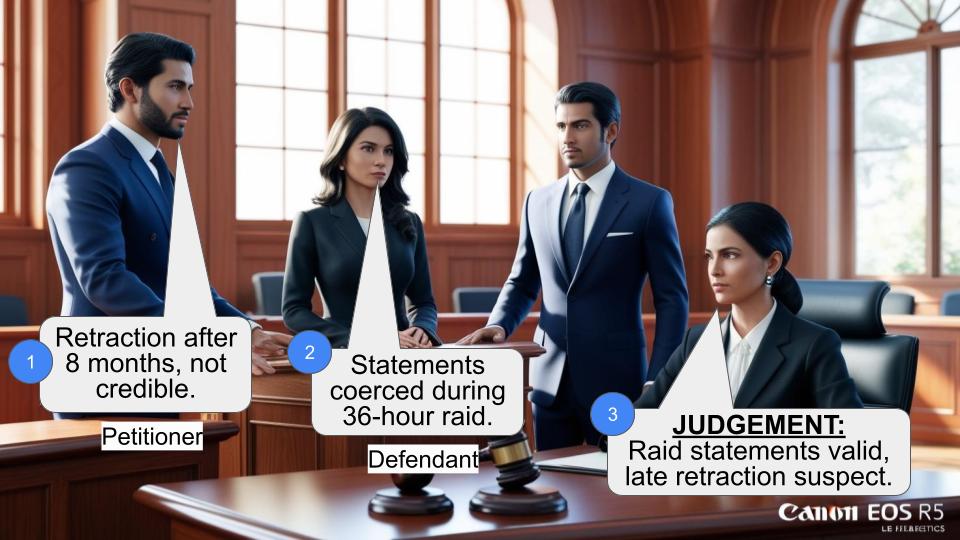
In the case of Shiv Tiwari and others vs. Principal Director of Income Tax (Investigation) and another, the High Court ruled that the reasons for initiating action under Section 132A (of Income Tax Act, 1961), need not be disclosed to any person or authority, including the Income Tax Appellate Tribunal (ITAT). The petitioners sought the release of seized money and challenged the jurisdiction of the income tax authorities, but the court dismissed their petition.
Get the full picture - access the original judgement of the court order here.
Case Name:
Shiv Tiwari and Ors. vs. Principal Director of Income Tax (Investigation) and Anr.(High Court of Rajasthan)
S.B. Civil Writs No. 17567/2018
Key Takeaways
- Non-Disclosure of Reasons:
The court upheld that the reasons for "reason to believe" or "reason to suspect" under Section 132A (of Income Tax Act, 1961), as amended by the Finance Act, 2017, are not to be disclosed to any person or authority, including ITAT.
- Jurisdiction and Authority:
The court found that the income tax authorities had the jurisdiction to seize the money based on the information they possessed.
- Legal Precedents:
The court relied on the Supreme Court's decision in N.K. Jewellers & Anr. vs. Commissioner of Income Tax, New Delhi, which supported the non-disclosure of reasons for initiating action under Section 132A (of Income Tax Act, 1961).
Issue
Does the amendment to Section 132A (of Income Tax Act, 1961), by the Finance Act, 2017, allow income tax authorities to withhold the reasons for "reason to believe" or "reason to suspect" from any person or authority, including ITAT?
Facts
- Petitioners:
Shiv Tiwari and others.
- Seizure:
Rs.14,00,000/- was seized by the Mandal Police, Bhilwara, from petitioner No. 1, who claimed it was for business transactions.
- Legal Action:
The petitioners sought the release of the seized money and challenged the jurisdiction of the income tax authorities under Section 132A (of Income Tax Act, 1961).
- Court Proceedings:
The petitioners' application for the release of the money was dismissed by the Additional Chief Judicial Magistrate (Mandal), District Bhilwara.
Arguments
- Petitioners:
Argued that the income tax authorities lacked jurisdiction and that the reasons for the seizure should be disclosed. They claimed the money was for legitimate business purposes and provided affidavits and certificates to support their claim.
- Respondents:
Maintained that the reasons for "reason to believe" or "reason to suspect" under Section 132A (of Income Tax Act, 1961) need not be disclosed, as per the amendment by the Finance Act, 2017.
Key Legal Precedents
- N.K. Jewellers & Anr. vs. Commissioner of Income Tax, New Delhi:
The Supreme Court ruled that the reasons for "reason to believe" or "reason to suspect" under Section 132A (of Income Tax Act, 1961) need not be disclosed to any person or authority, including ITAT.
- Commissioner of Income-tax vs. Vindhya Metal Corporation:
Discussed the requirement of reasonable belief based on information for initiating action under Section 132A (of Income Tax Act, 1961).
- Surinder Kaur vs. Union of India:
Addressed the return of seized money and its adjustment against future tax liabilities.
- Pratap K. Pothen vs. Circle Inspector of Police:
Dealt with the retention and adjustment of seized money by the Income Tax Department.
Judgement
The High Court dismissed the petition, upholding the non-disclosure of reasons for "reason to believe" or "reason to suspect" under Section 132A (of Income Tax Act, 1961), as amended by the Finance Act, 2017. The court found that the income tax authorities had the jurisdiction to seize the money based on the information they possessed and that the petitioners could claim the money after the conclusion of the income tax proceedings.
FAQs
Q1. What was the main issue in this case?
A1. Whether the reasons for "reason to believe" or "reason to suspect" under Section 132A (of Income Tax Act, 1961), need to be disclosed to any person or authority, including ITAT.
Q2. What was the court's decision?
A2. The court upheld the non-disclosure of reasons for "reason to believe" or "reason to suspect" under Section 132A (of Income Tax Act, 1961), as amended by the Finance Act, 2017, and dismissed the petition.
Q3. What are the implications of this decision?
A3. The decision reinforces the authority of income tax officers to act on information without disclosing the reasons for their belief or suspicion, thereby strengthening the enforcement of tax laws.
Q4. Can the petitioners still claim the seized money?
A4. Yes, the petitioners can claim the money after the conclusion of the income tax proceedings initiated against them.
Q5. What legal precedents were cited in this case?
A5. The court cited the Supreme Court's decision in N.K. Jewellers & Anr. vs. Commissioner of Income Tax, New Delhi, among other cases, to support its ruling.

The instant joint petition has been filed by the petitioners seeking a direction to produce satisfaction note/reasons recorded, if any, under Section 132A(1) (of Income Tax Act, 1961) and further to declare the impugned action under Section 132A(1) (of Income Tax Act, 1961) and warrant of authorization dt.24.05.2018, to be without jurisdiction. The petitioners have further prayed for a direction to release amount Rs.14,00,000/- along with interest to the petitioners.
The brief facts of the case are that the petitioners have pleaded in the petition that petitioner No. 1, works as commission agent in Textile Industry and from his possession Rs.14,00,000/- were seized by the Mandal Police, Bhilwara. The petitioner No.2-6 are businessmen based in Vijaynagar whose money is said to be carried by petitioner No. 1 to make the payment to Marudhar Textile. The petitioner No. 7 is said to be widow of the petitioner and mother of the petitioner No.1 and petitioner No. 9 is wife of the petitioner No. 1 who is said to be a Tutor by profession. It has been pleaded that on 02.04.2018 when the petitioner No. 1 was on his way to Bhilwara, some police personnel stopped his car by barricading for inspection. It is alleged on inspection of his car an amount of Rs.14,000,00/- was found by the Police personnel.
The petitioners have pleaded in his petition that amount so recovered from him (petitioner no. 1) was well explained by him as he was asked to deposit certain amount with one Marudhar Taxtiles of Bhilwara for business transactions. The petitioner also explained that some part of money belonged to petitioner’s mother and wife which he was carrying to Bhilwara from Vijaynagar. It is pleaded that police personnel seized the said amount under Section 102 (of Income Tax Act, 1961) Cr.P.C.
The petitioners moved an application under Section 102 (of Income Tax Act, 1961) Cr.P.C. before the Court of Additional Chief Judicial Magistrate (Mandal), District Bhilwara for release of the amount. The petitioner is said to have filed an affidavit also with explanation as why the said amount was possessed by him at the time of inspection and seizure.
The petitioners have pleaded in petition that application filed by him (petitioner No. 1) for release of amount was dismissed by the Court of Chief Judicial Magistrate (Mandal) District Bhilwara vide order dt.06.06.2018 and the request was declined to release the amount in favour of the petitioners.
The petitioners have pleaded in petition that summon under Section 131 (of Income Tax Act, 1961) was issued to the petitioner to appear before the Dy. Director of Income-tax (Investigation), Ajmer and copy of summon dt.27.04.2018 has been filed along with the writ petition as annex.-4. The petitioner No. 1 has pleaded in his petition that after receipt of summon, he filed reply before the Dy. Director of Income-tax (Investigation), Ajmer and explained why he was carrying the money, which was seized by the police personnel. The petitioners have further pleaded that petitioner no. 1 was again called by the Dy. Director of Income-tax (Investigation), Ajmer in his office vide summon dt.01.05.2018 and it was informed that his attendance was required in connection with proceedings under the Income Tax Act, 1961. It was further intimated that if the petitioner intentionally omitted to attend and give evidence, the books of account and/or documents, as required, a fine of upto Rs.10,000/- may also be imposed upon him under Section 272A(1)(c) (of Income Tax Act, 1961). Learned counsel for the petitioners while assailing action of the respondents has submitted that the respondents have wrongfully assumed jurisdiction to issue requisition notice under Section 132A (of Income Tax Act, 1961) and there was complete absence of material and information for issuing warrant of authorization sub-section (1) of Section 132A (of Income Tax Act, 1961).
Learned counsel has submitted that the provisions of Section 132A (of Income Tax Act, 1961) necessarily requires information in possession of the competent Officer that he has reason to believe any assets of a person which represents either wholly or partly, income or property, of which has not been disclosed for the purpose of Income Tax Act,1922, and the action cannot be taken in “absence of information” and “reason to believe” that somebody is in possession of either assets or any other property, which is not disclosed for Income Tax purpose.
Learned counsel has submitted that in the instant case, the respondents are required to furnish the information in their possession which led to believe them that the petitioner was carrying cash without being disclosed, as per requirements of the Income Tax Act,1961.
Learned counsel has further submitted that recording of satisfaction is a condition precedent before initiating any action under Section 132A (of Income Tax Act, 1961). Learned counsel has submitted that if the money seized is fully explained and backed by affidavits and certificates issued by third party, the money so seized, is illegally been retained by the Income Tax authority.
Learned counsel has further submitted that the Court of ACJM (Mandal), District Bhilwara has also rejected the application for release of seized amount without considering the relevant provisions of the Income Tax Act, 1961 and the case law cited by counsel for the petitioners before the trial Court. Learned counsel has relied upon the judgment of Supreme Court reported in (1997) 91 Taxman 192 (SC) [Commissioner of Income-tax Vs. Vindhya Metal Corporation], judgment of Delhi High Court reported in (2000) 112 Taxman 370 (Delhi) [Surinder Kaur Vs. Union of India] and judgment of Kerala High Court reported in (1999) 105 Taxman 380 (Ker.) [Pratap K. Pothen Vs. Circle Inspector of Police].
I have heard counsel for the petitioner and perused the material available on record.
132A. (1) Where the [Principal Director General or] Director General or [Principal Director or] Director] or the [Principal Chief Commissioner or] Chief Commissioner or [Principal Commissioner or] Commissioner], in consequence of information in his possession, has reason to believe that—
(a) any person to whom a summons under sub- section (1) of section 37 (of Income Tax Act, 1961) of the Indian Income-tax Act, 1922 (11 of 1922), or under sub-section (1) of section 131 (of Income Tax Act, 1961) of this Act, or a notice under sub- section (4) of section 22 (of Income Tax Act, 1961) of the Indian Income-tax Act, 1922, or under sub-section (1) of section 142 (of Income Tax Act, 1961) of this Act was issued to produce, or cause to be produced, any books of account or other documents has omitted or failed to produce, or cause to be produced, such books of account or other documents, as required by such summons or notice and the said books of account or other documents have been taken into custody by any officer or authority84 under any other law for the time being in force, or
(b) any books of account or other documents will be useful for, or relevant to, any proceeding under the Indian Income-tax Act, 1922 (11 of 1922), or under this Act and any person to whom a summons or notice as aforesaid has been or might be issued will not, or would not, produce or cause to be produced, such books of account or other documents on the return of such books of account or other documents by any officer or authority by whom or which such books of account or other documents have been taken into custody under any other law for the time being in force, or
(c) any assets represent either wholly or partly income or property which has not been, or would not have been, disclosed for the purposes of the Indian Income-tax Act, 1922 (11 of 1922), or this Act by any person from whose possession or control such assets have been taken into custody by any officer or authority under any other law for the time being in force, then, the [Principal Director General or] Director General or [Principal Director or] Director] or the [Principal Chief Commissioner or] Chief Commissioner or [Principal Commissioner or] Commissioner] may authorise any [Additional Director, Additional Commissioner,] [Joint Director], [Joint Commissioner], [Assistant Director [or Deputy Director]], [Assistant Commissioner [or Deputy Commissioner] or Income-tax Officer] (hereafter in this section and in sub-section (2) of section 278D (of Income Tax Act, 1961) referred to as the requisitioning officer) to require the officer or authority referred to in clause (a) or clause (b) or clause (c), as the case may be, to deliver such books of account, other documents or assets to the requisitioning officer. 66a[Explanation. - For the removal of doubts, it is hereby declared that the reason to believe, as recorded by the income-tax authority under this sub-section, shall not be disclosed to any person or any authority or the Appellate Tribunal.] inserted by the Finance Act, 2017, w.e.f.1.10.1975.
(2) On a requisition being made under sub-section (1), the officer or authority referred to in clause (a) or clause (b) or clause (c), as the case may be, of that subsection shall deliver the books of account, other documents or assets to the requisitioning officer either forthwith or when such officer or authority is of the opinion that it is no longer necessary to retain the same in his or its custody.
(3) Where any books of account, other documents or assets have been delivered to the requisitioning officer, the provisions of sub-sections (4A) to (14) (both inclusive) of section 132 (of Income Tax Act, 1961) and section 132B (of Income Tax Act, 1961) shall, so far as may be, apply as if such books of account, other documents or assets had been seized under sub-section (1) of section 132 (of Income Tax Act, 1961) by the requisitioning officer from the custody of the person referred to in clause (a) or clause (b) or clause (c), as the case may be, of subsection (1) of this section and as if for the words “the authorised officer” occurring in any of the aforesaid sub-sections (4A) to (14), the words “the requisitioning officer” were substituted.]
A bare perusal of Section 132A (of Income Tax Act, 1961) gives power to the Officers who have been prescribed under Section 132A (of Income Tax Act, 1961) to take action in respect of assets or income or property, where the Officer concerned, in view of information in his possession, has reason to believe that such requisition is required to be made as per clause (a), (b) and (c) of Section 132A(1) (of Income Tax Act, 1961). The submission of counsel for the petitioner that information which comes in the possession of the Officer concerned, must be divulged to a person whose property or income or money is seized, this Court finds that information in respect of any action which is required to be taken and which comes in the exclusive possession of an Officer, is not required to be divulged on merely asking of a person. The initial steps which is being taken by gathering information, is required to be in possession of the authority, who believes or has reason to believe that action under Section 132A (of Income Tax Act, 1961) is required to be taken. The submission of learned counsel for the petitioner that “reason to believe” as recorded by the Income Tax authority, should be disclosed, this Court finds that even the explanation which has been added to Section 132A (of Income Tax Act, 1961) clearly provides that reason to believe which is required to be recorded by the Income Tax authority under Section 132A (of Income Tax Act, 1961), shall not be disclosed to any person or any authority or the Appellate Tribunal. The explanation so added is reproduced hereunder:
66a[Explanation. - For the removal of doubts, it is hereby declared that the reason to believe, as recorded by the income-tax authority under this sub-section, shall not be disclosed to any person or any authority or the Appellate Tribunal.] inserted by the Finance Act, 2017 w.e.f.1.10.1975.
The submission of learned counsel for the petitioner that the Supreme Court in the case of Commissioner of Income-tax Vs. Vindhya Metal Corporation (supra) has laid down the law that mere unexplained possession of the amount, without anything more, could hardly constitute information leading to an inference that the said amount is income which would not have been disclosed by the person in whose possession the amount is recovered, this Court finds that the Supreme Court was considering the direction issued by the High Court where the High Court after recording the finding that warrant of authorization was issued by the Officer concerned only on the basis of information received that there was certain money in possession of one person and further there was no papers or documents in regard to ownership of possession of the amount and as such on the facts, the High Court found that on the basis of information in possession of the Commissioner, no reasonable person could have entertained the belief that the amount in possession of a person from whom the money was seized, represents income which would not have been disclosed by him.
This Court finds that the said judgment does not deal with the proposition of law that information is required to be given to a person whose money is seized on reason to believe and the basis of information in possession of Officer, under Section 132A (of Income Tax Act, 1961), needs to be divulged.
In the judgment cited by learned counsel for the petitioner in the case of Surinder Kaur (supra), the Delhi High Court has considered the fact that Income Tax Department has authorization under Section 132A (of Income Tax Act, 1961) from FERA authorities for remittance of the seized amount to them so that block assessment proceedings could be initiated which might result in creation of demand and the seized amount could be available for realisation of tax liabilities of the person. The Delhi High Court found that amount which was seized by Enforcement Department under the search and seizure operation, was required to be returned and the future liability which might arise, could not be adjusted against the money seized.
The judgment relied by learned counsel for the petitioner in the case of Pratap K.Pothen (supra), again deals with the situation that Income Tax Department retained the seized money or adjusted the same against the Income Tax arrears which might become due from a person whose money had been seized, these judgments are of little assistance to learned counsel for the petitioner.
This Court finds that the issue with regard to amendment made in Section 132A (of Income Tax Act, 1961) by Finance Act, 2017 i.e. “reason to believe” or reason to suspect”, shall not be disclosed to any person or any authority or Appellate Tribunal came up for consideration before the Apex Court in the case of N.K. Jewellers & Anr. Vs. Commissioner of Income Taxt, New Delhi reported in (2018) 12 SCC 627. It would be relevant to quote the para 6, 7 & 8 of the judgment passed in the case of N.K. Jewellers & Anr. (supra).
“6. Before us the learned counsel for the appellant submitted that the proceedings initiated under Section 132 (of Income Tax Act, 1961) were invalid for the reason that it cannot be based on a search conducted on a train by the police authorities and, therefore, the proceedings initiated for block assessment period 1st April, 1991 to 3rd June, 2000 are without jurisdiction.
7. This plea was not raised by the appellant before any of the authorities. Further, we find that in view of the amendment made in Section 132A (of Income Tax Act, 1961) by Finance Act of 2017, the 'reason to believe' or 'reason to suspect', as the case may be, shall not be disclosed to any person or any authority or the Appellate Tribunal as recorded by Income Tax Authority under Section 132 (of Income Tax Act, 1961) or Section 132A (of Income Tax Act, 1961). We, therefore, cannot go into that question at all. Even otherwise, we find that the explanation given by the appellant regarding the amount of cash of Rs.30 lacs found by the GRP and seized by the authorities has been disbelieved and has been treated as income not recorded in the Books of Account maintained by it.
8. In view of the above, we do not find infirmity in the order passed by the High Court. Accordingly, the Civil Appeal is dismissed.” (Emphasis supplied).
This Court finds that in the case before the Hon’ble Supreme Court, the proceedings were initiated under Section 132A (of Income Tax Act, 1961) and the authorities came to the conclusion that person who was going in train, had cash/sale proceeds with him and the Income Tax Authorities came to the conclusion that it was concealed income. The Apex Court found that in view of amendment in Section 132A (of Income Tax Act, 1961) by the Finance Act, 2017, “reason to believe” or “reason to suspect” was not to be disclosed to any person or authority or Appellate Tribunal. Considering the law laid down by the Apex Court, the claim of the present petitioners is not justified at all. This Court finds that the ACJM, Mandal while deciding the application of the petitioner has clearly recorded a finding, after considering the case law, that the money which has been seized by the police can always be claimed by the petitioner, after the Income Tax Department concludes its proceedings, which have been initiated by issuing notice to the petitioner.
This Court finds that in case summon to the petitioner was issued under Section 131 (of Income Tax Act, 1961) and petitioner has been asked to explain the amount so seized, the authorities are bound to conclude the proceedings as per law and the petitioner has all the liberty to avail remedy provided against such order being passed.
Accordingly, the present writ petition being devoid of merit, is dismissed.
(ASHOK KUMAR GAUR),J
×