


Full News
Income Tax Dept. Ordered to Release Seized Assets After 120 Days
Income Tax Dept. Ordered to Release Seized Assets After 120 Days
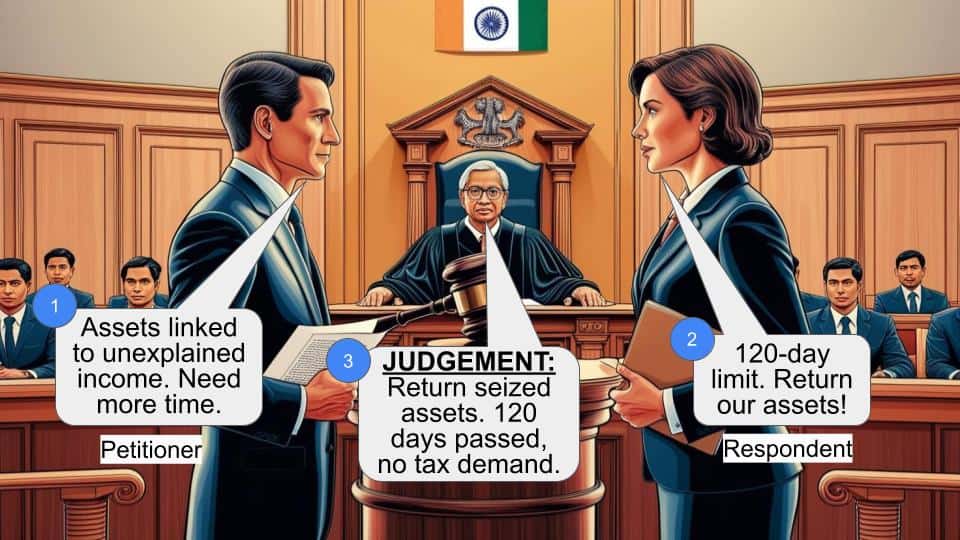
This case is all about a dispute between the Income Tax Department and some individuals (Nayan Kothari, Rupam, and Rajendra P. Gorecha) over seized cash and silver bullion. The court basically said, "Hey, Income Tax Department, you can't just hold onto these assets forever!" They ruled that the department has to release the seized stuff after 120 days unless there's a specific tax demand. It's a pretty big deal for how the Income Tax Department can handle seized assets.
Get the full picture - access the original judgement of the court order here
Case Name:
Deputy Director of Income Tax (Investigation) Vs Nayan Kothari (High Court of Madhya Pradesh)
Writ Petition No.4941/2014
Date: 1st December 2015
Key Takeaways:
1. The Income Tax Department can't hold onto seized assets indefinitely.
2. There's a 120-day limit on retaining seized assets without a specific tax demand.
3. The court emphasized the importance of following proper procedures in asset seizure cases.
4. The judgment highlights the balance between tax enforcement and individual property rights.
Issue:
The main question here was: Can the Income Tax Department retain seized assets beyond 120 days without a specific tax demand?
Facts:
- On March 11, 2014, the police in Badnagar, Ujjain seized cash (₹27.80 lacs) and silver bullion (479.50 kg, worth ₹2.05 crores) from Nayan Kothari.
- The Income Tax Department got involved, saying Kothari couldn't explain where this stuff came from.
- The Department tried to keep the assets under Section 132-A (of Income Tax Act, 1961).
- Kothari and others said, "Hey, it's been 120 days, give our stuff back!"
- There was also some drama with the Commercial Tax Department getting involved.
- The lower court (JMFC) said the assets could be given to the Income Tax Department, but with some conditions.
Arguments:
Income Tax Department said:
- "We have the right to keep these assets because of our investigation."
- "The lower court shouldn't have put conditions on us getting the assets."
Kothari and others said:
- "It's been 120 days, you gotta give our stuff back."
- "We've paid all our taxes and penalties."
- "This is for our business, and we have proof!"
Key Legal Precedents:
1. Commissioner of Income Tax, Allahabad and others vs. Vindhya Metal Corporation and others (1997) 139 CTR (SC) 495: This case said that just having unexplained money isn't enough reason for the Income Tax Department to keep it.
2. Ajit Jain vs. Union of India (2000) 159 CTR (Delhi): This one said that just because the CBI tells the Income Tax people about some cash, it doesn't mean they can automatically keep it.
3. Director of Income Tax (Investigation) vs. Payal Selection and Company and others (2008) 217 CTR (MP) 378: This case is super similar to our current one. It said the Income Tax Department needs solid info before they can keep seized stuff.
Judgement:
The court basically said:
1. The Income Tax Department messed up by trying to keep the assets without proper info.
2. They can't hold onto the stuff for more than 120 days without a specific tax demand.
3. The lower court's order is set aside.
4. Both parties can file fresh applications if they have new info.
5. The court wants this sorted out quickly.
FAQs:
1. Q: Does this mean the Income Tax Department can never keep seized assets?
A: No, they can, but only for 120 days or if they have a specific tax demand.
2. Q: What happens to the seized assets now?
A: The parties can file fresh applications, and the court will decide based on any new information.
3. Q: Does this judgment apply to all asset seizure cases?
A: While it's not a blanket rule, it sets a precedent that courts may follow in similar cases.
4. Q: Can the Income Tax Department appeal this decision?
A: Yes, they could potentially appeal to a higher court if they disagree with the judgment.
5. Q: What should taxpayers learn from this case?
A: It's important to keep proper records and be ready to explain your assets if questioned by tax authorities.

1. These two petitions are taken up together since they arise out of the same cause of action and are therefore, decided by this common order, which shall govern both the petitions.
2. By Writ Petition No.4941/2014 under Article 227 of the Constitution of India, the Dy. Director of Income Tax (Investigation) Ujjain is aggrieved against the order dated 23/4/2014 passed by the JMFC, Badnagar, Ujjain in Case No.01/2014, whereby the JMFC ordered that security be paid for the supurdgi of the cash and silver that were to be handed over to the petitioner Income Tax.
3. Whereas, Writ Petition No.5602/2014 under Article 226 read with Article 19(g) of the Constitution of India has been filed by Rupam, Rajendra P. Gorecha and Nayan Kothari against the Income Tax Department being aggrieved by withholding of the silver bullion without any authority of law.
4. Briefly stated the facts of the case are that on 11.3.2014, information was received by the petitioner department from the police station Badnagar, Ujjain that they had seized cash of Rs.27.80 lacs. and silver bullion items weighing 479.50 kg valued at Rs. 2.05 crores from respondent Nayan Kothari when he was travelling in an Innova car at Badnagar while coming from Gujarat towards Indore. The Dy. Director of Income Tax (Investigation), Ujjain found upon investigation that Nayan Kothari was not a man of sufficient means and had no satisfactory explanation regarding the silver and cash found in his possession. It was found that he was a PAN holder, but he had never filed any income tax Return and he did not maintain any books of accounts also. That whereas, both the petitioner/Income Tax Department as well as the respondent Nayan Kotari sought the return of the assets from the Trial Court. The requisition has been executed under Section 132-A (of Income Tax Act, 1961) by Shri K.C. Ghumaria, Director of Income Tax (Investigation), Bhopal on 12/3/2014. Respondent Nayan Kothari after expiry of 120 days from the date of last requisition by the Income Tax Department filed a requisition under Section 132-B (of Income Tax Act, 1961) that the respondents Income Tax Department are the duty bound to release/return the assets since the requistion is valid only for 120 days. Counsel submitted that only if there was a demand of tax, interest or penalty outstanding the property could have been retained. Whereas nothing is outstanding against the present petitioners, Nayan Kothari,Rupam and Rajendra. All the liability of tax, interest and penalty as the case may be, have been paid. The seized cash and silver bullion have been deposited by the Police Authorities before the Court of JMFC. Counsel for the Income Tax Department has vehemently urged that by the impugned order dated 23/4/2014 the Lower Court, however, directed the Police Authorities, Badnagar to deliver the impugned cash and jewellery to the Income Tax Department. However, simaltatneously imposed several restrictions while delivering the possession of the impugned assets and cash to the Department. And these conditions have been challenged before this Court.
Counsel for the Income Tax Department has vehemently urged the fact that requisitioning of the assets under Section 132-A (of Income Tax Act, 1961) and thereafter when warrant of authorization is issued; it should not be accompanied by any conditions while granting possession of the cash and assets. In view of the above, the condition is bad in law. Counsel has candidly admitted the fact that the money and the silver bullion etc.were lying with the locker of State Bank of India, Main Branch, Budhwara, Ujjain due to onerous conditions imposed by the Commissioner of Income Tax could not get the deposit in the Public Deposit Account. Counsel further submitted that the warrant of authorization issued by the Director of Income Tax under Section 132-A (of Income Tax Act, 1961) cannot suffer from any such limitation and conditions as have been imposed by the Trial Court and under Section 293 (of Income Tax Act, 1961) the petitioner was constrained to file the present petition to set aside or modify the impugned condition. Hence, Counsel prayed that the impugned order be set aside.
5. Whereas, in Writ Petition No. 6502/2014 , it was alleged that despite order dated 23.4.2014 passed by the JMFC Badnagar, Ujjain under Section 132(A)(1)(c) (of Income Tax Act, 1961), the respondents/Income Tax was duty bound to release and return, the business assets within a period of 120 days on which the requisition was executed under Section 132 (of Income Tax Act, 1961) A by the Director of Income Tax (Investigation), Bhopal i.e., on 12/3/2014 and the period of 120 days has expired on 10/7/2014 and therefore, in absence of any demand of tax remained outstanding, the respondents are obligated to release and return the entire business assets to the petitioner. The respondents/Income Tax Department had failed to do so. Hence, the present petition.
6. Counsel for the Income Tax Department has vehemently urged the fact that the petitioner Income Tax Department had filed an application under Section 132-A(1)(c) (of Income Tax Act, 1961) read with under Section 451 (of Income Tax Act, 1961), 457 of the Cr.P.C. and by order dated 23/4/2014 the assets have been handed over to the Income Tax Department, due to the warrant of authorization issued earlier. There cannot be a rider imposed by the Trial Court such as payment of security of Rs. 2.05 crores. Counsel urged once that the Trial Court had come to a conclusion that the Income Tax Department was entitled to the supurdagi or handing over the assets; then under Section 41(1)(d) (of Income Tax Act, 1961) and 102 of the Cr.P.C. the silver bullion etc. were seized and deposited at the Treasury, Ujjain. Similarly application under Sections 451 (of Income Tax Act, 1961) & 457 of the Cr.P.C. for the returning of the assets by the respondents Nayan Kothari and others has been rejected. Under the circumstances Income Tax Department was entitled to silver bullion items and cash without any such condition being imposed and it is only under these circumstances, the Income Tax Department has prayed for handing over the same without any security to the respondents.
Whereas, the petitioners/respondents Nayan Kothari and others are aggrieved by the rejection of their application under Sections 451 (of Income Tax Act, 1961) and 457 of the Cr.P.C. since no tax was outstanding and proper bills and receipts were filed.
7. Counsel for the petitioner/Income Tax Department has vehemently urged the fact that besides the application by the Dy.Director (Investigation), Income Tax Department under Section 132-A (of Income Tax Act, 1961))1)(c) of the Income Tax Act before the Additional C.J.M. Badnagar, Ujjain seeking possession of the silver bullion etc. It was also submitted that the Anti- Evasion Bureau Commercial Tax Department had also moved an application before Additional CJM with respect to levy of commercial tax and penalty on the silver bullion seized by the police authority. The Assistant Commercial Tax Officer considering the silver bullion as business assets of the petitioner and considering Rupam s/o Rajendra Gorecha as owner of the silver bullion levied tax and penalty of Rs.11,18,090/-. Whereas Counsel for the Assessee/petiitioner urged that this amount which was reduced on being compounded and paid the tax and penalty of Rs.6,70,854/- and settled the issue with the Commercial Tax Department under the composition scheme. This clearly indicated that the silver bullion was purchased from Limdi Gujarat for the purpose of business. Affidavits in this regard were filed by Nayan Kothari and Hashmukh Gari and others to indicate that the silver has been transported for the purpose of business activities of the petitioner. The sale was executed by the seller Amit Chouksi, the proprietor of M/s Riddhi Siddhi Corporation on credit given by Rupam s/o Rajendra Gorecha and the affidavit is also available on record. However, the application under Section 132-A (of Income Tax Act, 1961) by the petitioner Nayan Kothari was rejected and as a consequence of rejection order the petitioners were suffering financial constraints and a registered demand notice was served by M/s Riddhi Siddhi Corporation for dishonour of cheque issued by Rapam Gorecha towards payment of dues for purchase of silver bullion and his business is almost brought to a standstill.
Despite these circumstances, the JMFC has directed to hand over the possession and custody of the business assets of the petitioner to the respondents/Department, which is contrary to the facts and circumstances of the case. Besides the respondents have no authority to retain the assets after expiry of 120 days from the date of last authorization as contemplated under Section 132-B (of Income Tax Act, 1961) and this Court be pleased to decide the matter and setting aside the order. Counsel prayed that appropriate order or writ or direction be given to the respondent/Department.
9. Counsel for the petitioner Assessee has placed reliance in the matter of Commissioner of Income Tax,Allahabad and others vs. Vindhya Metal Corporation and others (Civil Appeal No.5526/1983 decided on 5/3/1997 (equivalent citation (1997) 139 CTR (SC)495. Counsel submitted that mere unexplained possession of the amount, without anything more, could hardly be said to constitute information which could be treated as sufficient information relatable to a conclusion, leading to an inference that it was income which would not have been disclosed by the person in possession for purpose of the Act. Counsel further relied on Ajit Jain vs. Union of India (Civil Writ Petition No.3756 of 1997 decided on 31/1/200 {equivalent citation (2000)159 CTR (Delhi); Counsel stated that mere information from the CBI to the Income Tax Authorities about the recovery of the cash from the petitioner could not constitute information within the meaning of Section 132(1) (of Income Tax Act, 1961) of the ITA particularly when the petitioner had also stated that the entire money found in his possession was reflected in the books of account of the company and regularly assessed at Delhi. The Court has held that it was empowered to enquire into the existence of the information and its relevancy regarding search and seizure under Section 132-A (of Income Tax Act, 1961) of the ITA.
10. Finally, Counsel for the petitioner relied on the decision of our own Court in the matter of Director of Income Tax (Investigation) vs. Payal Selection and Company and others decided on 2/4/2008{equivalent citation (2008) 217CTR (MP) 378, whereby in almost similar case this Court was pleased, to consider the fact whether the police had seized the silver under Section 102 (of Income Tax Act, 1961) of the Cr.P.C. suspecting it to be stolen property and the assessee company had made an application under Section 451 (of Income Tax Act, 1961)/457Cr.P.C.for returning of the goods on supurdginama and the Income Tax Department has filed application under Section 132-A (of Income Tax Act, 1961) before the Chief Judicial Magistrate for supurdgi of the goods. The CJM rejected the application of the assessee company for supurdgi of goods and ordered that custody of the seized property be given to Income Tax Department under Section 132-A (of Income Tax Act, 1961). In appeal against the order, a stay was granted by the Sessions Judge and matter was remanded to CJM with the direction that silver seized should be placed in treasury. However, police entrusted the wrongfully seized silver property to the department and the order was challenged as contrary to law. This Court had held that the Commissioner Income Tax was not in the possession of such information as to arrive to a conclusion that the silver pertained to undisclosed assets of the assessee. Moreover, the silver was found in the possession of the employees of the respondent company and neither the police nor the CIT had at this stage of the proceedings gathered any information on record regarding the ownership of the silver to dispute the version of the respondent company. It was then fallacious on the part of the CJM, to have entertained the application under Section 132-A (of Income Tax Act, 1961) and the Court had directed handing over of the seized silver/assets to the department and the order of Sessions Judge was upheld.
11. Counsel for the Income Tax has vehemently urged the fact that in the present case the assessee has failed to explain the source of assets made in the application and the assessment proceedings under Section 153-A (of Income Tax Act, 1961) of the ITA was still lying with the Assessment Officer. And hence it cannot be said that there was no existing liability and Counsel has fully supported the order of the Additional CJM and prayed that the order be withheld by striking out the demand for security. He also raised doubt about genuineness of the claim of Nayan Kothari and Rupam Gorecha and the genuineness of the invoices produced for the assessment.
12. Considering the above submissions, we find that the matter is squarely covered with the ratio laid down in the case of Payal Selection (supra), whereby this Court has considered the question whether the requisition issued by the respondent under Section 132-A(1)(c) (of Income Tax Act, 1961) before the JMFC, Badnagar Ujjain was maintainable. It is pertinent to note that in this case also that the law was set in motion under Section 132-A(1)(c) (of Income Tax Act, 1961) and also under the Criminal Procedure Code and not under the Income Tax Act alone, then this fact cannot be blinked away or marginalized and the question that whether the department has right to retain the assets under Section 132-A (of Income Tax Act, 1961) of the ITA has to be considered first.
13. It has been an admitted fact that a routine checking has been conducted during the Lok Sabha election in the year 2014 and M.P. Assembly election in the year 2013. Moreover, according to the requisition filed by the assessee petitioner, it clearly indicated from the books of accounts that the goods belonging to Rupam s/o Rajendra Gorecha and all necessary documents were filed before the Income Tax Department and the application under Section 132-A(1)(c) (of Income Tax Act, 1961) was not at all justified. Considering the facts, we find that neither the police nor the Commissioner, Income Tax had at the stage of proceedings gathered any information on record regarding the ownership of the silver to dispute the version of the assessee company. It was then fallacious on the part of the learned Judge of the lower Court, Badnagar, Ujjain to have entertained the application under Section 132-A (of Income Tax Act, 1961) of the ITA by the department. At the same time the fact drawn to the notice of this Court that the proceedings under Section 132-A(1)(c) (of Income Tax Act, 1961) of the ITA regarding assessment of the assessee company is still pending consideration before the Assessment Officer. We find that the learned Judge of the lower Court was right in considering the payment of security on production of silver bullion etc.and hence, there is no infirmity in the impugned order in this regard. The condition was imposed by way of abundant caution.
14. In this light, both the writ petitions are disposed of by holding that the impugned order dated 23/4/2014 is set aside and it is directed that fresh application be moved by the assessee company and liberty is granted to the Income Tax Department to move an application under Section 132-A (of Income Tax Act, 1961), if it has come to any fresh information regarding the ownership of the silver bullion etc. The application shall be considered as expediously as possible. Original order be retained in Writ Petition No.4941/2014 and a copy thereof be placed in the record of Writ Petition No order as to costs. C.c. as per rules.
(Mrs. S.R. Waghmare) (Sujoy Paul)
Judge Judge
×
Similar Ripples
Questions
Income Tax Dept. Ordered to Release Seized Assets After 120 Days
Write your CommentSimilar Posts


Generic
- Reportdata/3274.pdf
