


Interest Expenses Allowed to Offset Income: Vodafone Wins Tax Case



Full News
Interest Expenses Allowed to Offset Income: Vodafone Wins Tax Case
Interest Expenses Allowed to Offset Income: Vodafone Wins Tax Case
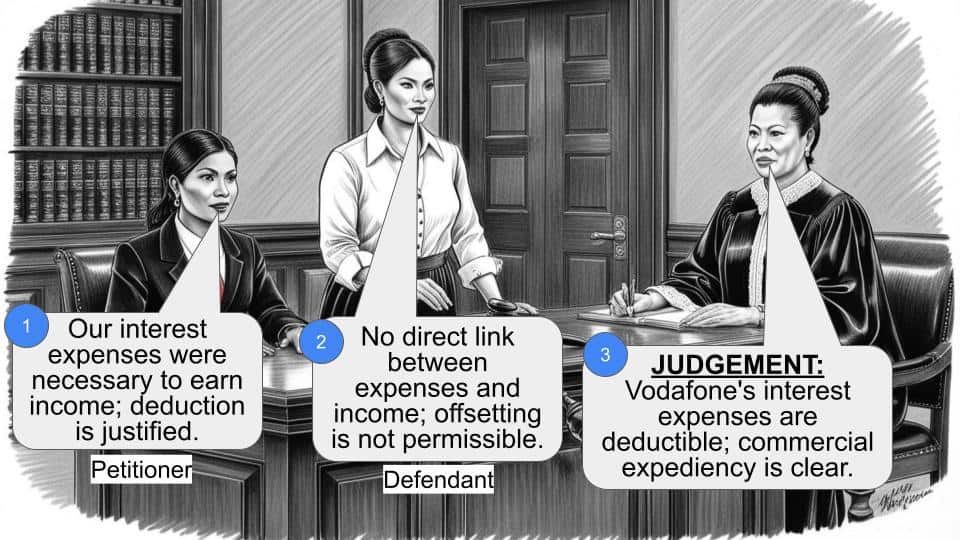
In the case of Vodafone South Limited vs. Commissioner of Income Tax, the court ruled in favor of Vodafone, allowing them to offset interest expenses paid to HSBC against interest income earned from a loan to their holding company, SCL. The court found that the interest expenses were incurred wholly and exclusively for the purpose of earning income, thus permitting the netting of these expenses under Section 57(iii) (of Income Tax Act, 1961).
Get the full picture - access the original judgement of the court order here
Case Name:
Vodafone South Limited Vs. Commissioner of Income Tax (High Court of Delhi)
ITA 334/2014 & CM 10693/2014
Date: 21st September 2015
Key Takeaways:
- The court allowed Vodafone to net interest expenses against interest income, emphasizing the principle of commercial expediency.
- The decision clarifies the application of Section 57(iii) (of Income Tax Act, 1961), which allows deductions for expenses incurred wholly and exclusively for earning income.
- The ruling distinguishes between pre-operative expenses and those incurred during business operations, impacting how companies can manage their financial strategies.
Issue
Can Vodafone offset the interest paid to HSBC against the interest income earned from a loan to its holding company under Section 57(iii) (of Income Tax Act, 1961)?
Facts
Vodafone South Limited, engaged in providing cellular services, borrowed funds from HSBC and subsequently loaned a portion to its holding company, Sterling Cellular Limited (SCL). Vodafone paid interest to HSBC and earned interest from SCL. The dispute arose over whether Vodafone could offset the interest paid against the interest income earned, with the Revenue arguing against such netting.
Arguments
- Vodafone’s Argument: The interest paid to HSBC was a necessary expense incurred to earn the interest income from SCL, thus qualifying for deduction under Section 57(iii) (of Income Tax Act, 1961).
- Revenue’s Argument: The Revenue contended that there was no direct nexus between the interest expense and income, and the interest should be treated as pre-operative expenses, not eligible for offset.
Key Legal Precedents
- Eastern Investments Limited v. Commissioner of Income-Tax (1951): Established that expenses incurred for commercial expediency are deductible.
- Commissioner of Income Tax v. Rajendra Prasad Moody (1978): Clarified that expenses need not result in income to be deductible.
- S.A. Builders Limited v. Commissioner of Income Tax (2007): Emphasized the concept of commercial expediency in allowing deductions.
Judgement
The court ruled in favor of Vodafone, allowing the netting of interest expenses against interest income. It found a direct nexus between the expenses and income, and recognized the commercial expediency of Vodafone’s actions. The court directed the deletion of the addition made by the Assessing Officer, affirming the applicability of Section 57(iii) (of Income Tax Act, 1961).
FAQs
Q1: What does this ruling mean for Vodafone?
A1: Vodafone can offset the interest expenses against the interest income, reducing their taxable income and potentially lowering their tax liability.
Q2: How does this case impact other businesses?
A2: It sets a precedent for businesses to claim deductions for expenses incurred in earning income, provided there is a clear nexus and commercial expediency.
Q3: What is Section 57(iii) (of Income Tax Act, 1961)?
A3: It allows for the deduction of expenses incurred wholly and exclusively for the purpose of making or earning income from other sources.

1. These are two appeals filed by the Assessee Vodafone South Ltd. (formerly known as Vodafone Essar South Ltd. and earlier to that as Hutchison Essar South Ltd.) under Section 260A (of Income Tax Act, 1961) („1961 Act‟) against a common order dated 7th February, 2014 passed by the Income Tax Appellate Tribunal („ITAT‟) in ITA Nos. 4146/Del/2011 and 91/Del/2011 for the Assessment Years („AYs‟) 2002-03 and 2003-04 respectively.
2. The Assessee is engaged in the business of providing cellular services in the Delhi Region. The Assessee actually commenced its business from June,2002. During the AY 2002-03 the Assessee availed of financing facilities from the HSBC Bank, Barakhamba Branch, New Delhi. HSBC's sanction letter dated 2nd August 2001, a copy of which has been placed on record,offered the Assessee a combined credit limit of Rs.340 crores. The fixed rate of interest was 11.5% for the first year but the letter mentioned that this was "an indicative rate and will be firmed up closer to date of drawdown.” The interest was payable quarterly. The terms and conditions set out in the Appendix to the said sanction letter stated inter alia that the Assessee could advance the funds availed by it to any other concern, other than in the usual course of business, after receiving the bank‟s prior approval.
3. By a Board Resolution dated 5th November 2001, it was resolved that the Assessee would make available to its holding company Sterling Cellular Limited (SCL) a sum of Rs.100 crores on terms and conditions to be decided by the Director of the Assessee. The Assessee has placed on record a copy of the relevant statement of account which shows that an amount of Rs. 25 crores was availed of by the Assessee as a loan from HSBC at 11.60% interest per annum on 24th December 2001. Immediately thereafter, on that very date, the Assessee advanced a loan of Rs.25 crores to SCL. A letter from SCL dated 15th April, 2008 addressed to the Assessee confirms that the aforementioned loan of Rs.25 crore was disbursed to it by the Assessee @11.75% interest p.a.
4. The Assessee filed its return for AY 2002-03 on 30th October 2002
declaring a loss of Rs. 35,69,97,065, which it subsequently revised at a
profit of Rs. 1,00,690. In the revised return filed on 2nd December 2003 the Assessee showed income from other sources after adjusting interest
expenses of Rs. 77.86 lakhs.
5. For AY 2003-04 the Assessee filed its return on 2nd December 2003
declaring a loss of Rs. 2,62,87,59,740. The Assessing Officer (AO) by an
order 29th March 2006 noted that for AY 2003-04 the Assessee had
received interest in the sum of Rs. 81,00,165 on the loan advanced and had sought to set it off against the interest expenses. Referring to the decision of the Supreme Court in Tuticorin Alkali Chemicals and Fertilizers Ltd. v. CIT [1997] 6 SCC 117, the AO held that setting off the interest income of the pre-operative period against the interest expense was not allowed. It was held that "interest expense will form part of the pre-operative expenses pending capitalization and the interest income will be taxed separately as income from other sources." The interest income of Rs. 81,00,165 was added to the income of the Assessee for AY 2003-04.
6. As far as the return for AY 2002-03 was concerned, the AO issued a
notice under Section 148 (of Income Tax Act, 1961) on 28th March 2006 in response to
which the Assessee stated that the revised return already filed on 2nd
December 2003 may be treated as return in compliance with the said notice. The AO by an order dated 29th December, 2006 disallowed the set off on the ground that there was no nexus between the earning of the interest income by the Assessee and the payment of the interest to the bank on the loans borrowed by it for business purposes. The AO observed that the total loans raised by the Assessee as on 31st March 2002 for the purpose of its business was Rs. 598,01,05,218 and "since the assessee had surplus funds, part of these funds of Rs. 25 crores" had been given to SCL. The AO referred to the decision in Tuticorin Alkali (supra) and held that the interest paid to the bank would have been treated as business expenses but since the business was yet to commence they would form part of the pre-operative expenses to be capitalised. The interest earned from advancing of the loan to SCL would
be taxed separately as income from other sources. The AO accordingly
made an addition of Rs.78,86,987/- to the income of the Assessee for AY
2002-03.
7. The Assessee took the matter in Appeal to the Commissioner of Income
Tax [„CIT (A)‟]. The CIT (A) by separate orders dated 13th October 2010 for AY 2003-04 and 15th July 2011 for the AY 2002-03 concurred with the
corresponding orders of the AO. The CIT (A) held that "there is no nexus
between the expenditure incurred and the income sought to be earned in the instant case." Observing that the interest expense related to the pre-operative period and the giving of loan to SCL was not the business activity of the Assessee, the CIT (A) held that SCL on its own could have approached the bank for loan.
8. The ITAT passed the impugned common order in the two appeals filed by
the Assessee for AYs 2002-03 and 2003-04. The ITAT noted that the
Assessee had commenced its business only in June 2002. The ITAT adopted
the AO's finding that the Assessee had made a total borrowing of Rs.
598,01,05,218 up to 31st March 2002 and that it was out of the
aforementioned total borrowings that a sum of Rs. 25 crores had been
advanced and interest earned thereon. The ITAT too observed that the
Assessee was not engaged in the business of money lending. The interest
income earned by the Assessee was to be considered under the head „incomefrom other business‟. The Assessee's contention that the interest expenditure incurred should be netted off against the interest income was held to be "not sustainable."
9. This Court, while admitting these appeals on 8th July 2014, framed the following question of law:
Did the Tribunal fall into error of law in holding that the
expenditure on interest claimed by the Assessee could
not be allowed in terms of Section 57(iii) (of Income Tax Act, 1961)?
10. This Court has heard the submissions of Mr. Kavin Gulati, learned
Senior counsel for the Assessee and Mr. Kamal Sawhney, learned Senior
Standing Counsel for the Revenue.
11. Before discussing the facts of the case, it may be noticed that the
provision in the Income Act, 1922 („1922 Act‟), corresponding to Section 57(iii) (of Income Tax Act, 1961), was Section 12 (of Income Tax Act, 1961). In Eastern Investments Limited v.
Commissioner of Income-Tax (1951) 20 ITR 1 the Appellant was an
investment company originally formed for acquiring, holding and otherwise dealing with shares and government securities which belonged to one Lord Cable. The share capital of the company was Rs. 250 lakhs, and the majority of its shares, including 50,000 ordinary shares of the face value of Rs. 50 lakhs were held by Lord Cable and the rest of the shares were held by his nominees. Upon the death of Lord Cable, one Mr. Geoffrey Lacy Scott was appointed as Administrator of his estate and held the said 50,000 shares in question in that capacity. Since money was urgently needed by the executors of Lord Cable, an agreement was reached between the Administrator and the company under which the latter agreed to reduce its share capital of Rs. 50 lakhs by taking over from Mr. Scott the 50,000 shares at the rate of Rs. 100 per share. Mr. Scott on his part agreed to receive debentures of the face value of Rs. 50 lakhs carrying interest @ 5% per annum issued by the company which were redeemable at the option of the registered holder at any time. The company sought to adjust the 5% interest paid to Mr. Scott against its income under Section 12(2) of the 1922 Act by treating it as “expenditure incurred solely for the purpose of making or
earning such income, profits or gains”.
12. After the company lost both before the ITAT and the High Court, it
appealed to the Supreme Court. The Supreme Court in Eastern Investments
Limited (supra) inter alia held that it was not necessary, for the purposes of Section 12(2) of the 1922 Act, to show that the expenditure was a profitable one or that in fact any profit was earned. It was enough to show that “the money was expended not of necessity and with a view to a direct and immediate benefit to the trade, but voluntarily and on the ground of commercial expediency, and in order indirectly to facilitate the carrying on of the business.” It was further held that the mere fact that the conversion had the effect of diminishing the taxable income of the company was not a proper consideration particularly when the transaction was not challenged on
the ground of fraud. The Court further explained that “most commercial
transactions are entered into for the mutual benefit of both sides, or at any rate each side hopes to gain something for itself. The test for present purpose is not whether the other party benefited, nor indeed whether this was a prudent transaction which resulted in ultimate gain to the Appellant, but whether it was properly entered into as a part of the Appellant‟s legitimate commercial undertakings in order indirectly to facilitate the carrying on of its business.”
13. Analysing the clauses of the agreement in question in that case, the
Supreme Court in Eastern Investments Limited (supra) held as under:
“The matter is clearly “writ in the bond”. Moreover, we do not think
that this inquiry is relevant, for we are dealing with a question of
income-tax and not judging the legality or propriety of the transaction
on an application to reduce the capital of the company. The only
question is whether this was done in the ordinary course of business
for the purposes we have already pointed out however mistaken the
directors and shareholders of the company may have been.”
14. Ultimately, the Supreme Court while allowing the appeal observed that “there are usually many ways in which a given thing can be brought about in business circles but it is not for the Court to decide which of them should have been employed when the Court is deciding a question under Section 12(2) (of Income Tax Act, 1961).”
15. Subsequently in Commissioner of Income Tax v. Rajendra Prasad
Moody (1978) 115 ITR 519 the Supreme Court addressed the question
whether interest paid on money borrowed for investment in shares would be allowable as expenditure under Section 57(iii) (of Income Tax Act, 1961) even where such shares had not yielded any dividend during the relevant AY. The Supreme Court explained that while Section 37(1) of the Income Tax Act, 1961 provided for deduction of expenditure “laid out or expended wholly and exclusively for the purpose of the business or profession in computing the income chargeable under the head „profits or gains business or profession”, what was relevant for the applicability of Section 57(iii) (of Income Tax Act, 1961) was the purpose of expenditure i.e. the expenditure must be laid out or expended wholly and exclusively for the purpose of “making or earning income”. It was not necessary that the expenditure “should fructify into any benefit by way of return in the shape of income.” The Supreme Court answered the question urged in the affirmative, i.e., in favour of the Assessee and against the Revenue.
16. In S.A. Builders Limited v. Commissioner of Income Tax (Appeals)
Chandigarh (2007) 1 SCC 781, the Assessee company had advanced loans
to its subsidiary without charging any interest. The loans were transferred out of the cash-credit account of the Assessee in which there was a debit balance. The AO disallowed the proportionate interest earned on the said loan out of the total interest paid to the bank by the Assessee. The disallowance for both the AYs, although partially modified by the CIT (A),was upheld by the ITAT which observed that there was no material on record to show that the Assessee had derived any business advantage by advancing the interest-free amounts to its subsidiary. The High Court upheld the order of the ITAT.
17. Reversing the aforementioned orders and remitting the matter to the
ITAT for a fresh decision, the Supreme Court in S.A. Builders Limited
(supra) explained that expression „commercial expediency‟ was of wide
import and included “such expenditure as a prudent businessman incurs for the purpose of business. The expenditure may not have been incurred under any legal obligation, yet it is allowable as business expenditure if it was incurred on grounds of commercial expediency.” In the said case, what was relevant was “whether the interest-free loan was advanced to the sister company (which was a subsidiary of the Assessee) as a measure of commercial expediency, and if it was, it should have been allowed.” In para 36 of the said case, the Court observed as under:
“We agree with the view taken by the Delhi High Court in CIT
v. Dalmia Cement (B) Ltd. (2002) 254 ITR 377 (Del) that once
it is established that there was nexus between the expenditure
and the purpose of the business (which need not necessarily be
the business of the Assessee itself), the Revenue cannot
justifiably claim to put itself in the armchair of the businessman
or in the position of the Board of Directors and assume the role
to decide how much is reasonable expenditure having regard to
the circumstances of the case. No businessman can be
compelled to maximise its profit. The Income Tax Authorities
must put themselves in the shoes of the Assessee and see how a
prudent businessman would act. The authorities must not look
at the matter from their own viewpoint but that of a prudent
businessman. As already stated above, we have to see the
transfer of the borrowed funds to a sister concern from the point
of view of commercial expediency and not from the point of
view whether the amount was advanced for earning profits.”
18. In CIT v. Taj International Jewellers 2012 Law Suit (Del) 4834, the
Assessee had availed loan from a bank and converted it into fixed deposit receipts (FDRs) on which it earned interest. This Court upheld the order of the ITAT which permitted the netting of the interest paid from the gross interest earned on the FDRs. It observed that "the interest paid was expenditure laid out and expended wholly and exclusively for the purpose of making or earning the interest income."
19. In Tuticorin Alkali (supra), which has been relied upon by the Revenue,the facts were that during the financial years relevant to AYs 1982-83 and 1983-84, although the Assessee company had not commenced its business, a part of its borrowed funds which were not immediately required by it were invested in short term deposits with the various banks and financial institutions. The company then sought to set off the expenditure incurred on repayment of the interest on the loans against the interest earned on the short term deposits. It was held that while the company may be entitled to capitalise the interest paid by it during the pre-operative phase, it could not claim the adjustment of the said expenditure against the income assessable as „income from other sources‟. Importantly, it was noted that the company had "chosen not to keep its surplus capital idle, but has decided to invest it
fruitfully" and that "the fruits of such investment will clearly be of revenue nature." It was held that the expenditure incurred by the company for the purpose of setting up its business in the pre-operative phase cannot be allowed as deduction, nor can it be adjusted against any other income under any other head.
20. The legal position as regards deduction under Section 57(iii) (of Income Tax Act, 1961) of expenditure laid out or expended wholly or exclusively for the purpose of making or earning 'income from other sources' may be summarised as under:
(i) For the purpose of the deduction in terms of Section 57(iii) (of Income Tax Act, 1961) the test is not whether the transaction for which the expenditure was laid out was a prudent one which resulted in ultimate gain to the Assessee, but whether it was properly entered into as a part of the Assessee's legitimate commercial undertaking in order indirectly to facilitate the carrying on of its business.
(ii) The expenditure may not have been incurred under any legal obligation,yet it is allowable as business expenditure if it was incurred on grounds of commercial expediency. In other words, if it is such expenditure as a prudent businessman would incur for the purpose of business.
(iii) Once it is established that there was nexus between the expenditure and the purpose of the business, not necessarily the business of the Assessee itself, the Revenue cannot put itself in the armchair of the businessman and decide how much of the expenditure is reasonable having regard to the circumstances of the case.
(iv) Where in the pre-operative phase the surplus funds borrowed for the
purpose of business are kept by an Assessee in fixed deposits, the interest earned thereon would be 'income from other sources'. The interest paid on the loan borrowed would not be permitted to be netted against such interest income in the pre-operative phase.
21. The Court notes that the Revenue was under a basic misconception that the Assessee was using a part of its 'surplus' borrowed funds to advance a loan to SCL, its holding company. As already noticed, the Assessee had not advanced a sum of Rs. 25 crores from the surplus funds already borrowed by it for the purpose of setting up its business. The facts of this case are,therefore, different from the facts in Tuticorin Alkali (supra) where the company had invested its surplus funds borrowed for the purpose of its business in fixed deposits.
22. In the present case, the advancing of loan to SCL was a business
decision taken by the Assessee out of commercial expediency. Further, the sanction letter of HSBC made it clear that the Assessee could draw loans up to the sanctioned limit as and when needed. The sanction letter also permitted the Assessee to further utilise the money borrowed to advance loans to others. The sum of Rs. 25 crores drawn by the Assessee on 24th
December 2001 in terms of HSBC's sanction letter was transferred to SCL
on the very same date. Without the facility of credit by the HSBC, the
Assessee could not have advanced the loan to SCL. Therefore, there was a
direct nexus between the earning of interest on the loan advanced by the
Assessee to SCL and payment of interest to HSBC on the loan drawn in
terms of the sanction letter dated 2nd August 2001. The income earned on the loan advanced to SCL was rightly offered to tax by the Assessee as „income from other sources‟. Since the interest paid to HSBC on the loan availed was in the nature of an expenditure wholly and exclusively laid out for the purpose of earning the interest income, it ought to be permitted to be netted against such 'income from other sources' in terms of Section 57(iii) (of Income Tax Act, 1961).
23. There is also merit in the contention of the Assessee that for AY 2003-04, the CIT (A) and the ITAT mechanically followed the earlier order for the AY 2002-03 although the business of the Assessee had commenced in June 2002. Since this was no longer a pre-operative phase, the interest paid to HSBC would in any event have been allowable as business expenditure under Section 36 (of Income Tax Act, 1961) for AY 2003-04.
24. For the aforementioned reasons, the question framed is answered in the affirmative i.e. in favour of the Assessee and against the Revenue. The addition made by the AO is directed to be deleted and the netting of the interest paid on the borrowed sum against the interest income earned is allowed.
25. Consequently, the impugned order dated 7th February, 2014 of the ITAT is set aside and the appeals are allowed but in the circumstances, with no orders as to costs.
S. MURALIDHAR, J
VIBHU BAKHRU, J
SEPTEMBER 21, 2015
×
Similar Ripples
Questions
Interest Expenses Allowed to Offset Income: Vodafone Wins Tax Case
Write your CommentSimilar Posts


Generic
- Reportdata/3428.pdf
