


Interest on FDRs for export not business income, ineligible for 80HHC deduction


Full News

Interest on FDRs for export not business income, ineligible for 80HHC deduction
Interest on FDRs for export not business income, ineligible for 80HHC deduction
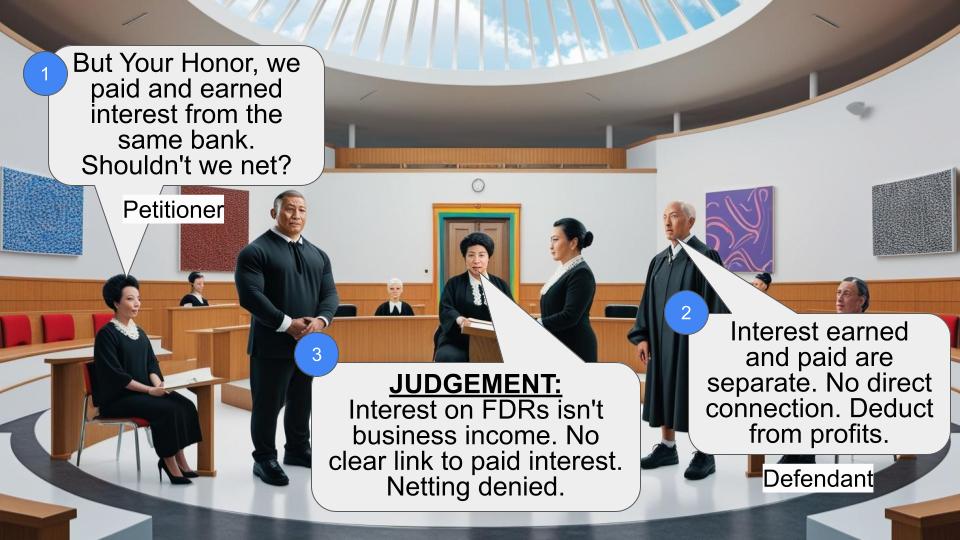
This case involves the Commissioner of Income Tax (CIT) appealing against Goldtex Furnishing Industries regarding the treatment of interest income earned on Fixed Deposit Receipts (FDRs) kept as earnest money for export performance. The High Court ruled in favor of the Revenue department, stating that such interest is not business income and cannot be excluded while computing deductions under Section 80HHC (of Income Tax Act, 1961).
Get the full picture - access the original judgement of the court order here
Case Name:
Commissioner of Income Tax Vs Goldtex Furnishing Industries (High Court of Delhi)
ITA 748/2007
Date: 1st April 2008
Key Takeaways:
1. Interest earned on FDRs kept as earnest money for export performance is not considered business income.
2. 90% of such net interest cannot be excluded from business profits when calculating deductions under Section 80HHC (of Income Tax Act, 1961).
3. The court's decision aligns with a previous ruling in CIT vs. Shri Ram Honda Power Equip., reinforcing this interpretation of the law.
Issue:
1. Is the interest income earned on FDRs kept as earnest money for export performance considered business income for the purpose of Explanation (baa) while calculating deductions under Section 80HHC (of Income Tax Act, 1961)?
2. Should 90% of the net interest be excluded from business profits as per Explanation (baa) while computing deductions under Section 80HHC (of Income Tax Act, 1961)?
Facts:
- The assessee, Goldtex Furnishing Industries, earned interest on Fixed Deposit Receipts (FDRs).
- These FDRs were kept as earnest money with a bank for the performance of export.
- The case was initially heard by a Tribunal, which made certain rulings regarding the treatment of this interest income.
- The Commissioner of Income Tax appealed against the Tribunal's decision in the High Court.
- The assessee did not appear for the hearing despite being served notice.
Arguments:
While the specific arguments aren't detailed in the provided context, we can infer:
1. The Revenue (CIT) likely argued that:
- The interest income from FDRs should not be considered business income.
- 90% of the net interest should not be excluded from business profits for Section 80HHC (of Income Tax Act, 1961) deductions.
2. The assessee (Goldtex Furnishing Industries) likely argued the opposite, but didn't appear to present their case in the High Court.
Key Legal Precedents:
The court relied on the decision in CIT vs. Shri Ram Honda Power Equip. (2007) 207 CTR (Del) 689 : (2007) 289 ITR 475 (Del) to answer both questions of law in favor of the Revenue.
Judgement:
1. The High Court ruled that the Tribunal was incorrect in treating the interest income earned on FDRs as business income for the purpose of Explanation (baa) while calculating deductions under Section 80HHC (of Income Tax Act, 1961).
2. The court also held that the Tribunal was wrong in stating that 90% of the net interest should be excluded from business profits as per Explanation (baa) while computing deductions under Section 80HHC (of Income Tax Act, 1961).
3. Both questions of law were answered in favor of the Revenue and against the assessee.
4. The appeal was disposed of accordingly.
FAQs:
1. Q: What is Section 80HHC (of Income Tax Act, 1961)?
A: Section 80HHC (of Income Tax Act, 1961) provides deductions for profits earned from the export of goods or merchandise. The exact details aren't provided in this judgment, but it's a provision designed to incentivize exports.
2. Q: What is Explanation (baa) in this context?
A: While not explicitly defined in the given text, Explanation (baa) likely refers to a specific clause within Section 80HHC (of Income Tax Act, 1961) that deals with the calculation of deductions related to export profits.
3. Q: Why is this ruling significant?
A: This ruling clarifies how interest income from FDRs used as earnest money for exports should be treated for tax purposes. It potentially impacts how exporters calculate their deductions under Section 80HHC (of Income Tax Act, 1961).
4. Q: What might be the implications for businesses engaged in exports?
A: Businesses may need to reassess how they account for interest earned on FDRs kept as earnest money for exports. This could potentially lead to higher taxable income if they were previously excluding this interest from their calculations.
5. Q: Can the assessee appeal this decision further?
A: While not mentioned in the judgment, typically, decisions of the High Court can be appealed to the Supreme Court of India if there's a substantial question of law involved.

1. The matter has been called out twice but there is no appearance on behalf of the assessee despite service.
2. We find that in IT Appeal No. 563 of 2007 decided on 3rd Oct., 2007, the assessee also did not appear.
3. Admit.
4. The following substantial questions of law are framed for consideration :
"1. Whether the Tribunal was correct in law in treating the interest income earned by the assessee on fixed deposit receipts, which were kept as earnest money with the bank for performance of export, as its business income for the purpose of Expln. (baa) while calculating deductions under s. 80HHC of the IT Act, 1961 ?
2. Whether Tribunal was correct in law in holding that 90 per cent of the net interest is to be excluded from the profits of the business as per the provisions of Expln. (baa) while computing deduction under s. 80HHC of the Act ?"
5. In view of the decision of this Court in CIT vs. Shri Ram Honda Power Equip. (2007) 207 CTR (Del) 689 : (2007) 289 ITR 475 (Del) , both the questions of law are answered in the negative, in favour of the Revenue and against the assessee.
6. The appeal is disposed of accordingly
MADAN B. LOKUR, J V.B. GUPTA, J APRIL 01, 2008 Bisht
×
Questions
Interest on FDRs for export not business income, ineligible for 80HHC deduction
Write your CommentSimilar Posts


Generic
- Reportdata/4719.pdf
