


Interest on Loan for Property Purchase Allowed as Deduction


Full News
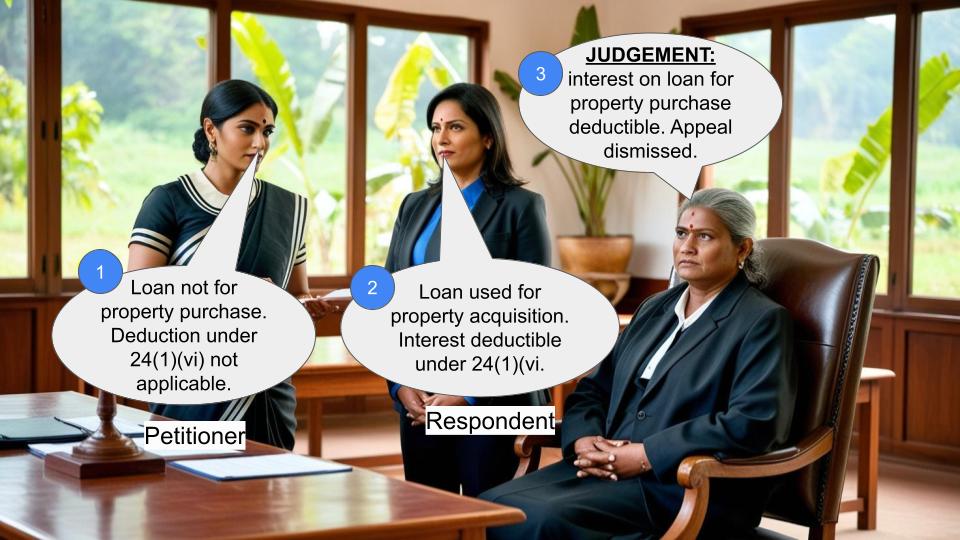
Interest on Loan for Property Purchase Allowed as Deduction
Interest on Loan for Property Purchase Allowed as Deduction
The case involves the Commissioner of Income Tax and Haryana Television Ltd. The main issue was whether the interest portion of the installment of the purchase price of a let-out property could be deducted under Section 24(1)(vi) (of Income Tax Act, 1961). The court ruled in favor of Haryana Television Ltd., allowing the deduction.
Get the full picture - access the original judgement of the court order here.
Case Name:
Commissioner of Income Tax vs. Haryana Television Ltd.(High Court of Punjab and Harayana)
ITA No. 634 of 2008 (O&M)
Key Takeaways
- The court confirmed that interest on borrowed capital used to acquire property is deductible under Section 24(1)(vi) (of Income Tax Act, 1961).
- The decision emphasized the importance of the direct nexus between the loan liability and the acquisition of the property.
- The ruling aligns with the precedent set in the case of Commissioner of Income-Tax v. Sunil Kumar Sharma.
Issue
Whether the interest portion of the installment of the purchase price of a let-out property is allowable as a deduction under Section 24(1)(vi) (of Income Tax Act, 1961).
Facts
- Haryana Television Ltd. filed its income return for the assessment year 1997-98, declaring an income of ₹3,81,405 and claiming a deduction of ₹10,00,000 under Section 24(1)(vi) (of Income Tax Act, 1961).
- The Assessing Officer disallowed the deduction, stating that the borrowed funds were not used for purchasing or constructing the property.
- The Commissioner of Income Tax (Appeals) upheld this decision.
- The Income Tax Appellate Tribunal reversed the decision, allowing the deduction.
- The revenue appealed against this decision.
Argument
- Revenue's Argument:
The loan was not taken for the purpose of purchasing or constructing the property, hence the deduction under Section 24(1)(vi) (of Income Tax Act, 1961) was not applicable.
- Assessee's Argument:
The loan was indeed used for acquiring the property, and thus the interest on the loan should be deductible under Section 24(1)(vi) (of Income Tax Act, 1961).
Key Legal Precedents
- Commissioner of Income-Tax v. Sunil Kumar Sharma (2002) 254 ITR 103:
This case supported the assessee's claim that the interest portion of the installment of the purchase price of let-out property was allowable as a deduction under Section 24(1)(vi) (of Income Tax Act, 1961).
Judgement
The court ruled in favor of Haryana Television Ltd., stating that the interest on the borrowed capital used to acquire the property is deductible under Section 24(1)(vi) (of Income Tax Act, 1961). The court found no perversity in the Tribunal's findings and dismissed the revenue's appeal.
FAQs
Q1: What was the main legal question in this case?
A1: Whether the interest portion of the installment of the purchase price of a let-out property is allowable as a deduction under Section 24(1)(vi) (of Income Tax Act, 1961).
Q2: What was the court's decision?
A2: The court ruled in favor of Haryana Television Ltd., allowing the deduction of the interest on the borrowed capital used to acquire the property.
Q3: What precedent did the court rely on?
A3: The court relied on the precedent set in Commissioner of Income-Tax v. Sunil Kumar Sharma, which supported the deduction of interest on borrowed capital used for acquiring property.
Q4: What does Section 24(1)(vi) (of Income Tax Act, 1961) state?
A4: Section 24(1)(vi) (of Income Tax Act, 1961) allows for the deduction of interest payable on borrowed capital used for acquiring, constructing, repairing, renewing, or reconstructing property from the income derived from such property.
Q5: Why did the revenue appeal the Tribunal's decision?
A5: The revenue appealed because they believed the borrowed funds were not used for purchasing or constructing the property, and thus the deduction should not be allowed.

1. This appeal has been filed by the revenue under Section 260A (of Income Tax Act, 1961) (in short “the Act”) against the order dated 28.9.2007 (Annexure A-III) passed by the Income Tax Appellate Tribunal, Delhi Bench “C”, New Delhi (hereinafter referred to as “the Tribunal”) in ITA No. 2212/DEL/2004 for the assessment year 1997-98. The appeal was admitted by this Court vide order dated 15.12.2008 for considering the question proposed in para 7 of the appeal which is to the following effect:-
Whether, on the facts and in the circumstances of the case, the Hon'ble ITAT has erred in law in holding that the assessee company is entitled for the deduction u/s 24(1)(vi) (of Income Tax Act, 1961) though the borrowed capital was not utilized for acquisition, renewal, repair, construction or reconstruction of the property which had been let out but had utilized for acquiring entire equity share holding of the company, so as to transfer the control and management of the company?
2. A few facts necessary for disposal of the present appeal as narrated therein are that the assessee filed its return of income on 28.11.1997 for the assessment year 1997-98 declaring the income at 3,81,405/-. The assessee was having rental income of ` 15,12,000/- and claimed deduction of ` 10,00,000/- from the said income under Section 24(1)(vi) (of Income Tax Act, 1961). The Assessing Officer vide assessment order dated 26.11.1999 (Annexure A-I) disallowed the said deduction as the assessee had not purchased/constructed any building from the funds on which the interest was paid. Feeling aggrieved, the assessee filed an appeal before the Commissioner of Income Tax (Appeals), Faridabad [hereinafter referred to as “the CIT(A)”]. The CIT(A), Faridabad vide order dated 5.3.2004 (Annexure A-II) while partly accepting the appeal of the assessee upheld the disallowance of ` 10,00,000/- under Section 24(1)(vi) (of Income Tax Act, 1961). Being dissatisfied with the order, Annexure A-II, the assessee filed the appeal before the Tribunal, who vide order dated 28.9.2007 (Annexure A-III) allowed the appeal and set aside the finding of the CIT(A) by holding that the assessee was entitled to deduction under Section 24(1)(vi) (of Income Tax Act, 1961). Hence, the present appeal by the revenue.
3. Learned counsel for the revenue submitted that the claim of the assessee that interest on loan was deductible under Section 24(1)(vi) (of Income Tax Act, 1961) was erroneous. The loan was not taken for the purposes of purchase of land and construction and in such a situation, Section 24(1)(vi) (of Income Tax Act, 1961) was not attracted as the amount was not utilized for acquisition, renewal, repair, construction or reconstruction of the property.
4. On the other hand, controverting the aforesaid submissions, learned counsel for the assessee besides supporting the order passed by the Tribunal and relying upon the judgment in Commissioner of Income-Tax v. Sunil Kumar Sharma (2002) 254 ITR 103 submitted that the assessee had purchased the land and constructed building thereon for which the loan was taken and hence deduction under Section 24(1)(vi) (of Income Tax Act, 1961) was rightly allowed by the Tribunal.
5. After hearing learned counsel for the parties, we do not find any merit in the appeal.
6. Section 24(1)(vi) (of Income Tax Act, 1961) at the relevant time provided that where the property had been acquired, constructed, repaired, renewed or re-constructed with borrowed capital, the amount of interest payable on such capital was a permissible deduction from income from house property. Thus, it would be required to be seen in the present case whether the deduction of interest amounting to ` 10,00,000/- paid by the assessee on the borrowed funds satisfied the requirements of clause (vi) of sub-section (1) of Section 24 (of Income Tax Act, 1961).
7. The Assessing officer had disallowed the claim of the assessee for deduction of interest at ` 10 lacs under Section 24(1)(vi) (of Income Tax Act, 1961) which was upheld by the CIT(A). However, the Tribunal while reversing the said orders of the Assessing Officer and the CIT(A) held that the assessee has fully justified the claim for deduction of interest under Section 24(1)(vi) (of Income Tax Act, 1961). The Tribunal concluded that as per agreement dated 20.11.1975, the assessee had mortgaged its property which created a charge over the assets of the company and the said liability continued. Subsequently, vide agreement dated 15.10.1992, the property of the assessee stood transferred and as per clause (3) thereof,the land and building of the company was handed over to the purchaser after the transfer of shares. Therefore, the liability undertaken by the assessee for payment of loan and interest thereon was for acquiring the property of the company and there is direct nexus between the loan liability and the acquisition of the property. The relevant findings recorded by the Tribunal read thus:-
“13. We have carefully considered the facts and circumstances of the case and the rival submissions. As per the agreement dated 20.11.1975 the assessee company had mortgaged its property. The said mortgage created a charge over the assets of the company. The liability of the company continued. Subsequently vide agreement dated 15.10.1992 the property of the company stood transferred and as provided in clause (3) of the agreement which has been reproduced above, the land and building of the company was handed over to purchaser after the transfer of shares in favour. Condition for the payment of loan of financial institutions through Haryana State Electronics Corporation was for acquiring the property of the company. Thus it cannot be said that the liability undertaken by the assessee for payment of loan and the liability of the interest thereon was not for acquiring the property of the company. In our view there is direct nexus between the loan liability and the acquisition of the property. The Assessing Officer was, therefore, not justified in holding that since the assessee had not borrowed the amount for acquiring the property, the conditions of Section 24(1)(vi) (of Income Tax Act, 1961) are not satisfied. In our view the Assessing Officer as well as the learned CIT(A) have not properly considered the conditions in the agreement. On perusal of the relevant clauses of the agreement, the intention of the parties becomes very clear. The purchaser purchased the property of the company by undertaking the liability for paying the remaining unpaid loan of the financial institutions. Section 24 (of Income Tax Act, 1961) deals with deduction from income from house property. As per clause (b) of Section 24 (of Income Tax Act, 1961), the deduction is permissible on account of interest where the property has been acquired, constructed, repaired, renewed or reconstructed with borrowed capital. The amount of interest payable on such capital against said borrowings is deductible under Section 24 (of Income Tax Act, 1961) so far as the instant case is concerned. Since the outstanding loan liability was taken over by the assessee simultaneously at the time of transfer of the property of the company under the same agreement, the taking over of this loan liability will tantamount to the borrowing of the amount for acquiring the property. The term “interest on borrowed capital” as appearing in the old provision of section 24(1)(vi) (of Income Tax Act, 1961) will cover the interest paid by the assessee because the borrowed capital was utilized by the assessee for acquiring the property. The logic of the Assessing Officer that in the assessment year under consideration, the assessee had not borrowed funds or had not constructed the property out of the borrowed funds is not in consonance with the relevant statutory provisions. The terms of statutory provisions are to be construed to carry out the purpose and object behind such enactment and to advance the intention of the legislature. What is necessary is that the amounts should have been borrowed directly or indirectly for acquiring the property and the earnings out of tin's property in the shape of rent should be income of the assessee from such property. In the instant case it is not disputed that the assessee company was deriving rental income by letting out the property. In the balance sheet of the assessee company as well as in the audit report, the facts and figures relating to quantum of interest and rental income have been specifically given. Thus, there is a direct nexus between the rental income and the interest liability paid by the assessee. In our opinion, therefore, the assessee fully qualifies for the claim of deduction.”
8. Nothing could be shown by learned counsel for the revenue that there was any perversity in the finding of fact recorded by the Tribunal. The Assessing Officer as well as the CIT(A) had wrongly adjudicated that since the assessee had not borrowed the amount for acquiring the property, it was not entitled to deduction under Section 24(1)(vi) (of Income Tax Act, 1961). Once it is held that the assessee had borrowed the amount for acquiring the property, as a necessary corollary, it is held that the assessee had rightly been allowed deduction of 10,00,000/- by the Tribunal as interest paid thereon under Section 24(1)(vi) (of Income Tax Act, 1961).
9. The judgment in Sunil Kumar Sharma's case (supra), supported the case of the assessee wherein it was held that the interest portion of the installment of the purchase price of let out property was allowable as deduction under Section 24(1)(vi) (of Income Tax Act, 1961).
10. In view of the above, the substantial question of law is answered against the revenue and the appeal stands dismissed.
(AJAY KUMAR MITTAL)
JUDGE
September 8, 2015 (RAMENDRA JAIN)
gbs JUDGE
×
Questions
Interest on Loan for Property Purchase Allowed as Deduction
Write your CommentSimilar Posts


Generic
- Reportdata/3463.pdf
