


Loan Waiver for Capital Assets Not Taxable: Bombay High Court Rules in Favor of…


Full News

Loan Waiver for Capital Assets Not Taxable: Bombay High Court Rules in Favor of V.S. Dempo & Co. Ltd.
Loan Waiver for Capital Assets Not Taxable: Bombay High Court Rules in Favor of V.S. Dempo & Co. Ltd.
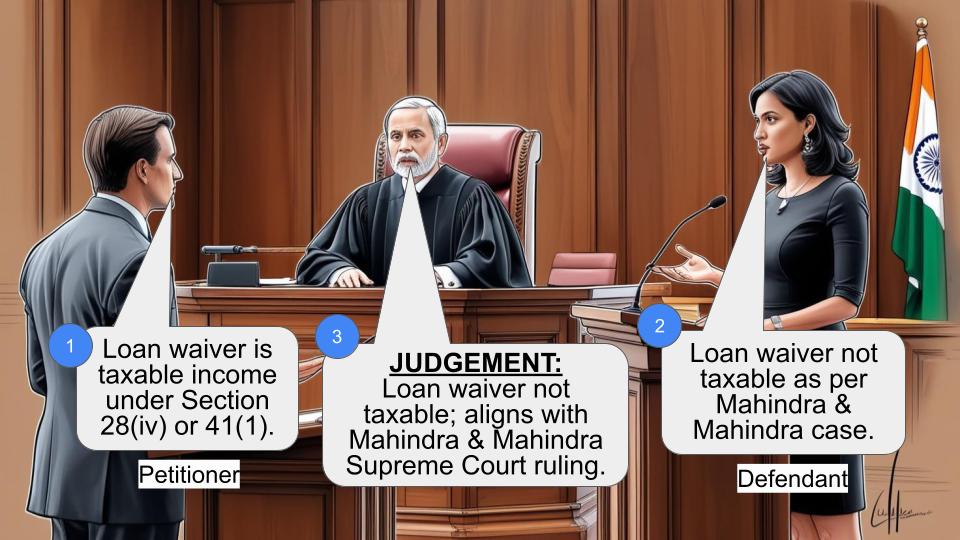
This case involves the Commissioner of Income Tax (appellant) challenging V.S. Dempo & Co. Ltd.'s (respondent) claim that a waived loan for capital assets should not be taxed as income. The Bombay High Court ruled in favor of the respondent, stating that the waiver of a loan taken for capital purposes does not convert it into taxable revenue.
Get the full picture - access the original judgement of the court order here
Case Name:
Commissioner of Income Tax Vs V.S. Dempo & Co. Ltd. (High Court of Bombay)
Tax Appeal No. 62 of 2006
Date: 9th April 2015
Key Takeaways:
1. Loans taken for capital assets remain capital in nature even when waived.
2. Section 41(1) (of Income Tax Act, 1961) doesn't apply to waived capital loans.
3. Only the portion of loan allowed as revenue expenditure in previous years is taxable under Section 41(1) (of Income Tax Act, 1961).
Issue:
Whether the waiver of a loan taken for purchasing capital assets should be considered as taxable income under Section 41(1) (of Income Tax Act, 1961), 1962?
Facts:
1. V.S. Dempo & Co. Ltd. took a loan of US $700,000 (equivalent to Rs. 33.42 lakhs) from M/s. Eisenberg Inc. Japan for purchasing machinery.
2. The loan was taken when the Income Tax Act didn't apply to Goa.
3. In the assessment year 1987-1988, the company showed Rs. 50.96 lakhs as income in its profit and loss account but didn't include it in taxable income.
4. The Assessing Officer added this amount to the company's taxable income.
5. The company appealed, arguing that the loan was for capital purposes and its waiver shouldn't be taxed.
Arguments:
Appellant (Revenue):
- Variations in loan liability due to exchange rate differences were allowed as revenue expenditure in previous years.
- The waiver of the loan should be considered income under Section 41(1) (of Income Tax Act, 1961).
Respondent (V.S. Dempo & Co. Ltd.):
- The loan was taken for capital purposes (purchasing machinery) and remains capital in nature even when waived.
- Only the portion related to exchange rate differences, previously allowed as expenditure, should be taxed under Section 41(1) (of Income Tax Act, 1961).
Key Legal Precedents:
1. Mahindra and Mahindra Ltd. Vs. Commissioner of Income Tax and Commissioner of Income Tax Vs. Mahindra and Mahindra Ltd. (2003) 261 ITR 501 (Bom.)
2. The Commissioner of Income Tax-3 Vs. M/s. Xylon Holdings P. Ltd. (Income Tax Appeal no.3704 of 2010, decided on 13/9/2012)
Both cases established that waiver of loans taken for capital assets doesn't convert them into revenue nature.
Judgement:
1. The court ruled in favor of the respondent (V.S. Dempo & Co. Ltd.).
2. It held that Section 41(1) (of Income Tax Act, 1961) doesn't apply to the waived loan amount.
3. The court reasoned that since the loan was taken for capital purposes (purchasing machinery), it remains capital in nature even when waived.
4. The benefit was restricted to the original loan amount of Rs. 33.42 lakhs.
5. The respondent agreed to pay tax on the portion related to exchange rate differences under Section 41(1) (of Income Tax Act, 1961).
FAQs:
1. Q: Why wasn't the entire waived loan amount taxable?
A: The loan was taken for capital purposes (buying machinery), so its waiver doesn't convert it into taxable income.
2. Q: What part of the waived loan is taxable?
A: Only the portion previously allowed as revenue expenditure due to exchange rate fluctuations is taxable under Section 41(1) (of Income Tax Act, 1961).
3. Q: How does this judgment impact similar cases?
A: It reinforces the principle that waiver of loans taken for capital assets doesn't make them taxable as revenue.
4. Q: What's the significance of the loan being taken before the Income Tax Act applied to Goa?
A: It emphasizes that the loan's original purpose (capital investment) is more important than when it was taken for determining its nature.
5. Q: How did previous court decisions influence this case?
A: The court relied on precedents set in the Mahindra and Mahindra Ltd. and Xylon Holdings P. Ltd. cases, which established similar principles.

1. This appeal filed by the Revenue under the Income Tax Act 1962 (the Act) challenges the order dated 21/12/2005 passed by the Income Tax Appellate Tribunal (ITAT) in respect of Assessment Year 1987-1988.
2. This appeal was admitted on 27/11/2006 on the following substantial question of law:
“(A) Whether on the facts and in the circumstances of the case the ITAT was justified in law in holding that the nature of the amount of Rs.50,96,000/- received by the assessee was capital in nature and not revenue?
3. For the assessment year 1987-1988, the respondent filed a return of income on 30/7/1987 declaring a total income of Rs.50.02 lakhs. During the course of assessment proceedings, it was noticed that the respondent had shown Rs.50.96 lakhs as an income in the profit and loss account. However, the same was not taken into account while computing its total taxable income as this was a loan taken of US # 7,00,000/- for M/s. Eisenberg Inc. Japan equivalent to Rs.33.42 lakhs is not requried to be returned. The respondent contended that the same was not offered for tax, as the loan was taken and utilized for purchase of machinery by its subsidiary M/s Dempo Mining Corporation. It was also contended that the loan was taken for capital purposes at a time when the Act did not apply to the State of Goa. This was not accepted by the the Assessing Officer on account of the fact that in the assessment year 1967- 1968, the liability on the loan was increased by Rs.19.07 on account of variation in the Exchange rate and this was allowed as revenue expenditure. Thus by an order dated 28 February 1990 under section 143(3) (of Income Tax Act, 1961) the Assessing Officer added the amount of Rs.50.96 lakhs to the taxable income of the respondent.
4. Being aggrieved, the respondent filed an appeal to the CIT (Appeals). By an order dated 28/9/1990, the CIT (Appeals) dismissed the respondent’s appeal sustaining the addition made by the Assessing Officer.
5. On further appeal to the Tribunal, the respondent restricted its appeal only to the principal amount of loan originally taken by it from M/s. Eisenberg Inc. Japan. The consequent increase of its liability on account of change in rate of exchange was claimed as revenue expenditure was not being contested. The respondent accepted that the amounts allowed as revenue expenditure on account of variation in the rate of exchange should be added to its income under section 41(1) (of Income Tax Act, 1961).
6. The Tribunal by the impugned order only considered the original loan taken by the respondent. On consideration, the impugned order records that the amount was to be utilized by the respondent's subsidiary for purchase of machinery. Therefore the taking of loan to procure machinery was on capital account and cannot be considered as revenue. In the circumstances, the impugned order allowed the respondent's appeal and directed a deletion of Rs.50.96 lakhs which was added to the respondent’s income.
7. Ms. Asha Desai, learned counsel for the appellant in support of the appeal submits that whenever there was a variation in the liability arising on account of the loan taken in view of the difference in the rate of exchange, the same was allowed as revenue expenditure or added as income. It is on the above basis it is submitted that non obligation to return that loan would results in income to the respondent and stands covered by section 41(1) (of Income Tax Act, 1961) and is chargeable to tax. Thus, it is submitted that the substantial question of law as framed is to be answered in favour of the revenue by holding that the amount of Rs.50.96 lakhs is revenue in nature and has to be a part of the respondent’s total income.
8. Mr. M. Naniwadekar, learned counsel for the respondents submits that so far as the amounts attributed to the difference in exchange rate claimed in the earlier years and allowed as expenditure in the earlier years is being offered to tax by the respondent under Section 41(1) (of Income Tax Act, 1961). So far as the loan being written off by the lender is concerned, it is submitted that the same having been on capital account for purchase of machinery, continue to be on capital account and cannot be charged to income tax. It is further submitted that Section 41(1) (of Income Tax Act, 1961) would have no application as held by this Court in “Mahindra and Mahindra Ltd. Vs. Commissioner of Income Tax and Commissioner of Income Tax Vs. Mahindra and Mahindra Ltd.” reported in (2003) 261 ITR 501 (Bom.) and the decision in Income Tax Appeal no.3704 of 2010 in the case of “The Commissioner of Income Tax-3 Vs. M/s. Xylon Holdings P. Ltd.”, rendered in 13/9/2012, wherein it has been held that when the loan has been taken for purchase of capital assets, then the waiver of that loan would not convert the loan taken on a capital account into revenue in nature.
9. It is in an indisputable position that the loan was taken by the respondent from M/s. Eisenberg Inc. Japan when the Act did not apply to the State of Goa. It is also not disputed that the loan was for purchase of machinery and that there was a cessation of liability to repay the amount. Section 41(1) (of Income Tax Act, 1961) would have no application in the present facts. This is for the reason that it is not the case of revenue that the principal amount of loan received has been allowed as a revenue expenditure in the earlier years so as to make Section 41(1) (of Income Tax Act, 1961) applicable. The amount which has been allowed in the earlier assessment years was only the variation on account of difference in rate of exchange. This the respondent is in any case offering for tax under Section 41(1) (of Income Tax Act, 1961). The principal amount of loan having been taken for purchase of capital amount was on capital account and therefore no occasion to apply Section 41(1) (of Income Tax Act, 1961) in respect of that could arise. The issue in fact stands concluded in favour of the respondent by the decision of this Court in Mahindra and Mahindra Ltd (supra) and M/s. Xylon Holding (supra) in the context of the submission made by the revenue before us. It needs to be recorded that the Revenue has made no submission to establish that the amounts received as a loan by the respondent was not capital in nature. Thus the substantial question in principle has to be answered in the affirmative, i.e. in favour of the respondent/assessee and against the appellant. However, as the loan originally received from M/s. Eisenberg Inc. Japan was only of Rs.33.42 the benefit in restricted to only Rs.33.42 lakhs. The appeal is dismissed subject to the above observations.
M. S. SANKLECHA, J. F. M. REIS, J.
×
Questions
Loan Waiver for Capital Assets Not Taxable: Bombay High Court Rules in Favor of V.S. Dempo & Co. Ltd.
Write your CommentSimilar Posts


Generic
- Reportdata/3872.pdf
