


Loan Waiver Not Taxable as Income, Overturning Revenue's Appeal





Full News
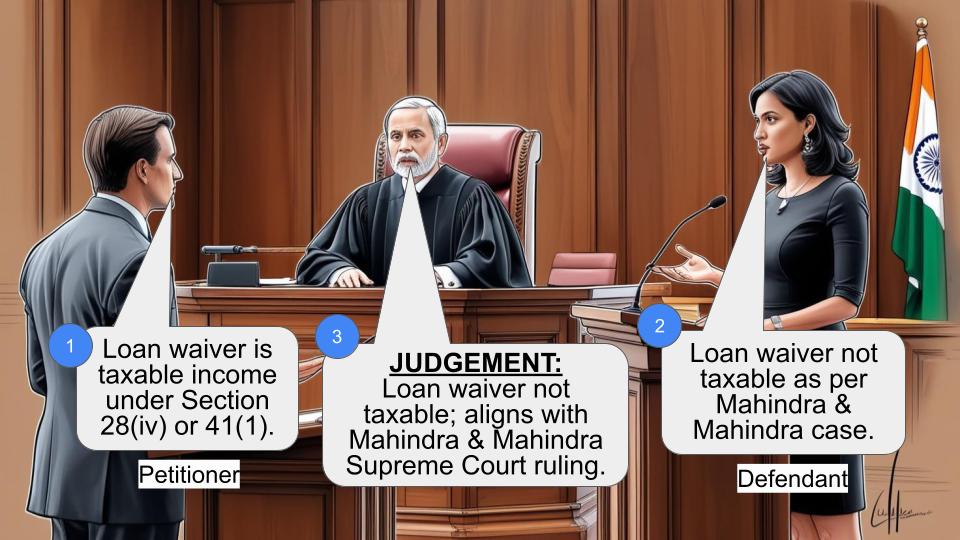
Loan Waiver Not Taxable as Income, Overturning Revenue's Appeal
Loan Waiver Not Taxable as Income, Overturning Revenue's Appeal
This case is all about whether a company (SICOM Ltd.) should pay tax on a loan that was waived by the Maharashtra government. The tax department said, "Yes, you should pay tax on this!" But SICOM disagreed. The case went through various levels of appeal, and finally, the High Court sided with SICOM, saying, "Nope, this loan waiver isn't taxable." The tax department wasn't happy and tried to appeal, but the High Court shut it down.
Get the full picture - access the original judgement of the court order here
Case Name:
Principal Commissioner of Income Tax Vs M/s. Sicom Ltd. (High Court of Bombay)
Income Tax Appeal No. 1692 of 2017
Date: 21st January 2020
Key Takeaways:
1. Loan waivers aren't automatically taxable as income.
2. There's a big difference between trading liabilities and other types of liabilities when it comes to tax.
3. The Supreme Court's decision in the Mahindra & Mahindra case is super important for similar situations.
4. The tax department can't just assume all financial benefits are taxable - they need to prove it.
Issue:
The main question here was: Is the waiver of a loan by the Government of Maharashtra taxable as income under Sections 28(iv) (of Income Tax Act, 1961) or 41(1) (of Income Tax Act, 1961)?
Facts:
1. SICOM Ltd. had a loan from the Maharashtra government.
2. The government waived off Rs. 114.98 crores of this loan.
3. The tax department (Assessing Officer) said, "Hey, this waiver is taxable income!"
4. They added this amount to SICOM's taxable income under Sections 28(iv) (of Income Tax Act, 1961) and 41(1) (of Income Tax Act, 1961).
5. SICOM wasn't having it and appealed.
6. This whole drama happened for the assessment year 2003-04.
Arguments:
The tax department's side:
- They argued that this loan waiver should be taxed either as a benefit arising from business (Section 28(iv) (of Income Tax Act, 1961)) or as a remission of a trading liability (Section 41(1) (of Income Tax Act, 1961)).
- They also pointed to a Madras High Court decision that said principal amount waivers could be taxed under Section 28(iv) (of Income Tax Act, 1961).
SICOM's side:
- They said, "Hold up, this isn't income at all!"
- They relied on a Bombay High Court decision in the Mahindra & Mahindra case, saying loan waivers aren't taxable.
Key Legal Precedents:
1. Mahindra & Mahindra Ltd vs. Commissioner of Income Tax [2003] 261 ITR 501: This Bombay High Court case said loan waivers aren't taxable.
2. Commissioner vs. Mahindra and Mahindra Ltd. [2018] 404 ITR 1: This is the Supreme Court case that confirmed the Bombay High Court's decision. It's a biggie! The Supreme Court said loan waivers aren't taxable under Section 28(iv) (of Income Tax Act, 1961) or 41(1).
3. CIT, Chennai vs. M/s. Ramaniyam Homes Pvt Ltd in Tax Case (Appeal) No. 278 of 2014 dated 22.4.2016: This Madras High Court case said principal amount waivers could be taxed under Section 28(iv) (of Income Tax Act, 1961). But the High Court in our case didn't agree with this view.
Judgement:
The High Court basically said, "Nice try, tax department, but no dice." They agreed with the lower authorities (CIT(A) and Tribunal) that the loan waiver of Rs.114.98 crores isn't taxable. Why? Because:
1. Section 28(iv) (of Income Tax Act, 1961) doesn't apply as it's about non-monetary benefits, and this was straight-up cash.
2. Section 41(1) (of Income Tax Act, 1961) doesn't apply because this wasn't a trading liability, just a regular loan.
3. The Supreme Court's Mahindra & Mahindra decision pretty much settles this issue.
So, they dismissed the tax department's appeal.
FAQs:
1. Q: Does this mean all loan waivers are tax-free now?
A: Not necessarily. This case specifically deals with government loans and follows the Mahindra & Mahindra precedent. Other types of loan waivers might be treated differently.
2. Q: Why doesn't Section 28(iv) (of Income Tax Act, 1961) apply here?
A: Section 28(iv) (of Income Tax Act, 1961) is about non-cash benefits. This was a cash benefit (loan waiver), so it doesn't fit.
3. Q: What's the difference between a trading liability and other liabilities?
A: Trading liabilities are directly related to your business operations (like money you owe suppliers). Other liabilities, like loans for buying equipment, aren't considered trading liabilities.
4. Q: Does this decision apply to all companies in India?
A: While it's a High Court decision and carries weight, it's not as binding as a Supreme Court judgment. However, it follows the Supreme Court's Mahindra & Mahindra case, so it's pretty solid precedent.
5. Q: Could the tax department appeal this further?
A: They could try to take it to the Supreme Court, but given that the Supreme Court has already ruled on a similar issue in the Mahindra & Mahindra case, their chances of success seem slim.

1. Heard learned counsel for the parties.
2. This appeal under Section 260A (of Income Tax Act, 1961) ("the Act" for short) has been preferred by the revenue against the order dated 6.12.2016 passed by the Income Tax Appellate Tribunal, "E" Bench, Mumbai ("the Tribunal" for short) in Income Tax Appeal No. 1685/Mum/2009 for the assessment year 2003-04.
3. The appeal has been preferred on the following questions which are projected as substantial questions of law:-
(A) Whether on the facts and circumstances of the case and in law, the Tribunal was justified in holding that the CIT(A) was correct in deleting Rs. 114.98 crores on account of remission of loan by Govt. of Maharashtra relying upon the decision in the case of M/s. Mahindra & Mahindra Ltd Vs. CIT 261 ITR 501 whereas the fact of the present case is entirely on different footing than the case of M/s. Mahindra & Mahindra Ltd?
(B) Whether on the facts and circumstances of the case and in law, the Tribunal was justified in holding that CIT(A) was correct in deleting Rs. 114.98 crores on account of remission of loan by Government of Maharashtra u/S. 41(1) (of Income Tax Act, 1961)/28(iv) without considering that the waiver of liability u/S. 41(1) (of Income Tax Act, 1961)/28(iv) is in character of stock-in-trade and certainly a trading liability?
(C) Whether on the facts and circumstances of the case and in law, the Tribunal was justified in holding that CIT(A) was correct in deleting Rs. 114.98 crores on account of remission of loan by Government of Maharashtra in view of the decision of the Madras High Court in the case of CIT, Chennai Vs. M/s. Ramaniyam Homes Pvt Ltd in Tax Case (Appeal) No. 278 of 2014 dated 22.4.2016 wherein it is held that the waiver of principal of amount would constitute income falling u/S. 28(iv) (of Income Tax Act, 1961) , being the benefit arising for the business?
4. In the assessment proceedings, Assessing Officer considered the issue of waiver of loan by Government of Maharashtra. The Assessing Officer vide the assessment order dated 12.12.2005 held that an amount of Rs. 114.98 crores covered by the loan given by the Government of Maharashtra is taxable under Sections 28(iv) (of Income Tax Act, 1961) and 41(1) of the Act. Accordingly, the said amount was treated as income of the assessee for the year under consideration and added back to the total income of the assessee.
5. This was challenged by the assessee before the first appellate authority i.e Commissioner of Income Tax (Appeals)-XXXII, Mumbai. The first appellate authority by order dated 25.9.2008 relied upon the Government resolution dated 30.9.2002 and took the view that only an amount of Rs. 46 crores remained interest bearing debt while the residual debt of Rs. 184 crore continued to be interest free debt from the Government of Maharashtra. Following the decision of this Court in Mahindra & Mahindra Ltd Vs. Commissioner of Income Tax1, the first appellate authority accepted the contention of the assessee that the onus of establishing that the receipts were chargeable to tax was on the Assessing Officer and held that the aforesaid decision in Mahindra and Mahindra Ltd (supra) squarely applies to the facts of the present case; the entire sum of Rs. 114.98 crores represented principal amount payable to the Government of Maharashtra and no part thereof comprised of waiver of any interest liability. Accordingly, the first appellate authority held that the sum in question i.e Rs. 114.98 crore was not chargeable to tax either under Section 41(1) (of Income Tax Act, 1961) or under Section 28(iv) (of Income Tax Act, 1961).
6. In further appeal before the Tribunal, Tribunal by its impugned order dated 6.12.2016 extensively referred to the decision of the first appellate authority and confirmed the same by taking the view that there was no reason to interfere with the order of the first appellate authority. Relevant portion of the order passed by the Tribunal is as under:-
"12. We have gone through the orders of authorities below and found that after considering various judicial pronouncements including Bombay High Court and also considering the decision relied on by the AO, the CIT(A) has reached to the conclusion that neither the provisions of Section 41(1) (of Income Tax Act, 1961) is applicable nor assessee’s income was liable to tax u/s.28(iv) (of Income Tax Act, 1961). The CIT(A) has also called remand report and after considering the same and applying various proposition of the law, reached to the conclusion that remission of loan would not be chargeable to tax either u/s.41(1) (of Income Tax Act, 1961) or u/s.28(iv) (of Income Tax Act, 1961). The detailed finding so recorded by CIT(A) has not been controverted by DR by bringing any positive material on record. Accordingly, we do not find any reason to interfere in the order of the CIT(A) deleting the addition made on account of remission of loan."
7. Submissions made by learned counsel for the parties have been considered.
8. The first appellate authority had followed the decision of this Court in Mahindra & Mahindra Ltd (supra) in deleting the addition made by the Assessing Officer on account of remission of loan. The decision of this Court in Mahindra and Mahindra (supra) was contested by the revenue before the Supreme Court in Commissioner Vs. Mahindra And Mahindra Ltd2. The issue before the Supreme Court was whether waiver of loan by the creditor is taxable as perquisite under Section 28(iv) (of Income Tax Act, 1961) or taxable as remission of liability under Section 41(1) (of Income Tax Act, 1961). Supreme Court held as under:-
"10. The term “loan” generally refers to borrowing something, especially a sum of cash that is to be paid back along with the interest decided mutually by the parties. In other terms, the debtor is under a liability to pay back the principal amount along with the agreed rate of interest within a stipulated time.
11. It is a well-settled principle that creditor or his successor may exercise their “Right of Waiver” unilaterally to absolve the debtor from his liability to repay. After such exercise, the debtor is deemed to be absolved from the liability of repayment of loan subject to the conditions of waiver. The waiver may be a partly waiver i.e., waiver of part of the principal or interest repayable, or a complete waiver of both the loan as well as interest amounts. Hence, waiver of loan by the creditor results in the debtor having extra cash in his hand. It is receipt in the hands of the debtor/assessee. The short but cogent issue in the instant case arises whether waiver of loan by the creditor is taxable as a perquisite under Section 28(iv) (of Income Tax Act, 1961) or taxable as a remission of liability under Section 41(1) (of Income Tax Act, 1961).
12. The first issue is the applicability of Section 28(iv) (of Income Tax Act, 1961) in the present case. Before moving further, we deem it apposite to reproduce the relevant provision herein below:-
“28. Profits and gains of business or profession.—The following income shall be chargeable to income-tax under the head “Profits and gains of business profession”-
(iv) the value of any benefit or perquisite, whether convertible into money or not, arising from business or the exercise of a profession;
13. On a plain reading of Section 28(iv) (of Income Tax Act, 1961), prima facie, it appears that for the applicability of the said provision, the income which can be taxed shall arise from the business or profession. Also, in order to invoke the provision of Section 28(iv) (of Income Tax Act, 1961), the benefit which is received has to be in some other form rather than in the shape of money. In the present case, it is a matter of record that the amount of Rs. 57,74,064/- is having received as cash receipt due to the waiver of loan. Therefore, the very first condition of Section 28(iv) (of Income Tax Act, 1961) which says any benefit or perquisite arising from the business shall be in the form of benefit or perquisite other than in the shape of money, is not satisfied in the present case. Hence, in our view, in no circumstances, it can be said that the amount of Rs 57,74,064/- can be taxed under the provisions of Section 28(iv) (of Income Tax Act, 1961).
14. Another important issue which arises is the applicability of the Section 41(1) (of Income Tax Act, 1961). The said provision is re-produced as under:
“41. Profits chargeable to tax.- (1) Where an allowance or deduction has been made in the assessment for any year in respect of loss, expenditure or trading liability incurred by the assessee (hereinafter referred to as the first-mentioned person) and subsequently during any previous year,-
(a) the first-mentioned person has obtained, whether in cash or in any other manner whatsoever, any amount in respect of such loss or expenditure or some benefit in respect of such trading liability by way of remission or cessation thereof, the amount obtained by such person or the value of benefit accruing to him shall be deemed to be profits and gains of business or profession and accordingly chargeable to income- tax as the income of that previous year, whether the business or profession in respect of which the allowance or deduction has been made is in existence in that year or not; or "
15. On a perusal of the said provision, it is evident that it is a sine qua non that there should be an allowance or deduction claimed by the assessee in any assessment for any year in respect of loss, expenditure or trading liability incurred by the assessee. Then, subsequently, during any previous year, if the creditor remits or waives any such liability, then the assessee is liable to pay tax under Section 41 (of Income Tax Act, 1961). The objective behind this Section is simple. It is made to ensure that the assessee does not get away with a double benefit once by way of deduction and another by not being taxed on the benefit received by him in the later year with reference to deduction allowed earlier in case of remission of such liability. It is undisputed fact that the Respondent had been paying interest at 6 % per annum to the KJC as per the contract but the assessee never claimed deduction for payment of interest under Section 36(1)(iii) (of Income Tax Act, 1961). In the case at hand, learned CIT (A) relied upon Section 41(1) (of Income Tax Act, 1961) and held that the Respondent had received amortization benefit. Amortization is an accounting term that refers to the process of allocating the cost of an asset over a period of time, hence, it is nothing else than depreciation. Depreciation is a reduction in the value of an asset over time, in particular, to wear and tear. Therefore, the deduction claimed by the Respondent in previous assessment years was due to the deprecation of the machine and not on the interest paid by it.
16. Moreover, the purchase effected from the Kaiser Jeep Corporation is in respect of plant, machinery and tooling equipments which are capital assets of the Respondent. It is important to note that the said purchase amount had not been debited to the trading account or to the profit or loss account in any of the assessment years. Here, we deem it proper to mention that there is difference between ‘trading liability’ and ‘other liability’. Section 41(1) (of Income Tax Act, 1961) particularly deals with the remission of trading liability. Whereas in the instant case, waiver of loan amounts to cessation of liability other than trading liability. Hence, we find no force in the argument of the Revenue that the case of the Respondent would fall under Section 41(1) (of Income Tax Act, 1961)."
8.1. Finally the Supreme Court summed up the decision in the following manner :-
"17. To sum up, we are not inclined to interfere with the judgment and order passed by the High court in view of the following reasons:
(a) Section 28(iv) (of Income Tax Act, 1961) does not apply on the present case since the receipts of Rs 57,74,064/- are in the nature of cash or money.
(b) Section 41(1) (of Income Tax Act, 1961) does not apply since waiver of loan does not amount to cessation of trading liability. It is a matter of record that the Respondent has not claimed any deduction under Section 36(1)(iii) (of Income Tax Act, 1961) qua the payment of interest in any previous year.
18. In view of above discussion, we are of the considered view that these appeals are devoid of merits and deserve to be dismissed. Accordingly, the appeals are dismissed. All the other connected appeals are disposed off accordingly, leaving parties to bear their own cost."
9. On careful examination of the matter, we are of the considered opinion that the decision of the Supreme Court as extracted above, is squarely applicable to the facts of the present case.
10. Consequently, we do not find any merit in the appeal to warrant admission. Appeal is accordingly dismissed but without any order as to cost.
[ MILIND N. JADHAV, J. ] [ UJJAL BHUYAN, J. ]
×
Similar Ripples
Questions
Loan Waiver Not Taxable as Income, Overturning Revenue's Appeal
Write your CommentSimilar Posts


Generic
- Reportdata/6318.pdf
