No Interest on Retrospective Tax Liability


Full News

No Interest on Retrospective Tax Liability
No Interest on Retrospective Tax Liability
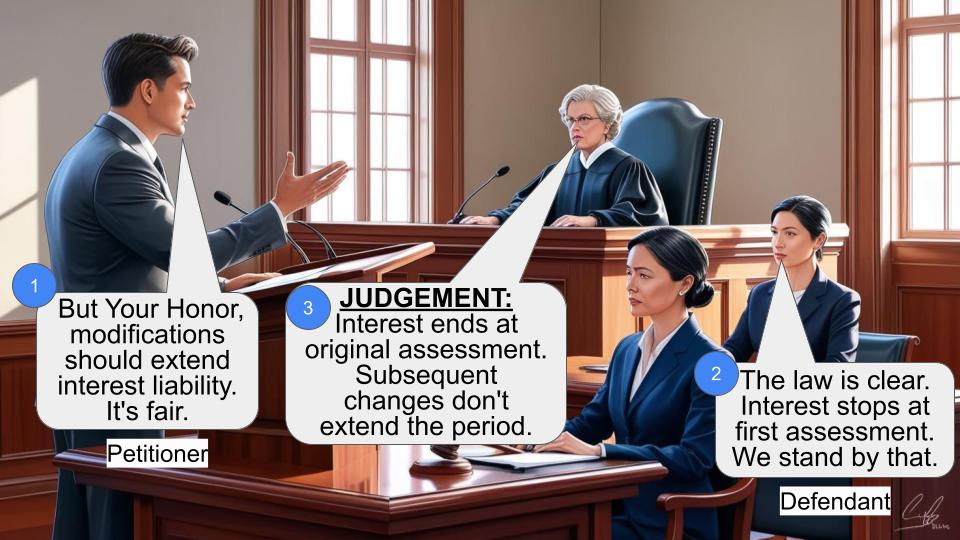
The case involves a dispute between the Commissioner of Income Tax and the National Dairy Development Board. The central issue was whether interest could be charged on a tax liability that arose due to a retrospective amendment to the Income Tax Act. The court ruled in favor of the assessee, stating that no interest could be charged in such circumstances.
Get the full picture - access the original judgement of the court order here.
Case Name:
Commissioner of Income Tax Vs National Dairy Development Board (High Court of Gujarat)
Tax Appeal No.361 of 2017
Key Takeaways:
1. Interest cannot be charged on tax liabilities arising from retrospective amendments.
2. The law does not expect a person to perform the impossible.
3. An assessee cannot be considered a defaulter for not paying advance tax on a liability that didn't exist at the time.
Issue:
Can interest be charged under Sections 234B (of Income Tax Act, 1961) and 234C of the Income Tax Act on a tax liability that arose due to a retrospective amendment?
Facts:
1. The case pertains to the assessment year 2008-09.
2. The assessee had paid advance tax, which was later found to be short due to a retrospective amendment.
3. Explanation 6 to Section 43(6) (of Income Tax Act, 1961) was inserted by Finance Act 2008 with retrospective effect from 01.04.2003.
4. This amendment created a new tax liability for the assessee.
Arguments:
The Revenue argued that interest should be charged on the shortfall of advance tax payment, even though the liability arose due to a retrospective amendment.
The assessee contended that they couldn't be held liable for interest on a tax liability that didn't exist at the time of advance tax payment.
Key Legal Precedents:
1. Emami Ltd. v. Commissioner of Income Tax (337 ITR 470)
2. Commissioner of Income Tax and Another vs. SEDCO FOREX INTERNATIONAL DRILLING CO. LTD. (264 ITR 320)
3. Star India P. Ltd. v. CCE ([2006] 280 ITR 321(SC))
Judgement:
The court ruled in favor of the assessee, holding that:
1. No interest can be charged on a tax liability arising from a retrospective amendment.
2. At the relevant time when the liability to pay advance tax arose, there was no shortfall as per the prevailing statutory provisions.
3. The law does not expect a person to perform the impossible.
FAQs:
Q1: Can the tax department charge interest on liabilities arising from retrospective amendments?
A1: No, the court ruled that interest cannot be charged in such cases.
Q2: What is the rationale behind this judgment?
A2: The court reasoned that the law doesn't expect a person to perform the impossible, such as paying tax on a liability that didn't exist at the time.
Q3: Does this judgment apply to all cases of retrospective amendments?
A3: While the judgment sets a precedent, its application may depend on the specific circumstances of each case.
Q4: How does this judgment impact the calculation of advance tax?
A4: It suggests that advance tax calculations should be based on the law as it stands at the time of payment, not on future retrospective amendments.
Q5: What sections of the Income Tax Act were central to this case?
A5: Sections 234B and 234C, which deal with interest on default of advance tax payment, and Section 43(6) (of Income Tax Act, 1961), which was retrospectively amended.

1. Tax Appeal is admitted for consideration of following substantial questions of law:
“1 Whether on the facts and circumstances of the case and in law, the ITAT was justified in restricting the disallowance made u/s.14A (of Income Tax Act, 1961) r.w.r 8D of the I.T.Act to Rs.10,00,000/ without appreciating that provisions of Rule 8D(2)(iii) (of Income Tax Rules, 1962) are applicable to the assessee?”
We notice that the Revenue has proposed another question, which reads as under:
“2 Whether on the facts and circumstances of the case and in law, the ITAT was justified in deleting interest u/s. 234B (of Income Tax Act, 1961) and 234C of the I.T.Act by holding that same would not have been charged on the assessee on account of increase in total income resulting from retrospective amendment to section 43(6) (of Income Tax Act, 1961) without appreciating that charging of interest u/s. 234B (of Income Tax Act, 1961) and 234C of the I.T Act is mandatory?”
2. This question relates to the liability of the assessee to pay interest on short fall of payment of advance tax. It is undisputed that such short fall occurred due to the liability, which arose on account of retrospective amendment. Explanation 6 to Section 43(6) (of Income Tax Act, 1961), was inserted by Finance Act 2008 with retrospective effect from 01.04.2003. This explanation essentially provided for computing the actual cost of asset, the depreciation allowed on such asset etc., in case of assessee who was not required to compute the total income for the purpose of the act for any previous year or years. It is not necessary to go into the nitigrity of explanation of this provision. Suffice it to record that for the assessment year 200809 which is under consideration, the assessee had paid advance tax, which was later on found to be short of the statutory computation on account of the above noted retrospective statutory amendment. In this context, the question arose whether the assessee was liable to pay interest on such short fall of the advance tax.
3. The issue when ultimately reached the Tribunal, the Tribunal by the impugned judgement held that interest cannot be levied under Section 234B (of Income Tax Act, 1961) and 234C of the Act. The tribunal relied on a decision of the Kolkata High Court in the case of Emami Ltd. v. Commissioner of Income Tax reported in 337 ITR 470 and of Uttaranchal High Court in the case of Commissioner of Income Tax and Another vs. SEDCO FOREX INTERNATIONAL DRILLING CO. LTD. reported in 264 ITR 320.
4 Para C of chapter XVII of the Act pertains to advance payment of tax. Section 207 (of Income Tax Act, 1961) contained in the said chapter pertains to liability for payment of advance tax. Subsection 1 of Section 207 (of Income Tax Act, 1961) provides that tax shall be payable in advance during any financial year in accordance to the provision of Sections 208 to 219 in respect of total income of the assessee, which would be chargeable to tax for the assessment year immediately following the financial year and such income would be referred to as current income. Section 208 (of Income Tax Act, 1961) provides for condition for liability to pay advance tax and requires an assessee to pay such tax if tax liability exceeds Rs.10,000/ Section 209 (of Income Tax Act, 1961) provides for computation of advance tax.
5 In terms of Section 207 (of Income Tax Act, 1961), thus, advance tax is payable in respect of total income of the assessee, which would be chargeable to tax in the assessment year immediately following the financial year in question. Thus, the computation of advance tax would be made in advance and deposited with the Government Revenue as per the provisions contained in the said chapter. In absence of the amendment in Section 43(6) (of Income Tax Act, 1961), at the relevant time no liability to pay tax in case of assessee existed. Such liability arose by virtue of a subsequent amendment brought into the statute with retrospective effect. Therefore, at the relevant time when liability to pay advance tax arose, there was no short fall as per the statutory provisions prevailing. No interest can be charged on the ground that by virtue of subsequent amendment with retrospective effect the tax liability arose, the law does not expect the person to perform Page 4 of 7 the impossible.
6 This is precisely what the Division Bench of Kolkata High Court in the case of Emami Ltd. v. Commissioner of Income Tax (supra) had held. It was the case in which a certain tax liability arose by virtue of retrospective amendment under Section 115 (of Income Tax Act, 1961) JB of the Act. The Revenue demanded interest on short payment of advance tax calculated on the basis of such retrospective amendment. The Kolkata High Court held and observed as under:
“13 In our opinion, the amended provision of section 115JB (of Income Tax Act, 1961) having come into force with effect from April 1, 2001, the appellant cannot be held defaulter of payment of advance tax. As pointed out earlier, on the last date of the financial year preceding the relevant assessment year, as the book profit of the appellant in accordance with the then provision of law was nil, wecannot conceive of any “advance tax” which in essence is payable within the last day of the financial year preceding the relevant assessment year as provided in sections 207 and 208 or within the dates indicated in section 211 (of Income Tax Act, 1961) which inevitably falls within the last date of the financial year preceding the relevant assessment year. Consequently, the assessee cannot be branded as a defaulter in payment of advance tax as mentioned above.
14 At this stage, we may profitably rely upon the observations of the Supreme Court in the case of Star India P.Ltd. v. CCE reported in [2006] 280ITR321(SC), strongly relied upon by Mr.Bajoria, where the apex court in the context of imposition of service tax by the Finance Act, 2002 with retrospective effect held that the liability to pay interest would arise only on default and is really in the nature of quasi- punishment and thus, although the liability to pay tax arose due to retrospective effect of law, the same should not entail the punishment of payment of interest.
15 Although Mr Nizamuddin, the learned counsel appearing on behalf of the revenue, in this connection, strongly relied upon the decision of the Supreme Court in the case of Joint CIT v. Rolta India Ltd. Reported in [2011] 330 ITR 470(SC), we find that in that case the question was whether interest under Section 234B (of Income Tax Act, 1961) could be charged on the tax calculated on the book profit under Section 115JA (of Income Tax Act, 1961) and in other words, whether advance tax was at all payable on book profits under Section 115JA (of Income Tax Act, 1961). The Supreme Court answered the said question in the affirmative and further held that the provisions of interest on default as provided in Sections 234B and 234C would also apply. We have already pointed out that Mr. Bajoria, at the very outset, conceded that the said decision should be applied for answering the first question formulated in this appeal against his client. In our opinion, the said decision is not relevant for considering the second and the third questions as to whether an assessee can be said to be a defaulter in payment of advance tax if he had no liability to make payment of such tax on the last date of a financial year preceding the relevant assessment year as such the question did not arise in the said case before the Supreme Court.
16 It appears that the learned Tribunal has not at all considered the aforesaid aspect as to the liability of the assessee to make payment of the advance tax on the last day of the financial year, i.e.,March 31,2001, when its book profit was nil according to the then law of the land. The various decisions of the other High Courts and the Tribunals relied upon by the Tribunal did not effectively consider the question whether even in a case like the present one where on the last date of the financial year preceding the relevant assessment year, the assessee had no liability to pay advance tax, he would be nevertheless asked to pay interest in terms of section 234B (of Income Tax Act, 1961) and section 234C (of Income Tax Act, 1961) of theAct for default in making payment of tax in advance which was physically impossible.”
7 In the result, the second question is not entertained and the tax appeal is confined only to the first question.
(AKIL KURESHI, J.)
(BIREN VAISHNAV, J.)
×