


No Penalty for Honest Mistake in Tax Deduction


Full News
No Penalty for Honest Mistake in Tax Deduction
No Penalty for Honest Mistake in Tax Deduction
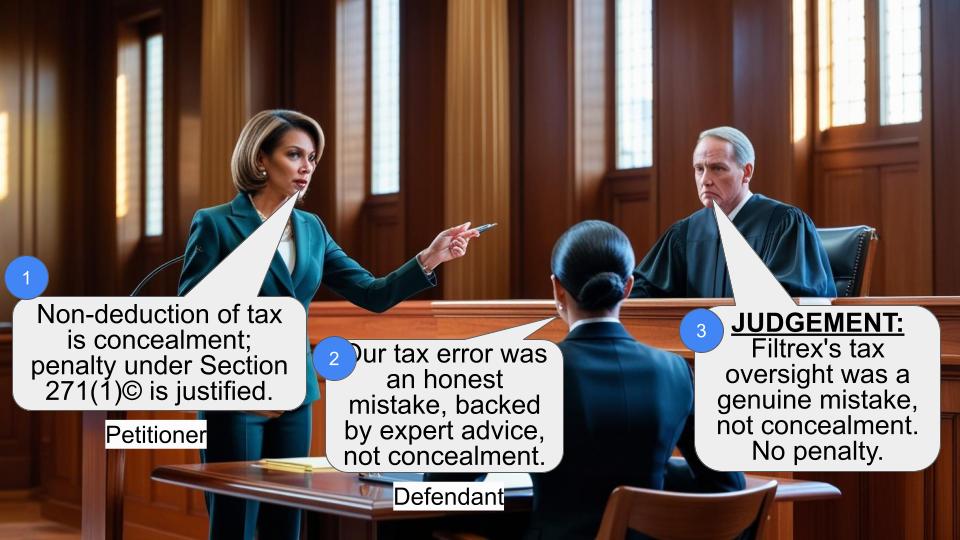
The case involves the Commissioner of Income Tax versus Filtrex Technologies (P.) Ltd., where the main issue was whether the company should be penalized for not deducting tax at source on a payment to a foreign entity. The court decided that the failure to deduct tax was a bona fide mistake, and thus, no penalty should be imposed.
Get the full picture - access the original judgement of the court order here
Case Name:
Commissioner of Income Tax vs. Filtrex Technologies (P.) Ltd. (High Court of Karnataka)
ITA Nos. 398 of 2014 & 55 of 2015
Date: 1st June 2015
Key Takeaways:
- Penalty Proceedings vs. Assessment Proceedings: The court emphasized that penalty proceedings are distinct from assessment proceedings. Just because an addition or disallowance is upheld does not automatically justify a penalty.
- Bona Fide Mistake: The court found that the failure to deduct tax was a genuine mistake, supported by a Chartered Accountant’s certificate, and not an attempt to conceal income.
- No Inaccurate Particulars: The court concluded that the company did not furnish inaccurate particulars of income.
Issue
Was the failure to deduct tax at source by Filtrex Technologies a case of concealment of income under Section 271(1) (of Income Tax Act, 1961)© of the Income Tax Act, warranting a penalty?
Facts
Filtrex Technologies, a company manufacturing carbon blocks for water filters, made payments to foreign parties. One such payment to M/s Filtrex Holdings Pte. Ltd., Singapore, was deemed liable for tax deduction at source. The company did not deduct this tax, relying on a Chartered Accountant’s certificate. The Assessing Officer initially treated this as concealment of income and imposed a penalty.
Arguments
- For the Revenue: The Revenue argued that the non-deduction of tax amounted to concealment of income and furnishing inaccurate particulars, justifying a penalty under Section 271(1) (of Income Tax Act, 1961)©.
- For Filtrex Technologies: The company contended that the non-deduction was a bona fide mistake, supported by expert advice, and not an attempt to conceal income.
Key Legal Precedents
- Section 271(1) (of Income Tax Act, 1961)© of the Income Tax Act: This section deals with penalties for concealment of income or furnishing inaccurate particulars. The court reiterated that penalties are not automatic and require specific conditions to be met.
- Dilip N. Shroff vs. Joint Commissioner of Income Tax: The court referenced this case to highlight that reliance on expert opinion, even if later found incorrect, does not constitute furnishing inaccurate particulars.
Judgement
The court ruled in favor of Filtrex Technologies, stating that the failure to deduct tax was a bona fide mistake. The company neither concealed income nor furnished inaccurate particulars. Consequently, the penalty imposed by the Assessing Officer was not justified.
FAQs
Q1: Why was the penalty not imposed on Filtrex Technologies?
A1: The court found that the failure to deduct tax was a genuine mistake, supported by a Chartered Accountant’s certificate, and not an attempt to conceal income.
Q2: What is the significance of Section 271(1) (of Income Tax Act, 1961)© in this case?
A2: This section outlines the conditions under which penalties for concealment of income can be imposed. The court emphasized that these conditions were not met in this case.
Q3: How does this case impact future tax penalty cases?
A3: It reinforces the principle that penalties are not automatic and require clear evidence of concealment or inaccurate particulars, especially when expert advice is involved.

1. These appeals are filed questioning the order dated 25.4.2014 passed by the Income Tax Appellate Tribunal, Bangalore in ITA.No.1628/Bang/2012, confirming the order of the Commissioner of Income Tax (Appeals), Bangalore.
2. The respondent-assessee is a company engaged in the manufacture of carbon blocks used in water purifying filters at residential buildings. It filed its return of income for the assessment year 2006-07 declaring the income at Rs.40,22,030/-. However, the total income determined by the concerned Assessing Officer in the assessment order, dated 22.12.2008 was Rs.1,77,14,890/-, including the fees of Rs.79,98,870/- paid for technical services to M/s.Filtres Holding Pte. Ltd., Singapore. The enhancement of income by the Assessing Officer was due to three disallowances made under
Section 40(a)(ia) (of Income Tax Act, 1961) (‘Act’ for short). Out of three disallowances made by the Assessing Officer, two disallowances were deleted by the Commissioner of Income Tax (Appeals), Bangalore by the order dated 28.4.2008. However, disallowance of Rs.79,98,870/- was sustained by the erstwhile Commissioner. The Assessing Officer treated the sum of
Rs.79,98,870/- both as concealment of income and furnishing of inaccurate particulars of income by the respondent-assessee and therefore initiated proceedings for levy of penalty under Section 271(1)(c) (of Income Tax Act, 1961).After hearing, the Assessing Officer imposed penalty of Rs.26,92,419/- being the penalty attributable to the concealment of income of Rs.79,98,870/-. The
Commissioner of Income Tax (Appeals) allowed the appeal filed by the respondent-assessee concluding that the respondent has neither concealed the income nor furnished inaccurate particulars of income. The said order of the Commissioner of Income Tax (Appeals) is confirmed by the Income Tax Appellate Tribunal, Bangalore. The order passed by the Income Tax Appellate Tribunal, Bangalore, is called in question in these appeals by the revenue contending that it involved substantial question of law and same has to be adjudicated.
3. By the impugned orders, the Commissioner of Income Tax (Appeals) and the Income Tax Appellate Tribunal, Bangalore, have concluded that the assessee-
respondent herein has not indulged in furnishing of inaccurate particulars of income; the assessee- respondent herein has made payments to three different foreign parties out of which two payments were held not
liable for deduction of tax; it is only the payment in
respect of M/s.Filtrex Holdings Pte. Ltd., Singaore was
held to be liable for deduction of tax; the respondent
herein remitted the payments based on the certificate
given by the Chartered Accountant; and no violations
were reported in Form No.3CD. On facts, both the
authorities have concluded that failure to deduct tax by
the respondent herein was a bona fide mistake and
hence, this is not a case to levy penalty. It is also held
by both the authorities that assessee has neither
concealed the income nor furnished inaccurate particulars
of income.
4. The question as to whether disallowance made
by the Assessing Officer of Rs.79,98,870/- would amount
to concealment of income under Section 271(1)(c) (of Income Tax Act, 1961) of the
Act? The very question was decided in the impugned
orders passed by the Commissioner of Income Tax
(Appeals) as well as the Income Tax Appellate Tribunal in
favour of the assessee.
5. We do not find any ground to interfere with the
impugned orders inasmuch as the Commissioner of
Income Tax (Appeals) and the appellate Tribunal, on
facts, have rightly concluded that the genuineness of the
payment was never in doubt; the explanation of the
assessee is acceptable and that the assessee has neither
concealed the income nor furnished inaccurate particulars
of income. In the matter on hand, the genuineness of
the payment was never in doubt and the dispute as to
whether the payment was made to foreign party was
liable for tax in India or not.
In the matter on hand, we find that there is no
material available on record to arrive at a conclusion that
conditions laid down in Section 271(1)(c) (of Income Tax Act, 1961) are
satisfied for levying penalty. It is well settled principle
that penalty proceedings are quite different from the
assessment proceedings. It is by now well settled that
levy of penalty is not automatic if the
addition/disallowance is sustained by the appellate
authorities. The ingredients of the provisions of Section
271(1)(c) are to be satisfied for levying the penalty. It is
no doubt true that the payment made by the respondent-
assessee to M/s.Filtrex Holdings Pte. Ltd., Singapore, was
liable for deduction of tax at source. It is also not in
dispute that such amount of tax was not deducted at
source in respect of the payment made to M/s.Filtrex
Holdings Pte. Ltd., Singapore. It appears that there was
genuine confusion on the question as to whether the
payment made to a foreign party was liable for levying
tax in India or not. It is also not in dispute that
disallowance as made by the Assessing Officer was
upheld by the appellate authorities. However, the
respondent-assessee has filed detailed statement,
explaining as to why it is not liable to be imposed with
penalty. After hearing the assessee and after considering
the material on record, the Commissioner of Income Tax
(Appeals) and the Income Tax Appellate Tribunal have
concurrently concluded that it is difficult to say that the
respondent has either concealed the income or furnished
inaccurate particulars of the income.
As has been held by the Apex Court in the case of
Dilip N.Shroff vs. Joint Commissioner of Income
Tax & another (291 ITR 590) where the assessee had
relied on the opinion of an expert and subsequently the
opinion of the expert is not accepted or another expert
had given a different opinion, it could not be held that
the assessee had furnished inaccurate particulars within
the meaning of the provisions of Section 271(1)(c) (of Income Tax Act, 1961) of the
Income Tax Act (‘Act’ for short).
In the matter on hand, as aforementioned, the
Chartered Accountant has given a certificate to the effect
that the assessee is not required to deduct tax at source
while making the payment to M/s.Filtrex Holding Pte.
Ltd., Singapore. Thus, the assessee acted on the basis
of the certificate issued by the expert and hence the
Commissioner of Income Tax (Appeals) and the Income
Tax Appellate Tribunal have rightly concluded that this is
not a fit case to conclude that the assessee has
deliberately concealed the income or furnished inaccurate
particulars of the income. The assessee has filed Form
3CD along with the return of income in which the
Chartered Accountant has not reported any violation by
the assessee under Chapter XVII B which would attract
disallowance under Section 40(a)(ia) (of Income Tax Act, 1961).
On reconsidering the entire material on record, we
do not find any ground to interfere with the impugned
order passed by the Income Tax Appellate Tribunal. No
substantial question is involved in these appeals.
Hence, appeals fail and accordingly the same stand
dismissed.
Sd/-
JUDGE
Sd/-
JUDGE
×
Similar Ripples
Questions
No Penalty for Honest Mistake in Tax Deduction
Write your CommentSimilar Posts


Generic
- Reportdata/3718.pdf
