


Penalty for Non-Deduction of TDS: Court Rules Against Assessees


Full News

Penalty for Non-Deduction of TDS: Court Rules Against Assessees
Penalty for Non-Deduction of TDS: Court Rules Against Assessees
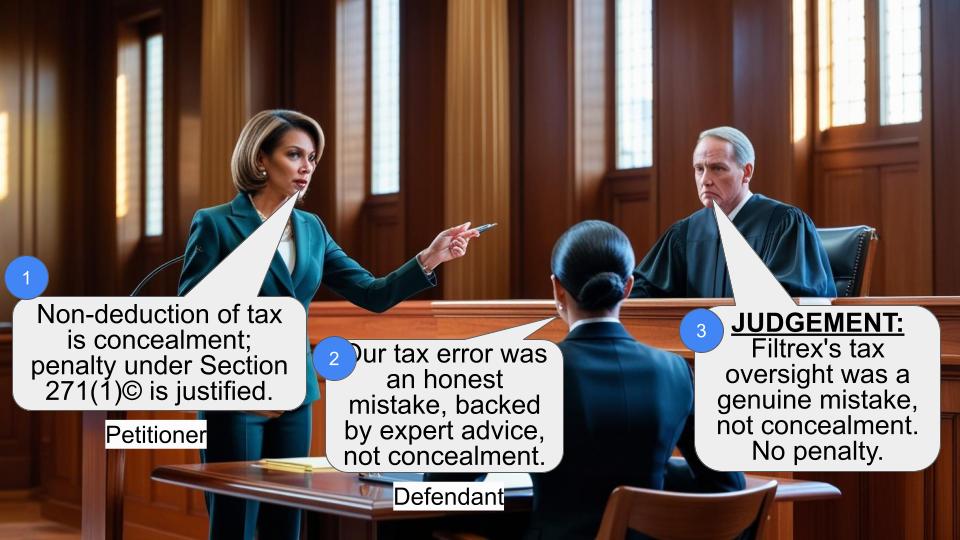
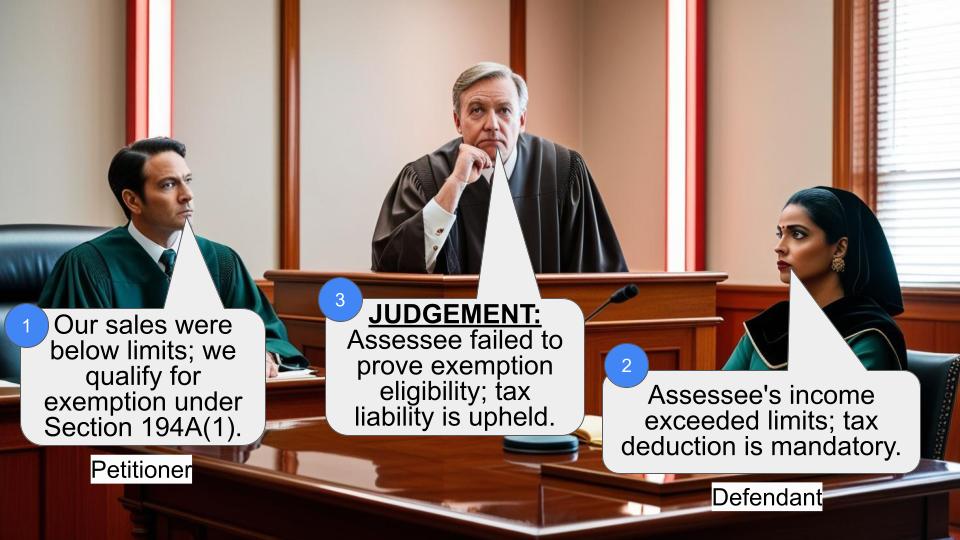
This case involves the Commissioner of Income Tax (TDS) and partners of M/s Muthoot Estate Investments. The partners failed to deduct tax at source on interest paid to their firm, leading to penalties under Section 271C (of Income Tax Act, 1961). The court ruled against the partners, emphasizing that ignorance of the law is not a valid excuse.
Get the full picture - access the original judgement of the court order here
Case Name:
Commissioner of Income Tax (TDS) vs. Thomas Muthoot (High Court of Kerala)
ITA. No. 139 of 2013
Date: 3rd July 2015
Key Takeaways:
- Ignorance of Law: The court reiterated that ignorance of the law is not a reasonable cause for non-compliance.
- Section 271C (of Income Tax Act, 1961) Penalty: Failure to deduct tax at source attracts penalties unless a reasonable cause is proven under Section 273B (of Income Tax Act, 1961).
- Burden of Proof: The onus is on the assessee to demonstrate a reasonable cause for non-compliance.
Issue
Did the partners of M/s Muthoot Estate Investments have a reasonable cause for not deducting tax at source on interest paid to their firm, thereby avoiding penalties under Section 271C (of Income Tax Act, 1961)?
Facts
- The partners of M/s Muthoot Estate Investments paid interest to their firm on overdrawn amounts but did not deduct tax at source as required by Section 194A (of Income Tax Act, 1961).
- The Joint Commissioner of Income Tax imposed penalties under Section 271C (of Income Tax Act, 1961) for this failure.
- The partners argued that they believed they were not required to deduct tax, as the firm had declared a loss and was not liable to pay tax.
Arguments
- Assessees: Claimed they were under the bona fide belief that no tax deduction was required, as the firm was not liable to pay tax due to declared losses.
- Revenue: Argued that the partners were liable to deduct tax at source and that ignorance of the law is not a valid defense.
Key Legal Precedents
- Section 194A (of Income Tax Act, 1961): Requires deduction of tax at source on interest payments, except for certain exemptions.
- Section 271C (of Income Tax Act, 1961): Imposes penalties for failure to deduct tax at source.
- Section 273B (of Income Tax Act, 1961): Provides relief from penalties if a reasonable cause for non-compliance is proven.
- Sitaram Ramcharan v. M.N. Nagrashana [AIR 1960 SC 260]: Ignorance of law is not an excuse.
Judgement
The court ruled in favor of the Revenue, setting aside the Tribunal's order that had canceled the penalties. The court emphasized that the partners' belief was not reasonable, and ignorance of the law could not be considered a reasonable cause under Section 273B (of Income Tax Act, 1961).
FAQs
Q1: What was the main legal issue in this case?
A1: Whether the partners had a reasonable cause for not deducting tax at source, which would exempt them from penalties under Section 271C (of Income Tax Act, 1961).
Q2: Why did the court rule against the partners?
A2: The court found that the partners' belief that they were not required to deduct tax was not reasonable, and ignorance of the law is not a valid excuse.
Q3: What does this case mean for other taxpayers?
A3: It underscores the importance of understanding tax obligations and the limited scope of "reasonable cause" as a defense against penalties for non-compliance.

1.These appeals are filed by the Revenue challenging the common order passed by the Income Tax Appellate Tribunal, Cochin Bench in ITA Nos.385/Coch/2011 and 391/Coch/2011.
2. Briefly stated the relevant facts are that the respondents are Partners of a firm M/s. Muthoot Estate Investments. They had drawn funds from the firm over and above their respective capital and paid interest to the firm on the amounts overdrawn by them. Accordingly, respondent in ITA No.139/13 paid a sum of Rs.1,39,00,000/- and the respondent in ITA No.177/13
paid a sum of Rs.6,28,28,000/- as interest to the firm.
Both of them did not deduct tax at source on the interest paid by them and noticing this as a violation of Section 194A (of Income Tax Act, 1961)
(hereinafter, the 'Act', for short) the Joint Commissioner of Income Tax levied penalty under Section 271C (of Income Tax Act, 1961). Accordingly, Rs.15,69,664/- and Rs.70,49,302/- were levied as penalty on the respondents in ITA Nos.139/13 and 177/13, respectively. The penalty orders were confirmed by the Commissioner (Appeals). The further appeals filed before the Tribunal were allowed and the impugned order was passed holding that the relief entertained by the assessees that they were not liable to deduct tax at source on the interest paid by them to the partnership firm can be considered as a reasonable cause as contemplated under Section 273B (of Income Tax Act, 1961).
The Tribunal also took note of the fact that the firm had included the interest it had received in its return of income and that since the firm had declared loss, it was not liable to pay any tax and hence there was no revenue loss. It was on these grounds the Tribunal set aside the order passed, deleted the penalty levied under Section 271C (of Income Tax Act, 1961) and
allowed the appeals. It is this order, which is challenged by the Revenue in these appeals and the questions of law formulated are:
1. Whether, on the facts and in the circumstances of the case, the tribunal is right in law and fact in cancelling the penalty levied under Sec.271C (of Income Tax Act, 1961)?
2. Whether, on the facts and in the circumstances of the case and also in the light of the specific exemption provided in section 194A(3)(iv) (of Income Tax Act, 1961) to such income credited or paid by a firm to a partner of the firm, the assessee is
reasonably entitled to entertain the belief that payment of interest by the partners to the firm is similar or similarly placed?
3. Whether, on the facts and in the circumstances of the case and in the absence of an issue of debate being raised by the assessee, the Tribunal is right in law and fact in introducing the concept of debate in the order and is not the order based on a “debatable issue” extraneous and perverse?”
3.We heard the senior Standing Counsel for the Revenue
and also the learned senior counsel for the
respondent assessees.
4.Section 194A (of Income Tax Act, 1961) requires any person, not
being an individual who is exempted, and responsible
for paying to a resident any income by way of
interest other than income by way of interest on
securities, shall deduct income tax thereon at the
rates in force, at the time of credit of such income
to the account of the payee or at the time of payment
thereof in cash or by cheque or draft or by any other
mode. Section 271C (of Income Tax Act, 1961) provides that if any
person fails to deduct the whole or any part of the
tax as required to be deducted by or under the
provisions of Chapter XVII-B, then such person shall
be liable to pay, by way of penalty, a sum equal to
the amount of tax which such person failed to deduct
or pay as aforesaid. Section 271C(2) (of Income Tax Act, 1961) provides that
any penalty imposable under sub section (1) shall be
imposed by the Joint Commissioner of Income Tax. As
per Section 273B (of Income Tax Act, 1961), notwithstanding anything contained
in the provisions of Section 271C (of Income Tax Act, 1961), no penalty shall
be imposable on the person or the assessee, as the
case may be, for any failure referred to in the
Section, if he proves that there was reasonable cause
for such failure.
5.A survey of the above statutory provisions show that
if an individual who is liable to deduct tax at
source under Section 194A (of Income Tax Act, 1961) commits default in doing
so, automatically, Section 271C (of Income Tax Act, 1961) is attracted and he
is liable to be levied penalty as provided therein.
However, that absolute liability to be penalised is
softened by section 273B (of Income Tax Act, 1961) by providing such person an
opportunity to prove that his failure to comply with
Section 194A (of Income Tax Act, 1961) was for a reasonable cause. It is
therefore evident that in order to escape from the
levy of penalty, it is for the assessee to prove that
he had reasonable cause for his non-compliance with
section 194A (of Income Tax Act, 1961) and the burden of proving the reasonable
cause is entirely on the assessee. The Act does not
define the term 'reasonable cause'. It is a standard
of proof which is applied to a set of facts or
actions to prove whether a reasonable person have
come to the same conclusion or acted in the same way
given the totality of the circumstances.
6.In this context, it is also relevant to note that in
Commissioner of Income Tax v. Sri Jagdish Prasad
Choudhary [(211) ITR 472], a Full Bench of the Patna
High Court has interpreted the expression “reasonable
cause”, as follows:
“The word “reasonable cause” has not been
defined under the Act but it could receive the
same interpretation which is given to the
expression “sufficient cause”. Therefore, in the
context of the penalty provisions, the word
“reasonable cause” would mean a cause which is
beyond the control of the assessee. “Reasonable
cause” obviously means a cause which prevents a
reasonable man of ordinary prudence acting under
normal circumstances, without negligence or
inaction or want of bona fides, from furnishing
the return in time”.
7.Subsequently, A Division Bench of the Delhi High
Court in its judgment in Deputy Commissioner of
Income-Tax v. Adinath Industries [(252) ITR 471] held
thus:
“Reasonable cause, as applied to human actions is
that which would constrain a person of average
intelligence and ordinary prudence. The
expression “reasonable” is not susceptible of a
clear and precise definition; for an attempt to
give a specific mean ing to the word “reasonable”
is trying to count what is not number and measure
what is not space. It can be described as rational
according to the dictates of reason and is not
excessive or immoderate. The word “reasonable”
has in law the prima facie meaning of reasonable
with regard to those circumstances of which the
actor, called on to act reasonably, knows or ought
to know see In re, A Soilicitor [1945] KB 368
(CA)). Reasonable cause can be reasonably said to
be a cause which prevents a man of average
intelligence and ordinary prudence, acting under
normal circumstances, without negligence or
inaction or want of bona fides.”
8.The same Division Bench of the Delhi High Court in
its judgment in Woodward Governor India P. Ltd. v.
Commissioner of Income-Tax and Others [(253) ITR
745] held thus:
“Reasonable cause” as applied to human action is
that which would constrain a person of average
intelligence and ordinary prudence. It can be
described as probable cause. It means an honest
belief founded upon reasonable grounds, of the
existence of a state of circumstances, which
assuming them to be true, would reasonably lead
any ordinarily prudent and cautions man, placed in
the position of the person concerned, to come to
the conclusion that the same was the right thing
to do. The cause shown has to be considered and
only if it is found to be frivolous, without
substance or foundation, the prescribed
consequences follow.”
9.Bearing in mind the above provisions of the Act and
principles, the facts of the case are to be seen.
The case pleaded by the assessees was that they were
under the bonafide belief that under Section 194A (of Income Tax Act, 1961),
they were not liable to deduct tax at source on the
interest paid by a partner to the firm. In other
words, the substance of the plea of the assessees was
that they were ignorant of their statutory liability
to deduct tax at source on the interest paid by them
to the firm of which they are partners. While
Section 194A (of Income Tax Act, 1961) provided for deduction of tax on
interest, by virtue of the provisions contained in
sub section (3), only such income credited or paid
by a firm to a partner of the firm is exempted
from deduction. The language of the provision does
not leave scope for any ambiguity on the liability of
a partner to deduct tax on interest paid by him
to the firm and there is absolutely no warrant
for a belief to the contrary. That being the
legal position, we do not know how the assessees,
who admittedly are persons having the services
of experienced chartered accountants at their
disposal, could entertain a belief that they
were not liable to deduct tax at source on the
interest paid to the firm. This, therefore, means
that the alleged belief of the assessees is certainly
not one a reasonable person would have entertained
nor such persons would have acted in the same way
given the totality of circumstances.
10.Therefore, we cannot accept the plea that the belief
allegedly entertained by the assessees was a bonafide
one or could be accepted as a reasonable cause as
provided under Section 273B (of Income Tax Act, 1961).
11.In effect, the defence put forward by the assessees
is one of ignorance of law. Ignorance of law, it is
trite, is no excuse in law and if that be so,
ignorance of law cannot also be a reasonable cause as
contemplated under Section 273B (of Income Tax Act, 1961). This view has been
taken by the Apex Court in Sitaram Ramcharan v.
M.N.Nagrashana [AIR 1960 SC 260].
12.The learned counsel for the assessees contended that
Section 194A (of Income Tax Act, 1961) excludes ‘person’ from the liability to
deduct tax at source. Therefore, according to the
learned counsel, the very proceedings against the
assessees is untenable. We are unable to accept
this contention. First of all, this contention was
not raised before any one of the authorities,
including the Tribunal and the parties proceeded thus
far, on the conceded basis that the assesees had the
liability under Section 194A (of Income Tax Act, 1961). That apart, unless the
assessees establish by evidence that they are
entitled to the coverage of the proviso to Section
194A(1), they cannot claim the benefit of exclusion.
This proviso reads thus:
“Provided that an individual or a Hindu undivided
family, whose total sales, gross receipts or
turnover from the business or profession carried
on by him exceed the monetary limits specified
under clause (a) or clause (b) of section 44AB (of Income Tax Act, 1961)
during the financial year immediately preceding
the financial year in which such interests is
credited or paid, shall be liable to deduct income
tax under this Section.”
13.Reading of the proviso shows that unless the facts
which are required to be established to attract the
proviso are made out, such a claim of exclusion
cannot be entertained. In this case, such facts are
not established and therefore, we are not in a
position to entertain this plea raised for the first
time before us. True the counsel contended that the
question raised being one of the law can be raised
before this Court, in our view, the question raised
is not a pure question of law but is a mixed question
of law and facts.
14.Learned counsel for the assessee relied on the
judgment in Hindustan Coca Cola Beverage (P) Ltd. v.
Commissioner of Income Tax [(2007) 293 ITR 226 (SC)]
to support his contention that the penalty levied is
untenable. In our view, a reading of this judgment
itself would show that even in cases where default is
committed, though tax cannot be recovered again,
penalty and interest can be recovered.
15.As contended by the learned counsel, it may be true
that penalty levied under section 201 (of Income Tax Act, 1961) read with
Section 221 (of Income Tax Act, 1961) has been set aside by the Tribunal
accepting the plea of “good and sufficient” reasons
urged by the assessees. However, the object of these
provisions being different from section 194A (of Income Tax Act, 1961) read
with Section 271C (of Income Tax Act, 1961), such an order passed by the
Tribunal cannot come to the rescue of the assessees.
In any case, principles of res-judicata and estoppel
are alien to tax jurisprudence and therefore, this
contention also cannot improve the case of the
assessees. One another reason which has weighed with
the Tribunal is that the firm had declared the
interest received in its return and that since the
firm had returned loss and was not liable to any tax,
no loss was caused to the revenue. In our view, even
if the findings are factually correct, statutory
provisions do not recognize this as a defence in a
proceeding under Section 271C (of Income Tax Act, 1961). As we have already
found, the only way out is by establishing
“reasonable cause” as provided in Section 273B (of Income Tax Act, 1961) of the
Act. When default in deducting tax at source
attracts proceedings for penalty under Section 271C (of Income Tax Act, 1961)
and when 273B is the only escape route, the
declaration of receipt of income by the firm or that
it did not have liability to pay tax are, to say the
least, irrelevant and immaterial.
For all the aforesaid reasons, the orders of the
Tribunal are unsustainable and are accordingly set
aside. Answering the questions of law raised in
favour of the revenue, these appeals are allowed.
Sd/-
ANTONY DOMINIC, Judge.
Sd/-
SHAJI P. CHALY, Judge.
×
Similar Ripples
Questions
Penalty for Non-Deduction of TDS: Court Rules Against Assessees
Write your CommentSimilar Posts

Generic
- Reportdata/3661.pdf
