


Full News

Punjab & Haryana High Court Declines Jurisdiction in Income Tax Appeal from Alwar
Punjab & Haryana High Court Declines Jurisdiction in Income Tax Appeal from Alwar
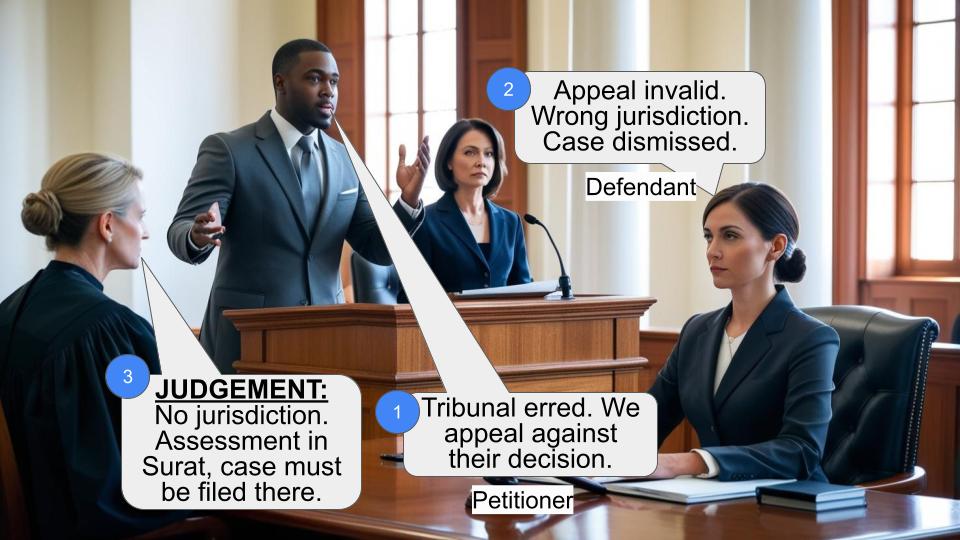
This case involves an appeal by the revenue department against an order of the Income Tax Appellate Tribunal (ITAT) in Jaipur. The Punjab & Haryana High Court dismissed the appeal, stating it lacks territorial jurisdiction to decide on an order passed by an Assessing Officer in Alwar, Rajasthan.
Get the full picture - access the original judgement of the court order here
Case Name
Commissioner of Income Tax vs. Misty Meadows Pvt. Ltd. (High Court of Punjab & Haryana)
ITA No. 318 of 2015
Date: 17th November 2015
Key Takeaways
- The High Court’s territorial jurisdiction is limited to orders passed within its jurisdiction.
- The location of the Assessing Officer who passed the original order determines the appropriate High Court for appeals.
- This decision reinforces the importance of filing appeals in the correct jurisdictional court.
Issue
Does the Punjab & Haryana High Court have territorial jurisdiction to decide an appeal against an Income Tax Appellate Tribunal order when the original assessment order was passed by an Assessing Officer in Alwar, Rajasthan?
Facts
- On September 17, 2008, there was a search and seizure operation conducted on the Kamdhenu Group, including our company in question, Misty Meadows Pvt. Ltd.
- Fast forward to January 22, 2010, and the company gets a notice under Section 153A (of Income Tax Act, 1961). In response, they filed a tax return on March 30, 2010, for the 2003-04 assessment year, declaring an income of ₹1,22,320.
- The plot thickens when the Assistant Commissioner of Income Tax in Alwar passes an assessment order on December 15, 2010. They weren’t buying the company’s declared income and assessed it at a much higher ₹3,62,00,330.
- Naturally, the company wasn’t happy about this and appealed to the Commissioner of Income Tax (Appeals) in Jaipur. The CIT(A) partially allowed the appeal, reducing some of the additions made by the Assessing Officer.
- Still not satisfied, both parties took it up a notch. The revenue department filed an appeal, and the company filed cross-objections with the Income Tax Appellate Tribunal (ITAT) in Jaipur.
- The ITAT, in its order dated December 19, 2014, sided mostly with the company. They dismissed the revenue’s appeal and allowed the company’s cross-objections.
- That brings us to the current case, where the revenue department has filed an appeal with the Punjab & Haryana High Court against the ITAT’s order.
Arguments
The revenue department raised several questions of law in their appeal, challenging the ITAT’s decision on various grounds. However, the court didn’t delve into these arguments because a more fundamental issue came up - whether the court had the jurisdiction to hear this case at all.
Key Legal Precedents
The court relied on two previous judgments to make its decision:
- Commissioner of Income Tax (Central) Gurgaon v. M/s Parabolic Drugs Ltd. (ITA No. 49 of 2012, decided on 11.10.2012)
- The Commissioner of Income Tax, Faridabad v. M/s Motorola India Ltd. (ITA No. 44 of 2005, decided on 3.10.2007)
Both these cases established that the Punjab & Haryana High Court doesn’t have territorial jurisdiction to decide appeals when the original assessment order was passed outside its jurisdiction (in these cases, in Delhi).
Judgement
The court decided to dismiss the appeal, stating that it doesn’t have territorial jurisdiction to adjudicate on an order passed by an Assessing Officer in Alwar. They returned the appeal to the revenue department, advising them to file it before the appropriate court with jurisdiction.
FAQs
Q: Why did the court dismiss the appeal?
A: The court dismissed the appeal because it determined it didn’t have the territorial jurisdiction to hear the case, as the original assessment order was passed in Alwar, Rajasthan.
Q: What does “territorial jurisdiction” mean in this context?
A: Territorial jurisdiction refers to the court’s authority to hear cases based on the geographical location where the original order or event occurred. In this case, since the original assessment was in Alwar, the Punjab & Haryana High Court doesn’t have jurisdiction.
Q: What should the revenue department do now?
A: The court advised the revenue department to file the appeal before the competent court with the appropriate jurisdiction, which would likely be the Rajasthan High Court.
Q: Does this decision set a precedent?
A: While this decision reinforces existing precedents, it’s not setting a new one. The court relied on previous judgments that had already established this principle of territorial jurisdiction.
Q: What’s the significance of this judgment for future cases?
A: This judgment emphasizes the importance of filing appeals in the correct jurisdictional court. It serves as a reminder for litigants and lawyers to carefully consider the appropriate forum when filing appeals in tax matters.

1. This appeal has been preferred by the revenue under Section 260A (of Income Tax Act, 1961) (in short “the Act”) against the order dated 19.12.2014 (Annexure-3) passed by the Income Tax Appellate Tribunal, Jaipur Bench, Jaipur (hereinafter referred to as “the Tribunal”) in C.O. No. 68/JP/2012, claiming the following substantial questions of law:-
(i) Whether, in the facts and in the circumstances of the case, the Ld. ITAT was right in law in upholding the order of CIT(A) and dismissing the appeal filed by the Revenue for the additions made on account of Unexplained share capital of Rs.1,05,00,000/- and Unexplained cash credit of Rs.14,01,765/-?
(ii) Whether, on the facts and in the circumstances of the case, the Ld. ITAT was right in law allowing the cross objection filed by the assessee?
(iii) Whether the ITAT relied upon inadmissible evidence as the procedure adopted by CIT (A) allowing the additional evidence is against the well defined procedure engrafted in Rule 46A (of Income Tax Rules, 1962)?
(iv) Whether, in the facts and circumstances of the case, Hon'ble ITAT was legally justified in deleting the addition of Rs.1,05,00,000/- and Rs.14,01,765/- made u/s 68 (of Income Tax Act, 1961) by holding that the assessee has discharged the onus cast upon it u/s 68 (of Income Tax Act, 1961) while ignoring the facts that the initial evidences furnished by the assessee were duly rebutted by the Assessing Officer after making thorough enquiries and holding that the applicant companies were not in existence?
(v) Whether ITAT has erred in law in deleting an addition under Section 68 (of Income Tax Act, 1961) by holding that insistence of the Assessing Officer asking the assessee to produce further evidence is 'impossible compliance' whereas the Assessing Officer based on enquiries has discarded evidence already adduced by the assessee?
(vi) Whether, in the facts and circumstances of the case, Hon'ble ITAT was legally justified in allowing relief to the assessee and deleting addition of Rs.10,00,000/- on the basis of cross objection filed by the assessee whereas the said issue was not a part of revenue's appeal and as such, no cross objection could have been filed by the assessee and the issue could have been legally decided only on appeal filed by the assessee before the Tribunal against this addition?
(vii) Whether the findings have been recorded by ITAT on misreading and misinterpretation of facts and evidence emanating on record?
(viii) Whether the ITAT committed grave error in arriving at such conclusions after adopting erroneous criteria and by importing such facts and circumstances which are contrary to record?
2. A few facts necessary for adjudication of the present appeal as narrated therein may be noticed. A search and seizure operation under Section 132 (of Income Tax Act, 1961) was conducted on 17.9.2008 in Kamdhenu Group of cases including M/s Misty Meadows Pvt. Ltd. (the assessee herein). A notice dated 22.1.2010 under Section 153A (of Income Tax Act, 1961) was issued to the assessee who filed its return on 30.3.2010 for the assessment year 2003-04 declaring the total income at ` 1,22,320/-. Thereafter, notice dated 7.5.2010 under Sections 142(1) (of Income Tax Act, 1961) and 143(2) of the Act along with a questionnaire were issued to the assessee who filed reply to the same. The assessment order dated 15.12.2010 (Annexure- 1) under Section 143(3) (of Income Tax Act, 1961) was passed by the Assistant Commissioner of Income Tax, Central Circle, Alwar assessing the income of the assessee at ` 3,62,00,330/-. Feeling aggrieved, the assessee filed an appeal under Section 250(6) (of Income Tax Act, 1961) before the Commissioner of Income Tax (Appeals), Central Jaipur [for brevity “the CIT(A)”]. The CIT(A) vide order dated 28.2.2012 (Annexure-2) partly allowed the appeal and deleted the additions of ` 1,05,00,000/- out of a total addition of 1,15,00,000/- on account of unexplained share capital and 14,01,765/- on account of unexplained cash credit. Against the said order, Annexure-2, the revenue filed an appeal whereas the assessee filed cross-objections before the Tribunal. The Tribunal vide order dated 19.12.2014 (Annexure-3) dismissed the appeal of the revenue and allowed the cross objections filed by the assessee. The Tribunal deleted the whole of the amount on account of unexplained share capital and ` 14,01,765/- on account of unexplained cash credit.
Hence, the present appeal by the revenue.
3. We have heard learned counsel for the revenue.
4. The issue that arises for consideration is whether this Court would have territorial jurisdiction to decide the appeal when the Assessing Officer who passed the assessment order was based at Alwar and the first appeal was adjudicated by the CIT(A), Central Jaipur. The second appeal was decided by the Tribunal at Jaipur.
5. The matter is no longer res integra. This Court in Commissioner of Income Tax (Central) Gurgaon v. M/s Parabolic Drugs Ltd. ITA No. 49 of 2012 decided on 11.10.2012 following its earlier Division Bench judgment in The Commissioner of Income Tax, Faridabad v. M/s Motorola India Ltd. ITA No. 44 of 2005 decided on 3.10.2007 had held that this Court had no territorial jurisdiction to decide the appeal when the order passed by the assessing authority was at Delhi. It was recorded as under:-
“8. Accordingly, the present appeal is dismissed by holding that this Court has no territorial jurisdiction to adjudicate upon the lis over an order passed by the Assessing Officer at New Delhi. Consequently, the appeal is returned to the Revenue for filing before the competent Court of jurisdiction in accordance with law.”
6. In view of the above, the present appeal is dismissed as this Court has no territorial jurisdiction to adjudicate upon the lis over an order passed by the Assessing Officer at Alwar. Consequently, the appeal is returned to the revenue for filing before the competent court of jurisdiction in accordance with law.
(AJAY KUMAR MITTAL)
JUDGE
November 17, 2015 (RAMENDRA JAIN)
gbs JUDGE
×
Similar Ripples
Questions
Punjab & Haryana High Court Declines Jurisdiction in Income Tax Appeal from Alwar
Write your CommentSimilar Posts


Generic
- Reportdata/3315.pdf
