Rule 8D (of Income Tax Rules, 1962) not mandatory for Section 14A (of Income Ta…


Full News
Rule 8D (of Income Tax Rules, 1962) not mandatory for Section 14A (of Income Tax Act, 1961) disallowance, AO must record satisfaction
Rule 8D (of Income Tax Rules, 1962) not mandatory for Section 14A (of Income Tax Act, 1961) disallowance, AO …
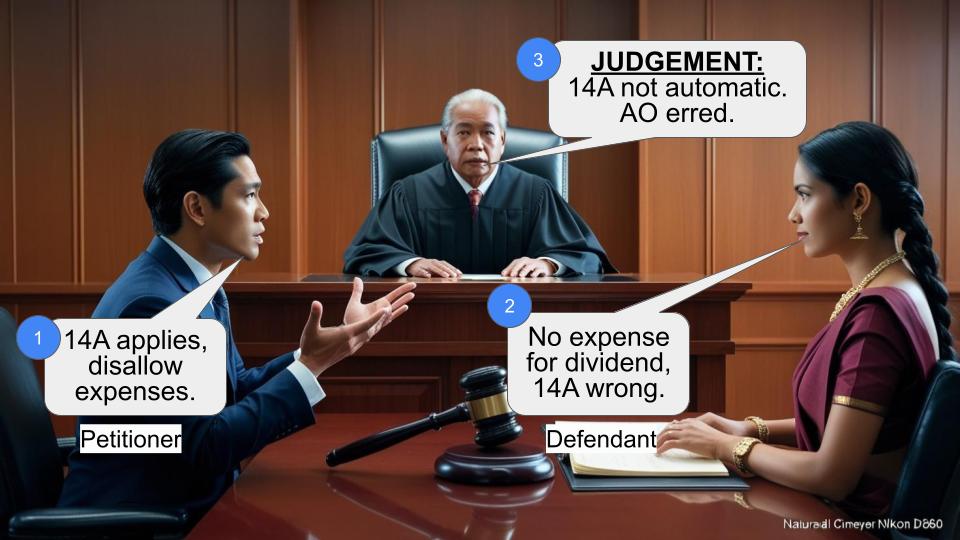
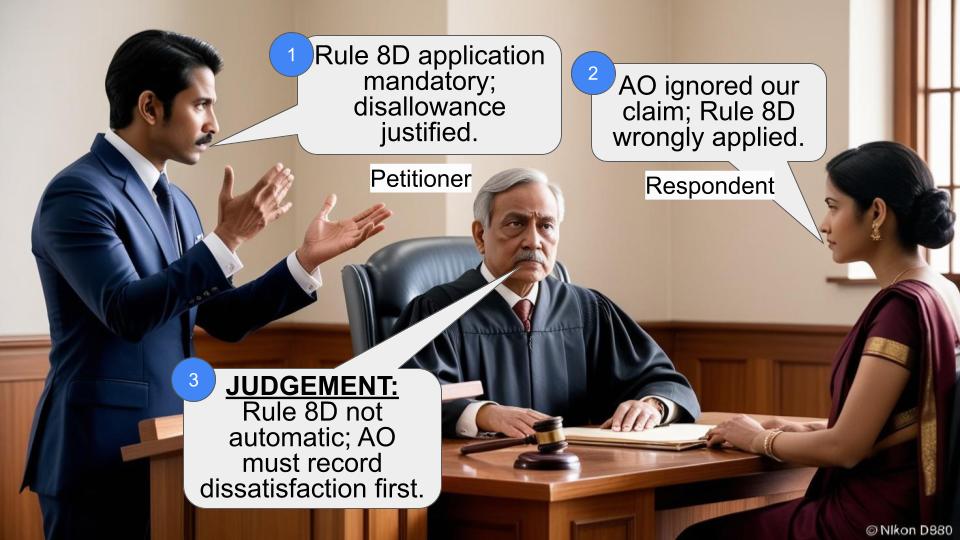
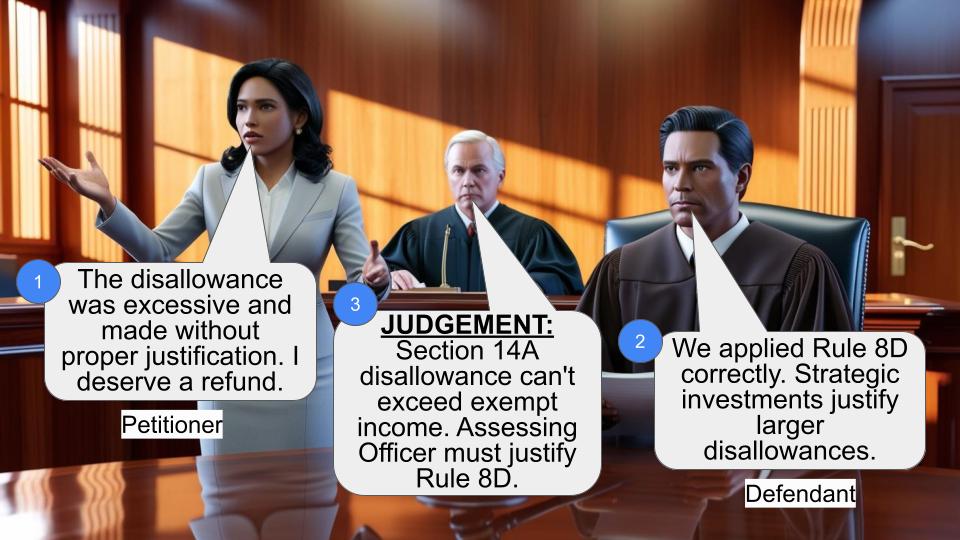
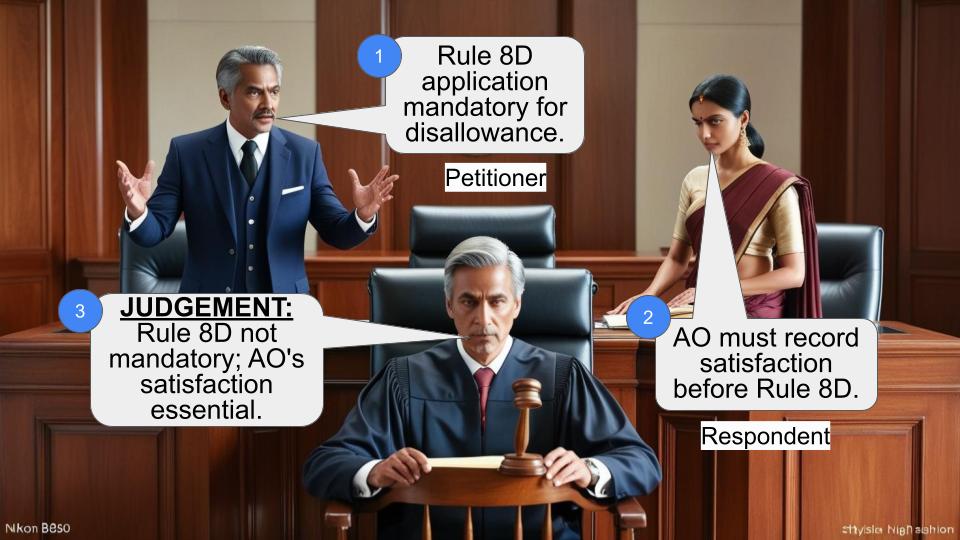
This case involves appeals by the Revenue (Income Tax Department) against Jagson International Limited for Assessment Years 2009-10 and 2010-11. The main issues were whether a drilling rig qualifies as a ship under Section 115VD (of Income Tax Act, 1961) and the application of Rule 8D (of Income Tax Rules, 1962) for disallowance under Section 14A (of Income Tax Act, 1961). The court dismissed the appeals, emphasizing that Rule 8D (of Income Tax Rules, 1962) is not mandatory and requires the Assessing Officer to record satisfaction before application.
Get the full picture - access the original judgement of the court order here
Case Name:
Principal Commissioner of Income Tax vs Jagson International Ltd. (High Court of Delhi)
Income Tax Appeal No.1234 of 2018 and 1179 of 2018
Date: 2nd November 2018
Key Takeaways:
1. Rule 8D (of Income Tax Rules, 1962) is not mandatory for computing disallowance under Section 14A (of Income Tax Act, 1961).
2. Assessing Officers must record their satisfaction regarding the assessee's accounts before invoking Rule 8D (of Income Tax Rules, 1962).
3. The Supreme Court's decision in Godrej Boyce Manufacturing Company Limited vs Deputy Commissioner of Income Tax Mumbai & Anr. (2017) is crucial in interpreting Section 14A (of Income Tax Act, 1961) and Rule 8D (of Income Tax Rules, 1962).
Issue:
1. Whether a drilling rig qualifies as a ship under Section 115VD (of Income Tax Act, 1961)?
2. Is the application of Rule 8D (of Income Tax Rules, 1962) mandatory for computing disallowance under Section 14A (of Income Tax Act, 1961)?
Facts:
1. Jagson International Limited is the respondent-assessee in this case.
2. The case relates to Assessment Years 2009-10 and 2010-11.
3. The Assessing Officer made disallowances of Rs.15,12,468/- and Rs. 13,83,209/- for the two years under Section 14A (of Income Tax Act, 1961) by applying Rule 8D (of Income Tax Rules, 1962).
4. The assessee had earned exempt income of Rs.2,94,299/- as dividend income and had disallowed Rs.10,520/- under Section 14A (of Income Tax Act, 1961) for the Assessment Year 2009-10.
Arguments:
The Revenue argued that:
1. A drilling rig should be considered a qualifying ship under Section 115VD (of Income Tax Act, 1961).
2. Rule 8D (of Income Tax Rules, 1962) should be applied mandatorily for computing disallowance under Section 14A (of Income Tax Act, 1961).
The assessee likely argued against these points, though specific arguments aren't detailed in the provided text.
Key Legal Precedents:
1. Godrej Boyce Manufacturing Company Limited vs Deputy Commissioner of Income Tax Mumbai & Anr., (2017) 7 SCC 421: This Supreme Court decision clarified that Rule 8D (of Income Tax Rules, 1962) is not mandatory and requires the Assessing Officer to record satisfaction before application.
2. The Commissioner of Income Tax, New Delhi versus Jagson International Limited (ITA 1395/2010): This Delhi High Court decision, dated 8th November 2012, covered the issue of whether a drilling rig is a qualifying ship under Section 115VD (of Income Tax Act, 1961).
Judgement:
1. On the first issue (drilling rig as a qualifying ship), the court noted that an appeal is pending before the Supreme Court. The parties agreed that the Supreme Court's ruling would apply to this case as well.
2. On the second issue (application of Rule 8D (of Income Tax Rules, 1962)), the court held that:
a. The Assessing Officer's reasoning cannot be sustained.
b. Rule 8D (of Income Tax Rules, 1962) is not mandatory and is in the nature of best judgment determination.
c. The Assessing Officer must record satisfaction that it's not possible to determine the correctness of the assessee's claim based on their accounts before invoking Rule 8D (of Income Tax Rules, 1962).
d. This statutory mandate was not satisfied in the present case.
The court dismissed the appeals without issuing notice on the second aspect.
FAQs:
1. Q: Is Rule 8D (of Income Tax Rules, 1962) mandatory for computing disallowance under Section 14A (of Income Tax Act, 1961)?
A: No, Rule 8D (of Income Tax Rules, 1962) is not mandatory. It can only be applied after the Assessing Officer records satisfaction that the assessee's accounts don't allow for accurate determination of disallowance.
2. Q: What is the "jurisdictional requirement" for invoking Rule 8D (of Income Tax Rules, 1962)?
A: The Assessing Officer must record satisfaction that, based on the assessee's accounts, it's not possible to determine the correctness of the assessee's claim regarding disallowance under Section 14A (of Income Tax Act, 1961).
3. Q: How did the Supreme Court's Godrej Boyce decision impact this case?
A: The Godrej Boyce decision clarified that Rule 8D (of Income Tax Rules, 1962) is a best judgment determination and not mandatory, which was a key factor in the court's reasoning in this case.
4. Q: What happens to the issue of whether a drilling rig qualifies as a ship under Section 115VD (of Income Tax Act, 1961)?
A: This issue is pending before the Supreme Court. The parties agreed that the Supreme Court's eventual ruling would apply to this case as well.
5. Q: Why did the court dismiss the Revenue's appeals?
A: The court found that the Assessing Officer had not satisfied the statutory mandate of recording satisfaction before applying Rule 8D (of Income Tax Rules, 1962), making the disallowance under Section 14A (of Income Tax Act, 1961) unjustified.

CM No. 46156/2018 in ITA No. 1234/2018
CM No. 45400/2018 in ITA No. 1179/2018
Exemption allowed subject to all just exceptions. INCOME TAX APPEAL Nos. 1234/2018 and 1179/2018
These appeals by the Revenue under Section 260A (of Income Tax Act, 1961) in the case of Jagson International Limited relate to the Assessment Years 2009-10 and 2010-11 and arise from the common order of the Tribunal dated 11th May, 2018.
2. The first issue raised by the Revenue; is whether a drilling rig is a qualifying ship within the meaning of Section 115VD (of Income Tax Act, 1961). This issue is covered against the Revenue by decision of the Delhi High Court dated 8th November, 2012 in ITA 1395/2010, The Commissioner of Income Tax, New Delhi versus Jagson International Limited.
3. Appeal against the said decision is pending before the Supreme Court as Special Leave Petition has been admitted on leave being granted. Counsel for the parties submit that ruling of the Supreme Court would equally apply to the present appeal. We take the statement on record. The first issue would be treated as disposed of in terms of the said statement. In case of any difficulty, it will be open to the parties to file an application in this appeal after the decision of the Supreme Court.
4. The above order in respect of the first issue would be in consonance with and in terms of the earlier order dated 26th October, 2018 passed in ITA No.1165/2018 in the case of the respondent-assessee. This order in fact follows the earlier orders of this court passed in several other ITAs.
5. The second issue in these appeals relates to disallowance of Rs. 15,12,468/- and Rs.13,83,209/- made by the Assessing Officer in the two years under Section 14A (of Income Tax Act, 1961) by applying Rule 8D (of Income Tax Rules, 1962). Reading of the Assessment Order for the Assessment Year 2009-10 would show that Rule 8D (of Income Tax Rules, 1962) was invoked as if the Rule is mandatory. Assessment Order for the Assessment Year 2009-10 records that the assessee had earned exempt income of Rs. 2,94,299/- in the form of dividend income and had disallowed an amount of Rs.10,520/- under Section 14A (of Income Tax Act, 1961). The Assessing Officer did not examine the issue/question whether the disallowance made by the respondent-assessee was justified or not. In the Assessment Order for the Assessment Year, 2010-11, again there is hardly or no discussion on the said aspect except reference to Rule 8D (of Income Tax Rules, 1962), as if the Rule is compulsory and mandatory for computing disallowance under Section 14A (of Income Tax Act, 1961).
6. The aforesaid reasoning of the assessing officer cannot be sustained as the Supreme Court in Godrej Boyce Manufacturing Company Limited versus Deputy Commissioner of Income Tax Mumbai & Anr., (2017) 7 SCC 421 after referring to Section 14A (of Income Tax Act, 1961) has held that Rule 8D (of Income Tax Rules, 1962) is in the nature of best judgment determination as it prescribes a formula for determination of the expenditure incurred in relation to income that does not form part of the total income under the Act, in a situation where the assessing officer is not satisfied with the claim of the assessee. The jurisdictional requirement for invoking Rule 8D (of Income Tax Rules, 1962) is recording of satisfaction by the assessing officer that having regard to the accounts of the assessee placed before him, it is not possible to generate requisite satisfaction with regard to the correctness of the claim of the assessee. It is only then that the provisions of Sub-section 2 (of Income Tax Act, 1961) and 3 (of Income Tax Act, 1961) to Section 14A (of Income Tax Act, 1961) read with Rule 8D (of Income Tax Rules, 1962) or best judgment determination can be applied. This statutory mandate is not satisfied in the present case.
7. In the aforesaid circumstances, we are not inclined to issue notice in the present appeals on the second aspect. The appeals are accordingly disposed of, without any order as to costs.
SANJIV KHANNA, J.
ANUP JAIRAM BHAMBHANI, J.
NOVEMBER 02, 2018
×