


Full News
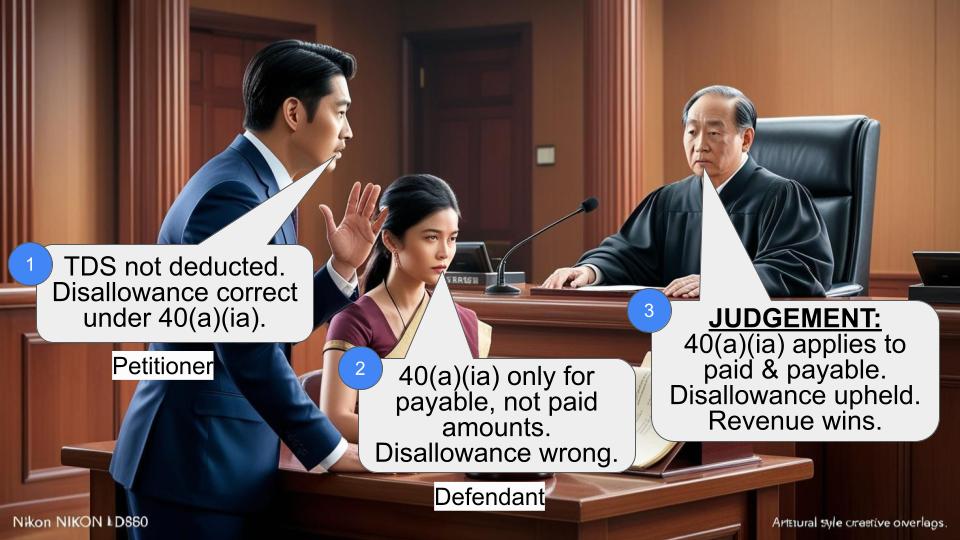
Section 40(a)(ia) (of Income Tax Act, 1961) applies to both payable and paid amounts, upholds tax disallowance
Section 40(a)(ia) (of Income Tax Act, 1961) applies to both payable and paid amounts, upholds tax disallowance
This case involves a dispute between the Principal Commissioner of Income Tax and Manzoor Ahmed Walvir regarding the interpretation of Section 40(a)(ia) (of Income Tax Act, 1961). The main issue was whether this section applies only to amounts payable or also to amounts already paid. The Supreme Court ruled in favor of the Revenue, concluding that the section covers both scenarios, thus upholding the tax disallowance of Rs.6,04,40,918/- made by the Assessing Officer.
Get the full picture - access the original judgement of the court order here
Case Name:
Principal Commissioner of Income Tax Vs Manzoor Ahmed Walvir (High Court of Jammu & Kashmir)
ITA No. 03/2016
Date: 27th July 2017
Key Takeaways:
1. Section 40(a)(ia) (of Income Tax Act, 1961) applies to both amounts payable and amounts already paid.
2. The Supreme Court's decision resolves conflicting interpretations by various High Courts.
3. This ruling has significant implications for tax deductions and compliance with TDS (Tax Deducted at Source) requirements.
Issue:
The central legal question in this case was: "Whether section 40(a)(ia) (of Income Tax Act, 1961) is applicable only on the amount payable and not on the amount actually paid?"
Facts:
1. The assessee (Manzoor Ahmed Walvir) made payments for dyeing, printing, embroidery, finishing, and bleaching charges.
2. The assessee claimed deductions of Rs.6,04,40,918/- for these payments.
3. The Assessing Officer disallowed the entire amount due to the assessee's failure to deduct TDS as required by Section 194C (of Income Tax Act, 1961).
4. The case went through various stages of appeal, including the Commissioner of Income Tax (Appeals) and the Income Tax Appellate Tribunal.
5. The matter eventually reached the High Court and then the Supreme Court for final interpretation.
Arguments:
Assessee's argument:
- Section 40(a)(ia) (of Income Tax Act, 1961) should only apply to amounts payable at the end of the year, not to amounts already paid during the year.
Revenue's argument:
- Section 40(a)(ia) (of Income Tax Act, 1961) should apply to both amounts payable and amounts already paid, as the purpose is to ensure compliance with TDS requirements.
Key Legal Precedents:
The main precedent cited in this case is:
Palam Gas Services v. Commissioner of Income Tax 394ITR 300 (SC)
- This Supreme Court decision addressed the same issue of interpreting Section 40(a)(ia) (of Income Tax Act, 1961).
- It concluded that the section covers both payable and paid amounts.
Judgement:
1. The Supreme Court ruled in favor of the Revenue.
2. It concluded that Section 40(a)(ia) (of Income Tax Act, 1961) covers both cases where amounts were payable and where they were already paid.
3. The court upheld the Assessing Officer's original disallowance of Rs. 6,04,40,918/-.
4. The High Court's impugned judgment was set aside to the extent it disagreed with this interpretation.
FAQs:
1. Q: What does this judgment mean for taxpayers?
A: Taxpayers need to ensure they deduct TDS on all applicable payments, whether pending or already made, to avoid disallowance under Section 40(a)(ia) (of Income Tax Act, 1961).
2. Q: How does this affect past assessments?
A: This judgment may have implications for past assessments where similar issues were involved. Taxpayers might need to review their past filings and consult with tax professionals.
3. Q: Why is this ruling significant?
A: It resolves conflicting interpretations by various High Courts and provides clarity on the application of Section 40(a)(ia) (of Income Tax Act, 1961), ensuring uniform implementation across India.
4. Q: Does this ruling apply to all types of payments under the Income Tax Act?
A: While the case specifically dealt with payments under Section 194C (of Income Tax Act, 1961), the principle may apply to other sections where TDS is required. It's advisable to consult a tax professional for specific scenarios.
5. Q: Can the assessee appeal this decision further?
A: As this is a Supreme Court decision, it is final and binding. There's no further appeal process available in the regular court system.

1. This is an appeal under section 260A (of Income Tax Act, 1961) filed on behalf of the Revenue being aggrieved by the Income Tax Appellate Tribunal’s order dated 25.02.2016 in ITA No. 417(Asr)/2012. That appeal was, in turn, directed against the order of the Commissioner of Income Tax (Appeals) order dated 31.08.2012 which arose out of the assessment order dated 28.11.2011 in respect of the assessment year 2009-10.
2. First of all, after hearing counsel for the parties, we feel that the question framed in the order dated 21.09.2016 needs to be re-framed as under:
“Whether section 40(a)(ia) (of Income Tax Act, 1961) is applicable only on the amount payable and not on the amount actually paid.?”
3. The brief facts are that the respondent-assessee made payments in respect of dyeing, printing, embroidery, finishing and bleaching charges. Deductions were claimed in respect thereof to the extent of Rs. 6,04,40,918/-. The Assessing Officer disallowed the said payment on account of default on the part of the assessee in not deducting TDS (Tax Deducted at Source) in terms of Section 194C of the Income Tax Act, 1961. Being aggrieved by the disallowance, the assessee filed an appeal before the Commissioner of Income Tax ( Appeals) which, as mentioned above was decided on 31.08.2012. The Commissioner of Income Tax ( Appeals) reduced the disallowance to Rs. 1,87,87,703/- on the ground that the said amount was found to be payable at the end of the year and the rest of the amount out of Rs. 6,04,40,918/- had been paid during the year and that was eligible.
4. One important point that needs to be noted at this juncture is that before the Commissioner of Income Tax (Appeals) ground No.1 related to disallowance of the said amount of Rs. 6,04,40,918/-. While addressing arguments on this ground, the representative of the assessee conceded before the Commissioner of Income Tax (Appeals) that the expenses, which were made for contractual payments, were covered under section 194C (of Income Tax Act, 1961). Consequently, the Commissioner of Income Tax ( Appeals) did not find it necessary to enter upon any discussion as to whether Section 194C of the Income Tax Act, 1961 applied or did not apply. In other words, the assessee having conceded that Section 194C (of Income Tax Act, 1961) was applicable, the Commissioner of Income Tax (Appeals) proceeded on that basis. So did the Income Tax Tribunal.
5. The assessee was aggrieved by the partial allowance and the revenue was aggrieved by the partial disallowance by the CIT(A). Consequently, both filed appeals before the Income Tax Appellate Tribunal, Amritsar Bench, Amritsar being ITA NO. 358(Asr)/2012 and ITA No. 417(Asr)/2012, respectively. By an order dated 31.5.2013 the Income Tax Appellate Tribunal allowed the revenue appeal and partly allowed assessee’s appeal for statistical purposes. The result of the tribunal’s order was that the disallowance of Rs. 6,04,40,918/- which was made by the Assessing Officer under section 40(a)(ia) (of Income Tax Act, 1961) was restored.
6. It may be pertinent to note that in the order dated 31.5.2013 the Tribunal had clearly recorded the admission by the assessee, in para 11 of the said order, that such payments, which were the bone of contention, were covered under Section 194-C (of Income Tax Act, 1961) of the said Act and that in view of this, the provisions of Section 40(a)(ia) (of Income Tax Act, 1961) were clearly applicable in the case of the assessee and that the contention of the assessee that these payments were out of the purview of Section 40(a) (of Income Tax Act, 1961) (ia ) of the said Act was not tenable.
7. Being aggrieved by the decision of the Income Tax Appellate Tribunal dated 31.5.2013 the assessee filed an appeal being ITA no. 06/2013 before this court. In that appeal, on 18.12.2014, this court framed the following substantial question of law;
“Whether Section 40(a)(ia) (of Income Tax Act, 1961) is applicable only on the amount payable and not on the amount actually paid?
No other question had been framed and the assessee did not request for framing of any other question either before this court or before the Supreme Court.
8. During the pendency of the appeal, the assessee filed an application under section 254(2) of the Income Tax Act, 1961 seeking rectification of the order dated 31.5.2013 and that application was numbered as Miscellaneous application no. 57 (Asr)/2013. By an order dated 16.09.2015 the said Misc. application was allowed and the order dated 31.5.2013 was recalled to the extent of rectification sought.
9. The matter, thereafter, was once again argued on merits before the Tribunal. After considering the rival contentions, the Income Tax Appellate Tribunal, by virtue of the impugned order dated 25.2.2016, upheld the decision of the Commissioner of Income Tax ( Appeals) and agreed with him that the disallowance to the extent of Rs. 4,16,53,215/- had to be deleted. The plea of the revenue was rejected and the order under appeal was confirmed.
10. No appeal has been filed by the Assessee against the order dated 25.2.2016. However, the revenue has filed the present appeal being ITA No. 03/2016 in which we have already re- framed the question.
11. We need not labour on the merits of the matter inasmuch as, the same had been the subject matter of controversy in various High Court decisions which has now been resolved by the Supreme Court in its recent decision in the case of Palam Gas Services v. Commissioner of Income Tax 394ITR 300 (SC). In the said decision also, section 40(a) (ia) of the Income Tax Act, 1961 was the subject matter of interpretation. The question that the Supreme Court was considering as is reflected in the said decision was as under:
“Whether the provisions of Section 40(a)(ia) (of Income Tax Act, 1961) shall be attracted when the amount is not „payable‟ to a contractor or sub-contractor but has been actually paid?
This clearly demonstrates the identity between the issue in the present appeal and that which was before the Supremen Court.
12. After referring to various decisions of High Courts, the Supreme Court concluded that Section 40(a)(ia) (of Income Tax Act, 1961) covered not only those cases where the amounts were payable but also those where it was paid. Accordingly, the question framed is decided in favour of the Revenue and against the Assessee in terms of the Supreme Court decision. Consequently the present appeal is allowed, the result whereof shall be that the view taken by the Assessing Officer of disallowance of Rs. 6,04,40,918/- is upheld.
13. The Impugned judgment to the aforesaid extent, is set aside and accordingly the view taken by the Assessing Officer is restored.
(Ali Mohammad Magrey) (Badar Durrez Ahmed) Judge Chief Justice
Srinagar
27.07.2017
Mujtaba Secy
×
Similar Ripples
Questions
Section 40(a)(ia) (of Income Tax Act, 1961) applies to both payable and paid amounts, upholds tax disallowance
Write your CommentSimilar Posts


Generic
- Reportdata/2080_ZWqV274.pdf
