Standalone Statements Insufficient for Tax Assessments


Full News

Standalone Statements Insufficient for Tax Assessments
Standalone Statements Insufficient for Tax Assessments
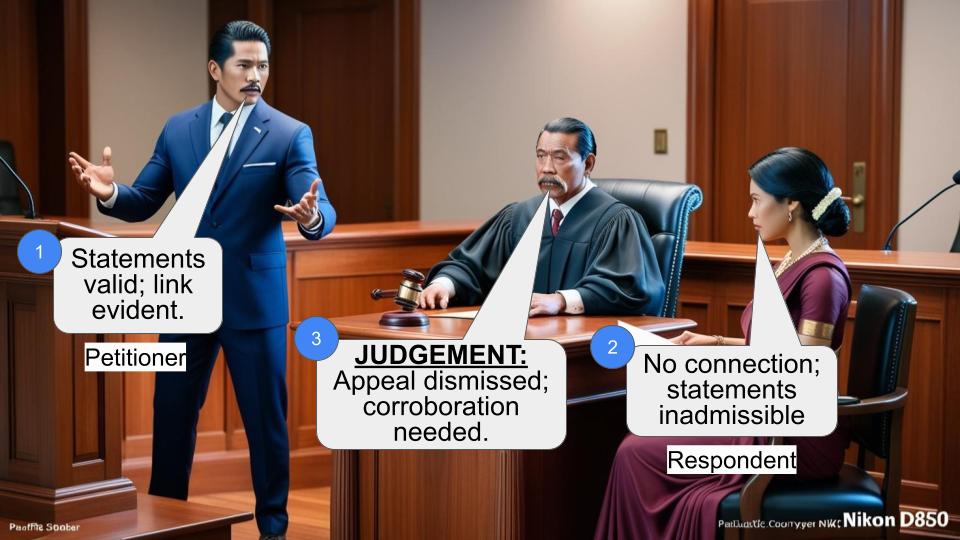
The case involves the Principal Commissioner of Income Tax (Central) and others versus Anand Kumar Jain (HUF) and others. The central issue was whether a statement recorded under Section 132(4) (of Income Tax Act, 1961), without any corroborating material, could justify an assessment under Section 153A (of Income Tax Act, 1961). The court ruled that such a statement alone is not enough to sustain an assessment.
Get the full picture - access the original judgement of the court order here
Case Name:
Principal Commissioner of Income Tax (Central) & Ors. vs. Anand Kumar Jain (HUF) & Ors. (High Court of Delhi)
ITA 23/2021 & CM APPL. 5385/2021 (Condonation of Delay)
Date: 12th February 2021
Key Takeaways:
- A statement under Section 132(4) (of Income Tax Act, 1961) cannot be the sole basis for an assessment under Section 153A (of Income Tax Act, 1961).
- The court emphasized the need for incriminating material found during a search to justify additions in assessments.
- The decision reinforces the legal requirement for corroborative evidence in tax assessments following a search.
Issue
Can a statement recorded under Section 132(4) (of Income Tax Act, 1961), without any other incriminating material, justify an assessment under Section 153A (of Income Tax Act, 1961)?
Facts
- The Assessee, Anand Kumar Jain (HUF), was involved in a transaction where shares of a private company were purchased, merged, and later sold for a profit claimed as exempt income.
- A search was conducted on November 18, 2015, at the premises of the Assessee and Pradeep Kumar Jindal, where Jindal admitted to providing accommodation entries.
- The assessment was framed under Section 153A (of Income Tax Act, 1961) based on Jindal’s statement, but no incriminating material was found at the Assessee’s premises.
Arguments
- Revenue’s Argument: The statement of Pradeep Kumar Jindal was incriminating and justified the assessment under Section 153A (of Income Tax Act, 1961). They argued that the Assessee was given a copy of the statement and had the opportunity to rebut it.
- Assessee’s Argument: The Assessee contended that no incriminating material was found during the search, and the statement alone could not justify the assessment. They also argued that they were not given the opportunity to cross-examine Jindal.
Key Legal Precedents
- CIT v. Kabul Chawla: Established that incriminating material is necessary for additions in assessments post-search.
- Principal Commissioner of Income Tax, Delhi v. Best Infrastructure (India) P. Ltd.: Statements under Section 132(4) (of Income Tax Act, 1961) do not constitute incriminating material by themselves.
- Commissioner of Income Tax v. Harjeev Aggarwal: Statements recorded during search need to be corroborated with other evidence to justify assessments.
Judgement
The court dismissed the Revenue’s appeal, holding that the statement under Section 132(4) (of Income Tax Act, 1961) alone, without corroborating material, cannot justify an assessment under Section 153A (of Income Tax Act, 1961). The ITAT’s decision to set aside the assessment was upheld.
FAQs
Q1: What does this decision mean for future tax assessments?
A1: It emphasizes the need for corroborative evidence in addition to statements recorded during searches to justify assessments under Section 153A (of Income Tax Act, 1961).
Q2: Why was the Assessee’s appeal successful?
A2: The court found that the assessment was based solely on a statement without any incriminating material, which is insufficient under the law.
Q3: Can a statement under Section 132(4) (of Income Tax Act, 1961) ever be used in assessments?
A3: Yes, but only if it is supported by other incriminating evidence found during the search.

1. The present appeals under Section 260A (of Income Tax Act, 1961) [hereinafter referred to as the ‘Act’] are directed against the common order dated 30th July, 2019 [hereinafter referred to as the ‘impugned order’] passed by the Income Tax Appellate Tribunal [hereinafter referred to as the ‘ITAT’] in ITA 5947/Del./2018, ITA No. 4723/Del./2018, ITA No. 5954/Del./2018, ITA No. 5950/Del./2018, ITA No. 5948/Del./2018, ITA No. 5947/Del./2018 and ITA No. 5955/Del./2018.
2. Briefly, the facts of the case are that the Assessee purchased shares of an unlisted private company in 2010. This unlisted company then merged with another unlisted company, M/s Focus Industrial Resources Ltd. and shares of this merged entity were allotted to the Assessee. Subsequently, the merged entity allotted further bonus shares to the Assessee and thereafter it was listed on the Bombay Stock Exchange. Assessee sold these shares on the stock exchange in 2014 and earned a huge profit which was claimed as exempt income on account of being long term capital gain.
3. A search was conducted u/s. 132 (of Income Tax Act, 1961) on 18th November, 2015 at the premises of the Assessee {being Anand Kumar Jain (HUF), its coparceners and relatives} as well as at the premises of one Pradeep Kumar Jindal. During the search, statement of Pradeep Kumar Jindal was recorded on oath u/s. 132(4) (of Income Tax Act, 1961) on the same date, wherein he admitted to providing accommodation entries to Anand Kumar Jain (HUF) and his family members through their Chartered Accountant. The assessing officer framed the assessment order detailing the modus operandi as to how the cash is provided to accommodation entry operator in lieu of allotment of shares of a private company. Thereafter when the matter was carried up in appeal before the CIT(A), the findings of AO were affirmed. However, in further appeal before the ITAT, the said findings were set aside vide the impugned order.
4. The Revenue is aggrieved with the aforesaid impugned order and has filed the present appeal under Section 260A (of Income Tax Act, 1961), proposing the following questions of law:
a. Whether the ITAT is justified in deleting the additions made on account of bogus long term capital gain on the ground that the evidences found during search at the premises of entry provider cannot be the basis for making additions in assessment completed u/S. 153A (of Income Tax Act, 1961) in the case of beneficiary ignoring the vital fact that there was a common search u/s 132 (of Income Tax Act, 1961) conducted on the same day in both the cases of the entry provider and the beneficiary?
b. Whether ITAT was justified in holding that mere failure of cross examination of entry operator is fatal when copy of statement was provided to the Assessee and Assessee failed to discharge the onus of providing the genuineness of LTCG especially in view of the apex court decision in the case of State of UP vs. Sudhir Kumar Singh [AIR 2020 SC 5215]?
5. Mr. Ajit Sharma, Sr. Standing Counsel submits that the ITAT has erred by holding that the Assessee’s premises were not searched, and therefore notice under Section 153A (of Income Tax Act, 1961) could not have been issued. He submits that ITAT ignored that the assessment order itself reveals that a common search was conducted at various places on 18th November, 2015, including at the premises of the entry provider and the Assessee and thus assessment u/s 153A (of Income Tax Act, 1961) has been rightly carried out. He further argues that ITAT erred in setting aside the assessment order on the ground that no right of crossexamining Pradeep Jindal was afforded to the Assessee. He argues that there is no statutory right to cross-examine a person whose statement is relied upon by AO, so long as the Assessee is provided with the statement and given an opportunity to rebut the statement of the witness. The Assessee has been provided with a copy of the statement of Pradeep Kumar Jindal and the ITAT has wrongly noted to the contrary. Furthermore, the Assessee has failed to bring in any evidence to dispute the factual position emerging therefrom and has therefore failed to establish any prejudice on account of not getting the opportunity to cross-examine the witness. In view of the statement of Mr. Jindal, it was incumbent upon the Assessee to discharge the onus of proof which had been shifted on him. The revenue has sufficient material in hand in the nature of the statements recorded during the search and therefore, the Assessee ought to have produced evidence to negate or to contradict the evidence collected by the AO during the course of the search and assessment proceeding which followed thereafter. Mr. Sharma also emphasised that the statement recorded under Section 132(4) (of Income Tax Act, 1961) can be relied upon for any purpose in terms of the language of the Act and thus action under section 153A (of Income Tax Act, 1961) was justified.
6. We have considered the contentions of Mr. Sharma, however, we feel that the instant appeals do not raise any question of law, much less substantial question of law for our consideration. The relevant portion of the impugned order reads as under:-
“5. (…) We find that the Ld. Counsel for the assessee has drawn our attention towards the relevant portion of the judgment / decision of the Hon'ble Supreme Court of India, Hon'ble High Courts and various Benches of the Tribunal on the legal issue on which he argued, Ld. Counsel for the assessee further submitted that admittedly from assessee's own premises during search u/s. 132 (of Income Tax Act, 1961) no incriminating material was found and no adverse statement is there on record of the assessee u/s. 132(4) (of Income Tax Act, 1961) and it is an admitted fact before us that mere basis of un-confronted statement of Sh. Pradeep Kumar Jindal recorded u/s. 132(4) (of Income Tax Act, 1961) in his own separate search action and on the basis of unconfronted material for the said search u/s. 132(4) (of Income Tax Act, 1961), which in our considered opinion, cannot be made as a sole basis for making the additions u/s. 153A (of Income Tax Act, 1961) without recourse of mandatory and exclusive provisions under the Act like u/s 153C (of Income Tax Act, 1961) which specifically covered the extant situation. In our opinion, the decision of the Hon'ble Supreme Court of India, Hon'ble High Courts and the various Benches of the Tribunal are directly applicable in the present case wherein they have adjudicated and decided the similar issue in favour of the assessee by accepting the similar arguments of the Ld. Counsel for the assessee.
5.1. As regards the arguments advanced by Ld. CIT(DR) are concerned, the same are not applicable in the present case because keeping in view the assessment order passed by the AO we have not seen from the proceedings of the AO regarding providing any statement of Sh. Pradeep Kumar Jindal to the assessee meaning thereby the Revenue Authorities have not provided the statement of Sh. Pradeep Kumar Jindal to the assessee and also did not provide the opportunity of cross examination of Sh. Pradeep Kumar Jindal, on which basis the addition has been made and the provisions of Section 153A (of Income Tax Act, 1961) have been wrongly applied in the case of the assessee. Therefore, we do not find any cogency in the arguments advanced by the Ld. CIT(DR) and the case laws cited by him in support of his contention are not applicable here.”
7. The preliminary question under consideration before us is whether a statement under Section 132(4) (of Income Tax Act, 1961) constitutes incriminating material for carrying out assessment under S. 153(A) of the Act. A reading of the impugned order reveals that the statement of Mr. Jindal recorded under Section 132(4) (of Income Tax Act, 1961) forms the foundation of the assessment carried out under Section 153A (of Income Tax Act, 1961). That statement alone cannot justify the additions made by the AO. Even if we accept the argument of the Revenue that the failure to cross-examine the witness did not prejudice the assessee, yet, we discern from the record that apart from the statement of Mr. Jindal, Revenue has failed to produce any corroborative material to justify the additions. On the contrary we also note that during the course of the search, in the statement made by the assessee, he denied having known Mr. Jindal. Since there was insufficient material to support the additions, the ITAT deleted the same. This finding of fact, based on evidence calls for no interference, as we cannot re-appreciate evidence while exercising jurisdiction under section 260A (of Income Tax Act, 1961).
8. Next, we find that, the assessment has been framed under section 153A (of Income Tax Act, 1961), consequent to the search action. The scope and ambit of section 153A (of Income Tax Act, 1961) is well defined. This court, in CIT v. Kabul Chawla,1 concerning the scope of assessment under Section 153A (of Income Tax Act, 1961), has laid out and summarized the legal position after taking into account the earlier decisions of this court as well as the decisions of other High Courts and Tribunals. In the said case, it was held that the existence of incriminating material found during the course of the search is a sine qua non for making additions pursuant to a search and seizure operation. In the event no incriminating material is found during search, no addition could be made in respect of the assessments that had become final. Revenue’s case is hinged on the statement of Mr. Jindal, which according to them is the incriminating material discovered during the search action. This statement certainly has the evidentiary value and relevance as contemplated under the explanation to section 132(4) (of Income Tax Act, 1961). However, this statement cannot, on a standalone basis, without reference to any other material discovered during search and seizure operations, empower the AO to frame the block assessment. This court in Principal Commissioner of Income Tax, Delhi v. Best Infrastructure (India) P. Ltd.,
2
has inter-alia held that:
“38. Fifthly, statements recorded under Section 132(4) (of Income Tax Act, 1961) do not by themselves constitute incriminating material as has been explained by this Court in Harjeev Aggarwal.
9. In Commissioner of Income Tax v. Harjeev Aggarwal,4 this Court had held as follows:
“23. In view of the settled legal position, the first and foremost issue to be addressed is whether a statement recorded under Section 132(4) (of Income Tax Act, 1961) would by itself be sufficient to assess the income, as disclosed by the Assessee in its statement, under the Provisions of Chapter XIV-B of the Act.
24. In our view, a plain reading of Section 158BB(1) (of Income Tax Act, 1961) does not contemplate computing of undisclosed income solely on the basis of a statement recorded during the search. The words “evidence found as a result of search” would not take within its sweep statements recorded during search and seizure operations.
However, the statements recorded would certainly constitute information and if such information is relatable to the evidence or material found during search, the same could certainly be used in evidence in any proceedings under the Act as expressly mandated by virtue of the explanation to Section 132(4) (of Income Tax Act, 1961). However, such statements on a standalone basis without reference to any other material discovered during search and seizure operations would not empower the AO to make a block assessment merely because any admission was made by the Assessee during search operation.
25. (…) However, as stated earlier, a statement on oath can only be recorded of a person who is found in possession of books of accounts, documents, assets, etc. Plainly, the intention of the Parliament is to permit such examination only where the books of accounts, documents and assets possessed by a person are relevant for the purposes of the investigation being undertaken. Now, if the provisions of Section 132(4) (of Income Tax Act, 1961) are read in the context of Section 158BB(1) (of Income Tax Act, 1961) read with Section 158B(b) (of Income Tax Act, 1961), it is at once clear that a statement recorded under Section 132(4) (of Income Tax Act, 1961) can be used in evidence for making a block assessment only if the said statement is made in the context of other evidence or material discovered during the search. A statement of a person, which is not relatable to any incriminating document or material found during search and seizure operation cannot, by itself, trigger a block assessment. The undisclosed income of an Assessee has to be computed on the basis of evidence and material found during search. The statement recorded under Section 132(4) (of Income Tax Act, 1961) may also be used for making the assessment, but only to the extent it is relatable to the incriminating evidence/material unearthed or found during search. In other words, there must be a nexus between the statement recorded and the evidence/material found during search in order to for an assessment to be based on the statement recorded.
26. In CIT v. Sri Ramdas Motor Transport Ltd., (1999) 238 ITR 177 (AP), a Division Bench of Andhra Pradesh High Court, reading the provision of Section 132(4) (of Income Tax Act, 1961) in the context of discovering undisclosed income, explained that in cases where no unaccounted documents or incriminating material is found, the powers under Section 132(4) (of Income Tax Act, 1961) cannot be invoked. (…)
27. It is also necessary to mention that the aforesaid interpretation of Section 132(4) (of Income Tax Act, 1961) must be read with the explanation to Section 132(4) (of Income Tax Act, 1961) which expressly provides that the scope of examination under Section 132(4) (of Income Tax Act, 1961) is not limited only to the books of accounts or other assets or material found during the search. However, in the context of Section 158BB(1) (of Income Tax Act, 1961) which expressly restricts the computation of undisclosed income to the evidence found during search, the statement recorded under Section 132(4) (of Income Tax Act, 1961) can form a basis for a block assessment only if such statement relates to any incriminating evidence of undisclosed income unearthed during search and cannot be the sole basis for making a block assessment.
28. If the Revenue's contention that the block assessment can be framed only on the basis of a statement recorded under Section 132(4) (of Income Tax Act, 1961) is accepted, it would result in ignoring an important check on the power of the AO and would expose assessees to arbitrary assessments based only on the statements, which we are conscious are sometimes extracted by exerting undue influence or by coercion. Sometimes statements are recorded by officers in circumstances which can most charitably be described as oppressive and in most such cases, are subsequently retracted. Therefore, it is necessary to ensure that such statements, which are retracted subsequently, do not form the sole basis for computing undisclosed income of an assessee.
29. In Commissioner of Income Tax v. Naresh Kumar Aggarwal: (2014) 3699 ITR 171 (T & AP), a Division Bench of Telangana and Andhra Pradesh High Court held that a statement recorded under Section 132(4) (of Income Tax Act, 1961) which is retracted cannot constitute a basis for an order under Section 158BC (of Income Tax Act, 1961). (…)”
10. Now, coming to the aspect viz the invocation of section 153A (of Income Tax Act, 1961) on the basis of the statement recorded in search action against a third person. We may note that the AO has used this statement on oath recorded in the course of search conducted in the case of a third party (i.e., search of Pradeep Kumar Jindal) for making the additions in the hands of the assessee. As per the mandate of Section 153C (of Income Tax Act, 1961), if this statement was to be construed as an incriminating material belonging to or pertaining to a person other than person searched (as referred to in Section 153A (of Income Tax Act, 1961)), then the only legal recourse available to the department was to proceed in terms of Section 153C (of Income Tax Act, 1961) by handing over the same to the AO who has jurisdiction over such person. Here, the assessment has been framed under section 153A (of Income Tax Act, 1961) on the basis of alleged incriminating material (being the statement recorded under 132(4) of the Act). As noted above, the Assessee had no opportunity to cross-examine the said witness, but that apart, the mandatory procedure under section 153C (of Income Tax Act, 1961) has not been followed. On this count alone, we find no perversity in the view taken by the ITAT. Therefore, we do not find any substantial question of law that requires our consideration.
11. Accordingly, the present appeals, along with all pending applications, are dismissed
×