


Stay of Tax Recovery Granted Pending Appeal


Full News

Stay of Tax Recovery Granted Pending Appeal
Stay of Tax Recovery Granted Pending Appeal
The case involves the Kalapet Primary Agricultural Co-op. Credit Society Ltd. challenging a tax assessment by the Income Tax Officer, Pondicherry. The society sought a stay on the recovery of the disputed tax demand while their appeal was pending. The court ruled in favor of the society, granting a stay on the recovery proceedings until the appeal is resolved.
Get the full picture - access the original judgement of the court order here
Case Name:
Kalapet Primary Agricultural Co-op. Credit Society Ltd. vs. Income Tax Officer (High Court of Madras)
W.P.No.15959 of 2015
Date: 5th June 2015
Key Takeaways:
- The court emphasized the importance of staying recovery proceedings when an appeal is pending, especially if the issue has been previously decided in favor of the assessee by a higher authority.
- The decision reinforces the guidelines set by the Central Board of Direct Taxes (CBDT) regarding the stay of demand.
- The judgment highlights the duty of assessing authorities to adhere to established guidelines and instructions when handling stay petitions.
Issue
Should the recovery of the disputed tax demand be stayed while the appeal is pending, given that the issue has been previously decided in favor of the assessee by a higher authority?
Facts
- The Kalapet Primary Agricultural Co-op. Credit Society Ltd. filed a return claiming deductions under Section 80P (of Income Tax Act, 1961) for the assessment year 2009-10.
- The Income Tax Officer rejected the claim, leading to a disputed tax demand.
- The society appealed the decision and sought a stay on the recovery of the tax demand during the appeal process.
- The assessing authority initially required the society to pay 50% of the demand as a condition for considering the stay petition.
Arguments
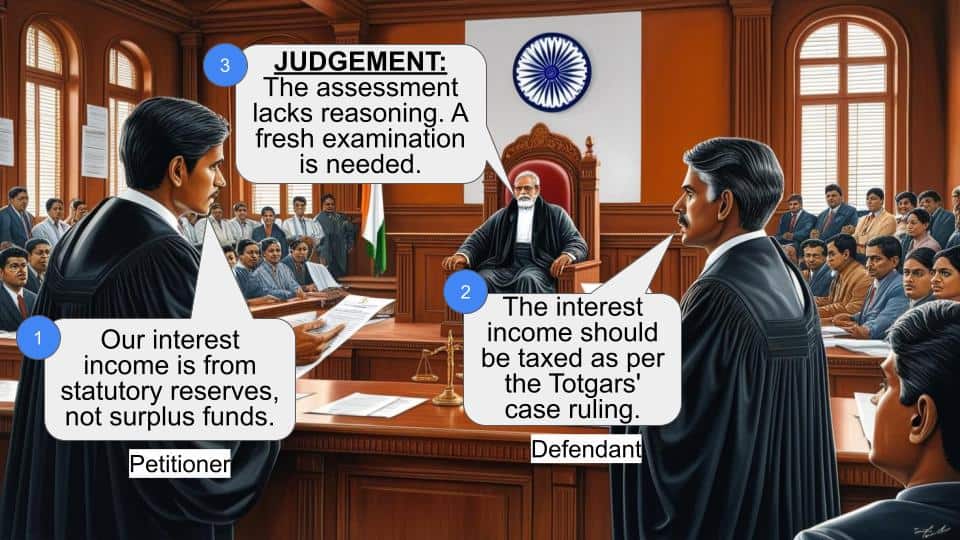
- Petitioner (Kalapet Society): Argued that the issue had been decided in their favor by the jurisdictional Income Tax Appellate Tribunal and that they should not be required to pay the demand while the appeal is pending.
- Respondent (Income Tax Officer): Contended that the mere filing of an appeal does not automatically warrant a stay on recovery and that the society should comply with the demand.
Key Legal Precedents
- The court referred to the CBDT’s Instruction No.1914, which outlines the conditions under which a stay of demand should be granted.
- The case of “Income Tax Officer, Ward-II(3), Coimbatore v. M/s Veerakeralam Primary Agricultural Cooperative Credit Society” was cited, where a similar issue was decided in favor of the assessee.
Judgement
The court granted a stay on the recovery of the disputed tax demand, emphasizing that the assessing authority should have considered the guidelines under Instruction No.1914. The court directed the appellate authority to dispose of the appeal on its merits within three months, and until then, the recovery proceedings should not proceed.
FAQs
Q1: Why was the stay granted?
A1: The stay was granted because the issue had been previously decided in favor of the assessee by a higher authority, and the guidelines from the CBDT supported staying the demand under such circumstances.
Q2: What does this mean for the Kalapet Society?
A2: The society is not required to pay the disputed tax demand while their appeal is pending, providing them temporary relief from the financial burden.
Q3: What are the implications of this case?
A3: This case reinforces the importance of following established guidelines for staying tax demands and highlights the need for assessing authorities to consider past decisions favoring the assessee.

1. This writ petition has been directed against the impugned order dated
18.05.2015 passed by the first respondent-Income Tax Officer, Ward-4,
Pondicherry in PAN:AAAAK1570G relating to the assessment year 2009-10, to
quash the same with a further direction to forbear the first respondent from
initiating or continuing with any proceedings for recovery of the disputed demand pursuant to the order of assessment in P.A.No./G.I.R.No.AAAAK1570G dated 10.03.2015 relating to the assessment year 2009-10.
2. Dr.Anita Sumanth, learned counsel for the petitioner submitted that the
petitioner, being a primary agricultural cooperative credit society, maintains regular books of accounts and has been filing the returns of income regularly in terms of the provisions of the Income Tax Act within the statutory period, hence, assessments were also completed by the department with the co-operation of the petitioner. While so, when the petitioner filed the return of income claiming deduction under Section 80P (of Income Tax Act, 1961) for the assessment year 2009-10, the claim of the petitioner was rejected holding that the petitioner did not satisfy the definition of 'agricultural credit society' set out in terms of the Explanation to Section 80P(4) (of Income Tax Act, 1961). Yet another grievance of the petitioner is that when the impugned assessment order dated 10.3.2015 was passed under Section 143(3) (of Income Tax Act, 1961) effecting disallowance of Rs.91,92,883/- under Section 40(a)(ia) (of Income Tax Act, 1961) for the alleged violation of Section 194A (of Income Tax Act, 1961) and Rs.3,20,686/- and Rs.27,500/- as
disallowances under Section 40(a)(ia) (of Income Tax Act, 1961) for the alleged violation of Section 194H (of Income Tax Act, 1961) and Section 194J (of Income Tax Act, 1961), the order of re-assessment under Section 143(3) (of Income Tax Act, 1961) read with Section 147 (of Income Tax Act, 1961) erroneously resulted in the determination of the income of the petitioner at Rs.1,28,87,139/- and the tax payable thereon at Rs.59,79,550/-. Aggrieved by the same, an appeal has been filed before the second respondent- Commissioner of Income Tax (Appeals), Chennai and the said appeal is pending after issuance of notice dated 4.2.2015. In this background, the grievance of the petitioner is that when the petitioner is a primary agricultural credit society and comes under the exclusion of Section 194A(viia) (of Income Tax Act, 1961), the disallowance brought under Section 40(a)(ia) (of Income Tax Act, 1961) is wholly unfounded. In any event the issue raised in the present writ petition has been decided in favour of the assessee by the jurisdictional bench of the Income Tax Appellate Tribunal 'D' Bench, Chennai in I.T.A.No.197/Mds/2013 dated 11.2.2014 (Income Tax Officer, Ward-II(3), Coimbatore v. M/s Veerakeralam Primary Agricultural Cooperative Credit Society, Coimbatore) in respect of the very same assessment year, therefore, the assessing authority cannot pass the assessment order nor refuse to grant stay during the pendency of the appeal, for the simple reason that when the petitioner, aggrieved by the impugned order of reassessment dated 10.3.2015, has preferred an appeal before the Commissioner of Income Tax (Appeals),
Chennai and along with the appeal, when the petitioner has filed a petition
before the assessing authority, the first respondent herein under Section 220(6) (of Income Tax Act, 1961) on 15.4.2015 for being treated as 'not in default' during the pendency of appeal before the appellate authority, the assessing authority arbitrarily passed an order directing the petitioner to pay 50% of the demand raised for the assessment year 2009-10 as preliminary measure even before the disposal of the stay petition. Such an approach is a clear violation of the procedure and also running contrary to the issue decided in favour of the assessee by the jurisdictional Bench of the Tribunal as mentioned supra.
3. Continuing her arguments, Dr.Anitha Sumanth contended that in spite
of bringing to the notice of the assessing authority that the petitioner is falling within the exclusion of Section 194A(vii)(a) (of Income Tax Act, 1961) being a primary agricultural credit society and the issue has been decided in favour of the assessee by the jurisdictional bench of the Tribunal in I.T.A.No.197/Mds/2013 dated 11.2.2014, more particularly, that the petitioner society does not have the resources to make any portion of the demand raised, the assessing authority has neither considered the same nor followed the instructions of the Central Board of Direct Taxes in File No.404/10/2009-ITCC dated 1.12.2009 affirming Instruction No.1914 dated 2.12.93, which mandates that stay of recovery is liable to be granted if the issue covered by orders of the superior authority, directly applicable to the present case. In support of her submissions, she also brought to the notice of this Court the various decisions of the Income Tax Appellate
Tribunal, Panaji and Chennai Benches in (1) I.T.A.Nos.1 to 3/PNJ/2012 dated
30.3.2012 (Deputy Commissioner of Income Tax, Central Cirlce, Panaji, Goa v.
M/s Jayalakshmi Mahila Vividodeshagala); (2) in I.T.A.No.174/Mds/2013 dated
23.8.2013 (Income Tax Officer v. Kasipalayam Primary Agricultural Co-operative Bank Ltd.) and (3) in I.T.A.No.197/Mds/2013 dated 11.2.2014 (Income Tax Officer v. M/s Veerakeralam Primary Agricultural Cooperative Credit Society), for the proposition that if the assessee is admittedly not a credit cooperative bank, but a credit cooperative society, the exclusion clause of sub-section (4) of Section 80P (of Income Tax Act, 1961), therefore, would not apply.
4. Taking support from the above decisions, it was contended that when
the petitioner had filed an appeal against the assessment order and the same is also pending consideration before the appellate authority, in the meanwhile, as against the demand of entire tax by the first respondent, a petition for stay was moved before the first respondent-assessing officer seeking to grant an order of stay of recovery till such time the appeal is finally heard and disposed of by the appellate authority. However, by a communication dated 20.4.2015, the petitioner was informed that the stay petition would be taken up only subject to the payment of 50% of the tax demand at once or on a proposal for making the payment of demand in installments. It was also further informed that in case of failure to respond to the said communication within a week, the stay petition would be treated as rejected and necessary coercive measures would be taken to
recover the entire demand. The learned counsel further submitted that aggrieved by the demand of 50% tax as a condition precedent even for consideration of the stay petition, the petitioner again approached the second respondent-appellate authority seeking an absolute stay of the recovery proceedings pending appeal. When the appeal/stay petition has been pending consideration before the second respondent-appellate authority, the first respondent has wrongly rejected the stay petition by order dated 18.5.2015 directing the petitioner to pay the demand at once. On this basis, the learned counsel sought the indulgence of this Court for an appropriate direction to the appellate authority to decide the appeal on merits, as otherwise irreparable loss would be caused to the petitioner.
5. On the other hand, Mr. T. Pramod Kumar Chopda, learned senior standing counsel for the respondents submitted that the writ petition cannot be
entertained for the simple reason that when the order dated 18.5.2015 passed
by the first respondent is explicitly clear that a mere pendency of the appeal would not be a ground for the petitioner to escape from the payment of the disputed liability, it is not open to the petitioner to bypass the pending appeal to maintain the present writ petition. The learned senior standing counsel also submitted that if at all the petitioner wants an early disposal of the matter, a direction may be issued to the second respondent-appellate authority to take up the stay petition and dispose of the same on merits expeditiously.
6. Replying to the said submission, the learned counsel for the petitioner
requested this Court to direct the second respondent-appellate authority to take
up the appeal itself in I.T.A.No.327/CIT(A)PDY/2013-14 for final hearing on
merits expeditiously, as the petitioner had already received the notice dated
4.2.2015 fixing the date of hearing on 16.2.2015, since adjourned to subsequent
date.
7. Heard the learned counsel on either side.
8. The circular issued by the Central Board of Direct Taxes in File
No.404/10/2009-ITCC dated 1.12.2009 affirming Instruction No.1914 dated
2.12.93 clearly enlightens the duty, responsibility and the guidelines cast on the
assessing authority for staying demand. In this context, it is appropriate to
extract the relevant portions of the Instruction No.1914 dated 2.12.93, as
follows:-
''A. Responsibility
(i) It shall be the responsibility of the Assessing
Officers and the TRO to collect every demand that
has been raised, except the following:
(a) Demand which has not fallen due;
(b) Demand which has been stayed by a Court or
ITAT or Settlement Commission;
(c) Demand for which a proper proposal for write off
has been submitted;
(d) Demand stayed in accordance with paras B & C
below.
.....
B. Stay petitions
(i) Stay petitions filed with the Assessing Officers
must be disposed of within two weeks of the filing of
petition by the taxpayer. The assessee must be
intimated of the decision without delay.
(ii) Where stay petitions are made to the authorities
higher than the Assessing Officer (DC/CIT/CC), it is
the responsibility of the higher authorities to dispose
of the petitions without any delay, and in any event
within two weeks of the receipt of the petition. Such
a decision should be communicated to the assessee
and the Assessing Officer immediately.
(iii) The decision in the matter of stay of demand
should normally be taken by Assessing Officer/TRO
and his immediate superior. A higher superior
authority should interfere with the decision of the
AO/TRO only in exceptional circumstances e.g. where
the assessment order appears to be unreasonably
highpitched or where genuine hardship is likely to be
caused to the assesee. The higher authorities should
discourage the assessee from filing review petitions
before them as a matter of routine or in a frivolous
manner to gain time for withholding payment of
taxes.
C. Guidelines for staying demand
(i) A demand will be stayed only if there are valid
reasons for doing so. Mere filing an appeal against
the assessment order will not be sufficient reason to
stay the recovery of demand. A few illustrative
situations where stay could be granted are--
(a) If the demand in dispute relates to issues that
have been decided in assessee's favour by an
appellate authority or Court earlier; or
(b) if the demand in dispute has arisen because the
Assessing Officer had adopted an interpretation of
law in respect of which there exist conflicting
decisions of one or more High Courts (not of the High
Court under whose jurisdiction the Assessing Officer
is working); or
(c) If the High Court having jurisdiction has adopted a
contrary interpretation but the Department has not
accepted that judgment.
.....“
9. A careful reading of the above guidelines clearly shows that it shall be
the duty of the assessing authority to collect every demand which has not fallen
due or has been stayed by a Court or Tribunal etc. It appears that the
jurisdictional Income Tax Appellate Tribunal 'D' Bench in I.T.A.No.197/Mds/2013
dated 11.2.2014 (Income Tax Officer, Ward-II(3), Coimbatore v. M/s
Veerakeralam Primary Agricultural Cooperative Credit Society, Coimbatore), while
dealing with a similar issue, placing reliance on the judgment of the Gujarat High
Court in the case of Commissioner of Income Tax v. Jatari Momin Vikas
Cooperative Credit Society Ltd., 2014 (2) TMI 28, has held as follows:-
''7. From the above clarification, it can be gathered
that sub-section (4) of Section 80P (of Income Tax Act, 1961) will not apply to an
assessee which is not a co-operative bank. In the case
clarified by CBDT, Delhi Coop Urban Thrift & Credit
Society Ltd., was under consideration. Circular clarified
that the said entity not being a cooperative bank,
section 80P(4) (of Income Tax Act, 1961) would not apply to it. In view
of such clarification, we cannot entertain the
Revenue's contention that section 80P(4) (of Income Tax Act, 1961) would
exclude not only the co-operative banks other than
those fulfilling the description contained therein but
also credit societies, which are not cooperative banks.
In the present case, respondent assessee is admittedly
not a credit cooperative bank but a credit cooperative
society. Exclusion clause of sub-section (4) of Section
80P, therefore, would not apply. In the result, Tax
Appeals are dismissed.
The Revenue has tried to establish that the assessee
although a credit cooperative society is carrying on
banking business and is thus not eligible. In our
opinion, the assessee is not a cooperative bank...''
10. The above observation, prima facie, brings the case of the petitioner
under the guidelines-C(i)(a) for staying demand, which says that if the demand
in dispute relates to issues that have been decided in assessee's favour by an
appellate authority or Court earlier, the demand will be stayed. While the issue
appears to be clear, this Court does not find any justification why the assessing
authority has not considered the guidelines under the Instruction No.1914 dated
2.12.93. Moreover, it is well settled legal position that all authorities, civil,
criminal and judicial, coming within the territory of the High Court, shall act in
the aid of the High Court. While so, the assessing authority is bound by the order
passed by the jurisdictional Tribunal without taking any stand that the Tribunal or
High Courts of other States are taking a different view.
11. Be that as it may, when the appeal has been filed by the petitioner
before the appellate authority along with stay petition, keeping in mind that any
further observation would have a cascading effect on the pending appeal of the
petitioner, with all hesitation, is restraining to express anything on the merits,
therefore, in the fitness of things, this Court, accepting the request made by the
learned counsel for the petitioner for a direction to dispose of the main appeal
itself, as the petitioner had received the notice dated 4.2.2015, hereby directs
the second respondent-appellate authority to dispose of the appeal in
I.T.A.No.327/CIT(A)PDY/2013-14 on its own merits within a period of three
months from the date of receipt of a copy of this order. Needless to mention that
till then, the first respondent shall not proceed with the recovery, as it is well
settled law that during the pendency of the appeal before the appellate
authority, the department is not entitled to initiate the recovery proceedings.
With the above direction, the writ petition stands disposed of. Consequently,
M.P.No.1 of 2015 is closed. No costs.
Index : yes/no 05.06.2015
Issue copy on 13.7.2015
To
1. The Income Tax Officer
Ward-4
Pondicherry
2. The Commissioner of Income Tax (Appeals)-15
121, Mahatma Gandhi Road
Nungambakkam
Chennai 600 034
T.RAJA, J.
W.P.No.15959 of 2015
05.06.2015
×
Similar Ripples
Questions
Stay of Tax Recovery Granted Pending Appeal
Write your CommentSimilar Posts


Generic
- Reportdata/3712.pdf
