


Stock valuation dispute: Court upholds deletion of addition, citing reasonable …


Full News

Stock valuation dispute: Court upholds deletion of addition, citing reasonable explanations
Stock valuation dispute: Court upholds deletion of addition, citing reasonable explanations
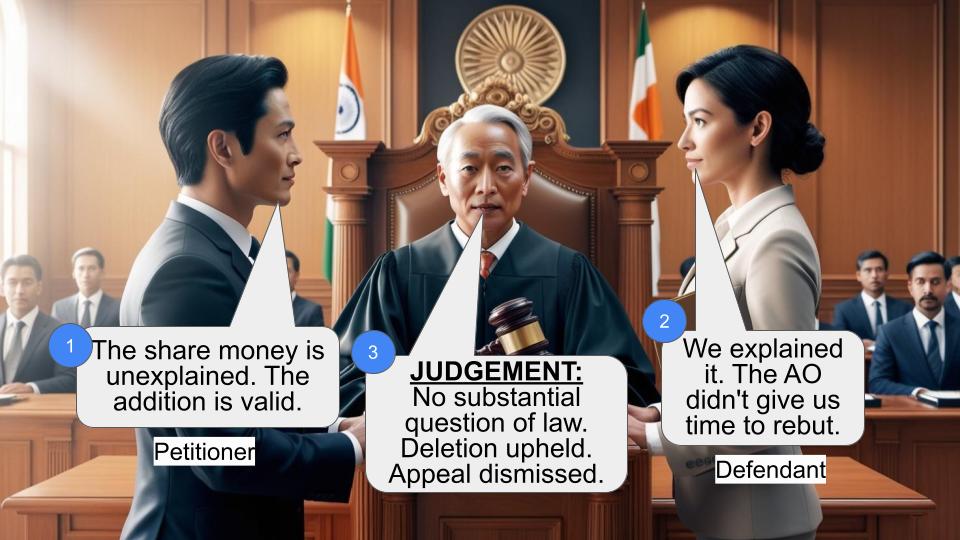
This case involves the Commissioner of Income Tax (Revenue) challenging a decision made by the Income Tax Appellate Tribunal (ITAT) regarding Heynon India Ltd.'s (the Assessee) stock valuation and account discrepancies. The High Court dismissed the Revenue's appeal, agreeing with the ITAT's findings that the Assessee's explanations were reasonable and supported by evidence.
Get the full picture - access the original judgement of the court order here
Case Name:
Commissioner of Income Tax vs Heynon India Ltd. (High Court of Delhi)
ITA 441/2007
Date: 5th December 2007
Key Takeaways:
1. The court upheld the deletion of additions made by the Assessing Officer (AO) when reasonable explanations are provided by the assessee.
2. Consistent methods of stock valuation, when explained and supported by evidence, are generally accepted by the court.
3. Discrepancies in accounts between associated companies can be justified if properly explained and reconciled.
4. The court gives weight to concurrent findings of lower appellate authorities (CIT(A) and ITAT) when based on facts and reasonable interpretations.
Issue:
Did the Income Tax Appellate Tribunal err in deleting the additions made by the Assessing Officer regarding stock valuation discrepancies and account differences between the Assessee and an associated company?
Facts:
1. The case pertains to the Assessment Year 1998-1999.
2. The Assessing Officer made two significant additions:
a) Rs.54.46 lakhs due to discrepancies between accounts of M/s Polar Industries Ltd. and the Assessee.
b) Rs.81.68 lakhs for the difference between reduction in stock value and sale price.
3. The Commissioner of Income Tax (Appeals) [CIT(A)] and the Income Tax Appellate Tribunal (ITAT) deleted these additions.
4. The Revenue appealed to the High Court, claiming a notional tax effect of about Rs.47.65 lakhs.
Arguments:
Revenue's Arguments:
1. The deletion of additions would be carried forward to subsequent years, potentially reducing future taxable income.
2. The discrepancies in accounts between M/s Polar Industries Ltd. and the Assessee were significant and unexplained.
3. The difference in stock valuation and sale price was not adequately justified by the Assessee.
Assessee's Arguments:
1. The account discrepancies arose because M/s Polar Industries Ltd. debited an amount, but a corresponding entry was not made by the Assessee.
2. The stock valuation was carried out reasonably, using a consistent method based on the average sale value of goods during the year.
3. The decrease in stock value was partly due to sales at lower than cost and partly due to diminution in the value of closing stock.
Key Legal Precedents:
No specific legal precedents were cited in the judgment. The court relied on the factual findings and reasoning of the CIT(A) and ITAT.
Judgment:
1. The High Court dismissed the Revenue's appeal, finding no substantial question of law arising from the ITAT's order.
2. Regarding the Rs.54.46 lakhs addition:
- The court agreed with the CIT(A) and ITAT that discrepancies can arise in normal business dealings, even between associated companies.
- The Assessee's explanation for reconciling the difference was found satisfactory.
3. Concerning the Rs.81.68 lakhs addition:
- The court accepted that the stock valuation method was reasonable and consistently followed by the Assessee.
- It agreed that the decrease in stock value was partly due to sales at lower than cost and partly due to diminution in closing stock value.
- The Assessee's explanation for the loss on sales was found reasonable and supported by documentary evidence.
FAQs:
1. Q: Why did the court dismiss the Revenue's appeal despite the claimed tax effect?
A: The court found that the ITAT's decision was based on reasonable interpretations of facts and explanations provided by the Assessee. No substantial question of law arose from these findings.
2. Q: What was the significance of the consistent stock valuation method?
A: The court viewed the consistent application of a reasonable valuation method favorably, as it demonstrated the Assessee's adherence to established accounting practices.
3. Q: How did the court view the discrepancies between associated companies' accounts?
A: The court accepted that such discrepancies can occur in normal business dealings and can be justified if properly explained and reconciled.
4. Q: What impact does this judgment have on future tax assessments?
A: While not explicitly stated, the judgment emphasizes the importance of considering taxpayers' explanations and supporting evidence when making assessments, potentially influencing future tax proceedings.
5. Q: Does this case set any new legal precedent?
A: The case doesn't establish new legal principles but reinforces the importance of factual analysis and reasonable explanations in tax dispute resolutions.

The Revenue is aggrieved by an order dated 22nd September, 2006 passed by the Income Tax Appellate Tribunal, Delhi Bench H , New Delhi (`the Tribunal) in ITA No. 3187/Del/2003 relevant for the Assessment Year 1998-1999. According to learned counsel for the Revenue the tax effect in this case on a notional basis is about Rs. 47.65 lakhs, although she does not deny that the Assessee has been assessed at a loss. According to learned counsel for the Revenue deletion of additions made by the Assessing Officer (AO) will be carried forward to the subsequent years and may reduce the taxable income for those years. Therefore, according to her, the appeal may be entertained. Notwithstanding the fact that the tax effect is nil, we have heard the matter on merits.
2. Learned counsel for the Revenue has urged two issues. The first is with regard to the deletion by the CIT (A) and the Tribunal of an addition of Rs.54.46 lakhs made by the AO on account of a discrepancy between the accounts of M/s Polar Industries Ltd. in the assessee s account and the accounts maintained by M/s Polar Industries Ltd. It appears that M/s Polar Industries Ltd. maintains one account of the Assessee in its books of accounts, while the Assessee maintains three different accounts - two under the head Sundry Creditors account for FBD and Pump Division and one unsecured loan account.
3.According to the Assessee, the difference arose on account of the fact that the amount was debited by M/s Polar Industries Ltd. but a corresponding entry was not made by the Assessee.
4. The CIT(A) was of the view that even if the Assessee was associated with Polar Group of Industries, it was possible for such a discrepancy to arise in the normal course of dealings between the parties. The CIT(A) was satisfied with the explanation of the Assessee and held that it has been able to reconcile the difference in the balance as pointed out by the AO. Accordingly,the addition of Rs.5446789/- was deleted by the CIT(A). As mentioned above, this has been upheld by the Tribunal on the same ground as the CIT(A). On examining this issue, we find that the view taken concurrently by the CIT(A) and the Tribunal is a reasonable view based on the explanation tendered by the Assessee and is not vitiated by any perversity. We do not find that any substantial question of law arises out of this finding.
5. The second issue urged by learned counsel for the Revenue is with regard to the addition of Rs.81.68 lakhs being the difference between reduction in value of stock and the sale price. The CIT(A) was of the view that the valuation of stock had been carried out by the Assessee in a reasonable manner.The market value had been taken to be the average of the sale value of the goods during the year. The CIT(A) observed that this manner of valuation was in accordance with the method consistently followed by the Assessee. It was also found that a decrease in stock of Rs.1.09 crores was partly due to the sale of finished goods at lower than cost and partly due to diminution in the value of the closing stock. The explanation given by the Assessee for making loss on such sales was found by the CIT(A) to be reasonable and supported by documentary evidence, which ought not to have been ignored by the AO.The Tribunal accepted the view of the CIT(A) and added that the AO has not made out any case that the Assessee realized an amount more than that declared in the sales invoices.
6. We find that no substantial question of law arises out of this finding as well, based as it is on facts. There is no merit in the appeal.
7. Dismissed.
MADAN B. LOKUR, J S.MURALIDHAR, J DECEMBER 05, 2007
×
Questions
Stock valuation dispute: Court upholds deletion of addition, citing reasonable explanations
Write your CommentSimilar Posts


Generic
- Reportdata/5110_.pdf
