


Full News

Supreme Court rules rental income from letting out properties is business income for Chennai Properties & Investments Ltd.
Supreme Court rules rental income from letting out properties is business income for Chennai Properties & Inv…
This case involved a dispute between Chennai Properties & Investments Ltd. and the Commissioner of Income Tax over whether the rental income earned by the company from letting out its properties should be treated as business income or income from house property for tax purposes. The Supreme Court ruled in favor of the company, holding that the rental income should be classified as business income based on the company's main objective and activities.
Case Name:
Chennai Properties & Investments Ltd. Vs Commissioner of Income Tax
Civil Appeal No. 4494 of 2004
Key Takeaways:
- The Supreme Court held that the deciding factor in determining whether rental income is business income or income from house property is the nature of the assessee's activities and operations, not merely the ownership of land or leases.
- The court emphasized that the objects of the company, as stated in its Memorandum of Association, must be considered when interpreting its activities.
- The court applied the principles laid down in the cases of 'Karanpura Development Co. Ltd. v. Commissioner of Income Tax, West Bengal' and 'Sultan Brothers (P) Ltd. v. Commissioner of Income Tax' to arrive at its decision.
Issue:
The central issue in this case was whether the rental income received by Chennai Properties & Investments Ltd. from letting out its properties should be treated as income from business or income from house property for tax purposes.
Facts:
- Chennai Properties & Investments Ltd. is a company incorporated under the Indian Companies Act.
- The main objective of the company, as stated in its Memorandum of Association, is to acquire properties in Chennai and let them out.
- The company had rented out its properties and shown the rental income as business income in its tax return.
- The Assessing Officer treated the rental income as income from house property and taxed it accordingly.
- The Commissioner of Income Tax (Appeals) and the Income Tax Appellate Tribunal ruled in favor of the company, treating the income as business income.
- The High Court allowed the Income Tax Department's appeal and held that the rental income should be treated as income from house property.
Arguments:-
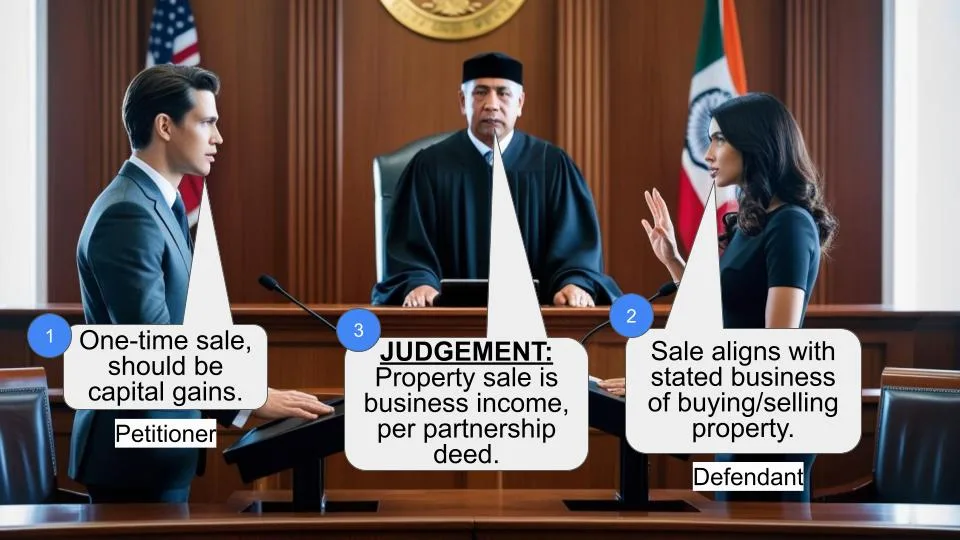
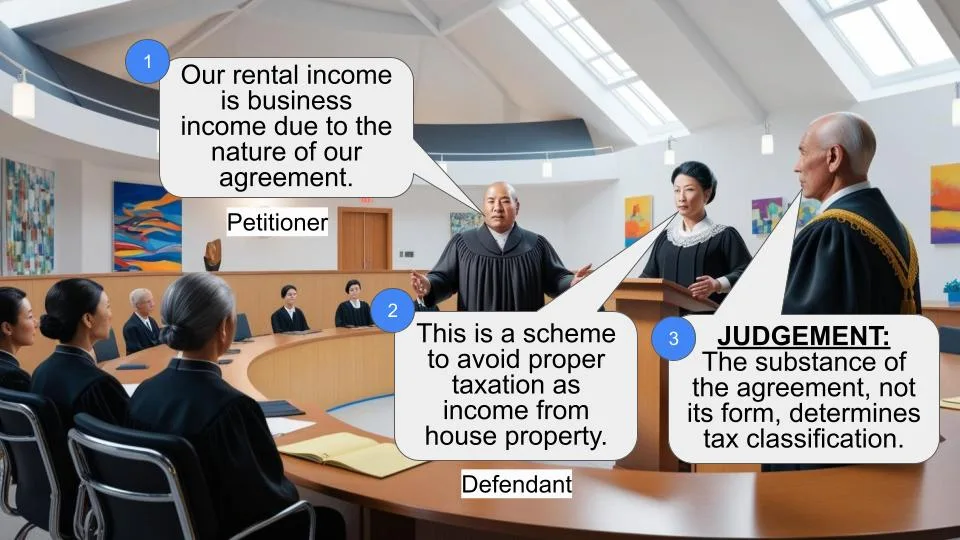
The Income Tax Department argued that since the income was derived from letting out properties, it should be treated as rental income and taxed as income from house property.
- The company contended that its main objective was to acquire properties and let them out, making the rental income a part of its business activities and, therefore, taxable as business income.
Key Legal Precedents:
- 'East India Housing and Land Development Trust Ltd. v. Commissioner of Income Tax, West Bengal' :
The court distinguished this case, where the main objective was to develop landed properties into markets, and the rental income was incidental.
- 'Karanpura Development Co. Ltd. v. Commissioner of Income Tax, West Bengal':
The court relied on this case, which held that the deciding factor is the nature of the assessee's activities and operations, not merely the ownership of land or leases.
- 'Sultan Brothers (P) Ltd. v. Commissioner of Income Tax':
The court considered this Constitution Bench judgment, which stated that each case must be examined from a businessman's point of view to determine whether the letting was a business or exploitation of property.
Judgement:
The Supreme Court allowed the appeal filed by Chennai Properties & Investments Ltd. and set aside the High Court's judgment. The court held that since the company's main objective was to acquire and let out properties, the rental income should be treated as business income and not income from house property. The court restored the order of the Income Tax Appellate Tribunal in favor of the company.
FAQs:
Q1: What is the significance of the court's decision in this case?
A1: The court's decision clarifies the principles for determining whether rental income should be treated as business income or income from house property for tax purposes, emphasizing the importance of the assessee's main objectives and activities.
Q2: Does the court's decision mean that all rental income earned by companies will be treated as business income?
A2: No, the court's decision does not establish a blanket rule. Each case will be examined based on the specific facts, including the company's objectives and the nature of its activities related to the rental income.
Q3: What legal principles did the court rely on in arriving at its decision?
A3: The court primarily relied on the principles laid down in the cases of 'Karanpura Development Co. Ltd. v. Commissioner of Income Tax, West Bengal' and 'Sultan Brothers (P) Ltd. v. Commissioner of Income Tax', which emphasize the importance of the assessee's activities and operations, as well as the objects of the company.
Q4: What is the impact of this decision on the Income Tax Department?
A4: The decision clarifies the approach the Income Tax Department should take when assessing rental income earned by companies, considering the company's main objectives and activities rather than solely relying on the nature of the income as rental incomeThe appellant-assessee is a company incorporated under the Indian Companies Act. Its main objective, as stated in the Memorandum of Association, is to acquire the properties in the city of Madras (now Chennai) and to let out those properties. The assessee had rented out such properties and the rental income received therefrom was shown as income from business in the return filed by the assessee. The assessing officer, however, refuse to tax the same as business income. According to the assessing officer, since the income was received from letting out of the properties, it was in the nature of rental income. He, thus, held that it would be treated as income from house property and taxed the same accordingly under that Head.

The assessee filed the appeal before the Commissioner of Income Tax (Appeals) who allowed the same by his orders dated 06.04.1989 holding it to be income from business and directed that it should be treated as such and taxed accordingly. Aggrieved by that order, the Department filed appeal before the Income Tax Appellate Tribunal which declined to interfere with the order of the Commissioner of Income Tax (Appeals) and dismissed the appeal. The Department approached the High Court. This appeal of the Department has been allowed by the High Court vide its order dated 05.09.2002 holding that the income derived by letting out of the properties would not be income from business but could be assessed only income from house property. A perusal of the impugned judgment of the High Court would show that it has primarily rested its decision on the basis of the judgment of this Court in 'East India Housing and Land Development Trust Ltd. v. Commissioner of Income Tax, West Bengal [(1961) 42 ITR 49] as well as the
Constitution Bench judgment of this Court in 'Sultan Brothers (P) Ltd. v. Commissioner of Income Tax' [1964 (5) SCR 807].
From the aforesaid facts, it is clear that the question which is to be determined on the facts of this case is as to whether the income derived by the company from letting out this property is to be treated as income from business or it is to be treated as rental income from house property.
We have heard the learned counsel for the parties on the aforesaid issue. Before we narrate the legal principle that needs to be applied to give the answer to the aforesaid question, we would like to recapitulate some seminal features of the present case.
The Memorandum of Association of the appellant-company which is placed on record mentions main objects as well as incidental or ancillary objects in clause III. (A) and (B) respectively. The main object of the appellant company is to acquire and hold the properties known as “Chennai House”
and “Firhavin Estate” both in Chennai and to let out those properties as well as make advances upon the security of lands and buildings or other properties or any interest therein. What we emphasise is that holding the aforesaid properties and earning income by letting out those properties is the main objective of the company. It may further be recorded that in the return that was filed, entire income which accrued and was assessed in the said return was from letting out of these properties. It is so recorded and accepted by the assessing officer himself in his order.
It transpires that the return of a total income of Rs.244030 was filed for the assessment year in question that is assessment year 1983-1984 and the entire income was through letting out of the aforesaid two properties namely, “Chennai House” and “Firhavin Estate”. Thus, there is no other income of the assessee except the income from letting out of these two properties. We have to decide the issue keeping in mind the aforesaid aspects.
With this background, we first refer to the judgment of this Court in East India Housing and Land Development Trust Ltd.'s case which has been relied upon by the High Court. That was a case where the company was incorporated
with the object of buying and developing landed properties and promoting and developing markets. Thus, the main objective of the company was to develop the landed properties into markets. It so happened that some shops and stalls, which were developed by it, had been rented out and income was derived from the renting of the said shops and stalls. In those facts, the question arose for consideration was: whether the rental income that is
received was to be treated as income from the house property or the income from the business. This court while holding that the income shall be treated as income from the house property, rested its decision in the context of the
main objective of the company and took note of the fact that letting out of the property was not the object of the company at all. The court was therefore, of the opinion that the character of that income which was from the house property had not altered because it was received by the company formed with the object of developing and setting up properties.
Before we refer to the Constitution Bench judgment in the case of Sultan Brothers (P) Ltd., we would be well advised to discuss the law laid down authoritatively and succinctly by this Court in 'Karanpura Development Co. Ltd. v. Commissioner of Income Tax, West Bengal' [44 ITR 362 (SC)]. That was also a case where the company, which was the assessee, was formed with the object, inter alia, of acquiring and disposing of the underground coal mining rights in certain coal fields and it had restricted its activities to acquiring coal mining leases over large areas, developing them as coal fields and then sub-leasing them to collieries and other companies. Thus, in the said case, the leasing out of the coal fields to the collieries and other companies was the business of the assessee. The income which was received from letting out of those mining leases was shown as business income. Department took the position that it is to be treated as income from the house property. It would be thus, clear that in similar circumstances, identical issue arose before the Court. This Court first discussed the scheme of the Income Tax Act and particularly six heads under which income can be categorised / classified. It was pointed out that before income, profits or gains can be brought to computation, they have to be assigned to one or the other head. These heads are in a sense exclusive of one another and income which falls within one head cannot be assigned to, or taxed under, another head. Thereafter, the Court pointed out that the deciding factor is not the ownership of land or leases but the nature of the activity of the assessee and the nature of the operations in relation to them. It was highlighted and stressed that the objects of the company must also be kept in view to interpret the activities. In support of the aforesaid proposition, number of judgments of other jurisdictions, i.e. Privy Counsel, House of Lords in England and US Courts were taken note of. The position
in law, ultimately, is summed up in the following words: -
“As has been already pointed out in connection with the other two cases where there is a letting out of premises and collection of rents the assessment on property basis may be correct but not so, where the letting or sub-letting is part of a trading operation. The diving line is difficult
to find; but in the case of a company with its professed objects and the manner of its activities and the nature of its dealings with its property,
it is possible to say on which side the operations fall and to what head the income is to be assigned.”
After applying the aforesaid principle to the facts, which were there before the Court, it came to the conclusion that income had to be treated as income from business and not as income from house property. We are of the opinion that the aforesaid judgment in Karanpura Development Co. Ltd.'s case squarely applies to the facts of the present case.
No doubt in Sultan Brothers (P) Ltd.'s case, Constitution Bench judgment of this Court has clarified that merely an entry in the object clause showing a
particular object would not be the determinative factor to arrive at an conclusion whether the income is to be treated as income from business and such a question would depend upon the circumstances of each case, viz., whether a particular business is letting or not. This is so stated in the following words: -
“We think each case has to be looked at from a businessman's point of view to find out whether the letting was the doing of a business or the exploitation of his property by an owner. We do not further think that a thing can by its very nature be a commercial asset. A commercial asset is only an asset used in a business and nothing else, and business may be carried on with practically all things. Therefore, it is not possible to say that a particular activity is business because it is concerned with an asset with which trade is commonly carried on. We find nothing in the cases referred, to support the proposition that certain assets are commercial assets in their very nature.”
We are conscious of the aforesaid dicta laid down in the Constitution Bench judgment. It is for this reason, we have, at the beginning of this judgment, stated the circumstances of the present case from which we arrive at
irresistible conclusion that in this case, letting of the properties is in fact is the business of the assessee. The assessee therefore, rightly disclosed the income under the Head Income from Business. It cannot be treated as 'income from the house property'. We, accordingly, allow this
appeal and set aside the judgment of the High Court and restore that of the Income Tax Appellate Tribunal. No orders as to costs.
The appeals are disposed of in terms of the aforesaid
Order in Civil Appeal No. 4494 of 2004.
[ A.K. SIKRI ]
[ ROHINTON FALI NARIMAN ]
New Delhi;
April 09, 2015.
×
Similar Ripples
Questions
Supreme Court rules rental income from letting out properties is business income for Chennai Properties & Investments Ltd.
Write your CommentSimilar Posts

Generic
- Reportdata/SC-4494-2004.pdf
