


Supreme Court Upholds Inclusion of Domestic Profits in Export Deduction Formula


Full News
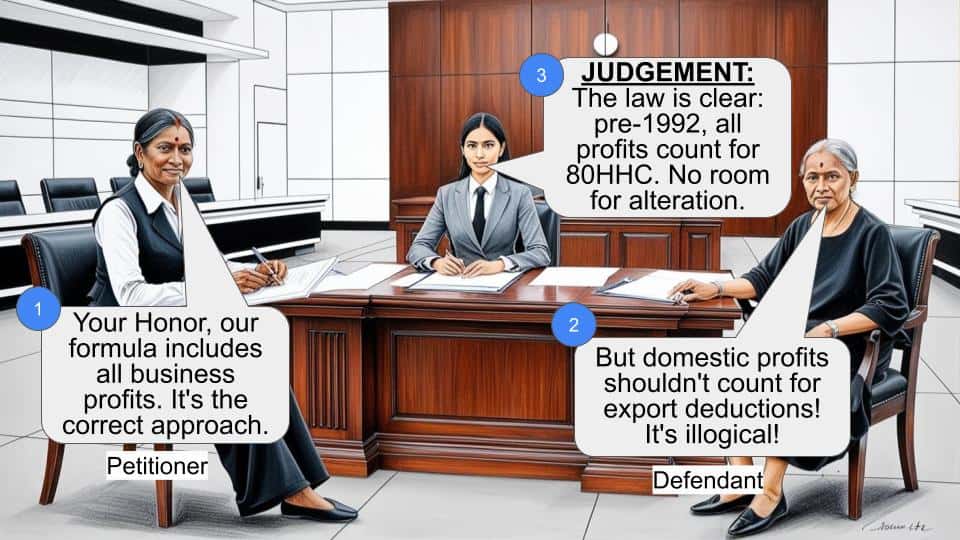
Supreme Court Upholds Inclusion of Domestic Profits in Export Deduction Formula
Supreme Court Upholds Inclusion of Domestic Profits in Export Deduction Formula
This case involves a dispute between an individual taxpayer and the Income Tax Department regarding the calculation of deduction under Section 80HHC (of Income Tax Act, 1961). The main issue was whether domestic profits (specifically interest income from money lending) should be included in the formula for calculating export profits. The court ruled in favor of the taxpayer, allowing the inclusion of domestic profits in the calculation.
Case Name**:
Commissioner of Income Tax vs. Anil Chanana
**Key Takeaways**:
1. The statutory formula prescribed in Section 80HHC(3) (of Income Tax Act, 1961) for calculating export profits is mandatory and cannot be altered.
2. Domestic profits, including interest income from money lending, should be included in the "profits of business" for calculating the Section 80HHC (of Income Tax Act, 1961) deduction for assessment years prior to 1992-93.
3. The amendment to exclude certain receipts from "profits of business" was prospective, effective from the assessment year 1992-93.
**Issue**:
Whether domestic business profits (specifically interest income from money lending) should be included in the calculation of export profits for the purpose of deduction under Section 80HHC (of Income Tax Act, 1961) for the assessment year 1991-92?
**Facts**:
1. The assessee is an individual engaged in the export business.
2. For the assessment year 1991-92, the assessee claimed a deduction of ₹33,63,149 under Section 80HHC (of Income Tax Act, 1961).
3. The assessee included interest income from money lending activities in the calculation of "profits of business" for the Section 80HHC (of Income Tax Act, 1961) deduction.
4. The Assessing Officer initially excluded the interest income from the calculation, reducing the deduction to ₹15,97,672.
5. The case went through appeals, reaching the Income Tax Appellate Tribunal (ITAT) and finally the High Court.
**Arguments**:
Assessee's Arguments:
1. The formula prescribed in Section 80HHC(3) (of Income Tax Act, 1961) is mandatory and should be applied as is.
2. Interest income from money lending constitutes "profits of business" and should be included in the calculation.
Revenue's Arguments:
1. Domestic profits (interest income) should be excluded from the calculation of export profits.
2. Section 80AB (of Income Tax Act, 1961) should be applied to limit the deduction to only export profits.
**Key Legal Precedents**:
1. International Research Park Laboratories Ltd. Vs. ACIT (1995) 212 ITR (AT)1(Del.)(SB): This Special Bench decision held that Section 80AB (of Income Tax Act, 1961) doesn't apply to Section 80HHC (of Income Tax Act, 1961) calculations, and domestic profits should not be excluded from the statutory formula.
2. P. R. Prabhakar Vs. Commissioner of Income Tax (2006) 284 ITR 548: The Supreme Court approved the Special Bench decision, clarifying that the amendment to exclude certain receipts from "profits of business" was prospective from the assessment year 1992-93.
**Judgement**:
The High Court ruled in favor of the assessee, holding that:
1. The statutory formula prescribed in Section 80HHC(3) (of Income Tax Act, 1961) is mandatory and cannot be altered.
2. Domestic profits, including interest income from money lending, should be included in the "profits of business" for calculating the Section 80HHC (of Income Tax Act, 1961) deduction for the assessment year 1991-92.
3. The amendment to exclude certain receipts from "profits of business" was prospective, effective from the assessment year 1992-93, and doesn't apply to the case at hand (1991-92).
**FAQs**:
Q1: Why was the interest income included in the calculation of export profits?
A1: The court held that for assessment years prior to 1992-93, the statutory formula in Section 80HHC(3) (of Income Tax Act, 1961) was to be applied as is, without excluding domestic profits like interest income.
Q2: What changed after the assessment year 1992-93?
A2: An amendment was introduced to exclude certain receipts like interest and commission from the definition of "profits of business" for Section 80HHC (of Income Tax Act, 1961) calculations.
Q3: Does this judgment apply to current tax assessments?
A3: No, this judgment specifically applies to assessment years prior to 1992-93. Current assessments would follow the amended rules.
Q4: What was the significance of the P. R. Prabhakar case?
A4: The P. R. Prabhakar case, decided by the Supreme Court, approved the interpretation that domestic profits should be included in the Section 80HHC (of Income Tax Act, 1961) calculation for pre-1992-93 assessment years.
Q5: How does this judgment impact the interpretation of tax laws?
A5: It emphasizes the importance of applying statutory formulas as prescribed and highlights that amendments to tax laws are generally prospective unless explicitly stated otherwise.

This is a reference made at the instance of the Commissioner of Income Tax,Delhi-VII under Section 256(1) (of Income Tax Act, 1961) (hereinafter referred to as “the Act”). The following questions of law were referred to us for opinion :
“1. Whether, on the facts and in the circumstances of the case, the I.T.A.T was right in law in holding that section 80 (of Income Tax Act, 1961)—HHC(3)(b) would be applicable even where assessee’s local business consists of dealing in goods different from the ones exported.
2. Whether the ITAT was right in law in holding that section 80 (of Income Tax Act, 1961) AB is not relevant for the purpose of computing deduction u/s 80-HHC (of Income Tax Act, 1961).
3. Whether the ITAT was right in law in holding that interest earned by assessee was in the nature of business income.
4. Whether the ITAT was right in law in holding domestic business need not have any nexus with the export business for the purpose of deduction u/s 80-HHC (of Income Tax Act, 1961).
5. Whether ITAT was right in law in holding that for deduction u/s 80-HHC (of Income Tax Act, 1961), the domestic business need not have any turnover and it need have only profit.”
2. The brief facts giving rise to the reference may be noticed. The assessee is an individual engaged in the export business. In the return of income filed for the assessment year 1991-92, he claimed deduction of `33,63,149/- under Section 80HHC (of Income Tax Act, 1961). While completing the assessment under Section 143(3) (of Income Tax Act, 1961), the Assessing Officer noticed that the assessee had claimed deduction under the aforesaid Section even in respect of rent and interest. These items of receipt were also treated as part of the turnover. He was of the opinion that deduction under Section 80HHC (of Income Tax Act, 1961) could only be allowed to the extent of the profits from the export business as envisaged by Section 80AB (of Income Tax Act, 1961) and accordingly, proposed to exclude the rent and interest receipts from the computation of the deduction. The assessee however, submitted that the proposal of the Assessing Officer would be contrary to the scheme of the deduction envisaged by Section 80HHC (of Income Tax Act, 1961). According to him the formula to be applied for determining the export profits was the one prescribed in sub-section (3) of Section 80HHC (of Income Tax Act, 1961), which was as under :
Export Profits = Profits of Business x (Export Turnover ÷ Total Turnover) It was the contention of the assessee that he was carrying on the business of money lending and the interest from this activity would amount to “profits of the business” and since sub-section (3) of Section 80HHC (of Income Tax Act, 1961) prescribed a formula which was mandatory, those profits cannot be excluded while applying the formula. The Assessing Officer did not accept the assessee’s contention and re-worked the deduction at `15,97,672/- in the following manner :
“Net Profit Rs.38,71,008/-
Less :
Interest Rs.22,41,296/-
Rent Rs. 35,640/- Rs.22,76,936/-
Rs.15,94, 072/
Add:
Expenses related
To interest & Rent. Rs. 3,600/-
Rs.15,97,672/-
3. It may be noticed that the Assessing Officer excluded both the interest and rent receipts from the computation of the profits of the business for the purpose of calculating the deduction under Section 80HHC (of Income Tax Act, 1961), but in this reference we are concerned only with the interest receipts. So far as the rent is concerned, even before the tax authorities the assessee does not press for the deduction. Accordingly, on 3rd August, 2012 we had reframed the questions referred to us by the Tribunal and consider it appropriate to deal with only one question of law which is “Whether the ITAT was right in law in holding that the domestic business need not have any nexus with export business for the purpose of deduction under Section 80HHC (of Income Tax Act, 1961)?”. As the question shows, the real objection of the income tax authorities in this case is that the interest income, even if it is assessed as business income on the footing that the assessee was carrying on money lending business, still it represented domestic profits and not export profits and therefore, a mechanism should be devised by which the domestic profits are excluded from the profits of the business for the purpose of applying the formula prescribed by Section 80HHC(3) (of Income Tax Act, 1961).
4. The CIT(Appeals) having upheld the view of the Assessing Officer, the assessee preferred a further appeal to the Tribunal which held, following the order of the Special Bench of the Tribunal in the case of International Research Park Laboratories Ltd. Vs. ACIT (1995) 212 ITR (AT)1(Del.)(SB), that Section 80AB (of Income Tax Act, 1961) had no application for computing the export profits under Section 80HHC (of Income Tax Act, 1961) since the latter section was a complete code by itself. The Tribunal also held that the assessee had advanced monies to various parties from time to time for which purpose it had also borrowed monies and considering the volume, frequency, continuity and regularity of the transactions of advancing the monies, the activity constituted money lending business and the interest therefrom was assessable as profits of the business. It further noted that in the case of International Research Park Laboratories Ltd. (supra) it was held that a statutory formula having been prescribed, it is not permissible to exclude the domestic profits from the profits of the business in order to arrive at the export profits and that even if the domestic business (the money lending activity in the present case) was not capable of having any “turnover”, the deduction under Section 80HHC (of Income Tax Act, 1961) cannot be denied and it had to be computed proportionately from the formula prescribed by the sub-section.
5. It is from the aforesaid order of the Tribunal that the question of law extracted above arises for decision. We find that the question stands covered in favour of the assessee by a judgment of the Supreme Court in the case of P. R. Prabhakar Vs. Commissioner of Income Tax (2006) 284 ITR 548 where the order of the Special Bench cited (supra) stands approved. It was clarified that the amendment made to clause (baa) of the Explanation below Section 80HHC (of Income Tax Act, 1961) which defines “profits of the business” in such a manner as to exclude receipts like interest, commission etc. which did not have an element of turnover, was introduced prospectively by the Finance (No.2) Act, 1991 w.e.f. the assessment year 1992-93 and the amendment did not operate retrospectively. It was therefore held that for the assessment years prior to the assessment year 1992-93, it would not be permissible to exclude interest receipts even if the business from which interest arose did not have an element of turnover. The Supreme Court expressly referred to the order the Special Bench of the Tribunal cited above and approved the same. Mr. Sabharwal, ld. senior standing counsel for the revenue initially took time to ascertain whether the amendment was brought into force w.e.f. 1.4.1987 or w.e.f. 1.4.1992. After ascertaining the same, he submitted that the amendment which would apply to the present controversy came into force only from 1.4.1992 and therefore would not apply to the assessment year 1991-92 which is the year in reference.
6. In the aforesaid view of the matter we answer the question of law, as reframed by us, in the affirmative, in favour of the assessee and against the revenue. There shall, however, be no order as to costs.
R.V. EASWAR, J.
S. RAVINDRA BHAT, J.
AUGUST 06, 2012
×
Questions
Supreme Court Upholds Inclusion of Domestic Profits in Export Deduction Formula
Write your CommentSimilar Posts


Generic
- Reportdata/5589.pdf
