


Tax Addition Remanded: High Court Orders Fresh Review of Alleged Suppressed Sal…


Full News

Tax Addition Remanded: High Court Orders Fresh Review of Alleged Suppressed Sales
Tax Addition Remanded: High Court Orders Fresh Review of Alleged Suppressed Sales
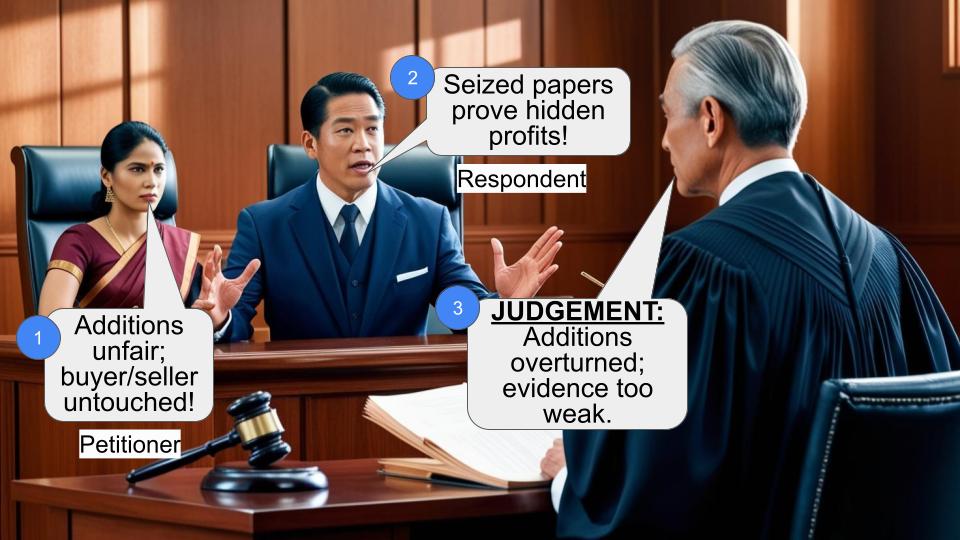
A case here involving Herbalife International India and the Commissioner of Income Tax. Basically, the tax authorities thought Herbalife was hiding some sales and added a big chunk of money to their taxable income. Herbalife wasn't happy about this, so they took it to court. The High Court looked at everything and decided to send the case back to the tax officer for a fresh look. They thought the previous decisions weren't well-explained and wanted a more thorough review.
Get the full picture - access the original judgement of the court order here
Case Name:
Herbalife International India Vs Commissioner of Income Tax (High Court of Delhi)
ITA 230/2007
Date: 24th October 2007
Key Takeaways:
1. The court emphasized the need for a clear basis when making tax additions.
2. Arbitrary or unexplained additions by tax authorities can be challenged.
3. The importance of considering all relevant factors, including changes in business conditions (like excise duty increases).
4. Courts can remand cases for fresh consideration when they find inadequate reasoning.
Issue:
The main question here is: Was the Income Tax Appellate Tribunal's order flawed because it didn't properly consider all the evidence and still upheld an arbitrary addition of Rs.3 crores, even though they found no proof of sales outside the books?
Facts:
1. Herbalife makes herbal products for weight management, nutrition, and personal care.
2. They had to destroy some perishable goods due to a sales slump and wrote off the value in their books.
3. The Assessing Officer (AO) asked them to explain some discrepancies in their accounts.
4. Herbalife mentioned they were using new software, which caused some issues.
5. They admitted to a difference of Rs.72 lakhs between closing and opening stock.
6. The AO rejected their explanations and added Rs.5 crores to their income.
7. This decision was upheld by the Commissioner of Income Tax (Appeals) or CIT(A).
8. The Income Tax Appellate Tribunal reduced the addition to Rs.3 crores.
Arguments:
Herbalife's side:
1. They argued that an increase in excise duty (from 0.65% to 10.18%) led to higher manufacturing costs.
2. They wanted to present a report from their chartered accountants to reconcile the accounts.
3. They claimed that at most, an addition of Rs.72 lakhs could be justified.
Tax Department's side:
1. The CIT(A) justified the Rs.5 crores addition based on factors like conversion costs, freight, and obsolete damage.
2. They calculated a 3.37% increase in manufacturing costs and applied it to the total sales.
Key Legal Precedents:
Interestingly, this case doesn't mention specific legal precedents. Instead, it focuses on the principles of proper assessment and the need for a clear basis when making tax additions.
Judgement:
The High Court decided to:
1. Set aside the Tribunal's order.
2. Answer the question in favor of Herbalife (the assessee) and against the Tax Department.
3. Send the case back to the Assessing Officer for a fresh look.
4. Direct the AO to consider all factors, including the increase in excise duty and its impact on manufacturing costs.
5. Allow the chartered accountants' report to be considered by the AO.
FAQs:
1. Q: Why did the High Court send the case back to the Assessing Officer?
A: The court felt that neither the AO nor the Tribunal had given a clear basis for their additions. They wanted a fresh, more thorough review of all the factors.
2. Q: Does this mean Herbalife won the case?
A: Not exactly. The court didn't decide on the merits of the case but gave Herbalife another chance to present their arguments to the tax officer.
3. Q: What's the significance of the excise duty increase?
A: The increase from 0.65% to 10.18% could explain the higher manufacturing costs, which might impact the assessment of any additional income.
4. Q: Why is the chartered accountants' report important?
A: It could provide a detailed reconciliation of Herbalife's accounts, potentially explaining the discrepancies that led to the additional tax.
5. Q: What happens next?
A: The Assessing Officer will review the case again, considering all the factors mentioned by the court, and make a fresh decision on whether any addition to Herbalife's income is justified.

1. The assessee is aggrieved by an order dt. 28th Feb., 2006 passed by the Tribunal, Delhi Bench ‘D’ in ITA No. 1771/Del/2005 relevant for the asst. yr. 2001-02.
2. After hearing learned counsel for the parties, we are of the opinion that the following substantial question of law arises for consideration :
"Whether the order of the Tribunal is vitiated for non-consideration of the material on record and sustaining an ad hoc addition of Rs. 3 crores despite the specific finding that the assessee has not carried out any sales outside the books of accounts ?"
3. Filing of paper books is dispensed with.
4. The assessee manufactures herbal products for use in weight management, to improve nutrition and enhance personal care. According to the assessee, in the nature of the business that it carries out, there is some degree of wastage due to the perishable nature of the goods manufactured. During the accounting year in question, the assessee had to physically destroy some stocks of perishable goods that had accumulated due to a slump in sales. Correspondingly, the value of these stocks was written off in its books. The assessee was asked to reconcile its accounts by the AO but it appears that despite adequate opportunities, the assessee was unable to explain the discrepancy in the accounts. One of the reasons given by the assessee was that it was using a new computer software and a lack of familiarity with this had led to some discrepancies. The assessee, however, seems to have admitted that the difference between the closing stock and the opening stock was to the extent of Rs.72 lakhs. The AO rejected the contention of the assessee taking into account certain factors such as manufacturing costs, inflation, slump in sales, etc. Quite separately, the AO made a lump sum addition of Rs.5 crores to the income of the assessee.
5. Feeling aggrieved, the assessee preferred an appeal before the Commissioner of Income-tax (Appeals) [for short the CIT(A)] who, by an order dt. 25th Feb., 2005 upheld the view taken by the AO. In paras 72 to 74 of its order, the CIT(A) sought to justify the increase of Rs.5 crores in the income of the assessee by considering three factors, that is, conversion costs, freight and obsolete damage. On this basis, the CIT(A) assumed that there would have been an increase of 3.37 per cent in the manufacturing cost and that a corresponding increase of 3.37 per cent in the profits. On a sale of Rs. 162.52 crores in the year under consideration, this would have resulted in an addition of Rs.5.47 crores. On this basis, the CIT(A) justified the addition of Rs.5 crores made by the AO. The CIT(A) noticed the contention of the assessee to the effect that there was an increase in the excise duty on the manufactured products from 0.65 per cent to 10.18 per cent and this was the reason for the increase in the manufacturing cost. However, this argument was not adequately dealt with by the CIT(A).
6. We may also mention that before the CIT(A), the assessee had sought to lead additional evidence regarding reconciliation of its accounts. This was in the form of a report prepared by the chartered accountants of the assessee, engaged by it for carrying out the exercise of reconciliation of figures of stocks. The CIT(A), however, did not permit the assessee to lead the said additional evidence.
7. Feeling aggrieved, the assessee preferred an appeal before the Tribunal which passed the order which has now been challenged before us.
8. The Tribunal noted that in view of the fact that the accounts of the assessee were not fully reliable, there would be a necessity of some guesswork with regard to the income of the assessee. The Tribunal also noted that the incidence of excise duty had increased from 0.65 per cent to 10.18 per cent and therefore, the proportion of increase in manufacturing costs cannot be the yardstick to estimate the income. Similarly, the three factors taken by the CIT(A), namely, conversion costs, freight and obsolete damage, could not be the sole basis of determining the impact of discrepancies on profits. More importantly, as pointed out by learned counsel for the assessee, the Tribunal noted that there is no material or evidence on record to the effect that the assessee had carried out any sales outside the books of accounts. Nevertheless, in the facts and circumstances of the case and in the interests of justice and to "plug the leakage of the revenue", the Tribunal made an addition of Rs.3 crores as against the addition of Rs.5 crores made by the AO and justified by the CIT(A).
9. We have strained ourselves to discover the basis on which the Tribunal arrived at a figure of Rs. 3 crores but have been unable to do so. We also find that the AO has given no basis for making the addition of Rs. 5 crores, while the CIT(A) has separately and independently given a justification for the increase, which was apparently not even in the mind of the AO. In the circumstances, given the facts of the case, it would be appropriate if the matter is remanded to the file of the AO to consider the entire issue afresh including the contention of the assessee to the effect that there was an increase in the excise duty which led to an increase in the manufacturing cost and that at best there could be an addition to the extent of Rs. 72 lakhs. Further, it would be in the interest of justice to direct that the report of the chartered accountants, which the assessee sought to produce before the CIT(A) is also considered by the AO.
10. Accordingly, we set aside the order of the Tribunal and answer the question in the affirmative, that is, in favour of the assessee and against the Revenue. We remand the case to the file of the AO who will take into consideration the factors that we have mentioned above in deciding whether any addition should be made to the income of the assessee and if so to what extent.
11. We make it clear that we have not expressed any opinion on any of the issues raised by learned counsel for the assessee since we are remanding the matter back to the file of the AO. We may also note that the Revenue has not challenged the order of the Tribunal reducing the addition to Rs. 3 crores.
The appeal is disposed of accordingly.
MADAN B. LOKUR, J
S.MURALIDHAR, J kapil
OCTOBER 24, 2007
×
Similar Ripples
Questions
Tax Addition Remanded: High Court Orders Fresh Review of Alleged Suppressed Sales
Write your CommentSimilar Posts


Generic
- Reportdata/5246.pdf
